zenpundit.com » 2010

Archive for 2010

Working…..

Wednesday, December 15th, 2010


On a sizable post. Adam was the catalyst.

Unfortunately, I have reached the stage of life, or perhaps it is simply the season of the year, when my time is increasingly fractionated by competing claims. This may take a few days. Grasping at something fundamental and clarity will be important.

Interviews at SWJ Blog

Wednesday, December 15th, 2010

I very much  like the turn toward the publication of short interviews with experts occurring of late at SWJ BLog, for example the COIN series by FP’s Octavian Manea. To toot my own horn for a moment, I did an early one for SWJ when I interviewed Tom Barnett.

There are two new ones up right now that I recommend:

Octavian Manea – Thinking Critically about COIN and Creatively about Strategy and War An Interview with Colonel Gian Gentile

Q: To what extent should Algeria be a warning for present?

A: The warning it should provide is that you should never think that improved tactics, whether it is a conventional or a counterinsurgency war, can rescue a failed strategy or policy. Sun Tzu offers one of the most profound statements on the relationship between tactics and strategy: Strategy without tactics is the slow road to victory, but tactics without strategy is the noise before defeat. Another historical example comes to mind. The German army up to a certain point in WWII was arguably one of the finest tactically fighting armies in history. But it lost. The warning is to be careful how much faith you place in the idea that better tactics can save a failed strategy or policy (or in the case of the Vietnam War – better tactics rescuing a war that was unwinnable in the first place)

Mike Few –A Conversation with Dr. Douglas Porch Relooking French Encounters in Irregular Warfare in the 19th Century

A:  Alas, Arquilla’s representation of these incidents as primitive versions of modern concepts are a stretch, when not total misrepresentations. At worst, his examples are lifted from context, include material factual inaccuracies, and misconstrue reasons for French “success.” (The “successes” themselves are debatable.) Finally, Arquilla perpetuates the fundamental COINdanista heresies that tactics can rescue flawed policy and defective strategy, while “modernizing” Western occupations will be perceived as “liberation” by indigenous societies. I will take each of Arquilla’s examples in turn to explain their context, in the process illustrating why an incomplete history can lead to misleading results.

Under Suchet, Aragon did in fact enjoy the reputation as the most pacified Spanish province in Spain. But Suchet’s achievement was temporary, contingent and a “success” only when contrasted with the overall catastrophic outcome of Napoleon’s Spanish project. Aragon and the sliver of bordering Catalonia over which Suchet had charge only shines in context: The French totally lost the narrative in Spain. Napoleon’s deposition and imprisonment of the Bourbon Ferdinand VII — whom he replaced with his brother Joseph Bonaparte in 1808 — established a government regarded as illegitimate, not only in Spain, but in Europe and Latin America as well. The obligation imposed by the Napoleon that the Spaniards pay the costs of occupation meant high taxes and requisitions of Church lands. “Modern” French secular ideas taken from the French Revolution were an affront to the values of conservative Spaniards, who were horrified that Napoleon had imprisoned two Popes and annexed the Papal States to the Roman Republic. The fact that Napoleon was unable to vanquish Great Britain, and the presence

Kudos to Bill and Dave! Keep’em coming!

Clausewitz vs. Sun Tzu

Monday, December 13th, 2010


This article at SWJ blog has stirred a lively debate in the comments section with some very able practitioner-scholars weighing in.

….Sun Tzu?s ancient military philosophy of indirectness and gradualism runs counter-culture with much of mainstream western military strategy. Western reliance on superior technology and firepower shaped American counterinsurgency doctrine to be largely lethal in nature and enemy focused. Clausewitz instructed generations of military officers that the destruction of the enemy?s army is the primary goal in all combat1; therefore, all political-military conflict results in offensive action where attrition of the enemy force becomes a universal requirement. Clausewitzian war theory „worked? in both world wars in that the Allies did accomplish their desired goals; however critics such as Israeli strategist Shimon Naveh raise valid questions on whether Clausewitz?s fixation on offensive action and attrition warfare helped or hindered the Allied causes2. Despite Clausewitzian strategy?s seemingly illogical structure, application of his theories in the major 20th century conflicts created an enduring military school of war strategy with „On War? taking a sacred position.

In fairness to Clausewitz, this is over the top.

The US military could use more Sun Tzu; it is far more Clausewitzian in the perspective of the officer corps than it is “Sun Tzuite”, but the armed services are not the Children of Clausewitz. Not even the US Army. We’d probably be better off if the American military was more thoroughly one or the other in terms of strategic culture than the industrial age, bureaucratic, ad hoc, legacy thinking non-strategic hodgepode that currently prevails.

I do not expect that to change. American military organizational culture is driven more by appropriations than by ideas.

Some Related Links:

Sonishi.com Interview with Martin van Creveld on Sun Tzu

Sonishi.com Interview with Chet Richards on Sun Tzu and Boyd

Christopher Bassford on Sun Tzu, Jomini and Clausewitz

Colin Gray on Clausewitz and the Modern Strategic World

The Clausewitz Roundtable

Strategy of the Headless Chicken

WikiLeaks in conspiracy space

Sunday, December 12th, 2010

I thought my response to a comment Lex posted at ChicagoBoyz might be of equal interest here.

Lex wrote:

This is starting to remind me a little bit of Robert Anton Wilson. Even the squirrels in the trees are in on the conspiracy. What conspiracy? You know, the conspiracy

My comment follows…

Indeed, it seems there’s plenty of room in conspiracy space for WikiLeaks:

Wikileaks – A Big, Dangerous US Government Con Job
By F. William Engdahl
12-10-10

The story on the surface makes for a script for a new Oliver Stone Hollywood thriller. A 39-year old Australian hacker holds the President of the United States and his State Department hostage to a gigantic cyber “leak,” unless the President leaves Julian Assange and his Wikileaks free to release hundreds of thousands of pages of sensitive US Government memos. A closer look at the details, so far carefully leaked by the most ultra-establishment of international media such as the New York Times, reveals a clear agenda. That agenda coincidentally serves to buttress the agenda of US geopolitics around the world from Iran to Russia to North Korea. The Wikileaks is a big and dangerous US intelligence Con Job which will likely be used to police the Internet.

*

WikiLeaks – More Israeli Game Theory Warfare?
By Jeff Gates
12-1-10

“The United States is the real victim of WikiLeaks. It’s an action aimed at discrediting them.” Franco Frattini, Foreign Minister of Italy

The impact of the WikiLeaks release of diplomatic cables fits the behavior profile of those well versed in game theory warfare. When Israeli mathematician Robert J. Aumann received the 2005 Nobel Prize in economic science for his work on game theory, he conceded, “the entire school of thought that we have developed here in Israel” has turned “Israel into the leading authority in this field.” The candor of this Israeli-American offered a rare insight into an enclave long known for waging war from the shadows. Israel’s most notable success to date was “fixing” the intelligence that induced the U.S. to invade Iraq in pursuit of a geopolitical agenda long sought by Tel Aviv. When waging intelligence wars, timing is often the critical factor for game-theory war planners. The outcome of the WikiLeaks release suggests a psy-ops directed at the U.S.

BTW, both theories come via the same publisher, rense.com.

The power of network visualization

Sunday, December 12th, 2010

[ by Charles Cameron ]

We’ve been having an intriguing discussion recently in the comments here on Zenpundit about mapping / modeling complex situations in a way that leaves us humans more liable to come to nuanced understandings and less liable to unintended consequences, and one point that keeps on cropping up is the need to pare down the number of nodes in our mapping without losing sight of the subtleties…

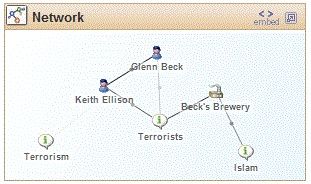
I was thus delighted to find, as I was doing my morning trawl of usual and unusual news sources, that Glenn Beck had come out with his estimate of how many Muslim terrorists there are in the world (10% of the global Muslim population, ie 157 million), Fareed Zakaria had refuted him — and there was even a helpful Silobreaker network diagram to show me how the relevant nodes under discussion fit together:
Beck Muslims and Brewery

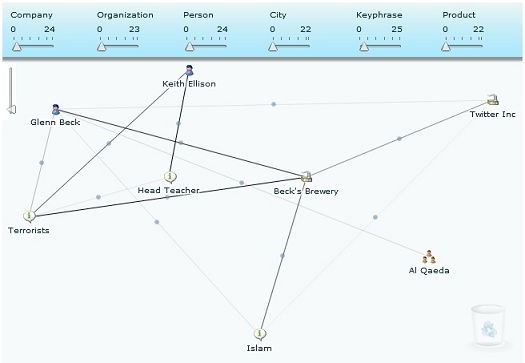
I was delighted to see that (Mormon) Glenn Beck is more closely associated with (Muslim) Rep. Keith Ellison than he is with terrorists, and sorry to note that Beck’s Brewery and Islam are somehow linked… But naturally, once I had seen this much I wanted to drill down even deeper — so I entered the appropriate keywords at Silobreaker and found this:
silobreaker beck islam

You’ll see that Beck’s link with Al Qaeda is, thankfully, a weak one. And I think you’ll agree with me that even shifting from a six node to an eight node graph considerably ups the sophistication of analysis required to fully comprehend the issues portrayed.

*

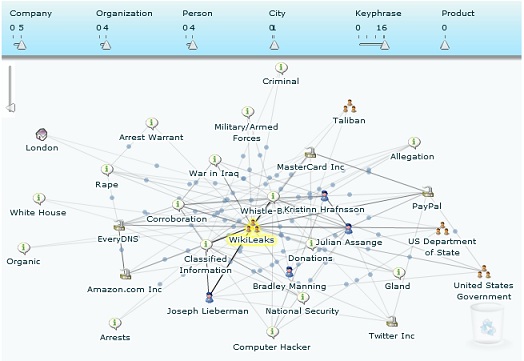
In any case, I thought it might be appropriate to post Silobuster’s more detailed map of the current situation with WikiLeaks here:
Wikileaks Silobreaker

All becomes clear, eh?

I particularly like the node labeled “Gland” (it’s almost hidden but not quite, you’ll find it lower right, between PayPal and Twitter)– that might be the one I’d zero in on to get a fuller appreciation of the complexities of the situation.

And for the record, this post is an example of British “humor” — or as we prefer to call it, “dry wit”.


Switch to our mobile site

