zenpundit.com » 2011 » June

Archive for June, 2011

With Greco: two views of Toledo

Monday, June 6th, 2011

[ by Charles Cameron — perception, painting, pre-modern, modern, post-modern, heaven, sky, simulation, John Donne, El Greco ]

.

It is Sunday.

I find it powerfully interesting that the sky as perceived by painters (our “seers” par excellence) used to be filled with supernatural beings and is currently filled with natural ones — a clear sign that our culture has effectively moved from what one might call a theological vision of the world to a meteorological one (with astronomical trimmings under a clear sky)…

And I see that transition captured very precisely in four words, when John Donne writes:

At the round earths imagin’d corners, blow
Your trumpets, Angells, and arise, arise
From death, you numberlesse infinities
Of soules, and to your scattred bodies goe…

The “round earth” is that of modern science, the “imagin’d corners” those of pre-modern maps – and angelology.

*

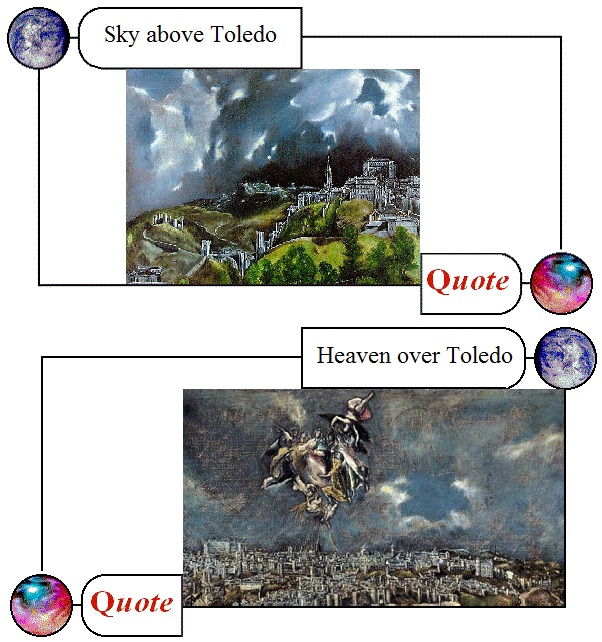
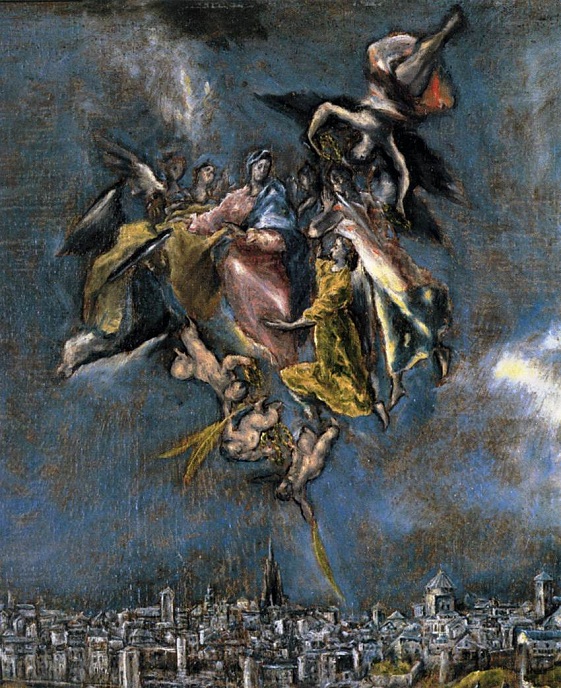
I have to admit, therefore, that I was surprised yesterday evening to come across an El Greco painting of Toledo that featured the blessed Virgin Mary over the city.

I have long been familiar with his better known View of Toledo, which is entirely naturalistic unless you want to consider storm-clouds as portents of a divine presence —
quo-sky-over-toledo.jpg

but the second of these images, from the View and Plan of Toledo, came as quite a surprise…

Here is a detail of the Virgin taken from it, to illustrate the point:
el-greco_view-and-plan-of-toledo_detalhe2_c1610.jpg

*

El Greco is famous for painting heaven-and-earth as a continuum – his great masterpiece, the Burial of Count Orgaz, catches the release of the soul from its bodily sheath as directly as Donne’s “to your scattred bodies goe” does to the return of those souls to corporeality at the General Resurrection:
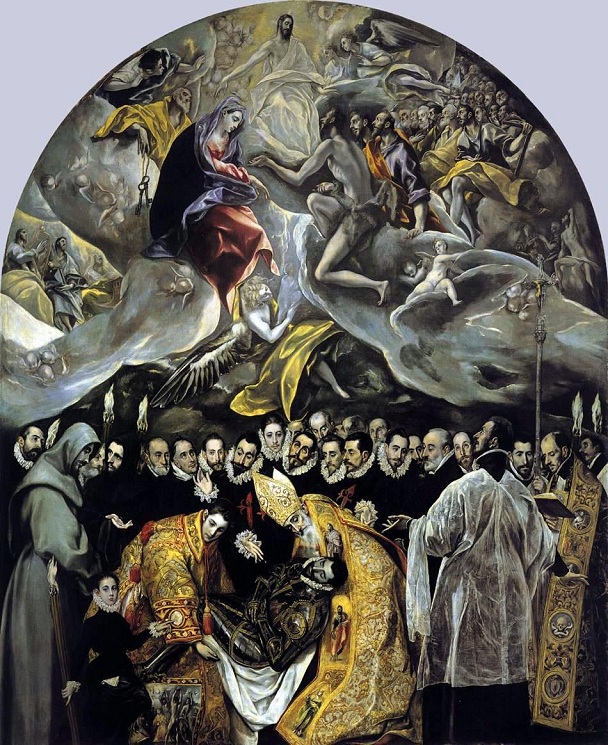
entierro-del-conde-de-orgaz-sm.jpg

*

And yet El Greco, like Donne, sees both – Toledo under storm-clouds, Toledo under the shelter of the blessed Virgin…

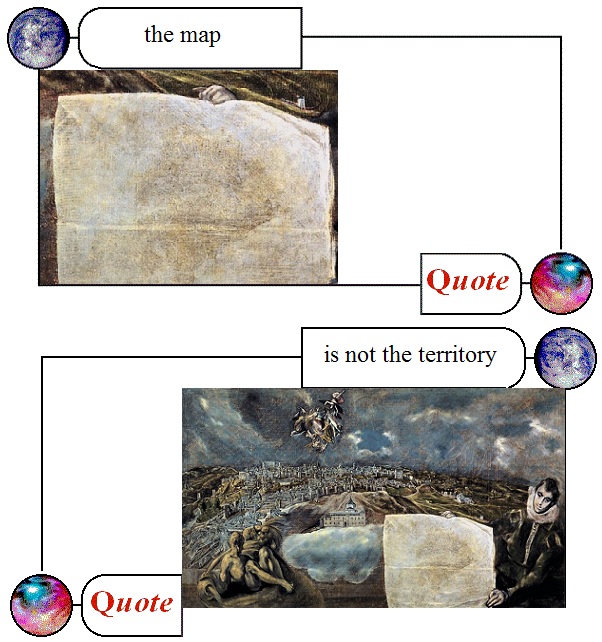
But there is more here, in this extraordinary painting. There is a map of the territory

quo-greco-toledo.jpg

*

If I could say in a nutshell what post-modern is, I would say it is recursive. It recognizes our perceived reality to be a simulation, and is thus always playing with maps and models, as Shakespeare was when he penned the words “All the world’s a stage” to be spoken in a theater whose sign and motto was “Totus mundus agit histrionem” – the whole world enacts a play.

Think of Hofstadter‘s Godel Escher Bach. Of Escher himself, and his image of himself holding his own small world in a glass sphere in his hand…

Think of Korzybski, and his dictum: the map is not the territory.

Think of Gregory Bateson, who wrote:

We say the map is different from the territory. But what is the territory? Operationally, somebody went out with a retina or a measuring stick and made representations which were then put on paper. What is on the paper map is a representation of what was in the retinal representation of the man who made the map; and as you push the question back, what you find is an infinite regress, an infinite series of maps. The territory never gets in at all. […] Always, the process of representation will filter it out so that the mental world is only maps of maps, ad infinitum.

Astoundingly, presciently – prophetically? – El Greco is already alluding to this, around 1610, in his View and Plan of Toledo.
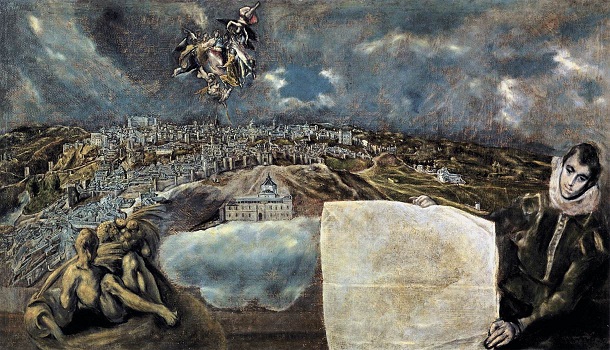
11777-view-and-plan-of-toledo-el-greco-sm.jpg

*

El Greco’s Burial of Count Orgaz is in the Church of Santo Tomé in Toledo.

El Greco’s View and Plan of Toledo is in the Museo de El Greco, Toledo.

Here is the complete text of Donne’s sonnet:

At the round earths imagin’d corners, blow
Your trumpets, Angells, and arise, arise
From death, you numberlesse infinities
Of soules, and to your scattred bodies goe,
All whom the flood did, and fire shall o’erthrow,
All whom warre, dearth, age, agues, tyrannies,
Despaire, law, chance, hath slaine, and you whose eyes,
Shall behold God, and never tast deaths woe.
But let them sleepe, Lord, and mee mourne a space,
For, if above all these, my sinnes abound,
‘Tis late to aske abundance of thy grace,
When wee are there; here on this lowly ground,
Teach mee how to repent; for that’s as good
As if thou’hadst seal’d my pardon, with thy blood.

El Greco’s View of Toledo is in the Metropolitan Museum of Art in New York:
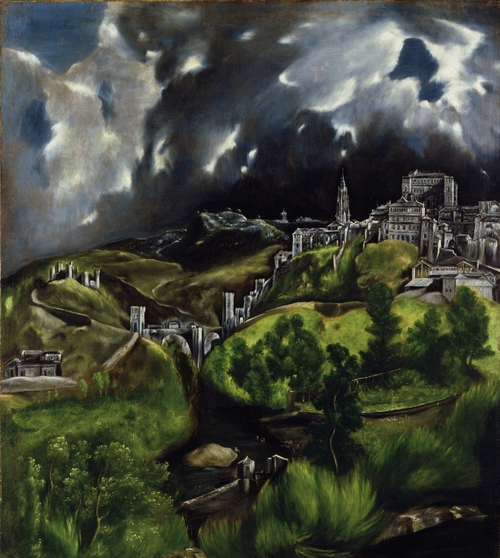
29_1006.jpg

Here we find no blessed Virgin, no angels with their final trumpets — and yet this painting can be viewed as analogous to his Vision of Saint John and the opening of the Fifth Seal — which owes its power to its “otherworldly stormy light” — and thus seen as yet another apocalyptic scene, one which “recalls St. John’s vision of the New Jerusalem in the Book of Revelations … a landscape of unearthly power and drama: a dialogue between heaven and earth conducted appropriately by the cathedral spire…”

On the Road

Saturday, June 4th, 2011

In a few days, I will be headed to the US Army War College to become a new member of their National Security Seminar, an honor I owe entirely to the kind offices of Dr. Steven Metz, as Big Steve saw fit to nominate me. Once at Carlisle, I will have the opportunity to participate with AWC students in a variety of sessions and discussions related to national security and strategy and hear speakers who are top experts in their field. The keynote, if I understand correctly, will be given by General David Petraeus. The liason assigned to me, Col. Richard “Flip” Wilson, has been gracious and friendly and I am very much looking forward to visiting the War College, meeting new friends and learning a thing or two.

My blogging here at ZP may be erratic next week, though Charles and Scott will carry on in my absence, but I will try to put up a few items or pictures as time and internet connectivity permits. Twitter may be a much better bet for frequent updates and I can be followed @zenpundit for readers who are interested.

That old-time hacker religion

Saturday, June 4th, 2011

[ by Charles Cameron — care and feeding of authors and publishers, secrecy and transparency, Abu Muqawama, New Yorker ]

.

I am a writer.

I somewhat understand the need for writers to be supplied with books and food, and that publishers of various sorts, online and off, take on the costs of finding us and giving us a public hearing – but I also think it’s idiotic for the best of our thinking to take place in gated communities.

On matters concerning national security, for instance…

*

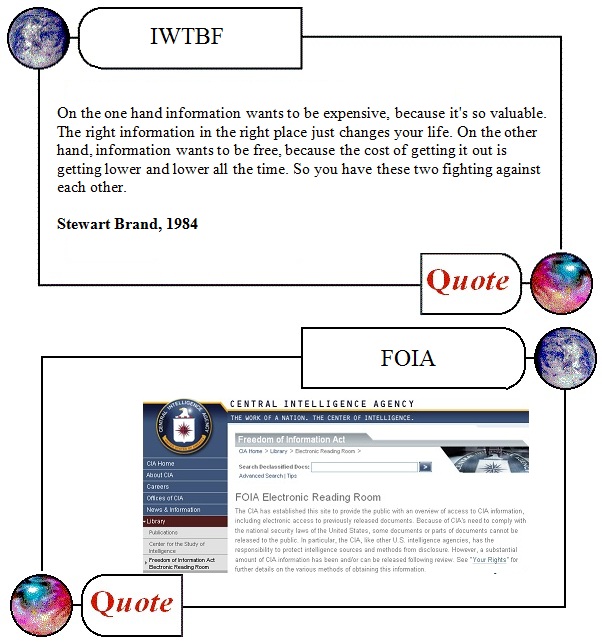
Two quick DoubleQuotes with a touch of that old time hacker religion…

quo-foia.jpg

And specifically…

quo-muqawama.gif

*

Certain things need to remain secret, I accept that. And there’s an inevitable tension, an ongoing tug-of-war between secrecy and transparency that even Stewart Brand, who coined the phrase “information wants to be free” admits, and that even the intelligence community responds to with CIA’s declassified search box, its responses to FOIA requests, and publications such as the unclassified extracts from Studies in Intelligence.

But here’s where I’m with Abu Muqawama:

The New Yorker has locked this article, which is silly, because this article has real policy relevance yet most of the people who need to read the article do not subscribe to the New Yorker.

Thankfully, Abu Muqawama / CNAS have summarized the piece in question, so you can read what it’s about and figure out for yourself whether you need to read the whole thing

*

So here’s a round of applause for all those who do bright thinking about world affairs in public view – or make such thinking available.

You are doing us all – I gasp to think of it – a public service.

Humanity among Monsters: The Descent of Mexico

Thursday, June 2nd, 2011

From Boing Boing:

A kindergarten teacher in Mexico seeks to protect her students and calm their fears as narco-cartel fighters conduct a raging gun battle outside the window of her school. The woman has nerves of iron.

But hey…..Mexico can’t have an “insurgency” because the narcos don’t have “political” goals. Or a unified political goal. Or because there are still good vacation deals there at all-inclusive resorts. Or….Or…Or…. whatever flimsy rationale helps policy makers continue to punt the war next door.


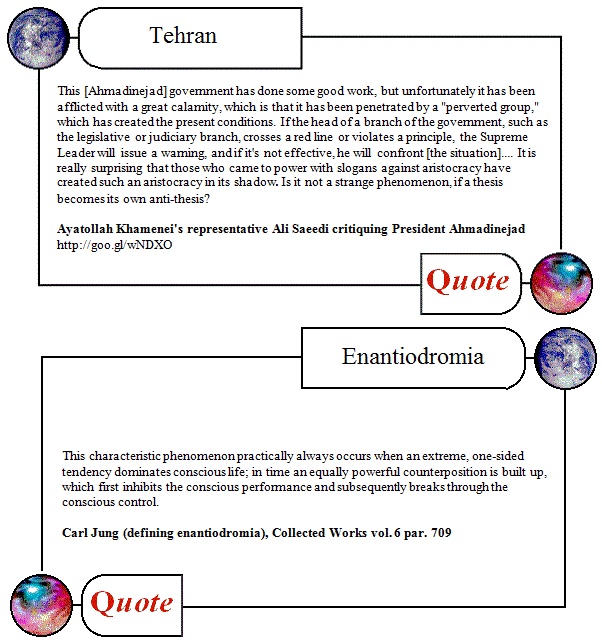
Jung in Tehran, aka “enantiodromia”

Wednesday, June 1st, 2011

[ by Charles Cameron — Ahmadinejad vs Khamenei, Jungian enantiodromia ]

.

quo-enantiodromia-in-tehran.gif

*

The western press, on the whole, has covered the recent tussle between Iranian President Ahmadinejad and his superior, the Ayatollah Khamenei, in political terms — as a power struggle between a President who wants increased authority for the Presidency and a Supreme Authority who isn’t about to relinquish his Supremacy.

It is also a theological struggle, and the LA Times nicely weaves the two strands together in commenting:

At its heart is a possible future struggle for power between the firebrand president and Khamenei’s conservative clergy, who are wary of Ahmadinejad’s messianic strain of Islam and his incendiary populism. They worry his tendency for explosive talk could threaten their long-term interests, if not render them obsolete.

Putting it bluntly, the arrival of the Mahdi – or a strong populist current holding the opinion that Ahmadinejad is the Mahdi’s trusted lieutenant, chosen to prepare the way for his coming – would disenfranchise the clerics of Qom, who ultimately derive their authority from the Imam Mahdi’s absence.

The fairly recent discovery of a video, apparently prepared by Ahmadinejad’s supporters and proclaiming the Mahdi’s “soon coming”, seems to have heightened the tension…

Having said that, it’s my impression that Ahmadinejad is losing this tug-of-war, that he doesn’t have the popular groundswell of support he would need to go up against the Supreme Authority and win, and that consequently, his Mahdist “messianic strain” is losing power and credibility.

Which in turn should mean that the West has less to fear from Iranian Mahdism…

Glenn Beck, take note.

*

Putting that another way, it seems that the extreme Mahdism of Ahmadinejad is resulting – ironically enough, by enantiodromia – in a backlash from Khamenei that appears likely to depotentiate and dissipate it.


Switch to our mobile site