zenpundit.com » 2011 » September

Archive for September, 2011

Jihad culture: its music, poetry, rituals and dreams

Monday, September 12th, 2011

[  by Charles Cameron – jihadist studies, Hegghammer, culture and influence ]

.

It is the evening of the tenth anniversary: the day is almost over.

*

In an engaging interview with Abu Muqawama posted today, terrorism and violent Islamism expert Thomas Hegghammer discusses his new project about jihad culture, or “the things jihadis do when they don’t fight”.

It is inspired by the observation that militants in the underground spend a lot of time doing things that appear to serve no immediate military purpose, like singing songs, reciting poetry, or discussing dreams. They also do unexpected things like weep on a regular basis, notably when reciting the Qur’an. The infamous Abu Mus‘ab al-Zarqawi, for example, was known among fellow militants as both “the butcher” (al-dhabbah) and “a weeper” (baki). All this “soft matter” of jihadism remains virtually unstudied; one reason, I think, is that it has been considered less consequential than the hard stuff of terror, such as attacks, resources, organizational structures and the like. My hypothesis is that jihad culture is not inconsequential at all; instead I think it may shed important new light on the processes by which jihadi groups recruit, exercise organizational control and make tactical decisions. I am sure that the military men and women reading this blog will find all this rather intuitive, because they have experienced the important role of music and rituals in their own organization.

As a first step in the inquiry, I am currently working with a great team of scholars on an edited volume that will explore various dimensions of jihad culture. I have recruited subject specialists – including a musicologist, an Arabic poetry expert, and an anthropologist of dreams – to help document and decipher al-Qaida’s internal culture.

I hope the book will cover miracle stories and the odor of sanctity, too…

*

Hegghammer is co-author of the forthcoming Meccan Rebellion (Amal 2011), which I very much hope to review here on Zenpundit, and which is likely to be the definitive work on the Mahdist takeover of the Grand Mosque in Mecca in 1979.

Needless to say, I’m delighted at the news of Hegghammer’s upcoming project.
The Nine Eleven Century?

Sunday, September 11th, 2011

nineleven2.jpg

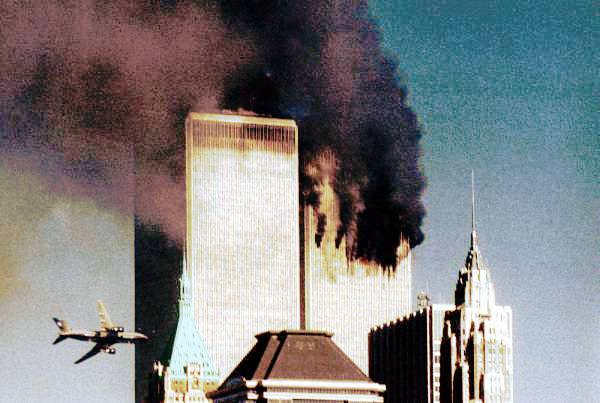
Ten years ago to this day, almost to the hour of which I am writing, commercial jetliners were highjacked by al Qaida teams armed with boxcutters, under the direction of Mohammed Atta, were flown into the towers of the World Trade Center and the Pentagon. A fourth plane, United Airlines Flight 93, believed to be headed to the US Capitol building, crashed in Pennsylvania when passengers led by Todd Beamer heroically attempted to stop the highjackers. The whole world watched – most with horror but some with public glee – on live television as people jumped out of smoke-engulfed windows, holding hands, to their deaths. Then, the towers fell.

From this day flowed terrible consequences that are still unfolding like the rippling shockwave of a bomb.

We look back, sometimes on the History Channel or some other educational program, at the grainy, too fast moving, sepia motion pictures of the start of World War I. The crowds wildly cheered troops with strangely antiquarian uniforms that looked reminiscent of Napoleon’s day, march proudly off to the war that gave Europe the Somme, Gallipoli, Passchendaele and Verdun. And the Russian Revolution.

After the armistice, the victors had a brief chance to reset the geopolitical, strategic and economic patterns the war had wrought and in which they were enmeshed. The statesmen could not rise to that occasion, failing so badly that it was understood even at the time, by John Maynard Keynes and many others, that things were being made worse. World War I. became the historical template for the short but infinitely bloody 20th century of 1914-1991, which historians in future centuries may simply describe as “the long war” or a “civil war of western civilization”.

There is a serious danger, in my view, of September 11 becoming such a template for the 21st century and for the United States.

On the tenth anniversary of 9/11, as we remember the fallen and the many members of the armed services of the United States who have served for ten years of war, heroically, at great sacrifice and seldom with complaint, we also need to recall that we should not move through history as sleepwalkers. We owe it to our veterans and to ourselves not to continue to blindly walk the path of the trajectory of 9/11, but to pause and reflect on what changes in the last ten years have been for the good and which require reassessment. Or repeal. To reassert ourselves, as Americans, as masters of our own destiny rather than reacting blindly to events while carelessly ceding more and more control over our lives and our livelihoods to the whims of others and a theatric quest for perfect security. America needs to regain the initiative, remember our strengths and do a much better job of minding the store at home.

The next ninety years being molded by the last ten is not a future I care to leave to my children. I can think of no better way to honor the dead and refute the current sense of decline than for America to collectively step back from immersion in moment by moment events and start to chart a course for the long term.

Kesler on R2P

Saturday, September 10th, 2011

Bruce Kesler, a long time friend of this blog, links here as he digs into R2P, the “Responsibility to Protect” doctrine and like me, finds the logical implications hold much to worry about in terms of being anti-democratic as well as destabilizing :

Transnational Elites Uber Alles

 It is the liberal internationalists’ concept of how US foreign policy ought to be. R2P reflects limitations of the US abilities to militarily intervene elsewhere as perceived by our liberal elites but raises our humanitarian impulses selectively by them to justify certain interventions, again, as they perceive which to be worthwhile. Further, R2P raises hazy international law or consensus of international liberal elites to supremacy over national law or consensus.

One of R2P’s main propounders, Anne Marie Slaughter, even advocates each US agency and members of our judiciary to act independently of Executive or Congressional oversight or law to conform to the consensus of foreign liberal elites. Slaughter is not just someone blathering. Slaughter was Dean of Princeton’s influential Woodrow Wilson School of Public and International Affairs from 2002-2009 then from 2009-2011 she served as Director of Policy Planning for the United States Department of State, now back at Princeton. Slaughter’s thinking is telling in the pieties mouthed by Secretary of State Hillary Clinton and President Obama as they ignore US laws, ignore Syria’s worse repression and threat as they intervene in Libya, and extol a hostile majority in the UN to undeserved credence. Slaughter isn’t alone. Obama administration insiders Samantha Powers and Susan Rice are R2P foxes in the henhouse.

Methinks, given what passes for strategic thinking these days, that they pushed against an open henhouse door. Kesler continues:

For a taste of Anne Marie Slaughter

At first glance, disaggregating the state and granting at least a measure of sovereignty to its component parts might appear to weaken the state. In fact, it will bolster the power of the state as the primary actor in the international system…Giving each government institution a measure of legitimate authority under international law, with accompanying duties, marks government officials as distinctive in larger policy networks and allows the state to extend its reach.

Actually, it extends the uncontrolled reach of liberal elites within our government to act regardless of our laws or popular will.

Read the rest here.

This is not an argument over whether genocide is bad and should be prevented or the positive good of Western liberal societal values but rather over how power will be exercised in our name, for what reasons and by whom. Any good ends sought under a putative R2P doctrine can be done today if the political will for intervention is present. That will is crystalized when the ends, ways and means are scrutinized in open, free, debate under our constitutional norms, not by a self-appointed vanguard.

The imagery of religion and war

Friday, September 9th, 2011

[ by Charles Cameron — graphical analysis, selling bibles to teenage boys, tge Mass in time of war ]

.

Following on from my post on the work of Al Farrow, and leading towards a series of posts on ritual and ceremonial, I’d like to show you two very different images at the overlap of war and religion.

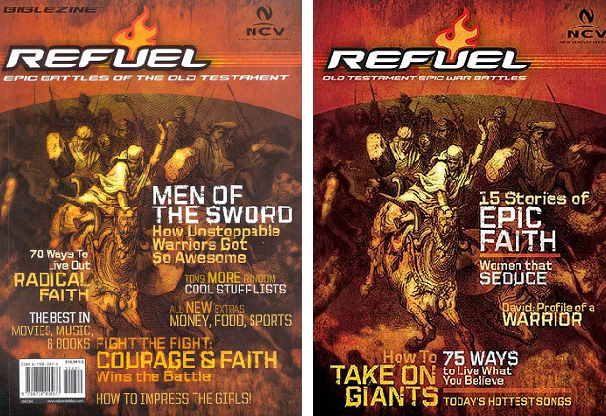
The first shows two different covers of the books of Joshua, Judges, Ruth, I & II Samuel, I & II Kings, Ezra and Nehemiah, as featured in a “biblezine” edition of the New Century Version of the Bible pitched at teenage testosterone.

double.png

Each of will have our own sense of whether that’s fun, stupid,  Biblical, unBiblical, enticing, disgusting or simply uninteresting — but whatever your aesthetic and/or belief-based response, there’s a powerful lesson there in the choice of subtitles:

how unstoppable warriors got so awesome…
courage and faith wins the battle…
how to impress the girls!
how to take on giants!
women that seduce…
tons more random cool stuff lists…

I’m not a fan of this kind of thing myself, but I picked up a copy when I saw one at the thrift the other day — the one with Men of the Sword on the cover — and as someone who has done a fair amount of copy-editing in my day, was surprised to see “courage and faith wins the battle” (sic) had slipped past the editorial eyes at Nelson Books

The New Testament in the same series is a bit better — the cover still features “dynamic stories of daring men” –but the, ahem, romantic element has been toned down a bit, with the catch phrase “class act: how to attract godly girls” replacing the Old Testament’s “how to impress the girls”.

* * *

Okay, I’m not as young as I once was, and maybe I’ve been mean enough at the expense of these people who want to market the Bible as though it was an invitation to warfare washed down with sex.

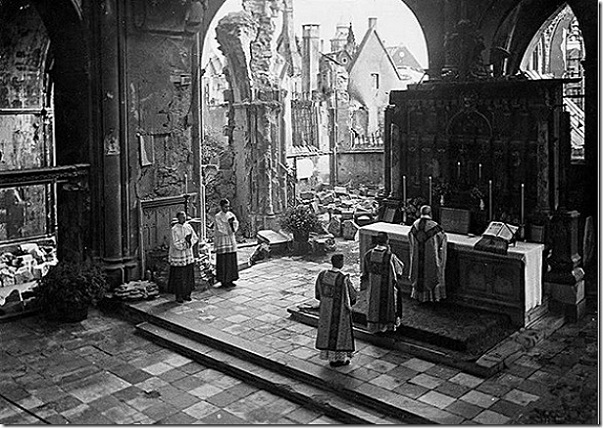
The other image I found recently comes a great deal closer to my own taste, and will serve as an excellent introduction to the idea of religious ceremonial as an oasis of peace in time of war:

missa_thumb3.jpg

Again, I suppose there may be some who will find the idea of religious ritual boring and irrelevant rather than beautiful — but it is its capacity to move us at a deep level — even (and perhaps particularly) when high tides of  circumstance and emotion are breaking over us — that I wish to focus on and, to the extent that it is possible, explore and explain in  some upcoming posts.

In my view, it was this kind of beauty, verging on the austere and the timeless, rather than the snazzy and faddish “impress the girls — draw in the kids” kind, that Pope Benedict XVI had in mind when he said:

Like the rest of Christian Revelation, the liturgy is inherently linked to beauty: it is veritatis splendor. The liturgy is a radiant expression of the paschal mystery, in which Christ draws us to himself and calls us to communion. As Saint Bonaventure would say, in Jesus we contemplate beauty and splendor at their source.

* * *

I am not a Catholic, though my sympathies run in that direction, and my examples of ceremonial will not be drawn only from Catholic or Christian sources — part of what i want to explore is the universal quality of ritual as a powerful source of motivation and inspiration, while another aspect has to do with the interweaving of military, religious and state symbols, but the point I would most like to make in each case is the profound impact that such symbols and rituals can have on the receptive heart.

I hope to touch on a wide range of ritual expressions, from the Requiem for a departed princely Habsburg to the Lakota sweat lodge, and from to the fire-walking ceremonial of the Mt Takei monks of Japan to the Spanish bull-fight, with a close look at the ritual surrounding coronation in my own British tradition.

For those who would like to peer deeper into these matters, I would suggest these four books:

Victor Turner, The Ritual Process
Geoffrey Wainwright, Eucharist and Eschatology
William Cavanaugh, Torture and Eucharist
Josepha Zulaika, Basque Violence: Metaphor and sacrament

The first explains “how ritual works” from an anthropological point of view, the second deals with the purposeful interweaving, accomplished within ritual, of time with the timeless, the third with the way in which sacramental transcendence is the very antithesis of torture, and the fourth with the impact of a sacramental sensibility within terrorism.

Each one is a masterpiece of intelligence and profound feeling.

The Wit and Wisdom of Edward Luttwak

Friday, September 9th, 2011

Uberstrategist, madcap academic and shadowy security consultant, Edward Luttwak gave a not entirely serious interview to Tablet (hat tip to Russ Wellen and Chirol):

Q&A: Edward Luttwak

Q: Are strategic minds nurtured through upbringing and education, or is the ability to think strategically an inborn gift, like mathematics?

It’s a gift like mathematics. The paradoxical logic of strategy contradicts the logic of everyday life, it goes against all normal definitions of intelligence we have. It only makes sense if you understand the dialectic. If you want peace, prepare for war. If you actively want war, disarm yourself, and then you’ll get war. Virile and martial elites understand that kind of thinking instinctively.

Q: Here’s an easily falsifiable statement, but there’s something in it that interests me and I want you to pick it apart. I would start with the moment when George W. Bush met Vladimir Putin and said, “I looked into his eyes and saw this was a man I could really trust.” So, my thesis is this: If you’re Vladimir Putin, and you rise to the top of this chaotic and brutal society after going through the KGB, you must be some kind of strategic genius with amazing survival skills, because the penalty for failure may be torture or death. This kind of Darwinian set-up exists in many countries around the world. What does it mean to be head of the security services in Egypt? It means that you had to betray your friends but only at the right time, and you had to survive many vicious predators who would have loved to kill you or torture you, or otherwise derail your career. By the time you become Vladimir Putin or Omar Suleiman, your ability to think ahead and analyze threats has been adequately tested.

By contrast, what does it take to become a U.S. Senator? You have to eat rubber chicken dinners, you have to impress some rich people who are generally pretty stupid about politics, and smile in TV commercials. The penalties for failure are hardly so dire. And so, American leadership generally sucks, and America is perennially in the position of being the sucker in the global poker game. That’s the thesis. So, tell me why it’s wrong.

Even if your analysis is totally correct, your conclusion is wrong. Think about what it means to work for a Putin, whose natural approach to any problem is deception. For example, he had an affair with this athlete, a gymnast, and he went through two phases. Phase one: He concealed it from his wife. Phase two: He launched a public campaign showing himself to be a macho man. He had photographs of him shooting a rifle, and as a Judo champion, and therefore had the news leaked that he was having an affair. Not only an affair with a young woman, but a gymnast, an athlete. Obviously such a person is much more wily and cunning and able to handle conflict than his American counterpart. But when such a person is the head of a department, the whole department is actually paralyzed and they are all reduced to serfs and valets. Therefore, what gets applied to a problem is only the wisdom of the aforementioned wily head of the department. All the other talent is wasted, all the other knowledge is wasted.


Now you have a choice: You can have a non-wily head of a department and the collective knowledge and wisdom of the whole department, or else you can have a wily head and zero functioning. And that is how the Russian government is currently working. Putin and Medvedev have very little control of the Russian bureaucracy. When you want to deal with them, and I dealt with them this morning, they act in very uncooperative, cagey, and deceptive ways because they are first of all trying to protect their security and stability and benefits from their boss. They have to deceive you because they are deceiving their boss before he even shows up to work. And they are all running little games. So, that’s the alternative. You can have a wily Putin and a stupid government. Or an intelligent government and an innocent head. There’s always is a trade-off. A Putin cannot be an inspiring leader. […]

Luttwak is interesting because he couples analytical smarts with bluntness and creativity. When someone in public life is less stellar than their position would indicate, Luttwak will say it. He will also tackle problems from unusual starting points, a good strategy for generating bursts of insight. It also generates weird, off-the-wall tangential observations. Small price to pay.


Switch to our mobile site