zenpundit.com » 2012

Archive for 2012

New Book: The Rise of Siri by Shlok Vaidya

Tuesday, November 13th, 2012

The Rise of Siri by Shlok Vaidya 

Shlok Vaidya has launched his first novel,  dystopian techno-thriller in e-Book format entitled The Rise of Siri.  Having been the recipient of a late draft/early review copy, I can say Shlok on his first time out as a writer of sci-fi has crafted a genuine page turner.

Companion site to the book can be found here –  The Rise of Siri.com

Blending military-security action, politics, emerging tech and high-stakes business enterprise, the plot in The Rise of Siri moves at a rapid pace. I read the novel in two sittings and would have read it straight through in one except I began the book at close to midnight.  Set in a near-future America facing global economic meltdown and societal disintegration,  Apple led by CEO Tim Cook  and ex-operator Aaron Ridgeway, now head of  Apple Security Division, engages in a multi-leveled darwinian struggle of survival in the business, political and even paramilitary realms, racing against geopolitical crisis and market collapse , seeking corporate salvation but becoming in the process, a beacon of hope.

Vaidya’s writing style is sharp and spare and in The Rise of Siri he is blending in the real, the potential with the fictional. Public figures and emerging trends populate the novel; readers of this corner of the blogosphere will recognize themes and ideas that have been and are being debated by futurists and security specialists playing out in the Rise of Siri as Shlok delivers in an action packed format.

Strongly recommended and….fun!

The 2012 Warlord Loop Reading List at SWJ

Tuesday, November 13th, 2012

Small Wars Journal has published the national security reading list  composed by members of  The Warlord Loop, a private listserv run by Colonel John Collins (ret.). You will find a wide-ranging list of titles in history, IR, strategic studies, military history, political philosophy and other fields recommended by experts and operators, soldiers and scholars and even a blogfriend or two. More than enough books to help fill out the empty shelves of your antilibrary.

The 2012 Warlord Loop Reading List

The U.S. national security community contains a slew of superlative political, military, economic, sociological, technological, and other specialists, but comparably qualified generalists prepared to cherry pick their products, then produce integrated policies, plans,  programs, and conduct operations that best suit this great Nation’s needs, are exceedingly scarce. The Warlord Loop’s 2012 reading list, which features interdisciplinary topics that cover the conflict spectrum from normal peacetime competition to what Herman Kahn’s classic On Thermonuclear War called a “wargasm,” is explicitly designed to help correct that imbalance.

Contributors include active and retired officials in executive and legislative branches of the U.S. Government, news media representatives, college professors, and   military personnel from every service who range in rank from noncommissioned officers to four-star generals and admirals. Males, females, liberals, conservatives, Republicans, Democrats, nonpartisans, assorted age groups, and a few foreigners span the complete range of public opinion. The Warlord recently challenged them to identify two books apiece that would help practitioners and concerned citizens better understand increasingly complex problems and optional solutions despite mutating situational changes that now circle this globe at bewildering speed. A cross-section of responses appears below. Publishers, dates, and synopses are available on the Internet.

Brigadier General Chris Arney, USA (Retired), a professor of mathematics at West Point, focuses on information networks, modeling, intelligence processing, and artificial intelligence.

          Mario Diani and Doug McAdam, Social Movements and Networks: Relational Approaches to Collective Action

          Howard Steven Friedman Howard, The Measure of a Nation: How to Regain America’s Competitive Edge and Boost Our Global Standing               

Lieutenant General David Barno, USA, (Retired), who saw combat in Grenada and Panama, commanded all U.S. and coalition forces in Afghanistan from 2003-2005. He now is a Senior Advisor and Senior Fellow at the Center for a New American Security.   

          Eliot Cohen, Supreme Command

          Colin Gray, Another Bloody Century

Captain Sean Barrett, USMC, is a Fellow for the Marine Corps Director of Intelligence, Office of Intelligence and Analysis, Department of Treasury. He served in Iraq and Afghanistan as an Intelligence Officer.

          Milton Friedman, Capitalism and Freedom

          George Orwell, Animal Farm

Lieutenant Colonel Robert Bateman, USA, formerly Office of Net Assessment, currently in International  Security Assistance Force Joint Command in Afghanistan.

          Azar Gat, A History of Military Thought

          John Lynn, ed., Feeding Mars, Logistics in Western Warfare, from the Middle Age to the Present   [….]

Read the rest here.

An interesting peek into the PKK

Monday, November 12th, 2012

[ by Charles Cameron — the PKK and religion, my own ignorance and curiosity ]
.

Flag of the Iraqi Kurds, not a PKK flag -- but see below...

**

The PKK is important in a “first cousin once removed” kind of way, if I’m understanding Karen Kaya‘s piece in SWJ this past May correctly:

As Turkish military and government officials often say, the PKK is to Turkey what Al-Qaida is to the U.S., or that “the PKK is Turkey’s Al-Qaida.”

**

So I was trawling the web today, and the mention of religion in this paragraph from McClatchy caught my eye:

Volunteers who join the Kurdish insurgency against Turkey must abandon Islamic religious practice and must forego “emotional ties” to anyone outside the group, as well as swear words and sex, or face trial and prison, according to a Syrian-born Kurd who defected from the group to Turkey over the summer.

People who “defect” not uncommonly offer prejudiced accounts of the organizations they’ve left, so I read on to see how trustworthy this source might be:

The 21-year-old defector, who surrendered in June, brought with him not only a tale of life inside the Kurdistan Workers’ Party, known by its Kurdish initials as the PKK, but also detailed information about a planned attack inside Turkey that helped Turkish authorities beat back the PKK offensive.

McClatchy obtained a copy of a 19-page Turkish-language account of his debriefing, which was dated July 4 and was not marked classified. The debriefing contained his name, but McClatchy is identifying him only by his initials, R.S., to protect family members who might still be in territory held by the PKK’s Syrian affiliate.

It seems his military intelligence was quite accurate — so far so good. Next, my own curiosity naturally led me to wonder what the PKK’s religious stance, apart from being opposed to Islam, might be. After all, it’s called the the Kurdistan Workers’ Party and was founded on Marxist principles…

Okay, I skipped a few paragraphs, and found this:

R.S. portrayed the PKK as anti-Islamic. Performing daily prayers, fasting and reading the Quran are among the offenses that could land a recruit in prison, he told Turkish authorities. Instead, fighters were told that the religion of Kurds is Zoroastrianism, one of the world’s most ancient religions, and they should worship fire. There are said to be fewer than 200,000 Zoroastrians today, mostly in Iran and India.

Now that’s a fascinating glimpse behind the curtain.

**

For an alternate viewpoint, here’s the University of Utrecht grad student in Conflict Studies and Human Rights, Wladimir van Wilgenburg, writing for Rudaw in English and sounding knowledgeable, though his own or Rudaw’s potential biases are unknown to me:

The idea that Kurds are actually Zoroastrians is not something new. Kurdish nationalists such as the Bedirkhan brothers tried to revive Zoroastrianism and Yezidism as the original religion of the Kurds in the 1920s and 1930s. By this the Bedirkhans aimed to separate the Kurds from their Muslim neighbors and give them a glorious pre-Islamic history that had once boasted many empires.

They did not emphasize much on the Kurdish Islamic warrior Salahadin al-Ayyubi that rallied the Muslims against the crusaders in the twelfth century. Similarly, Turkish nationalists tried to promote Shamanism as the original religion of the Turks. But despite these efforts, Islam remained an important element among Kurdish nationalist movements.

It is unlikely that Yezidis are originally Zoroastrians. The Zoroastrian religion is a dualist religion (with good and evil constantly fighting each other), while the Yezidi faith revolves more around a single deity as the Satan.

Therefore it is possible that the Zoroastrians would regard the Yezidis as devil-worshippers, just as some Muslims do.

There are still many Kurds (especially in Europe) who think Kurds are originally Zoroastrians and wear Zoroastrian symbols, even though they are non-religious and do not have much knowledge about Zoroastrianism and its rituals.

The PKK was particularly influenced by the ideas of early Kurdish nationalists. Its media promoted the idea that Kurds are originally Zoroastrians. Other Kurdish political groups also came under the same influence.

But in 1991 the PKK took a positive approach about Islam and thus managed to win some sympathy. Some say the PKK tried to merge Kurdish nationalism and Islam for its own cause.

In recent years the PKK has also used Imams, Friday prayers and Islamic language as a means to compete with the ruling Justice and Development Party (AKP). In return, the Turkish government is said to have plans to recruit 1000 Kurdish Imams in its battle to win the hearts and minds of the Kurdish people.

**

That (Iraqi) Kurdistan National Flag at the top of this post has a golden sun with 21 rays as it’s central feature — but it’s from Iraq. The PKK has used a variety of flags, some of them reflecting the group’s Marxist origins, but one in particular appears to borrow from the Iraqi flag:

As noted on this Flags of the World page:

This seems to be a variant of the original PKK flag, since it has the star and the red background of the PKK original flag but also the sun disc of the Kurdish Regional Government in Iraq.

That, in brief, is why the symbolism of the Iraqi Kurdish flag may be significant in understanding symbolism associated with the PKK.

The Kurdistanica page on the Iraqi Kurdish flag is a little coy on the topic of the sun, noting:

The primary Kurdish characteristic of the flag is the golden sun emblem at the center. The sun emblem has a religious and cultural history among the Kurds, stretching into antiquity. The sun disk of the emblem has 21 rays, equal in size and shape. The number 21 holds a primary importance in the native Yazdani religious tradition of the Kurds.

The sun might also be associated with Zoroastrianism, and the number 21 with the 21 nasks of the original Zoroastrian scriptures — but the issue of Kurdish religious nationalism is another area I’m unfamiliar with…

**

The nice thing about knowing that one doesn’t know is that it makes leaping to conclusions so much more difficult.

Cross-grain thinking, 2: mapping the jihadist mind & AQ’s #3 spot

Sunday, November 11th, 2012

[ by Charles Cameron — the different types of “leaders” should give us an idea of the different mental operations in play in the individual minds of the led, as well as the “mind” of the organization — plus fun ]
.
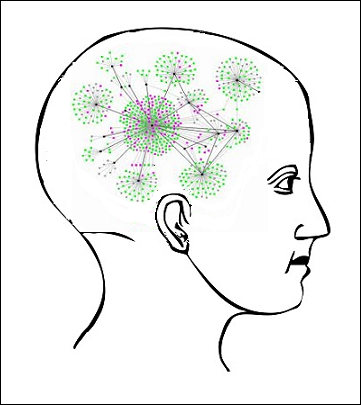
credit for mind map aspect of composite image to valdis krebs

.

Okay, I made my basic point here quite nicely in that little tag-line that gives you the brief overview of each of my posts right next to my name, so I’ll just repeat it here, very slightly amplified for focus:

The different types of “leaders” we identify in AQ should give us an idea of the different mental operations usually in play in the individual minds of jihadists, as well as within the “mind” of the organization itself.

I tried to show how cross-grain thinking in general, and thinking that includes both “subjective” and “objective” realities specifically, might play a considerable role in understanding some pressing contemporary issues in my recent post on Mozart — a figure so removed from those problems that some of you may have skipped it. Here’s my ending, with the Mozart details safely removed:

I think we should track that pattern, know as much as we can of that pattern, write the biography of the way in which some piece of music weaves between inspiration and thought, composer and instrument, mind and matter, performer and audience, studio and home digital music center…

Then, perhaps, we could begin to map other patterns – in some ways simpler and more urgent ones.

The sorts of “simpler and more urgent” patterns I was thinking of there include:

  • how discussions become deliberations and deliberations decisions
  • how scenarios are built and understood and sometimes poorly configured to our later detriment
  • how foreign policy plus feedback loops can create blowback and how to minimize it..
  • and specifically,

  • how the “jihadist” radicalization process moves from floating frustration and shame, via identification of a plausible “other” to rage against, to commitment, then via theology (!!) (for divine sanction of otherwise unpalatable acts) to the recognition of a binding moral obligation (fard ‘ayn in AQ terms) — and thence to camps for training in weaponry and the requirements and subtle limitations on Quranically sanctioned war…
  • **

    That last one has been an interest of mine, sitting in the back of my mind as an unanswered problem, quietly gathering data and forming insights for a while now, under a rubric along the lines of the question:

    Can we figure out a rough map of the workings of the “typical” mind of a potential jihadist as it radicalizes?

    It occurs to me that the leadership of an organization likely maps well to the organization’s functions, and those functions to the thought processes in which members are involved so a map of the aspects of leadership may well give us a rough draft of a mind-map for the individual member, including the passage from uninvolved observer to active participant: the process of radicalization.

    This may seem pretty obvious to some of you, but it’s a fresh idea for me, and to me it’s important because we already map communications networks and organizational flows, but the mind — the individual mind is one place we don’t seem to go.

    So I’m thinking in terms of sketching the mind of a “person” who is in some ways AQ as a whole, considered as if it were one sensate human-like being, filled with the usual variety of thoughts and emotions, ideals and pragmatisms, hopes and fears, hunches and hard data, clarities and confusions.. And I’m thinking of doing this by treating “leaders” as though they were distinct but coordinated processes in a single mind.

    We track and map people and their connections, we track and map groups and their connections, we track and map communications and their connections — are we tracking and mapping memes as such? ideas and their connections? minds?

    If we are already tracking ideas and minds — or if we aren’t doing that yet, but could — I’d be on the lookout for possible positive and negative feedback loops within the system, some that enhance the overall operation and could be disrupted, and some that fragment and damage it and could be amplified.

    So that, among other things, God willing, we could learn better ways to dampen some of the oscillations of hate…

    **

    I was looking at a comment in the recent ICSR report, Al-Qaeda at the Crossroads [h/t @azelin], and ran across this quote which struck me from an oblique angle:

    About ten core leaders have been subsequently killed, including Atiyah Abd al-Rahman, Abu Hafs al-Shahri, Samir Khan, Anwar al-Awlaki, and Abu Yahya al-Libi.

    Let’s take a look at these folk: Atiyah Abd al-Rahman was reported via Bill Roggio at Long War Journal as al Qaeda’s “operations chief” and a major planning a major attack on the US for the tenth anniverary of 9/11, as AQ’s “general manager” and bin Laden‘s “chief of staff”. Abu Hafs al-Shahri was another “operations chief”. Samir Khan was a publicist, the editor of the English-language magazine Inspire. Anwar al-Awlaki was a minor theologian with a talent for publicity and a decent understanding of his American audience…

    And as for Abu Yahya al-Libi, here’s an excerpt from an NYT piece about him:”I call him a man for all seasons for A.Q.,” said Jarret Brachman, a former analyst for the Central Intelligence Agency who is now research director of the Combating Terrorism Center at West Point. “He’s a warrior. He’s a poet. He’s a scholar. He’s a pundit. He’s a military commander. And he’s a very charismatic, young, brash rising star within A.Q., and I think he has become the heir apparent to Osama bin Laden in terms of taking over the entire global jihadist movement.”

    On that telling, al-Libi alone would be almost enough for my purposes — but let’s go with the whole list. The AQ mindset involves courage, poetry, scholarship, punditry and command and control. Specify that the scholarship needs to include theology (AQ at one point sent al-Libi to Mauretania for advanced Islamic studies) as well as strategy and guerrilla warfare (think Abu Mus’ab al-Suri, who was well-read in Taber’s The War of the Flea, Chairman Mao, Che Guevara, and Vo Nguyen Giap), and the significant influences on the jihadist mind begin to swim into focus.

    **

    See, I’m nudging my way to something fairly close to the Lincoln mention in Fred Kaplan‘s Slate piece about Petraeus the other day:

    Toward the end of the war, as the senior planning aide to Army Chief of Staff Gen. George Marshall, Lincoln realized that the Army needed to breed a new type of officer to help the nation meet its new global responsibilities in the postwar era. This new officer, he wrote to a colleague, should have “at least three heads—one political, one economic, and one military.” He took a demotion, from brigadier general to colonel, so he could return to West Point and create a curriculum “to improve the so-called Army mind” in just this way: a social science department, encouraging critical thinking, even occasionally dissent.

    How would we map these mental processes? How would we map the jihadist’s equivalent?

    **

    While I was fishing around for AQ leadership lists in search of an education, I ran across Robert Mackey‘s amusing piece on his NYT blog back in 2010, titled Eliminating Al Qaeda’s No. 3, Again, in which he mentioned as killed or captured claimants to the #3 spot Mustafa Abu al-Yazid, described as “a top financial chief for Al Qaeda” and quotes a colleague as saying “many of Mr. Yazid’s predecessors in Al Qaeda’s No. 3 slot” – from the Bush years alone, he lists Abu Zubaydah, Khalid Shaikh Mohammed, Abu Faraj al-Libbi, Hamza Rabia and Saif al-Adel.

    Okay, we should definitely add “financial chief” to my list above.

    The humorist and the artist in me often lead the more serious analyst in me to insights I’d not otherwise have access to, and since I’m worrying away at the notion that analysis needs to feature both “interior” (mind, heart) and “external” (world) realities, I keep the artistry and humor in my analyses, and hope that makes them more rather than less accessible — so let’s run with the AQ#3 nonsense for a bit.

    Mackey’s is a slightly tongue in cheek treatment of a reasonably serious topic. On Twitter the humor gets more incisive, with Andy Borowitz claiming 9,000 AQ#3s have been killed, and AQ#3 in person setting up a twitter account and tweeting merrily away for a while, see the two sample tweets in this SPECS graphic:
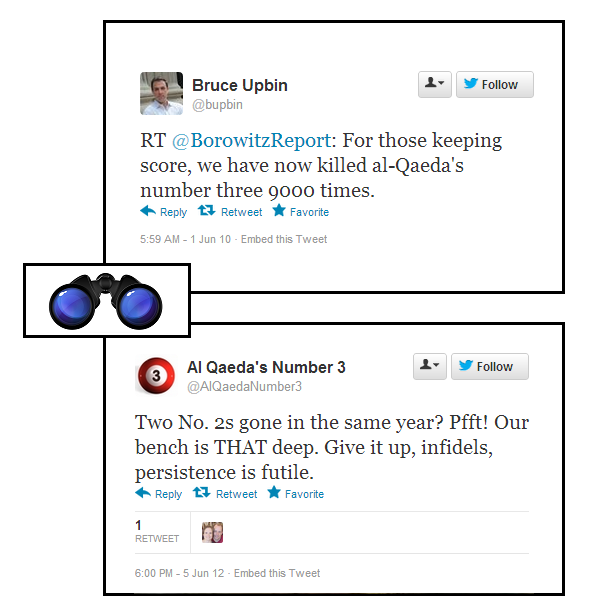
    My sources for those two tweets were Bupbin and AlQaedaNumber3.

    To be honest, I find the AQ#3 business both irritating — since it shows how little depth our popular understanding of who we’re dealing with really has — and amusing — because it’s so very ripe for satire…

    **

    I’ve been working at this post so long I’m mentally cross-eyed, so feel free to fill me in or chew me out…

    Armistice Day, Veterans Day

    Sunday, November 11th, 2012

    [by Charles Cameron — for the UK, US and others, a day to remember ]
    .

    .
    .

    The Great War ended on this date a little short of a century ago, November 11th, 1918. My grandfather, Sir Henry Clayton Darlington, commanded troops at the Hellespont, so for me that war — and the Armistice which ended it — is but one degree of separation from personal memory.

    Common British, Canadian, South African, and ANZAC traditions include two minutes of silence at the eleventh hour of the eleventh day of the eleventh month (11:00 am, 11 November), as that marks the time (in the United Kingdom) when armistice became effective.

    Poppies grew in the fields of Flanders where so many of our soldiers died, and in the UK poppies are worn in the lapel on this day to remember them. In the words of the Laurence Binyon‘s poem For the Fallen,

    At the going down of the sun and in the morning
    We will remember them.

    **

    Small Wars Journal has a history of the various Armistice Day, Veterans Day and Remembrance Day observances.

    The poppy pressed between the pages of St Luke’s gospel (image, above) was picked by one Les Forryan, who served with the UK’s Army Service Corps in France and Belgium during the Great War, and the book itself was a “Soldier’s Pocket Testament”, given to him in 1915. The field of poppies and crosses (image, below) was photographed by Brandanno1 in Cardiff, Wales, in 2007. The image of HM Queen Elizabeth II (image, inset) is from a Daily Mail report in 2008.


    Switch to our mobile site