zenpundit.com » 2012

Archive for 2012

Quick update / pointer: GR & AZ on prisoner release

Friday, October 12th, 2012

[ by Charles Cameron — prisoner releases in Arab springtime, abu Musab and Dr Fadl; Daveed G-R and Aaron Z; two major rules of expertise: detail and humility ]
.

video edit-bay photo credit http://www.cdmastercopy.com

.

When you watch a well edited movie, the experience is seamless — despite the fact that the film itself was made with hundreds of cuts and splices. Film critics, mavens and the director’s fellow auteurs who make close readings and detailed studies of the film will see and appreciate the juxtapositions and graphic matches, the fine-tuned timing of the edits and the rhythm they give the film — but for the regular viewer, one continuous fabric of story unspools from opening to final credits. The editor’s skill lies in getting the splices right to a degree beyond the perceptual acuity of the audience.

Similarly, a fine carpenter will often want to make joints that are imperceptible to the client, seeking a sensitivity to changes in height that is an order of magnitude greater than that required for the quick, cheap performance of the same task.

True expertise is at least one order of magnitude deeper and more self-critical than it needs to be to satisfy a cursory examination.

**

Thus when Daveed Gartenstein-Ross and Aaron Zelin tackle the important — and easily overlooked — question of How the Arab Spring’s Prisoner Releases Have Helped the Jihadi Cause in the Atlantic, they offer us both far more than we knew we needed to know, and yet less than they themselves know about the topic, let alone the broader current of jihadist movements of which this particular topic is a single strand.

It’s a significant topic, though, as their opening paragraphs neatly show:

The investigation of the devastating Sept. 11 attack on the U.S. consulate in Benghazi, Libya, that killed American ambassador Christopher Stevens — limited as it is by security concerns that hampered the FBI’s access to the site –has begun to focus on a Libya-based Egyptian, Muhammad Jamal (a.k.a. Abu Ahmad al Masri). As a detailed Wall Street Journal report explains, Jamal is notable not only for having fighters under his command and operating militant training camps in the Libyan desert, but also for having recently gotten out of Egyptian prison.

This latter fact makes Jamal part of a trend that has gone largely unremarked upon in the public sphere since the beginning of the “Arab Spring” uprisings: prisons in affected countries have been emptied, inmates scattering after being released or breaking free. In many cases, it is a good thing that prisoners have gone free: the Arab dictatorships were notorious for unjustly incarcerating political prisoners, and abusing them in captivity. But jihadists have also been part of this wave of releases, and we are now beginning to see the fruits of the talent pool that is back on the streets.

I recommend it highly, as does at least one other more knowledgeable than I.

**

A short piece in the Atlantic is just right for an overview, but not the place to lay out the next level of detail, though — and there are three people in particular whose names I am always on the lookout for, names of people who vanished from public view into some form of imprisonment, and who are of considerable interest to me personally — primarily for their theological significance.

The first of these is the Imam Musa al-Sadr, whose “disappearance” in Gaddafi’s Libya at the age of 50 in 1978 deprived the Lebanon of an inspiring leader — in a manner that eerily paralleled the ghayba or “occultation” of the Twelfth Imam of the Ithna ‘ashariyah.

The second would be Sayyed Imam Al-Sharif, aka Dr. Fadl, whose book The Essentials was one of the major works of AQ ideology and the #2 jihadist manual downloaded from the net according to the CTC Atlas (p.10), and who recanted it from Egyptian prison, writing his Rationalizing Jihad in Egypt and the World which so severely critiqued AQ-style jihad that al-Zawahiri felt obliged to pen a 200-page counter-argument. In Dr Fadl’s case, the interest would be to see what he would say if liberated now.

And my third “person of interest”? That would be Mustafa Setmariam Nasar aka Abu Musab al-Suri, whose massive Call to Global Islamic Resistance is a key document that chides bin Laden for “leading them to the abyss”, says “Al Qaeda is not an organization, it is not a group, nor do we want it to be. It is a call, a reference, a methodology”, and calls for “terrorism created by individuals or small autonomous groups (see Lawrence Wright, The Master Plan). Abu Musab, who may have been released from prison in Syria recently, is of interest to others as potentially the jihadi’s foremost strategist — and to me chiefly because of his use of apocalyptic forecasting in his Call.

**

Since their Atlantic piece was a short context-setter rather than a longer analytic paper, I asked Gartenstein-Ross and Zelin — Daveed and Aaron — net acquaintance and friendship is a funny thing, we haven’t worked out the etiquette as yet — about Dr Fadl and Abu Musab, not mentioned in the piece itself but surely not far from their thoughts.

Twitter, of course, is even more drastically reduced than a piece in the Atlantic, so you can think of their tweeted responses as something along the lines of snapshots of footnotes. Nevertheless, they give me, as an inquiring mind, a quick glimpse of what a couple of those at least an order of magnitude deeper into these things know or conjecture about two people whose names and potential activities we should all keep stashed quietly away on some easily accessible mental shelf.

Three things emerge from these tweets — how little we actually know, how important what we don’t know may be, and how honest the best analysts are about the limits of their knowledge. I’d tweeted, congratulating them on their piece and saying:

hipbonegamer: i note no mention of Musab a-S – any idea what’s up with Dr Fadl? Dead? Released? Still held?

And they responded:

Aaron Y. Zelin: Details still too murky on Abu Mus’ab and no info on Dr. Fadl.

D. Gartenstein-Ross: However, I think the question “where is Dr. Fadl, and why haven’t we heard from him?” is important for many reasons.

D. Gartenstein-Ross: But Aaron is right: I haven’t seen any open source info that speaks to his fate.

That’s two things at once: not very much, and a great deal.

**

So if lesson #1 of this post is that True expertise is at least one order of magnitude deeper and more self-critical than it needs to be to satisfy a cursory examination, lesson #2 must be…

True expertise never claims knowledge that is one order of magnitude deeper or more exact than is actually known.

Putting that in other terms: having an accurate mapping of one’s archipelago of knowledges within one’s oceanic ignorance is a highly significant form of meta-knowledge, lacking which one’s knowledges have blurred edges and little definitional value.

And that in turns means — especially in terms of human intelligence — humility.

**

It’s Follow Friday (#FF) on Twitter: @DaveedGR and @azelin are two folks you can follow and trust.


Form is insight: the funnel, part 2

Thursday, October 11th, 2012

[ by Charles Cameron — a post in my importance of form in intelligence series — following up on part 1 with a series of quotes zeroing in from context via analysis to decision — Pakistan, Afghanistan, OBL ]
.

The 2nd funnel is from Duke's Structural Biology & Biophysics Program "folding funnels" page

.

In Part 1 of this post, I introduced the form of the funnel. I want to use this form, this recognizable and repeating pattern in nature, mathematics, and the transfer of oil into car engines, to illustrate a movement in time, an imperative in intelligence, and a loss in nuance. With regard to Obama and Osama.

I shall do this by offering a series of quotes that, in various voices, take us through the zeroing in process, by which an unimaginably complex world gets sorted into a complex analytic understanding and reduced from there to a yes/no decision and a single, definitive (fatal) command.

**

Let’s start here:

The universe is a complex system in which countless causal chains are acting and interacting independently and simultaneously (the ultimate nature of some of them unknown to science even today). There are in fact so many causal sequences and forces at work, all of them running in parallel, and each of them often affecting the course of the others, that it is hopeless to try to specify in advance what’s going to happen as they jointly work themselves out. In the face of that complexity, it becomes difficult if not impossible to know with any assurance the future state of the system except in those comparatively few cases in which the system is governed by ironclad laws of nature such as those that allow us to predict the phases of the moon, the tides, or the position of Jupiter in tomorrow night’s sky. Otherwise, forget it.

Further, it’s an illusion to think that supercomputer modeling is up to the task of truly reliable crystal-ball gazing. It isn’t. … Certain systems in nature, it seems, are computationally irreducible phenomena, meaning that there is no way of knowing the outcome short of waiting for it to happen.

That’s Ed Regis, responding to the Edge Question for 2008, What Have You Changed Your Mind About?

**

What do we do about it? The great (one might say visionary) biologist Francisco Varela has something important to say about that:

Let me try and be clear in the terminology here: for every system there is an environment which can (if we so decide) be looked at as a larger whole where the initial system participates. Since it would be impractical to do this at all times, we often chop out our system of interest, and put all the rest in the background as “environment.” To do this on purpose is quite useful; to forget that we did so is quite dangerous.

**

Moving on and zooming rapidly in, here’s the state of the FBI’s understanding of Al-Qaida very shortly after 9/11.

…the business of counterterrorism intelligence gathering in the United States is akin to the construction of a mosaic. … At this stage of the investigation, the FBI is gathering and processing thousands of bits and pieces of information that may seem innocuous at first glance. We must analyze all that information, however, to see if it can be fit into a picture that will reveal how the unseen whole operates. … What may seem trivial to some may appear of great moment to those within the FBI or the intelligence community who have a broader context.

**

Michael Taarnby gives us a sense of the various drivers in play in his paper, Profiling Islamic Suicide Terrorists: A Research Report for the Danish Ministry of Justice, 2003 — note that he’s working on suicide bombers, but many of the same drivers are at work more generally among jihadists:

It should be stressed that this study was based on a sceptical view of the exclusively religious nature of Islamic suicide terrorism. The purpose was to look for alternative interpretations with an open mind. The complexity related to the importance of these parameters is not related to a hierarchical dimension since it is the interplay between the parameters that produces a suicide terrorist over a period of time. The profiling of suicide terrorists from an exclusively psychological perspective for instance is no longer valid, reality is much more complex. Nor is it just a question of political disagreements. When existing profiling techniques have failed to understand the complex issues that leads an individual to sacrifice his life, it is because of a habit of using a monocausal approach. This is not to say that psychological studies cannot contribute to terrorist profiling …

Terrorism is not moncausal.

**

The war against the Taliban / AQ is complicated, if for no other reason, then because it is inherently self-referential, contains a paradox, pushes what it pulls against. In Steve Coll‘s words:

This could not be a more complicated war. If you think about it, the United States is essentially waging a war against its own ally. The Taliban are a proxy of the government of Pakistan. We are an ally of the government of Pakistan. We are fighting the Taliban. In the end, the Taliban will be defeated strategically when the government of Pakistan makes a strategic decision that its future does not lie in partnership with Islamic extremists.

**

That’s a fairly simple complexity, something a loop diagram could illustrate nicely. But it’s more multifactorial than that, as National Security Adviser James Jones remarked at the Munich Conference on Security Policy in February 2009:

But to move forward, we must understand the terms “national security” and “international security” are no longer limited to the ministries of defense and foreign ministries; in fact, they encompass the economic aspects of our societies. They encompass energy. They encompass new threats—asymmetric threats involving proliferation, involving the illegal shipment of arms and narcoterrorism, and the like. Borders are no longer recognized, and the simultaneity of the threats that face us are occurring at a more rapid pace …

The challenges that we face are broader and more diverse than we ever imagined, even after the terrible events of 9/11. And our capacity to meet these challenges, in my view, does not yet match the urgency of what is required. To be blunt, the institutions and approaches that we forged together through the twentieth century are still adjusting to meet the realities of the twenty-first century. And the world has definitely changed, but we have not changed with it. But it is not too late, and this is the good news …

**

And so we move from the complicated business of analytic understanding to the relative singularity of an individual making a decision — Steve Coll’s words again:

As with much of modern American national security as a whole, the bin Laden raid came down to a complicated decision made by one person. Only one person is asked to simultaneously weigh the certainties, manage all the various domestic, military, diplomatic, legal, and moral considerations, and make a decision Americans will live with for years to come. It is a remarkable — some might argue impractical — burden.

**

That’s the zoom, that’s my funnel, complete in seven quotes.

Let’s take things a bit further, and examine for a moment what has been said about the man making the decision. From The American Conservative:

To read Niebuhr is to relish these tensions, to grip the fundamental balance of the moral universe. “Man’s capacity for justice makes democracy possible,” he wrote. “But man’s inclination to injustice makes democracy necessary.” The concepts gear together like great cosmic cogs. “Goodness, armed with power, is corrupted,” he wrote. But “pure love without power is destroyed.” Much of Niebuhr’s worldview depends on these balances.

Reading Obama yields a similar effect. In 2009, literary critic Andrew Delbanco pointed out in the New Republic that Obama’s books are populated by counterweighted sentences, for instance: “There’s the middle-aged feminist who still mourns her abortion, and the Christian woman who paid for her teenager’s abortion.” Obama expresses his worldview, Delbanco wrote, in sentences “organized around pairs of sentiments or arguments that exert equal force against each other–a reflection of ongoing thinking rather than a statement of settled thoughts.”

To me, that’s reassuring: the issue can still be complex as it reaches the President’s mind, even if his decision and command has to be given in a single, definitive word.

**

What happens if an impoverished understanding is at work, the wrong answer is given, the wrong decision taken? HL Mencken to the rescue with this dismal truth:

For every complex problem, there is an answer that is clear, simple and wrong.

**

And finally — where are we now?

I’ll take my answer from a series of tweets Aaron Zelin made earlier today:

Al-Qaeda has never been dead, neither have they ever been resurgent. They’ve always just hovered. Nimble, patient, and exploitative. The problem is, we are always one step behind, we were fighting the AQ of 9/11 for yrs, now we are fighting the AQ of 2009-2011. As we have changed our tactics they have changed, too. AQ and its affiliates now are not the same as they once were.

Form is insight: the funnel, part 1

Thursday, October 11th, 2012

[ by Charles Cameron — a post in my importance of form in intelligence series — Afghanistan, the complexity — also a Blackfoot Tale from Grinnell ]
.

Funnel image credit: Oxsite

.

One of my favorite tales of all time is the Blackfoot legend of The Bull Band, which begins thus in Grinnell‘s telling:

The people had built a great pis’kun, very high and strong, so that no buffalo could escape; but somehow the buffalo would not jump over the cliff. When driven toward it, they would run nearly to the edge, and then, swerving to the right or left, they would go down the sloping hills and cross the valley in safety. So the people were hungry, and began to starve.

Somehow I’d come by a sense that the pis’kun was a sort of funnel – perhaps from Joseph Campbell, whom I once heard tell this tale in his own words – and today I looked around my foolscap-sized screen and discovered that John Canfield Ewers reports what he calls a “buffalo fall” pretty much how I’d imagined the thing, in his Indian Life on the Upper Missouri:

The Piegan band called Never Laughs was camped on the Teton River a few miles north of the present town of Choteau. Their chief announced, “Now we are going to make a buffalo fall.” They built a corral below the cliff and piled rocks in a great V-shape on the slope above the fall. Then they chose a man to lead the buffalo to the fall. But each time he lured them in between the lines of rocks they broke away before they reached the cliff edge. After this had happened three times, young Many Tail Feathers became angry…

So that’s the shape I’m thinking of here: “a great V shape” – let’s call it a funnel.

**

I want to use the funnel to illustrate a movement in time, an imperative in intelligence, and a loss in nuance.

First, some background.

**

We are in a tricky situation here, because our minds would like to grasp a problematic reality (which resembles a landscape) by means of a thought (which resembles a road sign).

What’s up in Afghanistan?

Drought, and a huge humanitarian catastrophe, say those whose eyes are focused on human beings as fellow creatures in need of food, water and shelter. Preparations for getting the oil in Khazakstan to market, say those who focus on geology, resources, economics. The start of a strategic corridor that also includes Tibet and Kashmir, contested by India and Pakistan, the nuclear locals, and Russia and China, the nuclear regionals, in a four-sided tug of war. Islam itself, the religion of God, or a perverse and puritanical variant thereof. Or one man, Osama bin Laden.

Clearly a complex landscape – and we would like, depending which road sign we follow, to bomb the shit out of them, bring in truckloads of food and medicines, establish a stable government with which to ink a pipeline deal, export their Wahabi brand of Islam to the world — or discreetly support the US in its mission to extirpate the terrorists of Al-Qaida without rousing the more fundamentalist and simplistic of our citizens to topple the government and institute a radical Islamist state.

So much depends on whether we are in Peshawar or the Pentagon, in poverty or power. So much depends on our perspective, and the parallax it brings with it.

Because no matter what point of view we choose to consider the landscape from, some parts of the terrain will seem so close together as to be indistinguishable which we can understand to be worlds apart if we can only view them from another angle, in a different perspective.

I am not arguing for moral relativism. I am arguing for a recognition of complexity, and for an admission that sound bites and white papers cannot handle this style of problem. I have painted a highly impressionistic portrait of the complexities at work here, where China touches the tip of the eastwards panhandle of Afghanistan, where Kandahar can stand proxy for Jerusalem, where the national sport is a sort of polo with a goat’s head for a ball, and the tea served in thin, curved glasses is green and sweet.

**

I have checked Google and Dogpile, and as far as I can tell from poor memory, my sense of my own style, and the absence of the same text in the search engines, the above is my own work — the text of the bulk of which I found somewhat haphazardly on my hard drive while working on Part 2 of this post. If anyone else claims copyright, count me an admirer and let me know. I believe it’s “mine” for whatever that concept may be worth, I’m skeptical about solo creativity in any case, myself.

In part 2 of this post, which is definitely almost all borrowed from bright other beings, I’ll try to illustrate the funnel as it applies to America, Afghanistan, Obama and Osama, in a series of “zeroing in” quotes illustrating the complexity of the situation and analysis as contrasted with the “yes” of a kill-decision…

“Ground Hog Day” Afghanistan Style — Lara Logan Shining Light Where Needed

Wednesday, October 10th, 2012

[by J. Scott Shipman]

This is worth the 20 minutes. Strategy without clarity, isn’t. There is no clarity or strategy to our current problems in Afghanistan.

“We have killed all the slow and stupid ones. But that means the ones that are left are totally dedicated.” Ambassador Ryan Crocker

Cross posted at To Be or To Do.
H/T Feral Jundi at Facebook.

Apocalypse Revisited, not for the last time

Tuesday, October 9th, 2012

[ by Charles Cameron — Tim Tebow and 666, Charlie Fuqua and stoning disobedient children — addenda to two recent posts ]
.

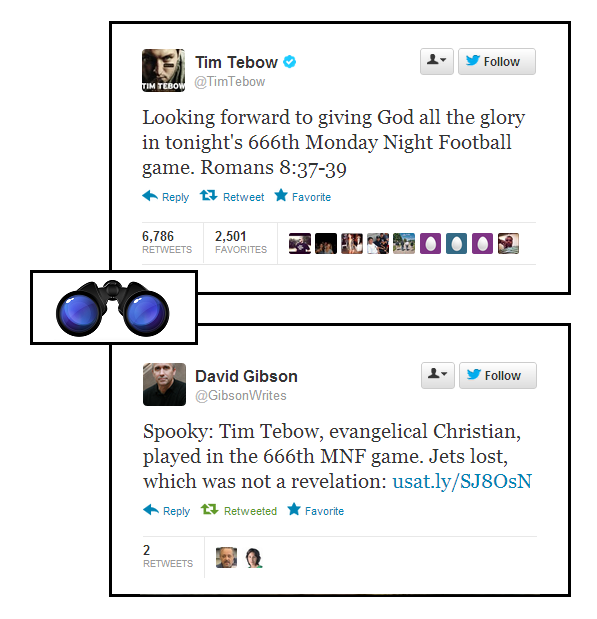
First, the more lighthearted news. Yesterday I featured three footballers prayingTim Tebow was one of them. Today: when prophecy fails on Twitter:

Just look at the retweets for Tebow: his tweet may have been half-tweet, half prediction, half-prayer, all in one forty characters, and his fans were behind it — yet the Jets lost.

At the time of writing, Tebow hasn’t tweeted for 24 hrs.

Permit me an aside, by way of clarification — as someone raised in the UK, I don’t know what “the Jets lost” means, to be honest. My Welsh ex once understood American Football while she was watching a game on hospital TV during a delivery — until the epidural wore off, at which point it went back to being incomprehensible. So that’s as close as I’ve come to understanding it myself — although I played both soccer and rugby in my schooldays.

**

Now onto more serious things. In a comment on another recent post, I mentioned Charlie Fuqua, a Republican candidate for the Arkansas House. I am beginning to think we should have a category to put after the names of such people, as in “candidate Charlie Fuqua (R-Ex)”, to indicate that many on their own team disavow their more extreme pronouncements.

In a post on his Running Chicken blog headed Today in inexplicable religious zealotry, Prof. Ari Kohen quotes the Arkansas Times on Charlie Fuqua, a Republican-side candidate for the Arkansas legislature:

Here’s the key passage from Fuqua’s 2012 book, “God’s Law: The Only Political Solution“:

The maintenance of civil order in society rests on the foundation of family discipline. Therefore, a child who disrespects his parents must be permanently removed from society in a way that gives an example to all other children of the importance of respect for parents. The death penalty for rebellious children is not something to be taken lightly. The guidelines for administering the death penalty to rebellious children are given in Deut 21:18-21:

Deuteronomy 21.18-21 reads:

If a man have a stubborn and rebellious son, which will not obey the voice of his father, or the voice of his mother, and that, when they have chastened him, will not hearken unto them: Then shall his father and his mother lay hold on him, and bring him out unto the elders of his city, and unto the gate of his place; And they shall say unto the elders of his city, This our son is stubborn and rebellious, he will not obey our voice; he is a glutton, and a drunkard. And all the men of his city shall stone him with stones, that he die: so shalt thou put evil away from among you; and all Israel shall hear, and fear.

The Arkansas Times continues:

Fuqua helpfully notes that “This passage does not give parents blanket authority to kill their children.” Rather, parents would have to “follow the proper procedure in order to have the death penalty executed against their children.” Fuqua assures the reader that, in his view, the procedure would “rarely be used.” The threat of death would, however, “be a tremendous incentive for children to give proper respect to their parents.”

**

Here’s where Prof. Kohen, Schlesinger Associate Professor of Political Science and Director of the Forsythe Family Program on Human Rights and Humanitarian Affairs at the University of Nebraska—Lincoln, adds his own informed scholarly input:

The trouble for Fuqua — and anyone else who thinks the Hebrew Bible provides a good template to follow in cases like these — is that he doesn’t actually have any idea what Jewish scholars and religious authorities have been thinking and writing about this particular passage for centuries:

In defining the extent and limitations of the laws of the ben sorer u-moreh, the Talmud (Sanhedrin 71a) states that the child is not considered liable until he has stolen his father’s property in order to acquire a tartimar of meat to eat, and a log of Italian wine to drink. The Halakha places further restrictions upon the ben sorer u-moreh so as to make the application of the law extremely unlikely, if not impossible. The rules only apply with the first three months after the child has reached halakhic manhood; both parents must be living and willing to press charges; neither parent can be deaf, lame, nor missing a limb; they must speak with the same voice and have the same appearance; the boy must steal the meat and wine from his father’s house, yet consume them elsewhere in the company of worthless individuals, in order for him to be convicted. According to the Tosefta Negaim, this law is not in effect in Yerushalayim. (The Meshekh Chokhma suggests that this is due to the continuous eating of so many sacrifices and offerings, as well as ma’aser sheni – the second tithe – within Jerusalem; consumption within the city, since it is performed for mitzva purposes, cannot be considered gluttony.) These are only a few of the numerous restrictions and limitations that apply before a boy can be judged as a ben sorer u-moreh, ensuring that the actual application of the law was extremely rare.

Several Talmudic opinions (Sanhedrin 71), having studied the above limitations, conclude that the case of the ben sorer u-moreh “never occurred and never will occur.” According to them, the sole purpose of having this section in the Torah is to learn the laws and provide a reward for those who do so.

So, in brief, here is my plea to people like Charlie Fuqua:

Stop cherry-picking the Torah to justify all of the terrible things you want people to do to one another; Jews don’t believe that things like this are mandated by the Torah and it’s our book.

**

I very much appreciate Prof. Kohen’s comments, which open a lively window not only on Judaic scripture, interpretation and practice, but also on how scriptures, their literal interpretations by outsiders, and the more skillful and adaptive interpretations of scholars within the traditions can function in the actual shaping of human lives…

When considering the scriptures of any religious tradition, we should bear such examples strongly in mind.

**

Indeed, I have only one qualification to make regarding Prof. Kohen’s post, and offer it as a small gift of thanks.

The one thing I can say that Fuqua is very likely not doing is cherry picking.

It is far more likely that he is a follower of the late RJ Rushdoony, whose massive work The Institutes of Christian Law advocates for the application of what he terms Biblical Law – in its entirety — to American society, and whose Chalcedon Institute published an article in its January 1999 issue on precisely this topic: Rev. William Einwechter‘s Stoning Disobedient Children?:

Deuteronomy 21:18-21 contains what is, perhaps, the most vilified law of the Old Testament. It is widely believed that this law authorizes the stoning of children who disobey their parents. … When this case law, which applies the moral law of the Fifth Commandment to a specific circumstance, is understood it will prove to be “holy, just, and good,” a delight to the heart of God’s true people (Rom. 7:12, 22).

This piece created a bit of a stir, and it was followed shortly thereafter by another Einwechter piece: Stoning Disobedient Children? Revisited.

Both articles seem to have proven unpopular enough that they have been removed from their respective original sites, so I am grateful that the Archive still has them as linked above. I recommend an acquaintance with Rushdoony’s work, and with essays such as these, to anyone interested in the influence of “Biblical Law” on contemporary politics.

**

By way of comparison, the Qur’an, like the Torah, stresses the importance of honoring one’s parents in close conjunction with that of having no god but God. Thus Qur’an 17:23 in the Shakir translation reads:

And your Lord has commanded that you shall not serve (any) but Him, and goodness to your parents. If either or both of them reach old age with you, say not to them (so much as) “Ugh” nor chide them, and speak to them a generous word.

— compare Exodus 20.3-5, 12 — while the hadith reported in Sahih Bukhari, Bk 48, Witness, #822 tells us:

Narrated Abu Bakra:

The Prophet said thrice, “Should I inform you out the greatest of the great sins?” They said, “Yes, O Allah’s Apostle!” He said, “To join others in worship with Allah and to be undutiful to one’s parents.” The Prophet then sat up after he had been reclining (on a pillow) and said, “And I warn you against giving a false witness, and he kept on saying that warning till we thought he would not stop.

To my knowledge, no specific (hudud) punishment for disobedient children is prescribed in the Qur’an.


Switch to our mobile site