zenpundit.com » 2012

Archive for 2012

Two TED Talks: Stavridis and van Uhm

Thursday, July 26th, 2012

[ by Charles Cameron — talking across the military / civilian divide ]
.

Adm. Stavridis' rheostat

.

I thought these two TED talks — one given in Amsterdam by Gen. Petrus J.M. “Peter” van Uhm, current Chief of the Netherlands Defence Staff, the other by Adm. James Stavridis, current Commander, U.S. European Command (USEUCOM) and NATO’s Supreme Allied Commander Europe (SACEUR) — were interesting in terms of the speaker-audience combination in each case, and the topics the two speakers chose to present.

**

First, Adm. Stavridis, speaking to A Navy Admiral’s thoughts on global security:

I’m particularly intrigued by the sub vs raft image, and by the admiral’s hard and soft power rheostat (image above) — I hope we’ll get to discuss that image.

**

Then Gen. van Uhm, speaking to Why I chose a gun:

**

Stavridis is the guy who says:

We are excellent at launching Tomahawk missiles … we need to get better at launching ideas.

and told his audience at National Defense University convocation:

in the end, 21st-century security is about brain on-brain warfare.

**

There’s some interesting bridge-building going on here — from military speakers to civilian audiences. I welcome your comments.

Silent reading, silent thinking, bifocal glasses

Thursday, July 26th, 2012

[ by Charles Cameron — two forms of creativity: far out and close in ]
.


.
Some of the most obvious things aren’t obvious at all, until you think of them. The things my friend Derek Robinson talks about as being in the beforeground. Too close to notice / right under our noses all along.
.
And I think that’s one of the principles of creative thinking — a lot of creative detailing takes place out on the bleeding edge, where someone pushes the limits of existing knowledge that little bit farther, and sometimes those insights can be revolutionary. But profound revelations also come from questioning the most basic assumptions — as Cambridge University Press blogged last year, celebrating the centenary of the Russell-Whitehead Principia Mathematica, vol II:

Principia attempted to ground mathematics in logic and the authors left no stone unturned in their attempt to create the ultimate definition of mathematics. For example, they were well into volume two before they had proved that one plus one equals two! They concluded their proofs with the laconic statement: “The above proposition is occasionally useful.”

BTW, that’s a point I also addressed in the context of my work on social entrepreneurship for the Skoll Foundation:

IMO, we need some funding sources that understand that the next significant breakthrough, too, will be all but invisible — and who therefore look specifically for projects that are categorized by their radical rethinking of the seemingly known and obvious.

**

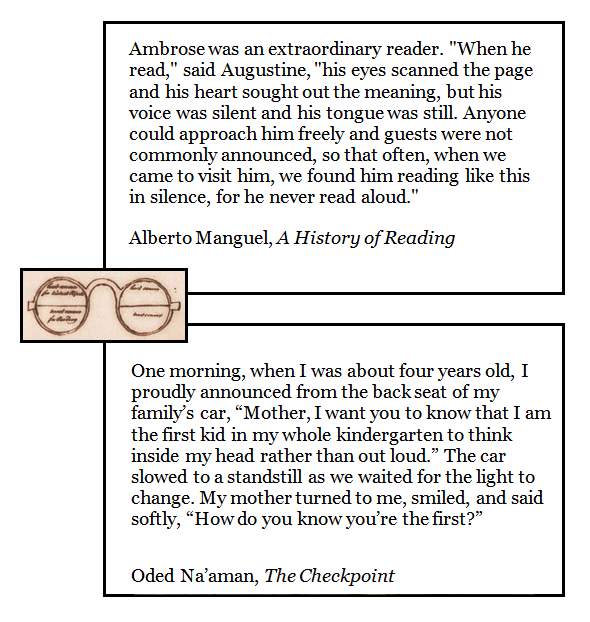
For anyone who’s curious, the bifocals pictured in the tiny “specs” section of my graphic above come from Ben Franklin‘s original letter proposing the idea of bifocal glasses, courtesy of the Library of Congress (link is to complete image).

The Odel Na’aman story, The Checkpoint: Terror, Power, and Cruelty is up at the Boston Review site. I haven’t read it yet, just tasted the first paragraph.

There are times when it helps to have bifocal (contrapuntal) vision…

No compulsion in religion

Thursday, July 26th, 2012

[ by Charles Cameron — conversion by force, the Qur’an — and a question about space travel ]
.

Under the header, Africa: ‘Christians Must Convert’ Says Islamist Group, the Catholic Information Service for Africa reported recently:

Islamist militants have claimed responsibility for the deaths of more than 50 people in north-central Nigeria – and called on the country’s Christians to convert to Islam. Boko Haram spokesman Abu Qaqa issued a statement that the Islamist group carried out the attacks on more than a dozen villages last weekend (June 30 – July 1) and said it will continue to attack the country’s Christians.

According to the statement: “Christians in Nigeria should accept Islam, that is true religion, or they will never have peace.”

“We do not regard them as trusted Christians as some illiterates are campaigning because it was Christians that first declared war on Muslims with the support of government.”

Violence in Plateau state last weekend was blamed on members of the predominantly Muslim Fulani ethnic group, which attacked Christian tribes in the region in March 2010 due to political and social tensions. According to a Red Cross statement issued late Sunday (July 1), aid workers counted 58 dead – but other estimates place the number higher. Press Trust of India reporters stationed in the capital Abuja stated that 135 people were killed.

In the statement Boko Haram thanked God for the massacre: “We praise God in this war for Prophet Mohammed, we thank Allah for the successful attack in Plateau state on Christians and security men”.

Speaking to Aid to the Church in Need last month, Bishop Martin Igwe Uzoukwu Minna said: “If we have to die for Christ, we will die for Christ, but why should we be forced to make the choice?”

**

Sheikh Sâmî al-Mâjid, professor at al-Imâm Islamic University, Riyadh, finds the answer quite simply set forth in the Qur’an:

Allah says: “Let there be no compulsion in religion. Truth has been made clear from error. Whoever rejects false worship and believes in Allah has grasped the most trustworthy handhold that never breaks. And Allah hears and knows all things.” [Sûrah al-Baqarah: 256]

He then comments:

One of the fundamental truths established by the sacred texts is that no one can be compelled to accept Islam. It is the duty of Muslims to establish the proof of Islam to the people so that truth can be made clear from falsehood. After that, whoever wishes to accept Islam may do so and whoever wishes to continue upon unbelief may do so. No one should be threatened or harmed in any way if he does not wish to accept Islam.

This verse is decisive in establishing that each person has the right to make his or her own choice about embracing Islam. There is other equally decisive evidence in the Qur’an, among which are the following verses:

Allah says: “If it had been your Lord’s will, all of the people on Earth would have believed. Would you then compel the people so to have them believe?” [Sûrah Yûnus: 99]

Allah says: “So if they dispute with you, say ‘I have submitted my whole self to Allah, and so have those who follow me.’ And say to the People of the Scripture and to the unlearned: ‘Do you also submit yourselves?’ If they do, then they are on right guidance. But if they turn away, your duty is only to convey the Message. And in Allah’s sight are all of His servants.” [Sûrah Âl `Imrân: 20]

Allah says: “The Messenger’s duty is but to proclaim the Message.” [Sûrah al-Mâ’idah: 99]

It is important to note that these last two verses were revealed in Madinah. This is significant, since it shows that the ruling they gave was not just contingent on the Muslims being in Mecca in a state of weakness, but is valid for all time.

**

We humans do seem to like imposing our own views on others, though, don’t we? And religion is a brilliant playground for that sort of thing.

If God had planted different the religions on different planets, do you think we’d have mastered space travel by now?

The most important post about Aurora doesn’t mention Aurora

Thursday, July 26th, 2012

[ by Charles Cameron — futurism, making, printing, printable guns, time of your life, intersecting timelines ]
.


.

We only have one mouth, so we’re linear speakers, confined to speaking one thought at a time. And we only have one body, so we tend to think of our lives along a single timeline — although other people with their own uncontolled timelines are constantly crisscrossing our paths and making things better (hey, thanks!) or worse (damn it!) or just plain interesting (okaaay) or boring (unhh)… but the world itself includes the crisscrossing of all those paths in its own timeline, and what this means in practice is that linear thinking doesn’t catch the drift.

Which is why it’s interesting that the most important blog-piece on the Aurora tragedy today doesn’t mention Aurora once.

It’s by John Robb, and it’s about printing these:

And it’s important because the world-line it talks about will cross the path of the Columbine > Virginia Tech > Utøya > Aurora timeline at some point.

**

It begins like this:

Printing Weapons at Home for Fun and Mayhem

.
It’s now possible to print functional weapons at home. This is going to progress rapidly now.

Think: global file sharing of designs for servicable weapons, from pistols on up to ?, that can be printed at home. What you can print — from the materials to the size/quality of the object to the completeness (snap together construction) — is already moving forward quickly. The weapons effort will just be along for the ride.

But read the whole thing. And read Duncan Kinder and the other comments there, too.

**

That’s John Robb’s message for the day — and apart from the fact that it talks about reliable home-printed weaponry, a line of development which will I suggest will cross that Columbine > Virginia Tech > Utøya > Aurora line some time in the not too distant, there’s one unremarkable little remark in there that’s well worth remarking on. John says:

The weapons effort will just be along for the ride.

**

Along for the ride. Side effects. Adverse reactions. Serendipity. Unintended consequences. Unknown unknowns. Black swans.

We have a variety of terms we use for the things that blindside us, for better or worse. Our future is full of them, our past is littered with the results…

So it’s interesting that if a bunch of us are thinking along the broad line of maker-printables, a few will be thinking printable guns. A bunch of us will be making films, a bunch more will be going to the movies to see them. And some will have far darker thoughts in mind.

**

Crisscross your thinking. Weave your world with care for the future, please.

Aurora, Samarra, Vermont…

Tuesday, July 24th, 2012

[ By Charles Cameron — the gun issue, complexity, human beings being humans and the world we live in ]
.

As always, I’m a fence-sitter bridge-builder, not wanting to take sides, preferring to talk with them.
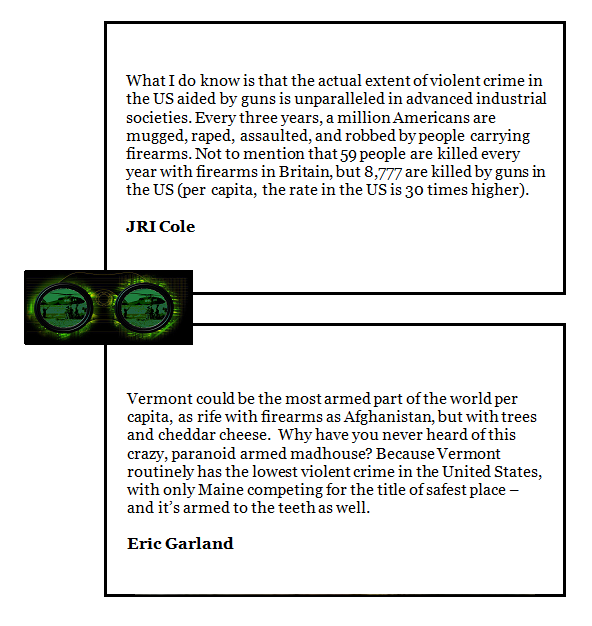
The irritating beauty of these two quotes is that either one taking separately might seem like a “case closed” argument in favor of guns or gun control — but taken together, they show the world to be a dappled place.

Here’s the lead-in to that Vermont quote:

One facet of Vermont life is neither famous nor quaint: Vermonters are armed to the teeth. Guns are absolutely everywhere. Rifles. Pistols. Shotguns. Muzzle-loaders. Semi-automatics. 50 caliber tripod-mount “semi” automatics that could take out aircraft. Every firearm you can possibly imagine. Vermont could be the most armed part of the world per capita, as rife with firearms as Afghanistan, but with trees and cheddar cheese…

Things are weird that way: just when you think you’ve got them figured out, there’s an exception to the rule… a black dot in the white part of the yin-yang symbol… an anomaly that challenges the easy paradigm.

Dappled, as Hopkins puts it.

**

Pied Beauty
by Gerard Manley Hopkins, SJ
.

GLORY be to God for dappled things—
For skies of couple-colour as a brinded cow;
For rose-moles all in stipple upon trout that swim;
Fresh-firecoal chestnut-falls; finches’ wings;
Landscape plotted and pieced—fold, fallow, and plough;
And áll trádes, their gear and tackle and trim.

All things counter, original, spare, strange;
Whatever is fickle, freckled (who knows how?)
With swift, slow; sweet, sour; adazzle, dim;
He fathers-forth whose beauty is past change:
Praise him.

**

The world is complex: scientists using microscopes and a suite of 128 computers recently (and triumphantly) managed to simulate the genome of one of the smallest micro-organisms in the world, Mycoplasma genitalium (neat name, that):
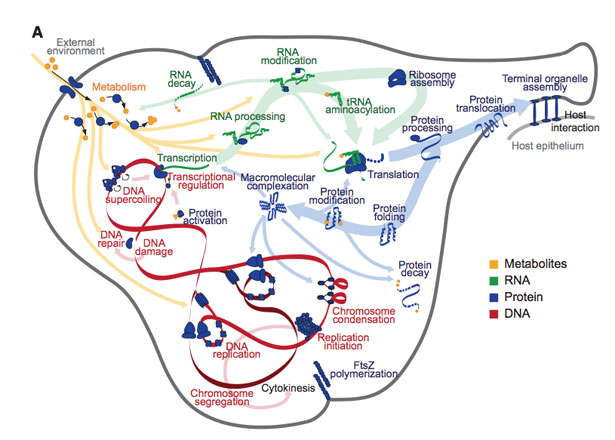
Alexis Madrigal (another neat name, btw) writes:

“Right now, running a simulation for a single cell to divide only one time takes around 10 hours and generates half a gigabyte of data,” lead scientist Covert told the New York Times. “I find this fact completely fascinating, because I don’t know that anyone has ever asked how much data a living thing truly holds.”

One cell. One division. Half a gig of data. Now figure that millions of bacteria could fit on the head of a pin and that many of them are an order of magnitude more complex than M. genitalium.

Yup. So think how complex the world is. No wonder we name things, divide stuff up into categories — use quite a large chunk of our brains for making distinctions.

But then think how complex the humans studying M. genitalium (still like that name, but this’ll be the last time I mention it) themselves must be… As Madrigal (really a nice name, you can almost sing it) goes on to point out:

Or ponder the idea that the human body is made up of 10 trillion (big, complex) human cells, plus about 90 or 100 trillion bacterial cells. That’s about 100,000,000,000,000 cells in total. That’d take a lot of computers to model, eh? If it were possible, that is.

**

Complexity looks at complexity with a view to modeling it. Simple, you think? Complex, you’d say?

The world’s a subtle place, and I might just go live in Vermont.

But people get shot in Vermont too, from time to time — there’s always a black and bleeding bullet-hole in the white half of the yin yang symbol — this world is hopelessly dappled.

And you know that story Somerset Maugham tells about Samarra?

There was a merchant in Bagdad who sent his servant to market to buy provisions and in a little while the servant came back, white and trembling, and said, Master, just now when I was in the marketplace I was jostled by a woman in the crowd and when I turned I saw it was Death that jostled me. She looked at me and made a threatening gesture, now, lend me your horse, and I will ride away from this city and avoid my fate. I will go to Samarra and there Death will not find me. The merchant lent him his horse, and the servant mounted it, and he dug his spurs in its flanks and as fast as the horse could gallop he went. Then the merchant went down to the marketplace and he saw me standing in the crowd and he came to me and said, Why did you make a threating getsture to my servant when you saw him this morning? That was not a threatening gesture, I said, it was only a start of surprise. I was astonished to see him in Bagdad, for I had an appointment with him tonight in Samarra.

Idries Shah tells a version of the same story as “When Death Came to Baghdad” in his Tales of the Dervishes, but with Samarkand rather than Samarra as the fatal destination.

It just might be the same with Vermont.


Switch to our mobile site