zenpundit.com » 2012

Archive for 2012

Crania Anatomica Filigre

Monday, June 18th, 2012

Crania Anatomica by Josh Harker

Just received a Crania Anatomica skull as a gift for father’s day from the dutiful Mrs. Zenpundit. The skulls come in various sizes and are the creation of sculptor-entrepreneur Joshua Harker; made with 3-D  printing, the polyamide nylon skull is extremely intricate, lightweight, slightly flexible and has the look of delicately carved ivory. Very cool gift.

Harker’s project and sculprures are explained in greater detail at his Kickstarter page.

Myst-like Universities, Oxford-like Games?

Saturday, June 16th, 2012

[ by Charles Cameron — games in education — written in 1996 for friends on the Magister-L mailing list — for background, see In response to Lewis Shepherd ]
.

I’ve been thinking about education, “edutainment” and games, with special reference to Myst-type games, Glass Bead Games and Universities not unlike my own alma mater, Oxford…

Here are some preliminary ideas…

I: Proposal

There is no reason why the books in a MYST-like game shouldn’t be real books.

Yeah? So?

There is no reason why studying the books in a MYST-like game to gain access to the information needed to “solve puzzles” within the game structure and gain access to more advanced levels of the game should be any different from studying the same books in an OXFORD-like university to gain access to the information needed to “pass exams” within the academic structure and gain access to more advanced levels of knowledge…

There is no reason why education and game should not merge. OXFORD is a walk-thru MYST, and the puzzles are exams. Education is Game, the supreme Game of life itself.

The only thing needed to make the future of computer game playing and the future of computer education one thing is a concept of gaming which extends as far as the concept of education — and Hermann Hesse’s Glass Bead Game does this.

A future Glass Bead Game with Myst-like properties could encompass the entirety of education, because (a) unlike chess it deals in the sum of human culture and knowledge while (b) its own skills involve a chess-like mastery: its game aspect stretches as high as its knowledge base.

We already know from such things as Sesame Street that learning about “fiveness” can take place at the intersection of education and entertainment, with a kangaroo bouncing five oranges on a trampoline and gleefully calling out “five, five”. We suspect that at this level, the entertainment element adds to the student’s interest in learning.

We also suspect that at higher levels of learning, entertainment quite naturally gives way to the “more important” educational element. No need to entertain, the subject itself fascinates…

But Feynmann — the Nobel Prize man, the drummer, the CalTech fellow — entertains while he educates, educates while he entertains: it’s an aspect of the nature of his genius…

The future of education lies in a Game involving mastery in the acquiring and manipulating of knowledges, both in depth within individual disciplines, and in breadth across them. This is the future of the Glass Bead Game…

It is stored on megacomputers. It is accessible through cable lines coming into your home. It is displayed on your new hi-res TV screen. Think of a terabyte holographic storage device which could transfer info in or out a gigabyte per second… Its architecture contains “rooms” at all levels of learning from K through post doctoral, in all subject areas. Any student of whatever age can access any “room” to which he has solved the “prerequisite” puzzles. The “rooms” contain a massive library of “books” and an equally impressive video library…

Imagine a world in which the very best classes taught at Harvard, Yale, MIT, CalTech, Stanford, Oxford, Cambridge, Heidelberg, the Sorbonne are accessible on the web in video form…

Imagine a world in which students can supplement their “live” classes with access to a virtual environment of this sort…

The arts — at the level of a Mozart, a Bach, a Yeats, a Shakespeare, a Leonardo, a Michelangelo — are games. Creative play with a very high order of skill…

Imagine the Great Game…

II: Background

That’s the main thrust of where I’m going, but it may help if I add in some background, in the form of the following notes:

I am wondering about a number of “threads” that seem to come together somewhere hereabouts:

(i) a recent effort in California to put together all the information in a “geography” curriculum from kindergarten through — I think — the second year of college on videodisks, in such a way that a student of any age could move as far and as fast through it as his/her ability to give “correct” answers to the quizzes along the way permitted…

(ii) the notion that large film archives such as those maintained by the studios may in the not too distant future be accessible on-line, with real time delivery along fiber optic “phone” cable for display on the “tv” screen…

(iii) the notion that all the classes in, say, Harvard, Yale, Stanford, MIT, CalTech, Oxford, Cambridge, Heidelberg… could be videotaped, also in the not too distant future, and be made available in a similar fashion…

(iv) efforts to put large libraries online in toto: I gather from an IBM commercial (!), for instance, that the Indiana musicological library is now available to the daughters of Italian vineyard owners over the net…

Putting these all together, I see the possibility of computers storing and delivering enough in the way of first class lectures and libraries to allow students of whatever age to move as far and as fast through self-education as their interest and capacity to pass quizzes permits…

III: Invitation

The “proposal” and “background” above, taken together, represent the thinking I’ve done so far, and the direction I hope to take — they’re my personal “state of the art” on all this. I suspect there are people already working on many of the ideas that go into this mix — but that the overall vision here is a “gourmet” version, and that we’ll get pretty thin soup if we leave it to people outside the GBG environment to do all the cooking.

There’s further background on the origins of Myst-like games in the classical Art of Memory in my piece The Mysts of Antiquity.

Please feel free to contact me if you are interested in discussing these ideas in more detail.

In response to Lewis Shepherd

Saturday, June 16th, 2012

[ by Charles Cameron — prescience, edutech, a twitter exchange — Glass Bead Games, Harper’s magazine and Microsoft ]
.


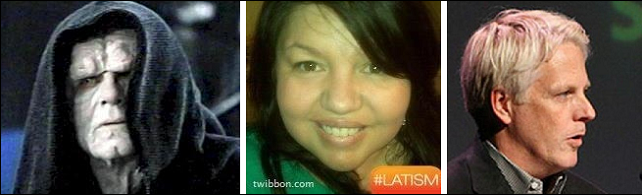
Twitter avatars, left to right: Mark Safranski, Enriqueta Turanzas, Lewis Shepherd
.

Mark Safranski, whom I like to think of as the Zen of Zen since there are now three of us who blog here, was tweeting with Lewis Shepherd and Enriqueta Turanzas about the future of education the other day, and Shepherd — who blogs at Shepherd’s Pi and is, as far as I know, Director of the Microsoft Institute for Advanced Technology in Governments — tweeted a phrase that caught my eye:

Education’s future = MMPORG

My friend Mike Sellers had released the path-breaking game Meridian 59 in 1996, and Richard Garriott coined the term MMORPG (for massively multiplayer online role-playing game) in 1997 — so the tech side of things was just swinging into view in 1996-97, though it would be another five years before MIT began offering courseware (2001), and eight years before Games for Change was founded (2004).

Back in 1996 and 1997 I was writing up my ideas on education and games for the Magister-L mailing list, and pushing them on anyone who would listen at the Computer Game Developers’ Conference — now renamed the GDC, since it has since become obvious that games and computers are a match… and to shorten a long story, my ideas back then seemed to me to rhyme with Shepherd’s tweet this week.

And rhymes between ideas are important to me.

I tweeted back to Shepherd, offering a link to a piece I’d written in 1996 titled Myst-like Universities, Oxford-like Games? — and along with the link, my tweet said, ee cummings style:

if i wrote this in 1997 i was prescient, eh?

To which Enriqueta, bless her, quickly agreed, while Shepherd responded:

Prescient, yes. And if you patented it in ’97. you should get a call from Sebastian Thrun : )

*

So.

That got me thinking, and I went back to look a little more carefully at what I’d written back then, and decided I should re-up it here on Zenpundit, which I will do in a follow up post to this one.

But first I should respond to Lewis Shepherd on the question of patenting.

I am a lot closer to a hermit than a man of business, to be honest – for reasons that Zenpundit regulars will have intuited from my two recent posts about Trevor Huddleston, and which followers of my games will know from my recent biographical sortie on the Sembl pages.

So, no – I didn’t patent my ideas, and indeed am deeply indebted to whoever engraved the words “to give, and not to count the cost, to labour, and not ask for any reward” on my heart early enough for me to be something of a Creative Commons type avant la lettre.

I’m not a purist, some of my writings have that dastardly little © mark attached, and I don’t mind getting paid on occasion – but to be honest, much of what I love about blogging is the free circulation of ideas and the cameraderie of bloggers…

The other thing that’s just a tad ironic about all this, though, is that back in April of 1997, Lewis Lapham, who was then editor-in-chief of Harper’s, wrote an extended editorial called Notebook: The Spanish Armadillo in which he recommended that Microsoft should consult me – publishing my email address for their convenience, no less:

Hesse’s bead game lends itself so obviously to the transcendent aspirations of the Internet that it’s probably only a matter of months before Microsoft buys the rights to his name for one of its software programs. The company’s marketing strategists might first want to consult Charles Cameron, reachable on the Internet at hipbone@earthlink.net, the foremost of 263 correspondents concerned with the implications of Hesse’s novel.

Well, I never got the email from Microsoft. I came to the conclusion they likely didn’t read Harper’s, or not at the requisite level for initiating consultations. And I was busy writing and thinking, thinking and writing, and taking pauses.

I still am.

But perhaps if Microsoft had called on me back then, I’d have blurted my thoughts out to them in greater detail than I was able to in that one HTML 1.0 post, so many years ago.

And perhaps they’d have thought I was prescient — and patented my idea or ideas, back in 1997.

*

It’s interesting to compare my thoughts back in 1996-97 with what we’re up to these days with the Sembl project.

Next up, for your amusement: the text of that 1997 post of mine, giving my thoughts on games and education sixteen years ago – when I thought a terabyte was huge, huge.

Video clips II: Egyptian roulette and the Apocalypse

Saturday, June 16th, 2012

[ by Charles Cameron — fear, hope, the Egyptian military, the Supreme Court, the Muslim Brotherhood, certainty and roulette ]
.

The Apocalypse is a trump card — the Final Trump card if you will.

And because we so often associate “apocalyptic” with devastation and “post-apocalyptic” with a glowing nuclear waste-land, I’d like to establish first the joyous feelings the word “apocalypse” can also evoke. From Handel‘s Messiah, then, the glorious sound of the apocalyptic trumpet:

*

That sounds pretty terrific, granted, but as we all know, apocalypse also has a darker side — in fact it is a two-sided business, offering both maximal terror and optimal hope.

On the one hand, as Yeats puts it:

Things fall apart; the centre cannot hold;
Mere anarchy is loosed upon the world,
The blood-dimmed tide is loosed, and everywhere
The ceremony of innocence is drowned;
The best lack all conviction, while the worst
Are full of passionate intensity.

While on the other, as John of Patmos says, “I John saw the holy city, new Jerusalem, coming down from God out of heaven, prepared as a bride adorned for her husband.”

Utmost disintegration and devastation — and the immaculate hope of a new heaven and a new earth.

*

As we watch events unfolding in Egypt, then, there are some specifically apocalyptic themes in the air, both on the Egyptian Islamic side…

… where a vision-swept crowd can chant for the triumph of Islam in Jerusalem … and on the Christian side, where an apocalyptic writer such as Joel Richardson can use that same clip to reinforce a message of the lateness of the hour from the other side of the apocalyptic coin:

*

We can, it seems to me, react to the clip of the TV preacher Safwat Hijazi in at least four ways — with jubilation, as the crowd in the video does; with quiet satisfaction, as the politicians of the MB who stand to gain from his support presumably do; with fear, as those of us roused by the video to a vision of the Middle East plunging headlong, unavoidably, into war are likely to do; or with concern — a more temperate approach, and one that await further details, further indicators, further events unfolding.

I don’t think it’s time, yet, to place any bets. Dr. Hegazi’s statement, and the crowd’s response, certainly concern me. The motif of a victorious march of Islam to retake Jerusalem is and end times motif, and I can think of few things more terrifying than a Mahdist army on the march.

But we are not there yet, Dr Hegazi is articulating a dream, not a party political program. And between that dream — a powerful one, to which many Egyptians are clearly susceptible — and its realization we have the moderating factors of realpolitik, of the Supreme Court rulings just a day or two ago — and of the power and entrenched financial interests of the Egyptian military.

In watching the video of Dr Hegazi it is possible to forget all this and be swept up by fear, just as the crowd was swept up by hope of conquest.

And as I’ve said before, I take comfort also in the fact that Joel Richardson is at pains not only to argue, from his own perspective, for the conversion of Muslims — but also to renounce the use of explicitly Christian force until that Trumpet sounds:

I explained to my host that unless a supernatural man bursts forth from the sky in glory, there is absolutely nothing that the world needs to worry about with regard to Christian end-time beliefs. Christians are called to passively await their defender. They are not attempting to usher in His return. Muslims, on the other hand, are actively pursuing the day when their militaristic leader comes to lead them on into victory. Many believe that they can usher in his coming.

*

From my point of view, then, we should be cautious, informed and deliberative. This is not the time to be leaping to conclusions.

I am no expert on Egypt. What I am attempting here is to be aware of the apocalyptic current that was stirring in that Egyptian crowd — and of the apocalyptic currents stirring here, also, in the United States — with calm, with moderation, with an eye to the other influences, some of them both powerful and entrenched, which will themselves tend to divert, moderate, arouse or inflame the situation.

The Supreme Court. The election and whatever comes of it in terms of both power and backlash. The Supreme Council of the Armed Forces. American dollars. Israeli nukes. The inevitable ebbing away at some point of heightened emotions. The economics of tourism…

The unknowns…

Video clips I: Torah, Theonomy, Sharia?

Saturday, June 16th, 2012

[ by Charles Cameron — religious law espoused in Judaism, Christianity and Islam ]
.

I came across this first video, featuring Dov Lior, Chief Rabbi of the Kiryat Arba settlement outside Hebron, yesterday, and thought it would be worthwhile to seek out companion pieces proposing divinely sanctioned legal systems in the two other Abrahamic traditions:

There are naturally differences as well as similarities between the three messages and the relative levels of influence of their respective messengers. A scholar of comparative religion might be concerned with their selections of canonical texts to enforce and the techniques of interpretation variously applied to them, an historian might compare our second speaker, the Chalcedon Institute’s (late) RJ Rushdoony‘s view of the applicability of Biblical law with that of Calvin in Geneva, a strategist consider the groundswells of popular opinion attaching to each of these speakers, their political and military potentials…

All three speakers claim that law should be based on a divinely authored and thus authoritative text — but the books so considered differ. Anjem Choudary, the third speaker, brings vividly to mind the impact that such doctrines can have on those who do not share his religious convictions when he proposes that Buckingham Palace could become a mosque…

I think it important to be aware that such men exist, and have followings. There are members of all three religions that I count as friends, events of horrific, divinely sanctioned violence in the histories of all three religions, and figures in the history of each religion from whom I take inspiration. I would not wish to live in a land where any one of these three men wielded power, and I do not believe that any one of them is fully representative of the grand sweep of his own tradition.

My intent in posting these three videos is to inform, not to inflame, and I invite you to view them in that spirit.


Switch to our mobile site