zenpundit.com » 2012

Archive for 2012

A fatwa on the disposal of the Qur’an by fire

Saturday, March 10th, 2012

[ by Charles Cameron — fire, respect, or local fury? a meld of motives ]
.

Yesterday my friend and colleague Dr Tim Furnish posted a piece on the permissibility of Qur’an burning on PJ Media under the title Burning Defaced Korans: Islam-Approved. My own experience of Islam is colored by almost fifty years of exposure to the Sufi poets (I corresponded with Thomas Merton about “dervish” spirituality in 1964, see Merton’s Road to Joy: The Letters Of Thomas Merton To New And Old Friends, p. 333), so my emphasis in these matters differs somewhat from that of Dr Furnish, but I wanted in particular to thank him for pointing us all to the fatwa issued by the Permanent Committee of Research & Islaamic Rulings Of the Kingdom of Saudi Arabia, which informs us, among other things, that:

It has been confirmed in Saheeh al Bukhaaree in the chapter entitled, “The Collection of The Qur’an”, that ‘Uthmaan Bin ‘Afaan (radi Allahu ‘anhu) ordered four of the good and righteous reciters from the Sahaabah to transcribe copies of the Qur’an from the Mushaf which was gathered by the command of Abu Bakr (radi Allahu ‘anhu). When they completed this task, ‘Uthmaan sent out copies of these Qur’ans to every region. Then he ordered that all other pages and copies of the Qur’an be burnt.

The Director of Religious Affairs of the Islamic Center of Southern California, Imam Jihad Turk, similarly remarked in an NPR interview last September (again, h/t to Dr Furnish for the pointer):

The Qur’an as an idea is something that is in the hearts and the minds of the believers and followers of Islam. It’s not the actual text. It’s not the piece of paper. Muslims don’t worship the text of the Qur’an or destroy the Qur’an.

Although it’s not sacred or something that’s worshiped, it is considered the representation of the sacred word of God, and given that it’s a representation of it, a Muslim would want to make sure that it’s treated respectfully.

When Muslims want to respectfully dispose of a text of the Qur’an that is no longer usable, we will burn it. So if someone, for example, in their own private collection or library had a text of the Qur’an that was damaged or that was in disrepair, so the binding was ruined, etc., or it got torn, they might bring it by to the Islamic Center and ask that someone here dispose of it properly if they were unsure how to do that. And what I’ll do is I’ll take it to my fireplace at home and burn it there in the fireplace. So I sort of take the pages out and then burn it to make sure that it gets thoroughly charred and is no longer recognizable as script.

In the Islamic tradition, it’s the Arabic that is really considered the authentic, original scripture. The very early scripture of the Qur’an—when it was first collated and put into a binding there were a lot of loose papers around, and this was about 1,400 years ago. The first companions of Muhammad, led under the leadership of the third caliph, Uthman, actually instructed the followers to take all of those pages and burn them, and so that kind of set the precedent as to what should be done. If you burn it, it destroys the word, the ink on the paper. It’s no longer perceptible, and so therefore it is no longer scripture. It’s just ashes at that point.

Taking those two comments together, it would appear that it’s not fire so much as respect that’s at issue, theologically speaking. Not that the folks rioting in Afghanistan were necessarily rioting theologically.

And in today’s Afghanistan, it also stands to reason that there are other factors in play…

*

In my own response to Dr Furnish, I quoted Dr. Abdalqadir as-Sufi, who wrote:

We have news for the poor creature. He cannot burn the Qur’an. It is impossible. The Qur’an is the uncreated word of Allah. When a Muslim asks another Muslim to hand it to him he does not say, “give me the Qur’an” but rather “give me the Mus-haf.” That is to say , “give me the copy.”

[ … ] The Qur’an is the uncreated word of Allah. That is why it is unassailable. Of course, we treat the Copy with respect. However this unbalanced peasant preacher, in copying Mao and The Red Guards simply displays his ignorance. “Allah uses the enemies of the Deen to advance the Deen.”

When word came to a remote Muslim village in China that Mao’s Revolutionary Guards were coming to burn their Mus-hafs, the Imam assembled all the children and began to teach them to recite the Qur’an. When the Guards finally arrived they were met by smiling villagers in front of a pile of Copies. As the Guards set fire to the books the sounds of a hundred children came from the Mosque reciting the blessed words of the Qur’an.

The subtleties are always more interesting than the barbarities — which is why a scholarly approach to such enthusiastically contested issues is so important.

*

FWIW, I’ve come at this topic before, and found myself in some neat conversations — see Burning scriptures and human lives, also Of Quantity and Quality I: weighing man against book, and more recently On fire: issues in theology and politics – ii.

In the shadow of the sacred

Saturday, March 10th, 2012

[ by Charles Cameron — international theft and collection of sacred objects, icons, relics ]


image credit: © Chriusha / CC-BY-SA-3.0

The other day I posted an image of the stolen heart of St Laurence O’Toole – and today’s Irish Independent [h/t Michael Robinson] carried a story headlined ‘Relic hunter’ may be behind theft of heart:

Church officials now fear a “relic hunter” may be behind the theft of the heart of St Laurence O’Toole from Christ Church Cathedral last weekend.

And there are suggestions the same person may be responsible for last year’s theft of the True Cross from the Holy Cross Abbey in Co Tipperary as well as the attempted theft of a relic of St Brigid from a church in Dublin.

A relic hunter!

*

I thought I ought to look into this a bit deeper, and what I found probably shouldn’t have surprised me, but did. A 2006 report from the Los Angeles Times headed Stolen icon travels a well-worn trail contained some interesting perspective — and striking statistics:

The collapse of the Soviet Union and the Yugoslav wars brought a flood of looted Christian works — including icons, chalices, crosses and gilded iconostases, or altar walls — into a black market already heavy with objects from places such as Eastern Europe and Turkish-occupied northern Cyprus. The wars in Iraq and Afghanistan drew an unprecedented wave of Muslim and pre-Islamic artifacts and cultural patrimony. Recently, investigators have noticed a surge in stolen works from Latin America and Southeast Asia, such as Buddhist ceremonial figures and pre-Columbian sacramental pieces.

“It’s a phenomenon that is now so widespread,” said Jennifer Thevenot, a spokeswoman for the Paris-based International Council of Museums, which works with Interpol and other agencies on art theft issues. “It affects all regions and all religions.”

Interpol and the U.N. cultural heritage agency UNESCO call stolen art the No. 3 illegal market behind drugs and arms trading.

Interpol statistics offer some guidance. For 2004 — the most recent data available — nearly 1,800 thefts were reported from places of worship, led by Italy and Russia. For the same period, there were 334 museum thefts and 291 from dealers or galleries.

Sacred beats secular in art theft, by almost 3 to 1!

*

I think it’s pretty clear that you don’t collect a stolen icon or relic because you want to ingratiate yourself to the divine by making it a private object of your devotion when the religion in question considers theft a sin… and the iconoclasts of old would have been perfectly content to smash or burn examples of imagery that they deemed offensive to the divine command.

No — the collectors for whom relic hunters hunt relics (which is quite a tongue-twister, if you like such things) collect them because of the aura of the sacred which they exude – likely with a dash of sin for the thrill of it, much like a twist of angostura bitters in gin…

The shadow of the sacred…

Of Esther, Israel and Iran, pt. I – Purim

Thursday, March 8th, 2012

[ by Charles Cameron — Purim, the gift of a scroll ]

Today is the Festival of Purim in the year 5772 of the Jewish calendar, and in preparation for the event and in light of current geopolitics, PM Benjamin Netanyahu presented Pres. Barack Obama with a Megillah — a scroll containing the biblical Book of Esther, which it is a mitzvah for Jews to listen to on Purim — only last week.

Today is also International Women’s Day in the year 2012 of the Common Era.

*

Purim is a festive celebration, and while I hope to post follow ups on the tangled topics of scriptural interpretation and prophetic politics in the coming days, I thought it appropriate to open this series of posts with an image of an early Megillah from the Library of Congress (see above), to raise a glass of virtual wine in honor of the dual event, and to wish all ZP readers Chag Purim Sameach.

Ahoy! Pirates off the Starboard Aft!

Thursday, March 8th, 2012


Jay Fraser interviews an anti-Piracy expert (not the IP kind, either) at Gunpowder& Lead:

Of diversity in Islam

Wednesday, March 7th, 2012

[ by Charles Cameron — against either / or thinking — a graphic reminder? ]
.

Islam is “a mosaic, not a monolith”.

Vartan Gregorian, president of the Carnegie Corporation, offered us a 177-page exposition of that theme in a book of that title published by the Brookings Institution (2003), expanding on an earlier and shorter essay of the same title. Of the book-length version, he writes:

Presenting such a wide-angle view in a relatively small space requires the free use of generalizations, summaries, and categorizations that must leave out many nuances of history.

1.

There’s no doubt that some currents within Islam preach a continuing war against “Crusaders and Zionists” — and make no mistake about it, this is a religious movement, claiming its sanction in scripture and its path as submission to the will of God, as indicated by David Martin Jones and MLR Smith in Whose Hearts and Whose Minds? The Curious Case of Global Counter-Insurgency [see Zen’s comments here]:

The process of radicalisation is obviously a complex one. Certainly, the passage to the act of terrorism cannot be reduced solely to religion. Nevertheless, it is somewhat naive, if not perverse, to dismiss it completely. The bombings of the Madrid and London transport systems in March 2004 and July 2005 respectively, and even the 9/11 assaults, are, whatever else, Islamist acts in a Western setting. The view that religion is at best a secondary motive defies the evidence. All the groups that have undertaken high-profile terrorist acts dating from 9/11 and stretching from Bali to Madrid, London and Mumbai have acted in the name of a militant understanding of Islam. Such a pattern of worldwide attacks, exhibiting a profound devotion to a politically religious cause intimates, if nothing else, a religious dimension to jihadism. In fact, to reduce jihadism to individual social pathology attempts to explain away political religion as a social fact. Rather worryingly, it assumes that when a highly motivated jihadist claims to undertake an operation to advance a doctrine, he does not really mean it.

This might seem so obvious as to require no comment — yet Jones and Smith follow this paragraph with a question:

we need to resolve this paradox: why do counterinsurgency theorists exhibit this reluctance to confront the ideological or politically religious dimension of modern insurgency?

— and there are no doubt other segments of the media, intelligence and policy communities of which the same question might be asked.

One aspect of the answer, I believe, lies in the general tendency of post-enlightenment thinkers to “push religion into the background of their story” (Richard Landes‘ words, which I quoted here in a different context a week ago).

2.

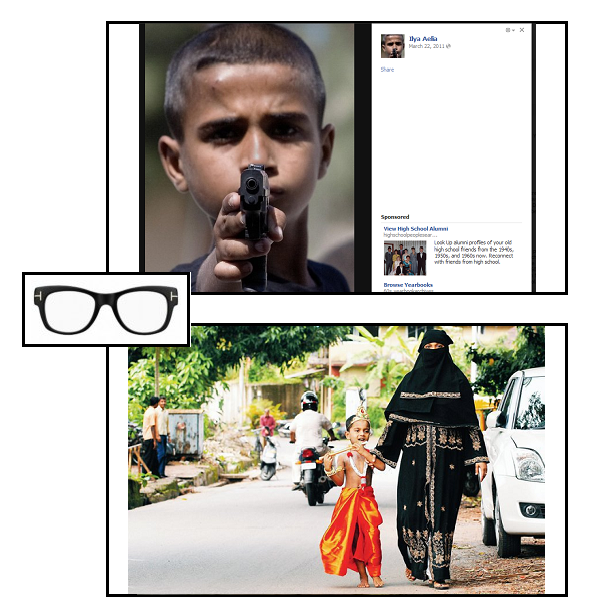
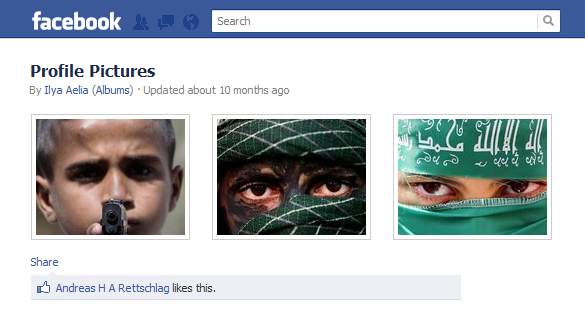
The young man pointing a gun at the viewer on a Facebook page (h/t Internet Hagganah) is the avatar of a net-salafi in Germany whose sequence of avatars looks like this:

Quintan Wiktorowicz defines a salafi thus:

The term “salafi” is used to denote those who follow the example of the companions (salaf) of the Prophet Mohammed. Salafis believe that because the companions learned about Islam directly from the Prophet, they commanded a pure understanding of the faith.

As he notes in another article:

The Salafi movement (often referred to as the Wahhabis)1 represents a diverse community. All Salafis share a puritanical approach to the religion intended to eschew religious innovation by strictly replicating the model of the Prophet Muhammad. Yet the community is broad enough to include such diverse figures as Osama bin Laden and the Mufti of Saudi Arabia. Individuals and groups within the community reflect varied positions on such important topics as jihad, apostasy, and the priorities of activism. In many cases, scholars claiming the Salafi mantel formulate antipodal juristic positions, leading one to question whether they can even be considered part of the same religious tradition.

The avatar-salafi depicted above sums up his own existence and “aim in life” by pointing a gun at you.

3.

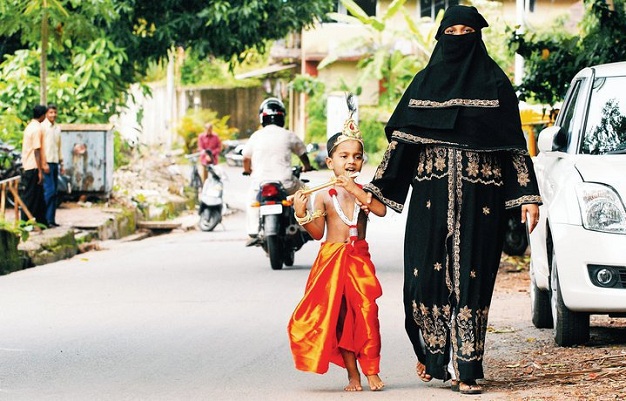
Not so the lady leading a child by the hand in the lower of the two images, from a photo taken in India.

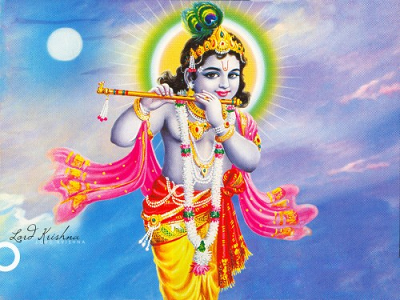
She offers us, in fact, a vividly contrasting picture of Islam to that of the salafi. She, a woman who is clearly observant of the demure dress code given in Qur’an 33.59 and wearing a niqab, is leading by the hand a joyful child arrayed in the finery of Krishna — beloved flute-playing avatar of Vishnu (avatar in its original sense) among her Hindu neighbors.

You might consider the pair of them together as monotheism hand-in-hand with polytheism. But then again, you might see them as peace and delight together, walking hand-in-hand.

You might see them as expressive of the Quranic proclamation (49.13 ):

O people, We have created you from a male and a female and made you into races and tribes so that you may know each other. Surely the most honored of you in the sight of God is the one who is the most righteous of you.

4.

To bring this back to contemporary politics, we may have our views about Islamist politics, and in the context of the changing scene across the Arab world it is worth pondering this recent quote from Rachid Ghannouchi, founder of the Ennahda Party in Tunisia, indicating another significant aspect of the contemporary evolution of Islamist thought:

Freedom is a fundamental principle in Islam, religion can not be forced on believers … Religion is not meant to give us guidance in all areas of industrial management, agricultural innovation, and governance, those subjects require human reason. Religion, however, gives us a code of values and principles.

Islam is not merely diverse, it is self-renewing.

5.

In light of all this, we need a far richer awareness of the mosaic that is Islam that our tendency towards black and white, war or peace, either / or thinking easily allows.

Consider these Quranic verses (35.27-28):

See you not that Allah sends down rain from the sky? With it We then bring out produce of various colors. And in the mountains are tracts white and red, of various shades of color, and black intense in hue. And so amongst men and crawling creatures and cattle, are they of various colors.

Again, the delight in diversity!

Now take another, closer look at those two folks from India:

Beautiful.


Switch to our mobile site