zenpundit.com » 2012 » August

Archive for August, 2012

Rethinking Fortification

Monday, August 13th, 2012

John Robb now has a Facebook page for Global Guerrillas, where he posts quick snippets of big ideas. It seems to be a replacement for his old, informal, personal blog which served a similar purpose some years back. In any event, John had a spectacular picture of Mexico City and an intriguingly dystopian caption:

Mexico City. 

Future of warfare. Megacities + millions of drones.

I wandered into a Mexican shantytown once, back in the 1990’s . Not sure I would care to repeat the experience at the present time.

Robb’s facebook post started me thinking. If drones of all sizes and functions become ubiquitous someday, it creates a great incentive for the powerful, at least to safeguard their privacy, to apply human ingenuity toward concealment, countermeasures and postmodern “citadels”.

All the moreso, if “megacities’ are all girdled in vast seas of slums. Imagine the LA or London riots with 20 times the underclass population. The bloody experience of the New York City Draft Riots during the Civil War taught the Robber Barons of the Gilded Age to support the building of public and private armories to defend the gentle classes from the great uprising that never came.

Fortification is something of a lost art, but it was up until recent history, a critical military capability. After castles went into a temporary decline with the advent of cannons blasting apart their high walls, post-renaissance architects redesigned European fortifications to endure the new bronze siege guns and defense again triumphed over offense. Military engineers like Vauban were more valuable than field marshals and kings staked their strategies on the strength of chains of fortifications and arsenals.  Obsolete by the time of the Napoleonic wars, massive fortresses nonetheless enjoyed a long twilight march to military irrelevance, ending in WWII with the ignominious capture of Belgium’s mighty Eben-Emael fortress by 75 lightly armed Germans and the utter uselessness of the extremely expensive Maginot Line during the Battle of France.

Fortification began to receive renewed interest as governments sought defensive measures to allow their leadership to survive a nuclear attack, such as the Cold War era secret bunkers for USG officials at Greenbrier or Raven Rock or efforts by rogue dictatorships to build facilities carved deep into a mountain to protect their leadership or nuclear weapons programs from American attack. The ancient arms race of defense and offense continues with the designers of “bunker-busters” as a peripheral military activity.

Governments and occasionally corporations and superwealthy individuals will continue to build and tweak these doomsday bunkers but as strategic investments they do not offer very good ROI. For one thing, if your national leadership is cornered fifty stories underground, it will be little comfort to you and your fellow citizens as the nuclear bombs are exploding; the game is pretty much over at that point. Secondly, the ultimate risk they are hedging against is far more remote and the benefits infinitesimal compared to what rethinking fortification as a concept would do to minimize more mundane and probable risks faced by the rest of us.

A great fortress conjures the idea of impregnability and, ironically, usually achieves eternal fame for falling or being breached – the walls of Constantinople,  the Great Wall of China, Masada, Alamut, Murud-Janjira and the aforementioned Maginot Line. “Impregnability” is a misnomer, what a good fortification really does is raise operational costs for adversaries, hopefully high enough to discourage them from making the effort to attack in the first place. Raising costs for those who bear us ill-will by adaptation and a priori design should be our paradigm.

What are the primary risks we will face in coming years as individuals and societies? Erosion of privacy and the security of our persons, property and data at the hands of criminals, avaricious elites, government and private surveillance and bouts of civil disorder, all in a number of forms. For example

  • Drones: As John Robb suggested in his FB post and at Global Guerrillas, drone usage could potentially become ubiquitous by governments, corporations and individuals with an axe to grind or an interest in stalking, terrorism or committing mayhem.  Imagine the Unabomber or Osama bin Laden with a drone swarm controlled from a laptop – superempowerment will go robotic.Drones will/are becoming semiautonomous. They are easily modified to carry cameras, recording/SIGINT devices, imaging systems, weapons, toxic substances or explosives.
  • Civil Unrest: The UK Riots were an excellent reminder that, as with the LA Riots, in the case of dangerous criminal-class rioting, elites will be unable to reestablish order or rescue law-abiding citizens until their reticence becomes a political debacle (and they may, as in Britain, initially restrain law enforcement personnel from suppressing the rioters). This contrasts with elite willingness to mobilize vast police and paramilitary forces against mere embarrassing political protests.
  • Cybersecurity: This adds a new dimension to fortification that is not limited to a physical space and place, even securing your home networks, but to your identity.

How might we adapt individually and collectively to these risks?

First, we are managing risk within reasonable costs and means while living a normal life. If you imagine something to hold off  an angry mob indefinitely or that will allow you to defy the US government then you need to come out of fantasyland or have a Bill Gates budget to play with. Here are some more practical possibilities:

Privacy architecture: Building design embedded with the idea of  promoting privacy, adjusted to the surrounding environment, which today includes thwarting advocates of a panopticon society. You want a structure that breaks clear fields of vision from the outside to the interior. Overhangs, angled exterior surfaces, material surface to reflect heat and light, ornaments/catwalks/netting and  landscaping to break up spatial fields. Perhaps layered walls of different materials to diffuse or mislead spectral/thermal imaging. This could be incorporated in public spaces in neighborhoods or campuses improving both aesthetics as well as privacy.

Underground: Increasing useful space by building down to sub-basement level gives you more possible points of egress, protection from surveillance technologies, storage and living quarters while concealing the true extent of your property from street level view. Best of all, it usually does not count toward your property tax assessment. Substreet complexes, like the system at Disneyworld, could easily planned into the development stage of residential and commercial construction.

Unobtrusive but Unconventional:  Attracting large amounts of attention is helpful in commerce or branding but generally disadvantageous to security. A home should be designed to frustrate opportunistic predators and delay determined ones with the most interesting elements reserved for the interior and (if possible) the rear with the street view presenting a target that is visually more bland than adjacent structures and also unattractive for forced entry. Windows should be treated to make it more difficult to see in or observe when residents are home vice away.

Defensive Security: This is something to consider individually and cooperatively. I once lived in a house in a town with a modestly high crime rate but never had a problem because the house was in a cul-de-sac with a wide oblong court and a long bottleneck entry. The neighbors knew one another and it was impossible (unlike on a conventional street) to not notice a strange car or pedestrian as every home faced the court.  Aside from alarm systems, simple things like better quality doors and locks buys you time to react. If multilevel, you should have at least two ways to escape from an upper floor (when I designed my second home, there were three) which also increases the interior complexity for an unfamiliar intruder. First floor windows should be out of easy reach from ground level.

Manage your Connectivity: Aside from normal cybersecurity precautions, you might consider managing, blocking or at least being aware of your geolocational activity by being selective about tracking devices (like smart phones) and your exposure to “the internet of things”. Do you really need to hook your fridge up to the internet or pay for everything with a debit card?

Fortification is largely about thinking ahead to put objects and systems between yourself and the world.

My early “close reading” of Nidal Hasan’s .ppt reposted

Monday, August 13th, 2012

[ by Charles Cameron — my original SWJ post featuring my attempt at interpreting Nidal Hasan’s powerpoint slide show when it was first published, plus more recent links ]
.


.

At Zen‘s suggestion, and since it’s no longer accessible on the revamped SWJ site, I’m posting here a link to my 2009 piece, The Hasan Slide Presentation: A Preliminary Commentary, as it originally appeared in .pdf in the Small Wars Journal.

My attempt then was to avoid, if possible, back-reading the facts of the Ft Hood shooting into the Hasan slide presentation — noting that at the time we lacked a clear sense of the verbal commentary with which Hasan had presented the slides.

Avoiding “projective hindsight” remains an interest of mine.

**

More recently, I raised a related question about Maj. Hasan here on Zenpundit, and received first rate answers from:

Daveed Gartenstein-Ross and Lauren Morgan, Nidal Hasan’s “Fairly Benign” Correspondence with Anwar al Awlaki
JM Berger, The Content and Context of Anwar Awlaki’s emails with Fort Hood Shooter Nidal Hasan

with indirect follow-ups from:

emptywheel, It’s Not Just Whether Nidal Hasan’s Emails Stuck Out, It’s Whether Abdulmutallab’s Did, and
Bernard Finel, Was Ft. Hood (or Aurora) Preventable?

**

I’m still in the relatively early throes of learning my new job at UrbIm, but hope to respond to these good folks once I’m a bit more settled in…

But I’ve noticed, I don’t always manage to get to everything… : (

Judaism, Islam and the death penalty

Sunday, August 12th, 2012

[ by Charles Cameron — surprising infrequency of capital punishment, though mandated in Sharia and Torah ]
.

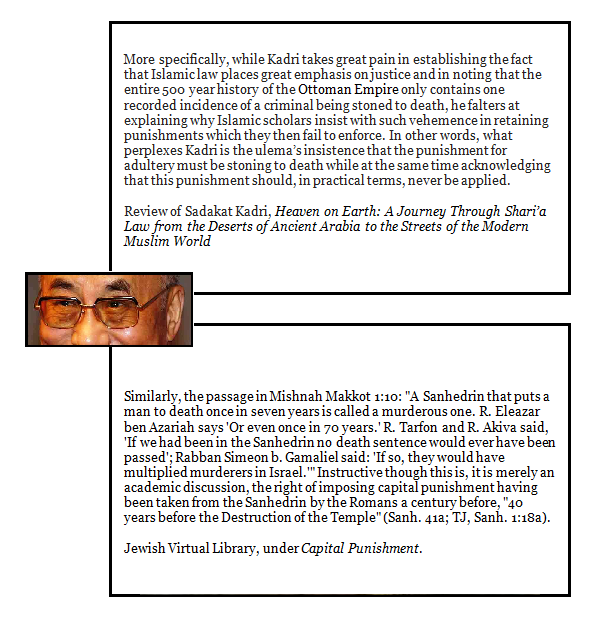
I’m always struck by formal parallelisms, particularly in matters religious — so when I came across this fascinating reference to the infrequency of capital punishment by stoning in the Ottoman Empire in a book review today (upper panel):

I was immediately reminded of a similar Jewish reluctance to use capital punishment — stoning being one of the four choices — as recorded in Tractate Sanhedrin (lower panel)

And i thought the Dalai Lama (inset) might like it too…

Of course, there’s more detail and nuance to be had in each case, but the parallelism is nevertheless instructive.

Sources:

Review of Kadri in Pakistan’s Express Tribune
Jewish Virtual Library, Capital Punishment

On a personal note, highly subjective: you gotta love R. Akiva — but you gotta respect R. Simeon, too.

As usual, life is nuanced and — dare I say this? — “systems dynamic”.

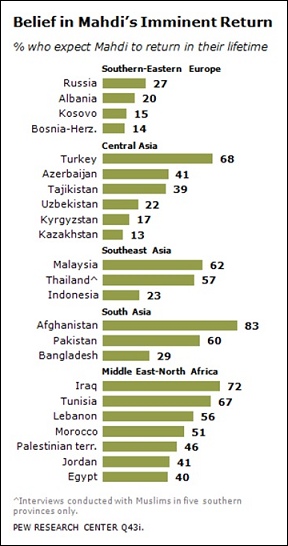
Pew on the prevalence of Mahdism — take heed!

Sunday, August 12th, 2012

[ by Charles “told you so” Cameron — Pew figures for Mahdist expectation, also the Second Coming, Israel, and the potential influence of apocalyptic ideation on foreign policy ]
.

The World’s Muslims: Unity and Diversity, p. 65

.

I am Qualit, not Quant by nature, really much more interested in the workings of the imagination that in the aggregates of poll responses, so it’s a bit like pulling teeth for me to report on a Pew report — but in this case I can legitimately say “I told you so”, which massively outweighs the reluctance I might otherwise feel…

**

Recently, Pew has been including questions about the expectation of the Mahdi in some of its reports, and even Tim Furnish — who wrote the book on Mahdist movements and has long been saying we neglect them at our peril — even Tim was surprised at how widespread Mahdist expectation is, as reported in their just released The World’s Muslims: Unity and Diversity. In a post aptly titled Don’t Leave a Live (or Occulted) Mahdi Out of Your Calculations, Tim says the report contains “The most notable — indeed, strikingly important — news” in the form of “fascinating — and disturbing — data on belief in the Mahdi’s imminent (in one’s lifetime) return.”

See graphic above.

I recommend you read Tim’s analysis for the full range of his points — I won’t, for instance, be touching on what he says about Turkey — here I am going to select a couple of his key issues, and make just a point or two of my own.

**

Furnish:

Of the 23 countries whose Muslim citizens were polled, nine have majorities which expect the Mahdi in their lifetimes, with the overall average percentage at 41.8% … it is safe to extrapolate this percentage to Islam as a whole; ergo, 42% of 1.6 billion = 672 million Muslims who believe in the Mahdi’s imminent return! This is FAR greater than I had supposed.

Furnish also notes that Iran, the world’s most intensely Shi’ite nation and the one whose President has been speaking openly of Mahdist expectation, is not even included among the 23 countries Pew sampled.

Simply put, we have been blind to a very real phenomenon, and now we have a statistical alarm call to wake us up.

More subtly: there’s a difference between answering yes to the question “do you expect the Coming of X in your lifetime” and being on the edge of your seat, viewing every week as threshhold. Damian Thompson is very good on this in his book, Waiting for the Antichrist, and Stephen O’Leary in Arguing the Apocalypse suggests there’s an optimal “arousal” period — if you believe the Coming is too far away, you won’t be motivated to prepare for it quite yet, and if it’s too close it may be too late for you to do much to spread the word…

So, Pew — next time, ask a question with the opinions “in the next five to ten years” and “in my lifetime” — okay? The distinction is important, and a shift towards the shorter time-span would be highly significant.

**

Furnish again:

Despite the conventional wisdom (repeated even by Pew, in the face of their own data) that Mahdism is primarily the province of Shi`is, note that three of the four countries with the highest percentage expecting the Mahdi are majority-Sunni ones: Afghanistan (83%), Turkey (68%) and Tunisia (67%). This has ramifications, respectively, for: US policy in a country we are currently occupying; the only NATO Muslim-majority nation; and the vanguard state of the “Arab Spring.”

In his Conclusions, Furnish says:

The usual State/Defense departments’ “rational actor” approach to international relations might be quite simply irrelevant, if almost half the world’s Muslims expect the imminent return of their eschatological deliverer.

So there you have it. I discussed the “rational actor” versus Scott Atran‘s “devoted actor” in a recent post. And yes indeed, there are “ramifications for U.S. policy”…

Notably with regard to Afghanistan …

**

Here’s Furnish again:

Afghanistan is so rife with Islamic messianism because the 80% of the population that is Sunni and the 20% that is Shi`i (albeit Sevener/Isma’ili, as well as Twelver) both are in the middle of a war and occupation by a “Christian” power — which tends to ratchet up such expectations …

And again, in his Conclusions:

Afghanistan is a lost cause: over eight in ten of its people expect the Mahdi in their lifetime, and no amount of roads and clinics and girls’ schools built by the infidels will change that.

I don’t want to argue that second point in detail, although I think there’s a great deal more to life that Mahdist expectation for many who would answer “yes” to Pew’s question about expecting the Mahdi in one’s lifetime — see my comment on Damian’s book above. But how can I put it? A background Mahdist expectation can become a passionate involvement in a Mahdist movement if the right trigger comes along.

But what I find most striking here is that Afghanistan should be the country with the strongest Mahdist current out of all those Pew selected. And I’m struck not because Afghanistan has been a battlefield for so much of recent history — indeed, for so much of its history, period. I am struck because, in Al-Qaida’s recruitment narrative, supported by a number of ahadith, Afghanistan as Khorasan is the very locus from which the Mahdi’s victorious army will sweep out to conquer (finally) Jerusalem. And this too I have been posting about, eg in my discussions of Ali Soufan‘s The Black Banners and Syed Saleem Shahzad‘s Inside Al-Qaeda and the Taliban.

So the highest level of Mahdist expectation also happens to be found in an area with a potentially major role to play in an end times scenario…

**

There’s at least one earlier report in which Pew raised the question of Mahdist expectation — this time tied in with both the expectation of the Caliphate, and Christian hope of the Second Coming — their 2010 report Tolerance and Tension: Islam and Christianity in Sub-Saharan Africa.

Here, for instance, we learn:

Both Christians and Muslims believe they are living in a time that will undergo momentous religious events. For example, at least half of Christians in every country with large enough samples of Christians to analyze believe that Jesus will return to earth during their lifetime, including nearly seven-in-ten Christians in the Democratic Republic of the Congo (69%).

And at least half of Muslims in 10 of the 15 countries with large enough Muslim populations to analyze say they believe that the caliphate, the golden era of Islamic rule, will be re-established in their lifetime; this belief is most common among respondents in Mozambique (69%). And in 12 of these 15 countries, roughly six-in-ten or more Muslims believe in the return of the Mahdi, the guided one who will initiate the final period before the day of resurrection and judgment, though the survey did not ask respondents whether they expect this to occur during their lifetime.

And here is the relevant data on sub-Saharan Mahdist belief. In Q51 of this poll, Muslims were asked whether they believe “in the return of the Mahdi, the guided one who will initiate the final period before the Day of Resurrection and Judgment? Here’s the table of responses:

Given the “religious fault line” of mixed conflict and amicable coexistence between Christians and Muslims running across Africa from (so to speak) Nigeria to Somalia, with Boko Haram and Al-Shabaab among the less delightful participants, keeping an eye out for signs of Mahdist “semiotic arousal” would be important here, too.

**

And “semiotic arousal” — that reminds me. Richard Landes, who coined the term, has the definitive, encyclopedic book out about all the many forms of apocalyptic, and why they’re important: Heaven on Earth: The Varieties of the Millennial Experience Essential reading, if you ask me, on a hugely neglected and no less critically important subject.

**

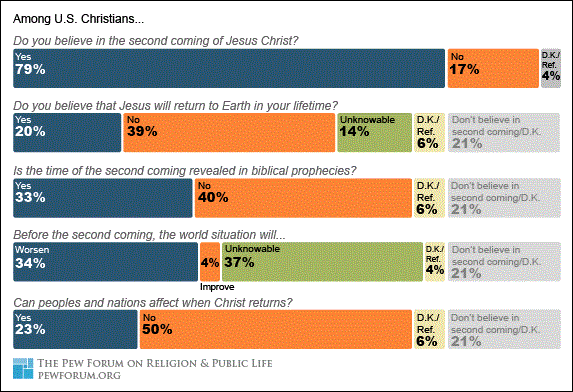
Finally, here’s yet another Pew graphic

— to be viewed in conjunction with this one, illustrating the ways in which belief in the Second Coming of Christ correlate with opinions about scriptures and the State of Israel:

**

Prophecy has impact, both on public opinion and on believing leaders. Jews with an expectation of the Messianic era, Christians expecting the soon Coming of Christ, and Muslims with Mahdist expectations each have their own apocalyptic scenarios, and in each case those scenarios exert some influence on policies relating to the Middle East and the Israeli-Palestinian situation in particular.

The bottom line?

Scriptural interpretation — and prophetic eschatology in particular — can no longer be assumed to be a quiet backwater topic for rabbinic students, seminarians and future mullahs to study, each in terms of their own tradition. It is now a series of conflicting drivers of current affairs — of war and peace.

State Failure is the Child of Oligarchy

Sunday, August 12th, 2012

An interesting piece in Democracy Journal by James Kwak:

Failure Is an Option

….Countries differ in their economic success because of their different institutions, the rules influencing how the economy works, and the incentives that motivate people,” write Acemoglu and Robinson. Extractive institutions, whether feudalism in medieval Europe or the use of schoolchildren to harvest cotton in contemporary Uzbekistan, transfer wealth from the masses to elites. In contrast, inclusive institutions—based on property rights, the rule of law, equal provision of public services, and free economic choices—create incentives for citizens to gain skills, make capital investments, and pursue technological innovation, all of which increase productivity and generate wealth. Economic institutions are themselves the products of political processes, which depend on political institutions. These can also be extractive, if they enable an elite to maintain its dominance over society, or inclusive, if many groups have access to the political process. Poverty is not an accident: “[P]oor countries are poor because those who have power make choices that create poverty.” Therefore, Acemoglu and Robinson argue, it is ultimately politics that matters.

The logic of extractive and inclusive institutions explains why growth is not foreordained. Where a cohesive elite can use its political dominance to get rich at the expense of ordinary people, it has no need for markets and free enterprise, which can create political competitors. In addition, because control of the state can be highly lucrative, infighting among contenders for power produces instability and violence. This vicious circle keeps societies poor. In more fortunate countries, pluralistic political institutions prevent any one group from monopolizing resources for itself, while free markets empower a large class of people with an interest in defending the current system against absolutism. This virtuous circle, which first took form in seventeenth-century England, is the secret to economic growth….

Read the rest here. 


Switch to our mobile site