zenpundit.com » 2013

Archive for 2013

He must have a long spoon that must eat with the devil

Sunday, September 1st, 2013

[ by Charles Cameron — borrowing my title from Shakespeare, though Chaucer and Erasmus said it first ]
.

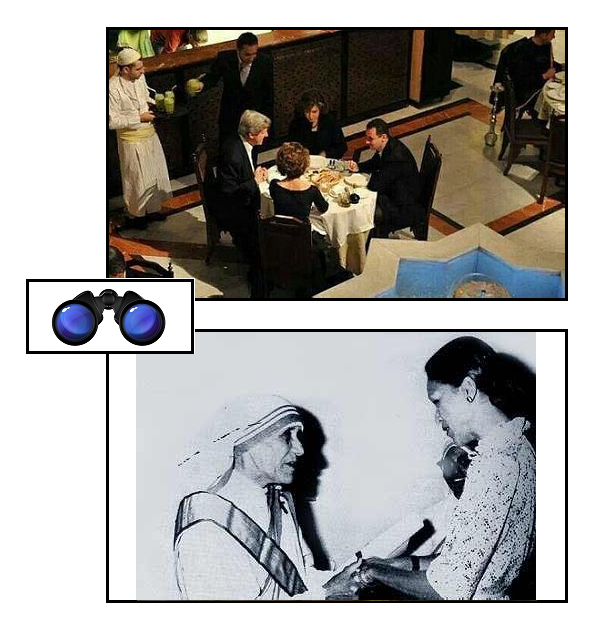
You may or may not like John Kerry. You may or may not like Assad. You may or may not like Mother Teresa, or Michèle Duvalier and Papa Doc. Rumsfeld and or Saddam. GW Bush or Abdullah bin Abd al-Aziz Al Saud. But paired photos of someone you dislike with someone many of us loathe is a neat visual tactic in which the not-so-bad party of the first part is tarred by association with the way-more-evil party of the second.

Does it ever work the other way around, though? is the party of the second part ever redeemed through contact with the party of the first? or even relieved of a few tens or hundreds of thousand dollars for authentic, charitable purposes?

What would I know?

The simplest way in which the two images above can be seen as similar to one another is that each one features someone named Teresa. But that’s not the point.

And I do have to say, that restaurant in Damascus looks pleasant enough.

Sunday surprise 03: some zing for zen

Sunday, September 1st, 2013

[ by Charles Cameron — fun and games — as if you’ll ever really catch me doing much else ]
.

I like to do something a little special on Sundays, to keep Zen and his readers amused in the absence of legitimate work.

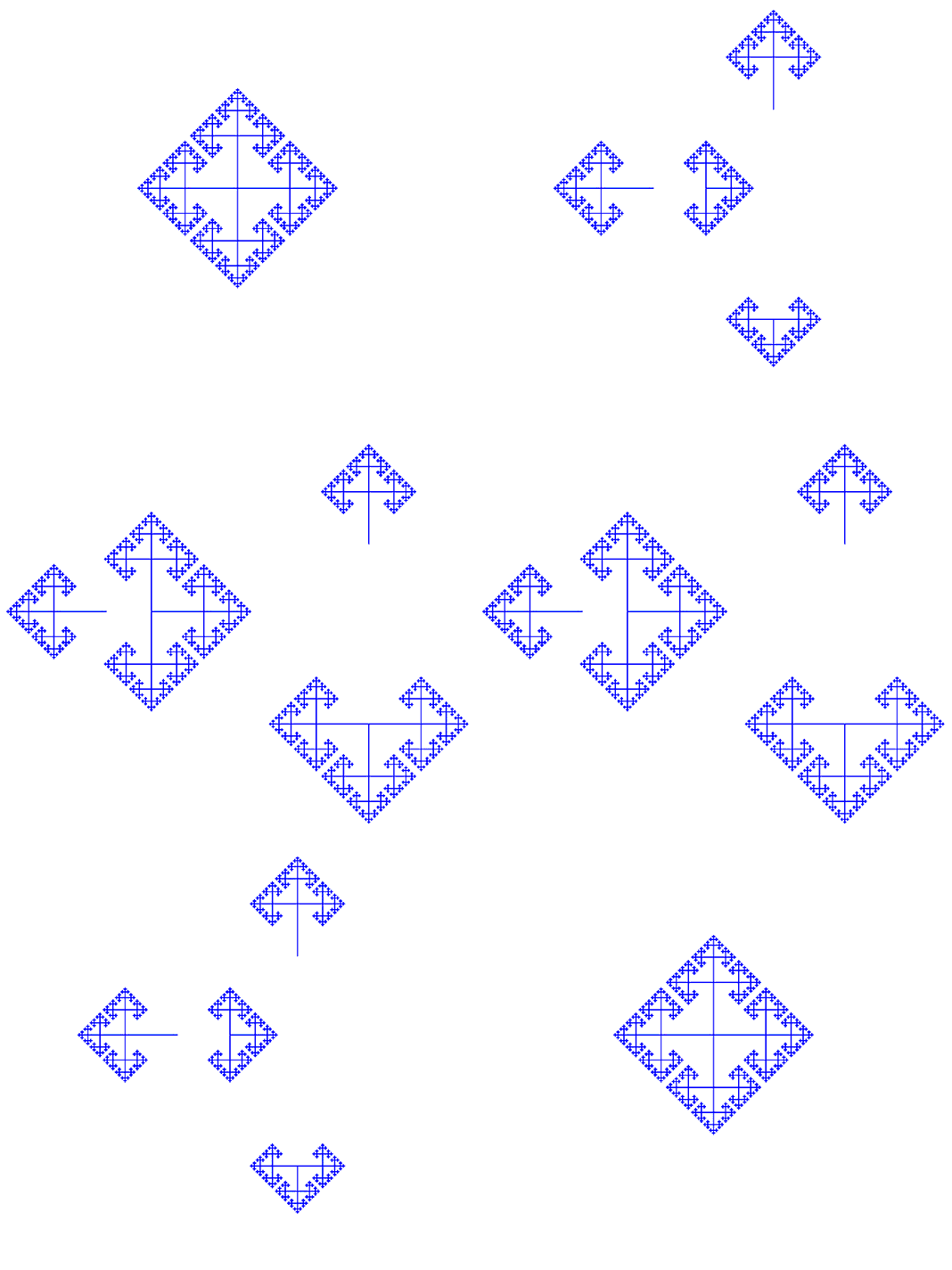
The “animated .gif” above is an illustration of something way above my head called the Banach–Tarski paradox. To my eye, it’s a brilliant illustration of the curious affair of the numbers one and two… or what I like to call more generally “dualities, contradictions and the nonduality“.

**

But in case that mesmerizing graphic doesn’t do the trick, here’s a foolish conundrum for you to chew on. Is:

e-meter : lie detector :: Scientology : NSA :: clear : clearance

?

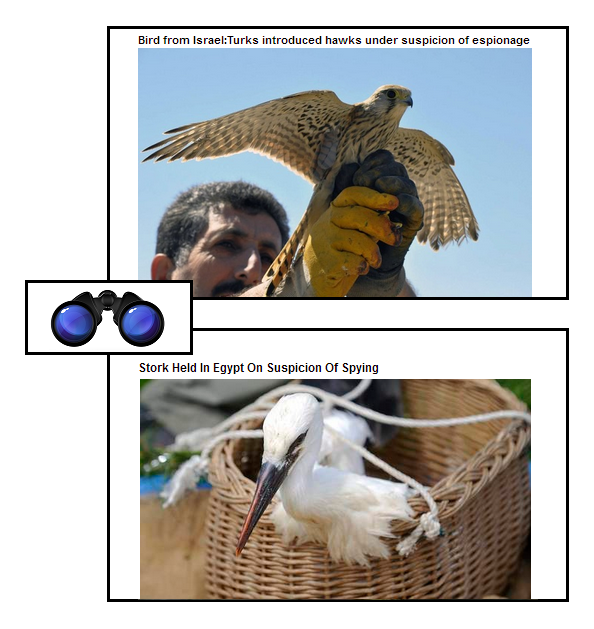
A wildlife DoubleQuote in the Wild, hat-tip Dan Trombly

Sunday, September 1st, 2013

[ by Charles Cameron — carrier pigeons, guilty, 1914, okay — dolphins, jury still out — but these storks and hawks, innocent I do believe ]
.

Sources:

  • Sky News, Stork Held In Egypt On Suspicion Of Spying, 31 August, 2013
  • National Turk, Turks introduced hawks under suspicion of espionage, 27 July, 2013
  • **

    I can claim no responsibility for this DoubleQuote, which I would never have “caught” without Dan Trombly‘s keen eye as manifest in his tweet today:

    For extra bite:

    The stork story concludes with this delicious tid-bit:

    In 2010, a series of shark attacks along Egypt’s Mediterranean coast were blamed on “GPS-controlled sharks” allegedly sent by Israeli security services into Sinai waters.

    Jumping the shark?

    Of serpent-bites in logic

    Saturday, August 31st, 2013

    [ by Charles Cameron — continuing my series on the “serpent bites tail” reflexive form (1, 2, 3, 4) in which analytic gems and other insights may often be easily discovered or succinctly expressed — read this post fast for fun, or reflectively (!!) for the ripples ]
    .

    I’m going to lead off with this tweet, which seems very timely considering the news this last week or so about Syria…

    I thought this was another quite beautiful example of “serpent bites its own tail” phrasing — timely too — uttered by JM Berger in summarizing his Loopcast with Daveed Gartenstein-Ross on the current status of Al-Qaeda, highly recommended, BTW:

    And if you want to know about Hezbollah and its global reach, this one refers to the book you need…

    **

    Okay, having given pride of place to those three, I’d like to catch those of you who are interested up on an entire series of self-referencing tweets I’ve run across since I last posted. I’m really collecting these things because I’d like, one of these days, to do a thorough analysis of what they teach us about our modes of thought, and how we can apply that to pattern-recognition in our own readings, and creative insight in our writings and analytic output… In the meantime, don’t feel obliged to read every last one, just dip in as you feel inclined — think of this as a reference section, okay? Take what you need and leave the rest.

    Here’s one that uses the Escher‘s hand draws hand format:

    And here’s a pair that needs to stay together:

    Continuing… I might as well give you a cluster from Teju Cole, since he’s a master…

    Okay, here’s another one with timely reference, this time to the whole NSA business:

    Really, this is just such a rich vein of humor and insight:

    Let’s go to another wordsmith — they’re often good at this stuff:

    Two from philosopher Allen Stairs:

    One from quasi-Einstein, via the very bright (non-quasi) Seb Paquet:

    **

    I’ll close with an example from the “all is nothing” category, this one from Peter J Munson:

    Of nested and coiled serpents in logic

    Saturday, August 31st, 2013

    [ by Charles Cameron — another exploration into forms of insight — in this case the Matrioshka effect, spiral staircases and the like, with a glance at holy winds and human fingertips ]
    .

    A mention of blogs about blogs about blogs seems to me to qualify for the “nested serpent” category of forms that are worth watching out for, the nest (or spiral, from which I am guessing the nest is not entirely separable) being of particular interest because while seemingly simple enough, it all too often reaches at one end or both into the infinities, where paradox meets epiphany… as my second example will show.

    But first, by sheer good fortune, I came across this verse from the book of Ecclesiastes as I was polishing this post for publication:

    The winde goeth toward the South, and turneth about vnto the North; it whirleth about continually, and the winde returneth againe according to his circuits.

    **

    That’s the pattern we’re looking for, and I ran across it recently in a comment my friend Allen Stairs made, and the response he received:

    Okay, I didn’t follow — so I asked Allen for an explanation, and he wrote me:

    Actually. “equipollent” was a bad choice of terms. “Equinumerous” wold have been better.

    But the thing about numbers and those dolls: natural numbers have their identity intrinsically, so to speak. In set theory, one way to represent them is as the series

    1 = {Ø}, 2 = {Ø,{Ø}}, 3 = {Ø,{Ø,{Ø}}}, etc.

    In fact, we can even use the simpler construction

    1 = {Ø}, 2 = {{Ø}}, 3 = {{{Ø}}}, etc.

    So if we’re given the set, its structure tells us which number it is. I

    Now a finite set of Russian dolls does much the same thing. We could count the innermost one as 1, the next as 2, the next as 3, and so on, and if you were given the doll, you’d be able to tell which number it represented. Or if we wanted, we could let the outermost doll represent 1, and work our way in. But if we take the set of all natural numbers, things get a little wonkier. The thing about a set of dolls is that there’s an outer one; the charm is in the fact that there’s a place to start opening them. So suppose we have an infinitely nested set of dolls. What number does the outermost one correspond to? It can’t be a natural number, because for any natural number, the nesting would have to be finite. It can’t be the infinite number Aleph-null because among other things, if the nesting is infinite downward then each doll has the same structure as the one that encloses it, and so it seems that there’s no way for the individual dolls to represent distinct integers.

    Now if we’re given the whole set of dolls, there’s a sort of substitute: match dolls to numbers depending on how many “predecessors” they have. The outermost doll has no predecessors, so let it be 1; the next one in has 1 predecessor, so let it be 2. And so on. But we still have a problem: there’s nothing about the doll itself that tells us which integer it represents.

    So my little point was that Harold’s joke was about “how many?” but the thing about the dolls is that they might seem at first to have the right structure to represent the natural numbers, and yet they don’t — at least, not the whole set of natural numbers.

    **

    Did Ecclesiastes mention the winds? Here’s a discussion of wind spirals from David Avram‘s The Spell of the Sensuous: Perception and Language in a More-Than-Human World:

    Although invisible, the Holy Wind can be recognized by the swirling and spiraling traces that it continually leaves in the visible world. The Winds that enter a human being leave their trace, according to the Navajo, in the vortices or swirling patterns to be seen on our fingertips and the tips of our toes, and in the spiraling pattern made by the hairs as they emerge from our heads. As one elder explains:

    There are whorls here at the tips of our fingers. Winds stick out here. It is the same way on the toes of our feet, and Winds exist on us here where soft spots are, where there are spirals. At the tops of our heads some children have two spirals, some have only one, you see. I am saying that those (who have two) live by means of two Winds. These (Winds sticking out of the) whorls at the tips of our toes hold us to the Earth. Those at our fingertips hold us to the Sky. Because of these, we do not fall when we move about.

    That last italicized quote is from James Kale McNeley, Holy Wind in Navajo Philosophy — a remarkable book for anyone interested in the holiness of spirit…
    Switch to our mobile site

