First impressions
Monday, August 5th, 2013[ by Charles Cameron — how “first impressions count” applies to print media, an egregious case ]
.

Both panels (above) are screenshots from the same WaPo post, at the same magnitude. FYI.
[ by Charles Cameron — how “first impressions count” applies to print media, an egregious case ]
.
Both panels (above) are screenshots from the same WaPo post, at the same magnitude. FYI.
Top Billing! Adam Elkus –Banquo in Bandit Country
One long, deadly night in an isolated outpost in a place few Americans could place on a map. A tragic turn of events and Americans dead. The headline could stand in for a dizzying number of places from the Horn of Africa to Afghanistan. So why Benghazi? Why has it stuck in the spotlight while the others have not?
Partisanship is a big reason. Like many post-Bush security debates, it’s easier to point fingers when the other guy is sitting in the Oval Office. But this doesn’t really begin to get to the bottom of the puzzle. The public has evinced little interest in Benghazi. The political press has mostly forgotten about it. So why do DC insiders fight so heavily over it? And why is CNN claiming in its latest scoop that the “CIA is involved in what one source calls an unprecedented attempt to keep the spy agency’s Benghazi secrets from ever leaking out?”
Benghazi is the Banquo’s Ghost of the post-Bush counterterrorism wars, a lingering symbol of a dangerous flaw within a consensus national security policy that many in Washington have convinced themselves is the way to fight the wars of future while avoiding a heavy ground presence. To be sure, the Macbeth analogy here is not a one-to-one mapping. The “ghost” here is a metaphor for the lingering specter of the disaster, its dead, and what the torching of the consulate represents for the indirect strategy. Like Banquo, the specter lingers during what should be a feast and time of celebration. But a review of the strategic landscape in the so-called “arc of conflict” reveals little to celebrate.
To understand why, it’s important to briefly review some parts of the Benghazi affair that have mostly escaped attention in the political obsession with tactical marginalia….
SWJ Blog (Gian Gentile) Counterinsurgency: The Graduate Level of War or Pure Hokum?, (Robert Bunker)-How Caribbean Organized Crime is Replacing the State and (William Olson) The Continuing Irrelevance of Clausewitz
….This notion of counterinsurgency warfare requiring a special martial skill set because of its so-called difficulty that conventional armies by nature do not have is nothing new in modern history. Starting in the 19th century, the French and British armies began to treat small wars (an earlier moniker for counterinsurgency) as a special form of war requiring officers with unconventional skills who can transform the hidebound conventional armies that were resistant to change.
Counterinsurgency experts, especially since the Vietnam War, have written histories of various cases of counterinsurgency warfare with the idea that a special form of war requires special skills as a foundational premise. For example, in The Army and Vietnam, Andrew Krepinevich argues that the American Army lost the war because it could not break out of its conventional war mindset that focused on the abundant use of firepower instead of the correct and special methods of COIN designed to win hearts and minds.[3]
Unfortunately, counterinsurgency is not the graduate level of war, it is simply war. Moreover, the notion that counterinsurgency wars require the soldiers who fight them to possess special skills is not supported by historical evidence. And contrary to what writers like Krepinevich and Cassidy say, counterinsurgency wars have not been won or lost by the tactical methods of the armies that have fought them. Instead, as historian Douglas Porch argues, they were won or lost “because the strategic context in which the wars were fought defied a tactical remedy.”[4]
Pundita –You didn’t actually think Obama would let Greenwald testify to Congress about NSA, did you? and Let’s roll: Some legislators mount desperate campaign to save the U.S. republic
Raúl goes on to speculate about other possible reasons for the President’s ploy. My take is that Obama had already lost face with Liberals over drone war and related issues. And I don’t think there is one genuine Leftist or civil libertarian in the world who has any illusions left about what Obama is.
Yet it was the American Leftist, law professor and political scientist Stephen F. Diamond who alone pegged Obama during the Democratic presidential primary campaign in early 2008. After studying Obama’s political career up to that point he said that Obama was no Leftist; that he was an authoritarian — although what specific type, he wouldn’t speculate at that early stage.
“Isn’t that just like a Leftist,” I observed sarcastically at the time. “When one of their own turns out to be a monster they say, ‘Oh that’s not a real Leftist.'” But I listened to Steve despite my grumbling, and made sure Pundita readers heard what he had to say. I am very glad I did.
The American democracy may be strong enough to survive the Obama presidency, but there are many younger democracies that can count themselves lucky he wasn’t born there.
The secret origin of Doctrine Man!
Not the Singularity (Steve Hynd) – NSA Surveillance Didn’t Help Identify New Alleged Al Qaeda Threat and ( Matthew Elliot) – Weekend NSA Reader
BLACKFIVE – Brian Stann – The Dark Side of a Warrior
Slightly East of New – Incestuous delusion
Dr. Tdaxp –Pimps, Hos, and When to Get Out of the Ghetto
Nick Carr – PRISM and the New Society
Bruce Schneier – XKeyscore and Scientists Banned from Revealing Details of Car-Security Hack
Presentation Zen –Good science makes for good story
Eric Drexler – Transforming the Material Basis of Civilization:
The Long Now Foundation blog – Language may be much older than previously thought
Aeon Magazine – Out of the Deep
Studies in Intelligence –Intelligence Officer’s Bookshelf
NRO – Jeb’s Education Racket
Democracy Journal – An Elite Deserving of the Name
Reason – Thanks to NSA Surveillance, Americans Are More Worried About Civil Liberties Than Terrorism
Recommended Viewing:
[ Charles Cameron — always on the lookout for signs of the dajjal — even in the New York Times ]
.
Seriously, WTF?
Are you Presbyterian?
**
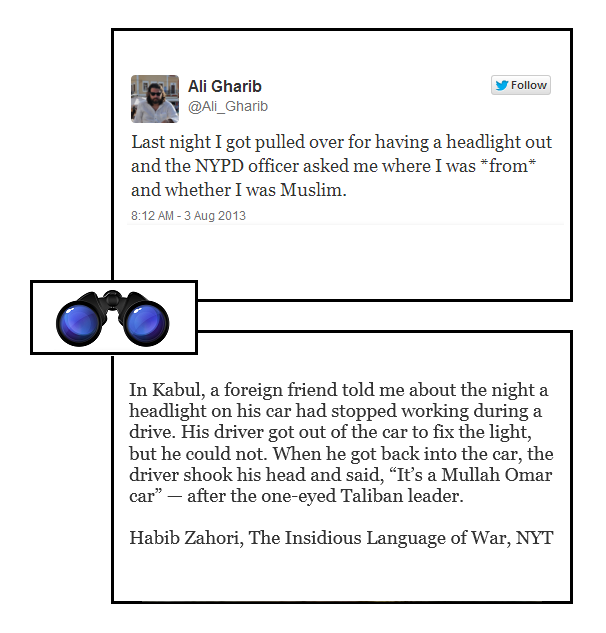
I probably wouldn’t have take much notice of Ali Gharib’s tweet (upper panel, above) if I hadn’t just wandered off after reading a tweet from Habib Zahori:
#Kabul: Driver: People only talk about Qeyamat, judgment day, we live every second of our lives in Qeyamat.
— Habib Zahori (@habibzahori) August 3, 2013
to find out who he was, and run across his NYT piece, The Insidious Language of War, which looked interesting enough that I read it — leading me to the headlights quote (lower panel, above).
Okay, two one-eyed remarks in five minutes got me thinking…
**
But as you may know, by now my mind is fully stocked with what Coleridge in his Biographia Literaria calls the “hooks and eyes of memory” — so a broken headlight in Kabul and mention of the Mullah’s missing eye brought me naturally to the celebrated image of Mullah Omar (below, upper panel)

and thence (lower panel) to the Dajjal — Islam’s version of the Antichrist.
**
Thus, a sort of Six degrees of Kevin Bacon game brought me from a Daily Beast blogger via broken headlights to the Dajjal in three quick hops — and the result is what one might term a false positive…
It was fun while it lasted — I just wonder how many times NYPD officers ask drivers “Are you Amish?” Maybe a horse and buggy on Fifth Avenue would somewhat justify so inquisitive an inquiry.
**
Sources:
Ali Gharib Habib Zahori Mullah Omar Dajjal
[ by Charles Cameron — I’ll keep this one short and painless, since long would be painful ]
.

Click for video.
**
Problem: the Snowden / NSA business is of interest to me as a human being, but way outside my competence.
Solution: To get NSA wrong, trust @ggreenwald. To get it right, filter GG through @joshuafoust, @20committee, @marcambinder and his book Deep State: Inside the Government Secrecy Industry — then the conversation gets interesting!
[by Lynn C. Rees]
Things change. Beliefs don’t. Facing change, belief clings to the agreeable and resists the disagreeable. Current fashion names this reflex “confirmation bias” and frames it as the enemy of truth. Closer truth names this reflex “concentration of force” and portrays it as the friend of victory.
The notion that discovery of truth is an individual effort persists. By this notion’s curiously resilient lights, the only truthful mind is a blank mind. Purge existing beliefs. Capture change free of entanglements. Embrace blindness to see clearly. Above all, lean neither one way nor the other. Only then, after much trial, with the last mental debris bulldozed away, will light come.
No one thinks like this. Despite the occasional brave try, everyone reflexively favors things that fortify belief over things that undermine belief. If truth is a self-help exercise, the existence of confirmation bias means the mind is inescapably flawed. If truth is trial by self-improvement, the only cure for mind flaws is constant reinforcement of what human history suggests is impossible. And if reinforcing the impossible only leads to more impossibility, at least it leads to an impossibility redeemed by its righteous aggression.
And so it would be, if leaving a vacuum and calling it truth is truth. But if truth comes from group contortion rather than individual self-flagellation, confirmation bias is a feature, not a bug. Then the mind is not flawed, at least not in that way. If the mind was guilty of chronic confirmation bias, it would only be guilty of operating to spec.
Those who insist on convening a symposium for a full and frank exchange of views every time they come under fire rarely need a good retirement plan. Because of this, to enforce effectiveness under fire, Darwin decrees that the mind comes preloaded and then preloaded with live ammunition, not blanks. Beyond this, freedom to arbitrarily switch the caliber of mental ammunition mid-stream is sacrificed for clarity of supply: mind yields measured in thoughts per calorie rise when ideas are bought in bulk following spec, especially amid uncertainty in the field.
Because buying ideas in bulk creates economies of scale, if confirmation bias is bias confirmed then it is bias shared. At the tribal scale, where human routine plays out, bias shared is indistinguishable from agreement. It too is guilty of operating to spec: Agreement reduces friction. Reduced friction lets group efforts prioritize targets. Prioritized targets let group effort selectively focus. Selective focus creates opportunities for local asymmetries. Local asymmetries can be exploited to further the tribe.
This makes confirmation bias concentration of force. Concentration of force is biased, first in favor being very strong and then at the decisive point. But it is confirmed only when being very strong and then at the decisive point yields victory. Local superiority in strength at a decisive point is neither constant nor guaranteed: it is only guaranteed to not be constant. So the mind must stay on target: it earns its keep by concentrating for victory, not emptying for truth.
This explains why what humans experience as “me” is a social loop: it is a argument simulator for forging chatter into weapons through endless drill of imagined conversations. It’s a display device, not a thinking machine. The thinking machine lies deep in the mind: real thought emerges from offline processing, especially during sleep. Conscious “me” is suited to rehearsing if small variations in action lead to opportunity through asymmetry. These variations are what gets flung at others as weaponized chatter. Some variations stick, leading to victory. Some miss, leading to defeat. Some should only be flung if clearly labelled FOR ENTERTAINMENT PURPOSES ONLY.
Truth emerges from accumulations of such victories piled on mass burials of such defeats. It is an unintended byproduct, not an intended end product. But its emergence reaches back to shape its source. Generation by generation, the mind is doomed to more and more bias in favor of weaponized thought measured in victories confirmed, always subject to how well they fit, however haltingly, what is true.
So things change while beliefs don’t. Confirmed truth is biased toward victory and victory is biased toward agreements with friends to win something with something rather than lonely pursuit of nothing through nothing.
See the argumentative theory of reason for more background on this framework.

Zenpundit is a blog dedicated to exploring the intersections of foreign policy, history, military theory, national security,strategic thinking, futurism, cognition and a number of other esoteric pursuits.
Customized Web Site & Blog Design

