zenpundit.com » 2013

Archive for 2013

Of plagues of locusts, then & now?

Tuesday, February 26th, 2013

[ by Charles Cameron — the juxtaposition of sacred and secular worldviews, and what happens where they overlap ]
.
**

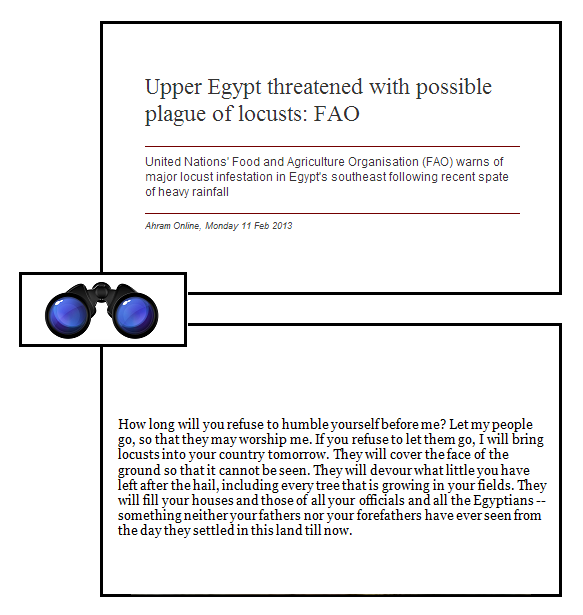
I’m returning here to an old theme of mine, the juxtaposition of worldviews — in this case, accounting for plagues of locusts in Egypt.

Such juxtapositions are like Rorschach blots in some ways — they allow each reader to see the items juxtaposed from within their own worldviews, perhaps applauding one and dismissing another, perhaps seeing some virtue in each or none in either — and perhaps arriving at some meta-level understanding which neither one alone would afford.

Is a plague of locusts in Upper Egypt of which the FAO warns in the upper panel above entirely explained in terms of rainfall? Is it pure mental happenstance that Egypt was the site of a Biblical locust plague at the time of the Israelite Exodus [Ex. 10. 3-6]? Is there, perhaps, a message for Egypt vis-a-vis Israel for our own day?

The answers people give to questions such as these, in which secular and sacred sources address what are putatively similar situations, can influence the way on which they voice themselves and vote — perhaps a good thing, perhaps not.

**

For what it’s worth, the plague of locusts is mentioned in the Qur’an in Sura 7.133:

So We let loose upon them [the Egyptians} the flood and the locusts, the lice and the frogs, the blood, distinct signs; but they waxed proud and were a sinful people.

**

In contemplating matters of this sort, it may be valuable to consider the remarks of the Pontifical Biblical Commission in The Interpretation Of The Bible In The Church, 1993/4:

The basic problem with fundamentalist interpretation of this kind is that, refusing to take into account the historical character of biblical revelation, it makes itself incapable of accepting the full truth of the incarnation itself. As regards relationships with God, fundamentalism seeks to escape any closeness of the divine and the human. It refuses to admit that the inspired word of God has been expressed in human language and that this word has been expressed, under divine inspiration, by human authors possessed of limited capacities and resources. For this reason, it tends to treat the biblical text as if it had been dictated word for word by the Spirit. It fails to recognize that the word of God has been formulated in language and expression conditioned by various periods. It pays no attention to the literary forms and to the human ways of thinking to be found in the biblical texts, many of which are the result of a process extending over long periods of time and bearing the mark of very diverse historical situations.

Recommended Reading

Tuesday, February 26th, 2013

Campaign Reboot –Forever War: Losing Track of Strategy 

….The Forever War is, unsurprisingly, a book about war. It charts the conflict between humanity and an alien species called Taurians. The Taurians are alien in the classic sense, unknown and for the majority of the book unknowable.

The core of the book is the war, but it is also a book about disconnection, since the protagonists suffer from the effects of time dilation every time they go on tour, with hundreds of years potentially passing each time they ship out and return home. The same is true of the Taurians, meaning that in every engagement is is impossible to know whether the Taurian enemy is operating with technology from the future, or the past (from the perspective of the protagonists).

Over time the characters become disconnected from their own species, as guided evolution turns humanity into a species in which they have no part. Despite being the cream of the crop when recruited (all recruits have an IQ of 150+, the effects of this brain drain are explored in the book) they are left behind by a humanity which has chosen to pursue a guided evolution.

Strategy is at it’s most effective when the environment over which a conflict is going to be fought is understood. Terrain is part of this, however the mindset and moral elements of the opponent must also be understood. The Forever War is a study in what happens when a conflict is unmoored from reality, indeed it never has a root in reality, since the Taurians are unknown and unknowable.

Dr. Tdaxp – The Humanities, the Sciences and Strategy 

The Servants of Strategy

The humanities and the Sciences are siblings. Both serve Strategy. Graduates from the Sciences can usefully serve Strategy to the extent they understand the tools of prediction and control: improvement, and are not distracted by non-normalrevolutionary science. Graduates from the Humanities can usefully serve Strategy to the extend they understand the tools of understanding and explanation, and are not distracted by critical political agendas. 

Opposed Systems Design – PRC, DC and the Myth of Scheming 

….All of this reminded me of Luttwak’s recently released The Rise of China vs. the Logic of Strategy.  Luttwak argues that the purported strategic wisdom of Chinese history actually impedes China’s ability to successfully carry out policy in the international sphere.  During the waring states period, massive intrigue and Game-of-Thrones-esque maneuvering was possible because of a common language, in addition to ethnic and cultural homogeneity.  International politics, on the other hand, is marked by disparate languages, ethnic groups and cultural  heritages.  In this hodge-podge, deep stratagems aren’t feasible because people have a hard enough time understanding one another when they aren’t attempting to dissemble.  In short, the fear of inscrutable Chinese strategists playing a brilliant long con on the world is simply not plausible because it would require a degree of cosmopolitan understanding of other nations and societies that no nation has successfully achieved.

Fabius Maximus – Who lies to us the most? Left or Right? 

Many posts on the FM website have described similarities between the Left and Right in America.  Some discuss their similar policy recommendations (eg, economic policy should benefit banks, foreign policy should be dominated by the military and advance our global hegemony). Some note how both Left and Right are OK with lies to start our wars in Iraq and Afghanistan, and to support torture and shred our civil liberties.  Some discuss their similar method of gaining public support: use exaggeration of threats to build fear that stampedes the public (DDT, ALAR, nuclear winter, climate change, government debt, creeping Sharia, al Qaeda).

This raises another question with which I’ve long grappled: magnitudes. Magnitudes matter.  While similar, which party does this the most — and the most egregiously?

A speculative diagram by Crittenden Jarvis.

SWJ – Book Review: Saddam Hussein’s Ba’th Party: Inside an Authoritarian Regime 

That’s it.

Zenpundit Decennium

Monday, February 25th, 2013

We have reached the tenth year here at zenpundit.com.

This is an uncommon duration in the blogosphere. When I started, blogging was a marginal activity, a “fad”, that I was warned against by a well-meaning academic who thought I would be wasting my time. Today institutions of great importance, politicians, celebrities and, strangely, major media outlets, believe that a blog is a “must have” platform, even when the cutting edge of debate has shifted to social media services like twitter and facebook – everyone’s blog “anchors” their presence and provides a place for arguments more complex than what can be conveyed in 140 characters.

It is appropriate at this time that I make a few brief remarks in honor of the occasion.

First, would be to say thank you to the readership and commenters, past and present. It is you who have made zenpundit.com worth doing by returning time and again, by making contributions of your own here, by email and by circulating posts with which you agree (or dispute) in your own networks. You have given us the ability to punch well above our weight and for that I am grateful.

Secondly, to our “bigger fish” supporters and affiliated sites who have given the bloggers here other forums or added attention. There are many, but especial thanks needs to be given to Dave Dilegge and the crew at Small Wars Journal, to Thomas P.M. Barnett,  to John Robb, to Bruce Kesler, to Dave Schuler and The Watcher’s Council, to Howard Rheingold’s Brainstorms community, to Pragati Magazine, to DoctrineMan!!, to Wikistrat and the gang at Chicago Boyz. Your help has not always been noted but it has always been appreciated.

Lastly, to my co-bloggers Charles Cameron and J. Scott Shipman, whose intellectual range, wise advice and excellent writing have vastly enriched zenpundit.com far beyond what I could have ever accomplished on my own. I am honored that you have chosen to be here.

May the next decade surpass the first!

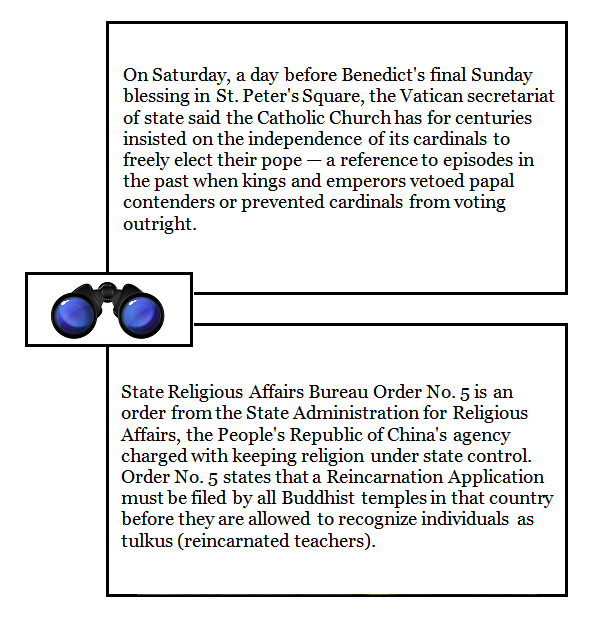
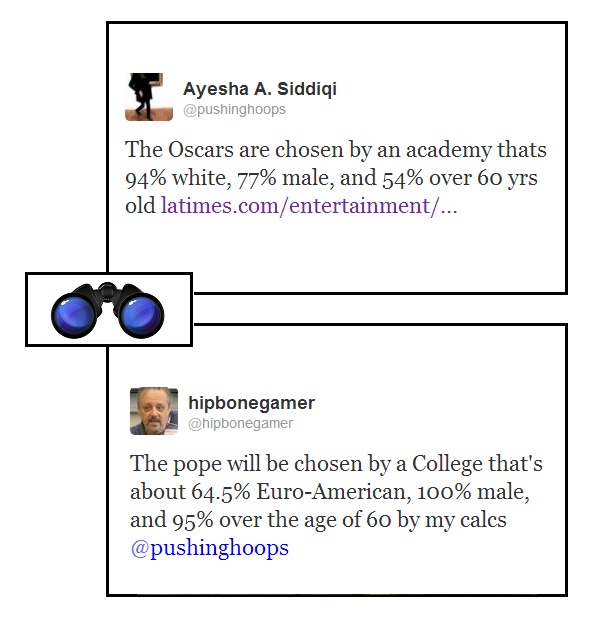
The Oscars, the Conclave and the Chinese

Monday, February 25th, 2013

[ by Charles Cameron — more on the upcoming papal election from a “comparative” perspective ]
.

As you know, I noodle around with parallelisms and oppositions quite a bit. Here are two recent pairings that caught my attenion — one of them just in time for the Oscars:

The other concerns political influence on spiritual appointments…

I had the good fortune to meet and befriend a “tulku” while I was at Oxford, so the whole business of the identification and recognition of reincarnated Tibetan lamas has long been an interest of mine.

Triangulating the Vatican

Sunday, February 24th, 2013

[ by Charles Cameron — three ways to get a fix on the present status and future needs of the Catholic Church ]
.

Perugino, The Entrusting of the Keys to Peter, Sistine Chapel

.

I want to make this brief. It seems to me that the most powerful statement of the present situation of the Church was that delivered by John Colet at Convocation in 1512:

You are come together today, fathers and right wise men, to hold a council. In which what you will do and what matters you will handle, I do not yet know, but I wish that, at length, mindful of your name and profession, you would consider of the reformation of ecclesiastical affairs; for never was there more necessity and never did the state of the Church more need endeavors. For the Church – the spouse of Christ – which He wished to be without spot or wrinkle, is become foul and deformed. As saith Isaias, “The faithful city is become a harlot”; and as Jeremias speaks, “She hath committed fornication with many lover,” whereby she has conceived many seeds of iniquity and daily bringeth forth the foulest offspring. Wherefore I have come here today, fathers, to admonish you with all your minds to deliberate, in this your Council, concerning the reformation of the Church.

The full text can be found here, where it is drawn from John C. Olin, The Catholic Reformation: Savonarola to St. Ignatius Loyola (Fordham U.Pr., 1992). I was pointed in this direction by Charles Chaput, Archbishop of Philadelphia, who quoted from it in his piece The church after Pope Benedict today.

**

By way of comparison, here’s a snippet from this week’s Time report, Bitter Pill: Why Medical Bills Are Killing Us, on the status of another large entity whose purported focus is the common good:

By the time Steven D. died at his home in Northern California the following November, he had lived for an additional 11 months. And Alice had collected bills totaling $902,452. The family’s first bill — for $348,000 — which arrived when Steven got home from the Seton Medical Center in Daly City, Calif., was full of all the usual chargemaster profit grabs: $18 each for 88 diabetes-test strips that Amazon sells in boxes of 50 for $27.85; $24 each for 19 niacin pills that are sold in drugstores for about a nickel apiece. There were also four boxes of sterile gauze pads for $77 each. None of that was considered part of what was provided in return for Seton’s facility charge for the intensive-care unit for two days at $13,225 a day, 12 days in the critical unit at $7,315 a day and one day in a standard room (all of which totaled $120,116 over 15 days). There was also $20,886 for CT scans and $24,251 for lab work.

**

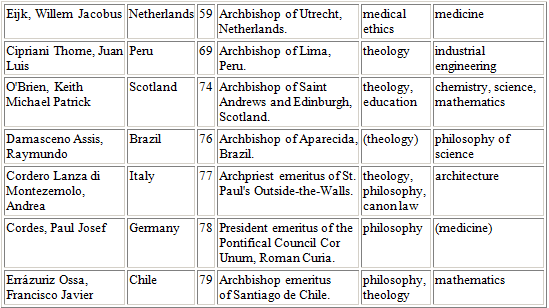
And for a third angle on the upcoming conclave, I would like to offer a brief cull from Anthony Judge‘s tabular listing of cardinals aged 80 and below, in which he identifies those who have some indication of competence in the “social” and “natural” sciences in their Wikipedia biographies.

I have omitted those who had no listing in the natural sciences — mathematics included — and those aged 80, since I understand they will be too old to vote. Of the 116 cardinals that remain, these seven apparently have some acquaintance with what Judge terms the natural sciences, as detailed in the final column:

Of these, Cardinal O’Brien, who appears to have the widest range of scientific disciplines in his background, has recently been the target of accusations of impropriety.

As those who read me regularly are aware, I “come from” the arts rather than the sciences myself. But I cannot help but agree with Anthony Judge’s comment, particularly insofar as it relates to mathematics and the sciences:

It is striking how few disciplines are represented in what amounts to a table of cognitive competence of those from whom guidance in world governance is expected.

**

I’m tossing you these three quotes not so much for themselves as for the ripples of thought, the further questions they may raise. Colet’s sermon, for instance, was delivered only five years before Martin Luther “nailed his theses to the door” — or at least sent them to his bishop — thus starting the Protestant Reformation in 1517.

The aptness of Colet’s sermon to today should give us considerable pause.


Switch to our mobile site