zenpundit.com » 2013 » March

Archive for March, 2013

CENTCOM, Rosenberg and Islamic eschatology, pt I

Monday, March 11th, 2013

[ by Charles Cameron — who’s giving advice to the head of CENTCOM these days? — a “prophetic” thriller novelist whose latest book concerns nuclear weapons and Iran ]
.
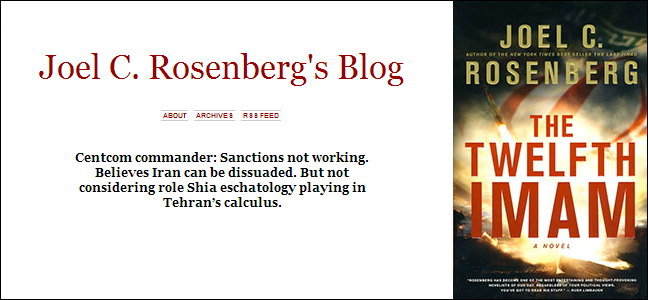
Here’s the advice apocalyptic thriller writer and political consultant Joel Rosenberg gave GEN Mattis, just two days ago:

I have deep respect for General Mattis as a military leader. Thus, I would encourage him to consider the role eschatology is playing in Tehran’s calculus. Iran’s Ayatollah Khamenei and President Ahmadinejad and their inner circle of advisors are not being driven by normal geopolitical and economic calculus, but rather by a Shia Islamic End Times theology.

I’m very interested in Islamic end times theology myself, and have a question:

What does Rosenberg claim that theology is, and what does he see as its ramifications in terms of CENTCOM — whose remit most notably includes Afghanistan, Egypt, Iran, Iraq, Saudi Arabia, Syria, Pakistan and Yemen?

**

Here’s what he says:

They believe the End of Days is at hand. They believe their messiah known as the Twelfth Imam or the “Mahdi” is coming soon.

That’s the theology as he describes it — the rest is geopolitical interpretation, no doubt favoring as well as influencing his own political ideas:

They believe that the way to hasten the coming of the Mahdi is to annihilate Israel (which they call the “Little Satan”) and America (which they call the “Great Satan.”) I wrote about this in detail in my non-fiction book, Inside The Revolution. And I factor this thinking into my current novel series, including The Twelfth Imam, The Tehran Initiative, and Damascus Countdown to consider how it could play out in real life. Such eschatology requires Iran’s leaders to acquire nuclear weaponry and the means to deliver it in order to please Allah and their coming messiah and king. As a result, the international is unlikely to convince them to disobey their most-deeply held religious beliefs through diplomacy or sanctions. A credible military threat might work, but we’re nearly out of time. Actual military action may soon be the only option. No one wants a war. I don’t. But we don’t want to have a genocidal cult to obtain and use nuclear weapons.

Hey, I don’t want a nuclear war, either. But does the Ayatollah Khamenei? Really?

**

Do you think nobody in DC listens to Rosenberg? Even before he wrote his books, when he was still only 27 and a “legman” for Rush Limbaugh, the New York Times carried a feature on him calling him “a Force in the Capital” which quoted a Senior VP at the Heritage Foundation:

I’ve been at meetings of conservative activists, and they have paid extraordinary deference and have been solicitous of him.

— but you can read the whole piece. And now, eighteen years later, he has a strong of NY Times best-sellers to his name, both fiction and non-fiction — and for his latest thriller, Damascus Countdown, published this week, Porter Goss, ex CIA Director, writes:

Whenever I see a new Joel Rosenberg book coming out, I know I need to clear time on my calendar. His penetrating knowledge of all things Mid-eastern — coupled with his intuitive knack for high stakes intrigue — demand attention.

So it’s worth asking — just how penetrating is that knowledge? And in particular, just how penetrating is it about the Iranian Twelfth Imam or Mahdi, who features prominently in his most recent series of books?

**

Three years back, Glenn Beck interviewed this same Joel Rosenberg, who writes about end-times Christianity and Islam and the need to support Israel from an end-times perspective — and the pair of them put out a sadly and dangerously muddled message. This excerpt from the transcript is worth noting for the significance it attributes to Mahdist eschatology and thus insinuates into the minds of millions of Americans:

BECK: OK. So, the Ayatollah Khomeini and the revolution of ‘79, he said these 12ers are too crazy for even him. What happened, because — is Ahmadinejad the only one? Are there a lot of them? It’s my understanding that the government now is full of these people. Is that true?

ROSENBERG: That’s right. Well, the Ayatollah Khamenei, the current supreme leader, was a disciple of the Ayatollah Khomeini.

BECK: OK.

ROSENBERG: Apparently, it’s turned out that he has been a secret closet 12er, because he clearly believes the same thing as Ahmadinejad.

Here’s what’s wrong: both Beck and Rosenberg seem to have confused “Twelvers” (the Ithna’ashariyya who make up about 85% of all Shi’a, though there are important smaller sects such as the Ismai’li) with a small and secretive faction within the Iranian Shi’a, almost certainly the Hojjatieh.

Beck says:

I want to talk to you about something that nobody seems to ever notice when they talk about Iran. When we’re talking about Iran, we’re talking about people, the leaders, that are called, they’re called “Twelvers” — they believe in the Twelfth Imam, the Mahdi. This is one spooky dude. Twelvers are so dangerous that the Ayatollah Khomeini at one point banned them, said we’ve gotta kill ’em all because they’re too crazy — the Ayatollah Khomeini said that.

It makes absolutely no sense to say that the Ayatollah Khomeini condemned the Twelvers — he was their leader in Iran — but he did oppose the (arguably extremist) Hojjatieh, which was basically a secret society — and that is almost certainly the group that Beck was thinking of.

But then Joel Rosenberg seems to get swept up in Beck’s confused and confusing rhetoric, and goes on to call the Ayatollah Khamenei “a secret, closet Twelver” — a phrase he also uses in his 2010 book, The Twelfth Imam (pp. 178, 259), and which is particularly inept since Rosenberg knows enough to have discussed the Hojjatieh in his book Inside The Revolution (copyright 2009, 2011), in which he writes (pp. 161-62):

During this same period, it appears Ahmadinejad was also involved in a shadowy Islamic society known as the Hojatieh, whose leaders taught that the Twelfth Imam was coming soon and whose members believed they were required to take spiritual (but not political) actions to hasten his coming. … the movement discouraged people from being fully devoted to creating an Islamic state, preferring instead to wait for it to come from the sky. In 1983, therefore, Khomeini actually banned the Hojatieh, and Ahmadinejad seems to have subsumed his sympathies for the group to protect his opportunities for career advancement.

**

I am happy to report that Joel Richardson, the other Joel currently writing about Islamic apocalyptic from a Christian end-times perspective, corrects Beck and Rosenberg on this point in his blog, Joel’s Trumpet:

Beck needs to have me on sometime. He gets a lot of his info wrong. Ayatollah Khomeini never banned “Twelvers”, as he himself was one. He banned the Hojjatieh of which Ahmadinejad is arguably a member of and which Mesbah Yazdi below is as well.

Beck’s the one Joel Richardson was addressing, but his critique applies equally to both Beck and Rosenberg. But this post is getting overlong, so I’ll continue with background from a scholar friend in a continuation of this post…

New Books

Monday, March 11th, 2013


Out of our Minds: Learning to be Creative by Sir Ken Robinson 

Wild Bill Donovan by Douglas Waller  

I am about half finished with the first book by creativity in education guru Sir Ken Robinson, who also has a new book out called, The Element. Technically, I have been reading a large volume of books, articles and research regarding creativity and creative thinking lately for a project, but most of those are academic in nature while Robinson is writing for mainstream audiences. I may or may not review it here, but it is clearly argued and Robinson is an effective popularizer.

The biography of Wild Bill Donovan is timely. If the idiosyncratic and at times improvisational OSS, staffed by gifted amateurs, eccentric adventurers and white-shoe, unapologetically elite WASPS, was something that would be impossible to exist in today’s rancid political climate, there are elements in that legacy that are in short supply in today’s modern and highly technological IC.

Ironically, many of the pioneers in creativity research that developed that field within cognitve psychology in America were themselves disproportionately veterans of the OSS.

Chavez and the Second Coming?

Sunday, March 10th, 2013

[ by Charles Cameron — the final, astounding, Messianic-Mahdist word goes to Hugo Chavez! caught on video! ]
.


.

We now know, thanks to VOA and the Atlantic, this much:

The death of Venezuelan leader Hugo Chavez has prompted eulogies from around the world, but few of the messages have been as eccentric as the second-coming predicted by Iran’s president.

And as if returning to Earth alone was not enough, President Mahmud Ahmadinejad says Chavez will do so alongside some esteemed company.

“I have no doubt that he [Chavez] will return alongside Jesus Christ and the Mahdi [the Hidden Imam] to establish peace and justice in the world,” Ahmadinejad wrote in an emotional condolence message posted on his personal website. The Mahdi is a revered figure among Shi’ite Muslims, many of whom believe he will return to save humanity.

Not surprisingly, as reported by Reuters, these remarks drew rebukes from some senior Iranian clergy:

“The terms Mr Ahmadinejad used to describe the Venezuelan president are not appropriate for us,” the semi-official Mehr news agency quoted Ghorbanali Dorri Najafabadi, a cleric and a senior member of the Assembly of Experts, as saying.

“One can naturally send a diplomatic letter without getting into religious discussions,” hardline Friday prayer leader Ahmad Khatami was quoted as saying by Iranian media, adding that he believed Ahmadinejad’s decision to do so was wrong.

According to the parliamentary news agency ICANA, lawmaker Mohammad Taqi Rahbar said on Thursday Ahmadinejad’s comments were “certainly wrong and exaggerated”.

**

Dr Timothy Furnish attributes this sort of blurring of theological categories to what he terms “ecumenical messianism” — for some quick context see his comments on the Lutheran Witness site. I’d suggest that is not just a fleeting idea but an area we should look into in some depth, if only because I myself was struck by an earlier incarnation of much the same idea, as expressed by the late Ayatollah Muhammad Baqir al-Sadr, who is quoted as having said:

The Mahdi is not an embodiment of the Islamic belief but he is also the symbol of an aspiration cherished by mankind irrespective of its divergent religious doctrines. He is also the crystallization of an instructive inspiration through which all people, regardless of their religious affiliations, have learnt to await a day when heavenly missions, with all their implications, will achieve their final goal and the tiring march of humanity across history will culminate satisfactory in peace and tranquility. This consciousness of the expected future has not been confined to those who believe in the supernatural phenomenon but has also been reflected in the ideologies and cult which totally deny the existence of what is imperceptible. For example, the dialectical materialism which interprets history on the basis of contradiction believes that a day will come when all contradictions will disappear and complete peace and tranquility will prevail.

In light of that quote, Ahmadinejad‘s interest in Hugo Chavez seems a little less far-fetched.

**

Okay, I’m no expert, but I do try to keep more or less on top of the swirling currents of contemporary Mahdism, which is from my POV understudied — and when studied in haste, often misunderstood — but I swear I never saw this one coming.

A further hat tip to Tim Furnish, then, for pointing us to this Iranian news report of a speech by Hugo Chavez himself in Masshad… the holy city in Iran where Imam Reza was martyred, indeed whose very name, mah-shahd, means “place of martyrdom”.. way back in 2009.

The Messiah [Jesus] and the Mahdi are not dead, they are alive and well and will soon return to spread justice over all the world. This afternoon Imam Khameini told us that as long as we two Presidents are united in our hearts and minds, as long as we pursue the same humanistic deeds together, and as long as we continue seeking justice, the Mahdi and the Messiah will emerge very soon. Therefore, we must struggle so that his holiness the Mahdi and the Messiah emerge to spread justice all over the world.

Dr Furnish’s Iranian source is Mehr News. I wonder if the Venezuelan press thrashed about it much, or whether they thought it was just diplo small talk?

I poked around the web a bit, and this looks to be a tape of a similar interview:

Whoah!

Recommended Reading & Viewing

Sunday, March 10th, 2013

Top Billing! Scholar’s Stage –The Power of Ideas in Antiquity and What Senator Paul Accomplished 

….Rand Paul is not Daniel Webster. But the comparison is an important one: it gives us a sense of just how far the goal posts have been moved. There was once a time when Senators and Representatives were expected to plead their case before the American people on the House and Senate floors.  Debate and discussion by leading statesmen in public forums was considered an essential part of popular democracy. Through such discussion Congressmen were held accountable and through this forum Congressmen would communicate to their constituents, and at times, to the nation. There is a strong correlation between the decline of popular discourse on the Senate and House floors and the eclipse of the national legislature by the technocrats of a bloated executive branch. 

By bucking all of these sad trends Senator Paul has done our Republic a great favor. This is true even if the critics are correct. Senator Paul may be an unprincipled scally-wag who is using this filibuster purely for personal advantage, but this does not curtail his accomplishment. Senator Paul has proven than a rising politician can publicly declare his opposition to the establishment consensus and not be marginalized by doing so. Indeed, as the massive wave of twittering that accompanied the senator’s stand suggests, Rand Paul has benefited, not suffered, from his decision to take the ruling class consensus head on.

It is good to see T. Greer back after a long hiatus

Small Wars Journal (Octavian Manea) –The American Way of War after COIN’s Waterloo: An Interview with Fred Kaplan 

OM: Can we talk and point to a “Petraeus Generation”? An Accidental Generation? Or by design? I mean most of “the insurgents” (the COINdinistas) shared a common cognitive map or were influenced to some extent by the same “big ideas”: the classic COIN masters (Galula, Thompson, Kitson, Larteguy), classic COIN campaigns (Malaya, Vietnam) or by the “moot-wah” wars of the 1990s.

FK: The key thing is that an entire generation of officers has fought, and trained for, COIN-style wars – and no other kind. This is bound to have some kind of enduring impact. Also the fact that the Soviet Union has since imploded means that, much as some might like to do so, the military can’t go back to the firepower-intensive wars (“the American way of war”; there’s no logical enemy for them. Hard to say.) Some of these officers were influenced by the “big ideas,” but the bigger influence was their experience. As far back as the mid-’80s, when the generals of the day were referring to any conflict smaller than major combat operations as “Military Operations Other Than War” (moot-wah), the junior officers were engaged in precisely those kinds of conflicts (Salvador, Somalia, Bosnia, etc.) – and they sure felt like war to the officers. Iraq and Afghanistan, especially from 2007 on, solidified this sense.

I’m a fan of Octavian’s interview series on COIN – hope he continues.

INTELWIRE.com – Inspire 10: Still Sucks 

I guess I’m never going to get to write a self-congratulatory post about how I got a shout-out in Inspire, because I still don’t have anything much good to say about it.

Issue No. 10 of the English-language vehicle for Al Qaeda in the Arabian Peninsula just came out, and while it’s crawled back from the precipice of copy-editing collapse hinted at in its last issue, it’s still a sad little effort that gets taken awfully seriously.

The “hit list” of targets named by Al Qaeda and friends repeatedly over the years is neither fresh nor surprising. The recycled content remains recycled, the original content remains uninspired. The flashy graphics remain flashy.

The part of the publication that most concerns U.S. counterterrorism officials is, of course, “Open-Source Jihad,” AQAP’s how-to guide for “lone wolf” terrorists. Regular readers will recall that this feature was self-parody from the beginning, and it’s descended further into absurdity with this issue’s advice that Western mujahideen should try to cause traffic accidents and carry out ninja-style assassinations. And no, I’m not joking, that’s really their advice….

The Sophmores of jihad…..

Duck of Minerva – ‘Rodman-gate’ Can ‘Useful Idiots’ please stop shilling for North Korea (Robert Kelly) and Is the Weakness of the Liberal Order Overblown (Josh Busby)

Feral Jundi – Soviet soldier missing for 33 years, found alive in Afghanistan

Not the Singularity (Bob Morris) –Clay Claiborne banned from Daily Kos for Speaking the Truth about Syria 

Eeben Barlow – “The Specialists” 

USNI Blog – Guest Post by LTJG Matthew Hipple: From Epipolae to Cyberwar 

Steven Pressfield Online (Shawn Coyne) –The Difference Between Self-Discipline and Self-Flagellation

Boing Boing – Invisibility Cloak Demoed at TED2013 

The Volokh Conspiracy –En Banc Ninth Circuit Holds That Computer Forensic Searches Are Like “Virtual Strip Searches” And Require Reasonable Suspicion At the Border

The National InterestSpengler’s Ominous Prophecy

WPR (Dr. Steve Metz) –Strategic Horizons: Iraq’s Biggest questions still Unanswered for US 

Aeon (James Palmer) – The Bailinghou 

Scientific American (Heather Pringle) –The Origin of Human Creativity Was Surprisingly Complex 

The Atlantic (Ta-Nehisi Coates) –‘Lucrative Work for Free Oportunity’

Recommended Viewing:


Honor, Shame, Scandal and Integrity

Friday, March 8th, 2013

[ by Charles Cameron — reflecting on the anthropology of honor – shame, its relevance to cover ups of many kinds, and its potential for impact in our search for a more peaceable modus vivendi ]
.

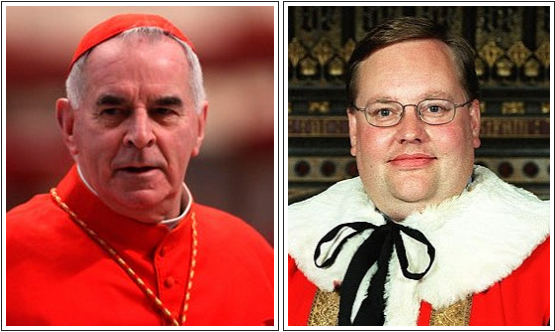
Cardinal O'Brien & Lord Lennard, their images as juxtaposed on the Cranmer blog


**

Recent political news in the United Kingdom, from The Telegraph:

Liberal Democrat leader Nick Clegg has been forced to admit that his office knew for years of claims that a senior party figure might be sexually molesting volunteers and staff.

The Deputy Prime Minister changed tack in a statement on Sunday evening over the sex scandal which is engulfing his party.

He broke into the end of his holiday to admit for the first time that his office had been aware of the allegations surrounding his former chief executive Lord Rennard since 2008. But he said he was personally unaware of the claims.

Nick Clegg admits his office knew of Lord Rennard rumours for five years

**

In today’s Wired, concerning a cover-up in the US Air Force:

A military jury found Lt. Col. James Wilkerson guilty of groping a sleeping woman’s breasts and vagina. But the Air Force wasn’t done with the “superstar” F-16 pilot. It reinstated Wilkerson to active duty and wiped away his conviction — but, to save face, is pledging not to promote him to full colonel.

[ … ]

Now the embarrassed Air Force is looking for a face saving way out of its institutional mess. Its answer thus far, reports Stars & Stripes, is to remove Wilkerson’s name from its promotions list. There’s an opportunity for Wilkerson to appeal the decision.

Air Force Accountability for Sexual Assault: Not Promoting Convicted Officer

**

And concerning Lockheed and China, a short while back from emptywheel:

I’m just wondering out loud here: what if China did more than just steal data on the F-35 when it hacked various contractors, and instead sabotaged the program, inserting engineering flaws into the plane in the same way we inserted flaws in Iran’s centrifuge development via StuxNet?

[ … ]

I don’t know that we would ever know if this clusterfuck was caused with the assistance of China. It’s not like Lockheed would publicize such information, just as it asked for another $100 billion. And I don’t want to underestimate the defense industry’s ability to screw up all by themselves.

What if China Not Just Hacked — But Sabotaged — the F-35?

**

I think one of the least appreciated parts of our human make-up is what anthros call the honor-shame system. It considers the honor of a larger group — the family, the regiment, the city, the nation, the corporation, the church — as of overriding importance, with personal considerations clearly secondary. And by honor I mean the respect with which the rest of society views it.

That’s the system that gives us “honor killings” in a swathe of countries, and in modified western form it’s also at the root of every cover-up, every attempt by hacks and flacks to put a good face on things — and it’s very much something that investigative journalism exists to uncover, just as PR attempts to cover it up.

To my mind, this is one of the big battlefronts in the world today, comparable perhaps to the battle post-Descartes between “enlightenment” and “superstition”. And when there’s murky business to cover up or admit to, corporations are often slower than individuals to ‘fess up — if only because the stock market favors appearances rather than realities. Until the bubble bursts.

And much the same is true for politicians and the electoral market, and for churches and the market in faith.

**

My mentor Richard Landes believes honor-shame is a large part of the battlefront between “the Israelis” and “the Arab world” — he quotes these two definitions:

Politeness is not saying certain things lest there be violence; civility is being able to say those certain things and there won’t be violence.

and writes:

In an honour culture, it is legitimate, expected, even required to shed blood for the sake of honour, to save face, to redeem the dishonoured face. Public criticism is an assault on the very “face” of the person criticised. Thus, people in such cultures are careful to be “polite”; and a genuinely free press is impossible, no matter what the laws proclaim.

Modernity, however, is based on a free public discussion, on civility rather than politeness, but the benefits of this public self-criticism – sharp learning curves, advances in science and technology, economic development, democracy – make that pain worthwhile.

Leaving aside their applicability to the Israeli-Arab issue, are those fair distinctions between two modes of being? How much of the battle between those forces can be found in the world around us, in our politics, our economics situation, and so on?

How much impact did the differences between honor cultures and modernity have, in the wars in Iraq and Afghanistan? Where else might this kind of conflict of values confront our leaders and ourselves?

How can we best handle interfaces between these two ways of experiencing, evaluating and acting in our shared world?


Switch to our mobile site