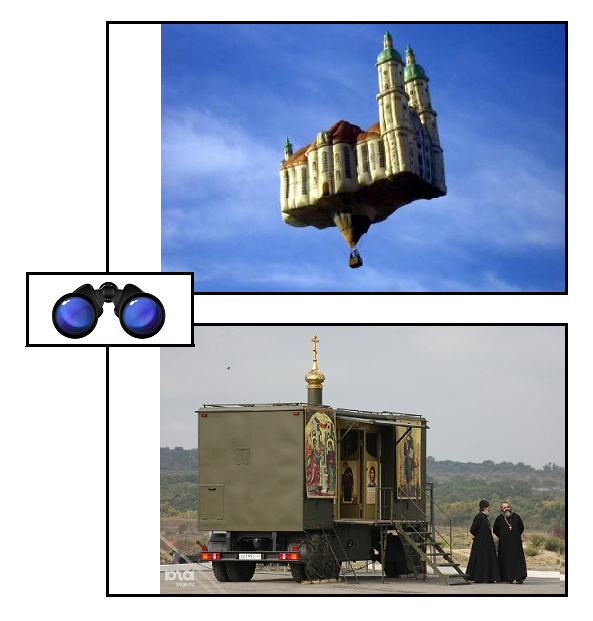
I suppose you could think of this double image as representing “the ideal” (above) and “the real” (below). In actuality, the upper image is of “Cathedral Balloon @ Balloon Fiesta ’08” — while the lower image is of an actual Russian army chapel, of which the Guardian notes:
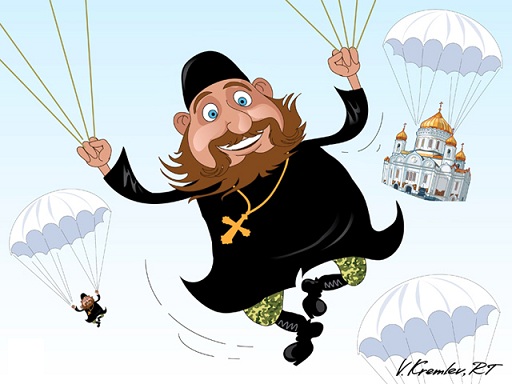
The latest addition to the Russian military arsenal takes the form of an airborne church complete with parachuting priests.
**
Fr John Peck over at The Orthodox Church of Tomorrow gleefully tosses us this image from the Russian Airborne Force Press-Service:
**
Not until that rather boxy parachuting chapel equals and indeed surpasses the great mediaeval cathedrals in splendor will we begin to be on our way to Revelation 21.21:
And I John saw the holy city, new Jerusalem, coming down from God out of heaven, prepared as a bride adorned for her husband.
**
Hat-tip to Michael Robinson, my “go to” source (what an abysmal phrase, but language is never static. eh?) for all things antiquarian, aesthetic and ecclesial…
….By using this power in addition to examine human history, we can gain insights into the origin and nature of aesthetic judgment. For example, neurobiological monitoring, in particular measurements of the damping of alpha waves during perceptions of abstract designs, have shown that the brain is most aroused by patterns in which there is about a 20 percent redundancy of elements or, put roughly, the amount of complexity found in a simple maze, or two turns of a logarithmic spiral, or an asymmetric cross. It may be coincidence (although I think not) that about the same degree of complexity is shared by a great deal of the art in friezes, grillwork, colophons, logographs, and flag designs. It crops up again in the glyphs of the ancient Middle East and Mesoamerica, as well in the pictographs and letters of modern Asian languages. The same level of complexity characterizes part of what is considered attractive in primitive art and modern abstract art and design. The source of the principle may be that this amount of complexity is the most that the brain can process in a single glance, in the same way that seven is the highest number of objects that can be counted at a single glance. When a picture is more complex, the eye grasps its content by the eye’s saccade or consciously reflective travel from one sector to the next. A quality of great art is its ability to guide attention from one of its parts to another in a manner that pleases, informs, and provokes
This is fascinating. My first question would be how we could determine if the pattern of degree of complexity is the result of cognitive structural limits (a cap on our thinking) or if it represents a sufficient visual sensory catalyst in terms of numbers of elements to cause an excitory response (neurons firing, release of dopamine, acetylcholine etc. ) and a subsequent feedback loop. Great art, or just sometimes interesting designs exhibiting novelty can hold us with a mysterious, absorbing fascination
Later, Wilson writes:
….If ever there was a reason for bringing the humanities and science closer together, it is the need to understand the true nature of the human sensory world, as contrasted with that seen by the rest of life. But there is another, even more important reason to move toward consilience among the great branches of learning. Substantial evidence now exists that human social behavior arose genetically by multilevel evolution. If this interpretation is correct, and a growing number of evolutionary biologists and anthropologists believe it is, we can expect a continuing conflict between components of behavior favored by individual selection and those favored by group selection. Selection at the individual level tends to create competitiveness and selfish behavior among group members—in status, mating, and the securing of resources. In opposition, selection between groups tends to create selfless behavior, expressed in greater generosity and altruism, which in turn promote stronger cohesion and strength of the group as a whole
Very interesting.
First, while I am in no way qualified to argue evolution with E.O. Wilson, I am dimly aware that some biological scientists might be apt to take issue with Wilson’s primacy of multilevel evolution. As a matter of common sense, it seems likely to me that biological systems might have a point where they experience emergent evolutionary effects – the system itself has to be able to adapt to the larger environmental context – how do we know what level of “multilevel” will be the significant driver of natural selection and under what conditions? Or does one level have a rough sort of “hegemony” over the evolutionary process with the rest as “tweaking” influences? Or is there more randomness here than process?
That part is way beyond my ken and readers are welcome to weigh in here.
The second part, given Wilson’s assumptions are more graspable. Creativity often is a matter of individual insights becoming elaborated and exploited, but also has strong collaborative and social aspects. That kind of cooperation may not even be purposeful or ends-driven by both parties, it may simply be behaviors that incidentally help create an environment or social space where creative innovation becomes more likely to flourish – such as the advent of writing and the spread of literacy giving birth to a literary cultural explosion of ideas and invention – and battles over credit and more tangible rewards.
Mr. Lewis Shepherd of Microsoft came to Purdue to give a talk for CERIAS awhile back and he talked about how equating the Manhattan Project to the world of cyber security is completely wrong. I liked his talk quite a bit, and it aligned closely with something I’ve been talking to people about for awhile. Talking to people is important. I know my impact on the world is going to be negligible but I’ve dedicated my life to infecting the youth of the world with a few stray ideas. They call it teaching, and it doesn’t pay much. I think Mr. Shepherd was making a good case that scope, and cause and effect, and process of one program might no align realistically with another program. The secrecy, single mindedness, and type of problem that was the Manhattan project has almost nothing to do with the quite different project of cyber security. Much like I’ll never be able to equate my teaching to Socrates, the cyber security community shouldn’t really think “Manhattan Project”.
….Everything you likely think about defense in depth is wrong. All of the audit and compliance stuff is wrong. The firewall and intrusion detection and prevention technologies are wrong. The autocratic and dictatorial policies of information security are wrong. The underlying theories of robust and resilient programming are wrong. There is nothing about the current information technology infrastructure that is security oriented. The foundations of the technologies are fundamentally at odds with creation of an information secure culture. Now to be honest I didn’t say this. Neumann, Saltzer, Cerf, Bernack, and so many other people said this long before I did. But, maybe you haven’t read their stuff before.
How can I possibly support that they are all wrong and don’t work? Pretty simple. They don’t. Though we can secure systems to some point we are almost always talking about a security absent some failure in the system. There is nothing really secure. This is a huge problem that breaks most peoples “common sense” way of thinking about security. Simply put the way we do things will never be secure and we should stop trying to fix things the way we know doesn’t work.
In a world of growing uncertainty and mounting performance pressure, it’s understandable that resilience has become a very hot topic. Everyone is talking about it and writing about it. We all seem to want to develop more resilience. But I’m going to take a contrarian position and suggest that resilience, at least as conventionally defined, is a distraction and perhaps even dangerous.
….In this context, the conventional view of “bounce back” resilience for enterprises is profoundly dangerous. It simply increases the ability of the institutional status quo to survive when conditions demand a fundamental transformation. It increases the gap between what we are doing and what we need to do. We already face a growing mismatch between the institutions and practices that dominate in business and the needs of the markets and societies that are being re-shaped by the global forces outlined earlier. As long as this mismatch persists, we will face increasing disruptions and stress as struggle to maintain institutions and practices that are no longer viable. We don’t need to bounce back; we desperately need to move forward.
J.M. Berger, author of Jihad Joe (reviewed here by Charles) frequently tackles Islamist militants and various kinds of terrorism at Intelwire but the focus in the above paper is on far Right, white nationalist and radical racist strands of violent extremism
A new Texas Department of Public Safety Threat Assessment report states that criminal cartels are operating in Texas and are the No. 1 threat to the Lone Star State. Narcobloqueos (narco-blockades) are now being seen north of the border.
[ by Charles Cameron — expecting the unexpected — transcribing Bill Roggio on “something that everyone is overlooking” and Ambassador Haqqani on “one of the unwritten books it has been my desire to write” ]
.
I’ve talked about the “Black Banners” hadith and the Mahdi‘s victorious army marching from (roughly) Afghanistan to Jerusalem more than once, and perhaps less frequently, the other prong of the jihad, the Ghazwa-e-Hind, which flows from Pakistan into India. In the video that follows, Bill Roggio of the Long War Journal talks with Husain Haqqani, one-time Pakistani Ambassador to the US — and both have some striking things to say.
We pick up the conversation close to the end of the first half of a two-tape session at the Foundation for the Defense of Democracies — and I’ve provided a transcript after the video, for easier quotation and annotation.
**
BILL ROGGIO:
One of Al-Qaida’s propaganda since it took a beating in Iraq was, that they made the Khorasan, which is an old Islamic empire basically in central Asia and South Asia, they said that this is where we are going to beat them, and once we win in the Khorasan, we’re going to move towards the Levant. So this has become a key part of AQ’s propaganda. What do we think is going to happen when we lose in Afghanistan, when the second superpower loses? That is going to be a huge recruiting boom for foreign terrorists operating in Afghanistan. I think this is something that everyone is overlooking as we’re running for the doors in Afghanistan.
That’s a pretty powerful prediction, though prediction itself is a high risk enterprise. And it bears repeating that the Khorasan hadith is explicitly an “end times” prophecy. Ambassador Haqqani then doubles up on Bill Roggio’s concern, adding in the Ghazwa-e-Hind, which he describes as both “famous” and “the final, biggest war between good and evil and between Islam and kufr”…
A lot of people make fun of the Pakistani analyst and Youtube personality, Zaid Hamid, who seems to be the main public proponent of the Ghazwa — take a look here to see a wild sampler! — which is why I find Ambassador Haqqani’s response particularly impactful.
HUSAIN HAQQANI:
You know, there are days when I think I should have stayed in the scholarship business and written some of that stuff I was writing at that time. This was one of the things, even before Iraq, I had pointed out. For example, bin Laden had given a statement at that time about Americans being the new Mongols, and nobody could understand what he was talking about, and I said he’s talking about the 1258 conquest of Baghdad, and he’s playing on Islamic history and Islamic mythology.
And so Khorasan was an important element in that because, if you remember, the Abbasids rose to power through Khorasan, because that was an important element, they overthrew the Umayyads based on the argument that there is a hadith – which in my opinion is of relatively weak significance, but I am taking off my hat of a theologian since I never completed my religious training – but anyway, they used that, that there is a hadith, that the people from Khorasan will come and save the people of the Levant or whatever. And so that was used, and that was used again, and that has been part of the Al-Qaeda thing.
And then the other part is this famous Ghazwa-e-Hind, and the Pakistani groups use it – actually, just as jihad is the war, a holy war or war for religious purposes, ghazwa is a battle — and there is ostensibly a saying of prophet Muhammad that before the end times, the final, biggest war between good and evil and between Islam and kufr is going to take place in Hind, which is India, which is the land east of the river Indus.
So Khorasan takes care of what is today Afghanistan and some parts of central Asia, and all of that – it means a lot to people who believe in it, these end times prophecies etcetera. So one of the unwritten books it has been my desire to write, I wrote a piece on it once, an article I think, which said, that, you know, Americans pay a lot of attention to their own end time prophecies, but getting into that whole theater, they have totally neglected this.
And so far as recruitment is concerned I am totally agreeing with you, that failure in Afghanistan is going to be a big boon for both. The TTP — the Tehrik-i-Taliban Pakistan — and the Pakistani groups are going to start saying, Right, now is the time to start recruiting, and fighting in that famous Ghazwa-e-Hind –let’s get ready for that. And the Arab groups are going to say, Ah, salvation is coming by joining up with the folks who are fighting in Khorasan.
And both those fronts are going to be a source of a lot of problems.
Increased jihadist recruitment, and India as a second major front for the jihad — that’s quite a left lead and right cross combo…
**
Do you recall the opening of Aldous Huxley‘s final novel, Island?
“Attention,” a voice began to call, and it was as though an oboe had suddenly become articulate. “Attention,” it repeated in the same high, nasal monotone. “Attention.”
[ by Charles Cameron — on peace in Northern Ireland, soldiers and Christ ]
.
The upper image is of the celebrated “Shroud of Turin” — in which it is thought by some that Jesus was wrapped to be buried, leaving a negative image of his features on its linen. Below it, the image of “a British soldier behind a bullet-resistant riot shield in Northern Ireland in 1973, during the Troubles” which heads an article by the novelist Colum McCann in today’s NY Times magazine, Remembering an Easter Miracle in Northern Ireland.
McCann writes:
PEACE, said W. B. Yeats, comes dropping slow.
After 15 years, the Good Friday peace agreement in Northern Ireland still occasionally quivers, sometimes abruptly, and yet it holds. It is one of the great stories of the second half of the 20th century, and by the nature of its refusal to topple, it is one of the continuing marvels of the 21st as well. While rockets fizzle across the Israeli border, and funeral chants sound along the streets of Aleppo in Syria, and drones cut coordinates in the blue over Kandahar, Afghanistan, the Irish peace process reaffirms the possibility that — despite the weight of evidence against human nature — we are all still capable of small moments of resurrection, no matter where we happen to be.
This is the Easter narrative: that the stone can be rolled away from the cave.
Hundred of years of arterial bitterness, in Ireland and elsewhere, are never easy to ignore. They cannot be whisked away with a series of signatures. It takes time and struggle to maintain even the remotest sense of calm. Peace is indeed harder than war, and its constant fragility is part of its beauty. A bullet need happen only once, but for peace to work we need to be reminded of its existence again and again and again.
In the twinned images above, we see the crucifixion and burial of Christ, commemorated on Good Friday and Holy Saturday, and their analog in the lives we ourselves live, in a world whose body is blooded with strife and buried in the many forms of forgetfulness and denial.
Here we should recall Wilfred Owen’s words — seeing in the soldier before him, Christ:
For 14 hours yesterday, I was at work-teaching Christ to lift his cross by the numbers, and how to adjust his crown; and not to imagine he thirst until after the last halt. I attended his Supper to see that there were no complaints; and inspected his feet that they should be worthy of the nails. I see to it that he is dumb, and stands before his accusers. With a piece of silver I buy him every day, and with maps I make him familiar with the topography of Golgotha.
In McCann’s piece we may find a modern type and hope of resurrection:
This is the Easter narrative: that the stone can be rolled away from the cave.
Zenpundit is a blog dedicated to exploring the intersections of foreign policy, history, military theory, national security,strategic thinking, futurism, cognition and a number of other esoteric pursuits.