Archive for May, 2013
Grass Hoppers and Frost
Sunday, May 5th, 2013[from Ellen Greer Rees, compiled by Helen Thackeray Rees Berger, modern day arrangement by Lynn C. Rees]
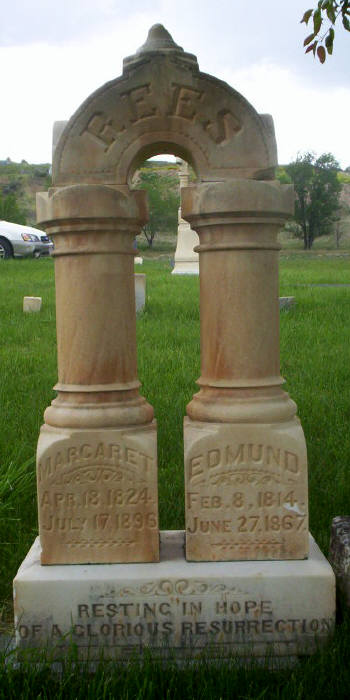
On September 22, 1859, Edmund Rees, wife Margaret, and their five children ages 12-18 months (the 12-year old was my great-great grandfather) arrived in Great Salt Lake City, twelve-year old capital of the nine-year old Utah Territory. Edmund and Margaret were natives of Monmouthshire, located in the southeastern corner of Wales. While they’d joined the Church of Jesus Christ of Latter-day Saints in the early 1850s, they didn’t gather to Zion until Edmund developed asthma after years spent cutting coal in the Monmouthshire mines that fueled the early Industrial Revolution.
The Rees family started their journey with $500, the results of selling their home. $100 got them from Wales to Iowa: they left the old country on April 11, 1859, sailed across the Atlantic on the William Tabscott, landed at New Orleans, and sailed up the Mississippi and Missouri Rivers to Council Bluffs, Iowa by steam boat. Another $100 got them two oxen, a covered wagon, a milk cow, and safely across the Great Plains to Utah.
Edmund was unfamiliar with handling livestock: the first time he put the yoke on the oxen, he put it on upside down.
Margaret took over.
Syria, chemicals, Israel: the fast and slow of it
Sunday, May 5th, 2013[ by Charles Cameron — always we need the rapid response, always we need the slow, thoughtful understanding ]
.
It’s almost axiomatic, isn’t it, we need two brain speeds, two types of intelligence, two modes of analysis, to handle the moment and the times we live in. Both.
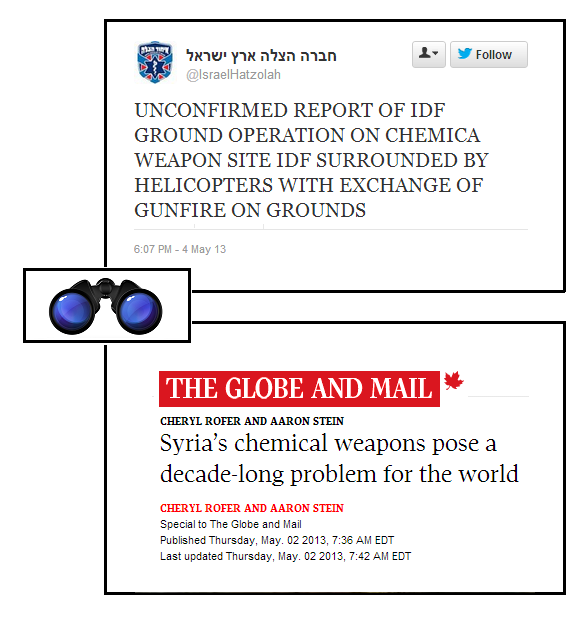
Chevra Hatzolah Israel has the immediacy of Twitter, Cheryl Rofer and Aaron Stein the longer view from the Globe and Mail. Both.
**
Cheryl Rofer, a good friend of this blog, “supervised a team developing supercritical water oxidation for destruction of hazardous wastes, including chemical warfare agents, at the Los Alamos National Laboratory” — bio from the Globe and Mail article. I don’t want to pick and choose excerpts from her piece, I’m certainly no expert on her topic — but as things heat up in Syria, the considerations she describes offer us significant background.
Read her insights as posted two days ago in Syria’s chemical weapons pose a decade-long problem for the world.
**
[ edited 45 mins later to add: ]
Blake Hounshell’s post a few minutes ago for FP, That awkward moment when … Israel launches airstrikes in Syria, begins to bring the two strands of thinking together — Israel attacks, but cautiously…
Syrian state TV is claiming that Israel hit a “research center,” while opposition Facebook pages are saying that several elite units on Mt. Qassioun, overlooking Damascus, were the targets.
…
Because it’s so difficult, not to mention risky, to destroy chemical-weapons stocks from the air, the next-best thing is to take out Assad’s means of delivering them. And Mt. Qassioun is reportedly where many of the Syrian regime’s best missiles are kept.
That’s a lot less worrisome.
**
As the “fog of war” slowly clears, the longer and slower insights will prove to be the more reliable and enduring.
Jottings 3: Espionage on the chess board
Friday, May 3rd, 2013[ by Charles Cameron — playing the two great games, from Caxton to Le Carré ]
.

.
Karla, the Russian spymaster in John Le Carré‘s Smiley novels, is represented as the white queen in the 2011 Tomas Alfredson / Gary Oldman film of Tinker Tailor Soldier Spy (lower panel, above).
In chess terms, that’s quite a step up for spies — pawn promoted to queen.
**
Before the digital age, in the early years of printing, way back in 1474, Thomas Caxton‘s press issued the second book ever printed in England — his Game and Playe of the Chesse — and things were subtly different. The eight pawns, for instance, differed one from another, each representing a different human type or craft, and named accordingly: “Labourer, Smith, Clerk, Merchant, Physician, Taverner, Guard and Ribald.”
It’s the Ribald (in the upper panel, above) who interests us here — for he’s the spy on the chessboard, as surely as Joshua the son of Nun and Caleb the son of Jephunneh were spies in the land of milk and honey. Caxton describes the Ribald, stationing him in front of the Rook, thus:
The rybaulders, players of dyse and of messagers and corrours ought to be sette to fore the rook/ For hit apperteyneth to the rook whiche is vicayre & lieutenant of the kynge to haue men couenable for to renne here and there for tenquyre & espie the place and cytees that myght be contrarye to the kynge/ And thys pawn that representeth thys peple ought to be formed in this maner/ he must haue the forme of a man that hath longe heeris and black and holdeth in his ryght hand a lityll monoye And in his lyfte hande thre Dyse And aboute hym a corde in stede of a gyrdell/ and ought to haue a boxe full o lettres
And what should be the appearance of such a one?
And thys pawn that representeth thys peple ought to be formed in this maner/ he must haue the forme of a man that hath longe heeris and black and holdeth in his ryght hand a lityll monoye And in his lyfte hande thre Dyse And aboute hym a corde in stede of a gyrdell/ and ought to haue a boxe full o lettres
Let’s go over that first part one more time, and make sure we understand it:
It pertains to the Rook, which is vicar and lieutenant of the King, to have men available to run hither and yon to make inquiries and spy out the place and cities that might be contrary to the King.
**
And isn’t that precisely what Moses sent Joshua and Caleb out to do, when he instructed them in Numbers 13.17-20:
Get you up this way southward, and go up into the mountain: And see the land, what it is, and the people that dwelleth therein, whether they be strong or weak, few or many; And what the land is that they dwell in, whether it be good or bad; and what cities they be that they dwell in, whether in tents, or in strong holds; And what the land is, whether it be fat or lean, whether there be wood therein, or not. And be ye of good courage, and bring of the fruit of the land.
**
Espionage has been around longer than chess: some things never change — and some things have changed significantly.
Today, you can’t tell one pawn from the next…
Jottings 1: Wittypedia
Friday, May 3rd, 2013[ by Charles Cameron — concerning the Dajjal, the Muslim antichrist — and introducing “jottings” ]
.
.
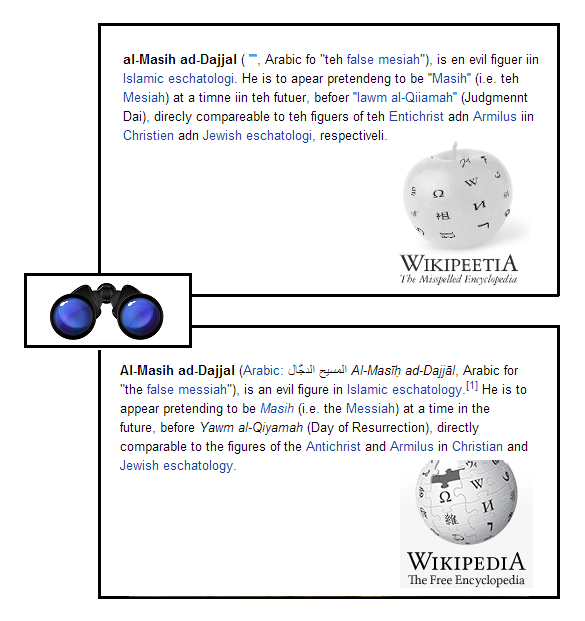
That’s witty — Wikipeetia, a version of Wikipedia that you may some day find yourself reading if you mis-spell a search term.
Like, if you write Entichrist.
Fascinating.
**
Jottings:
I am hoping to make Jottings a continuing series of brief posts, some serious and some light-hearted, that release the toxins of fascination and abhorrence from my system rapidly, ie without too much time spent in research. Jottings — hey, my degree was in Theology, Mother of the Sciences — derives from the English “jot” — and thence from the Greek iota and Hebrew yod, see Wikipedia on jots and tittles.



