zenpundit.com » 2015

Archive for 2015

On form and beauty

Saturday, November 28th, 2015

[ by Charles Cameron — capable photographers capture “form” in their viewfinders, not just “content” ]
.

A toothy sea

A toothy sea

**

I have just been browsing someone’s choice of the “100 best photographs ever taken without photoshop”, and was struck by the ways in which form in general, and contrasts in juxtaposition more specifically — two of my recurring interests, form and the DoubleQuotes respectively — kept cropping up. I’ll get to them, and offer some stepped-down images from the series —

but first, take a look at the whole series as posted at The 100 best photographs ever taken without photoshop. Even the reduction to 60% of published size necessitated by the ZP column width loses much of the beauty — and imagine how they’d be as actual framed prints, in their original full sizes!

Someone’s choices? Yes, and by no means necessarily the best choices — this selection no doubt answers to a selection bias in the individual who put the series together — so the patterns I’m seeing here may belong either to that individual, or to the general human delight in contrasts, parallelisms and oppositions.

**

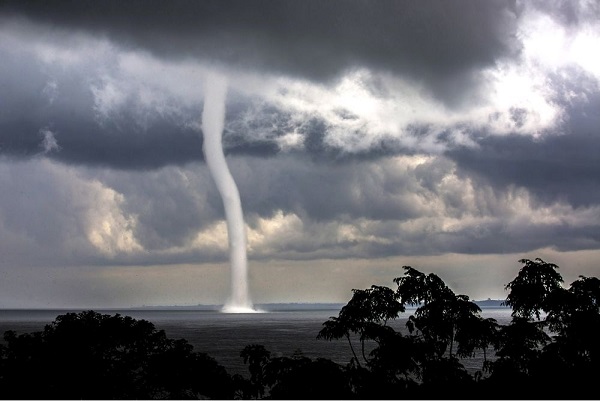
Earth and Sky, Heaven and Earth:

Waterspout on Lake Victoria, Uganda

Fickle moods
Fickle moods

Volcanic eruption in IcelandVolcanic eruption in Iceland

**

The seasons: time as change

An autumn forest. 50 percent Downloaded

Autumn and winter meet in Colorado, USA

Autumn and winter meet in Miklukhin, Rostov region, Russia


**

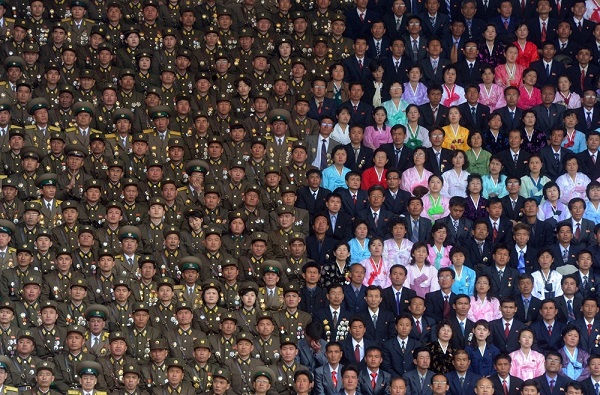
Human impact observed:

Two worlds divided, New York, USA

Celebrating the 100th anniversary of the birth of Kim Il-sung, North Korea’s founder

An Italian beach

An Italian beach

**

On reflection, sheer, simple symmetries:

The aftermath of a flood in Ljubljana, Slovenia

An eagle soaring over a lake in Canada


**

And that’s only a fraction of what the whole series of a hundred photos offers us. Each of these, I’d submit, is what I’d term a DoubleQuote in the Wild.

One final shot, color against grey — perhaps the loveliest of all:

A temple covered in ash from the Ontake volcanic eruption, Japan
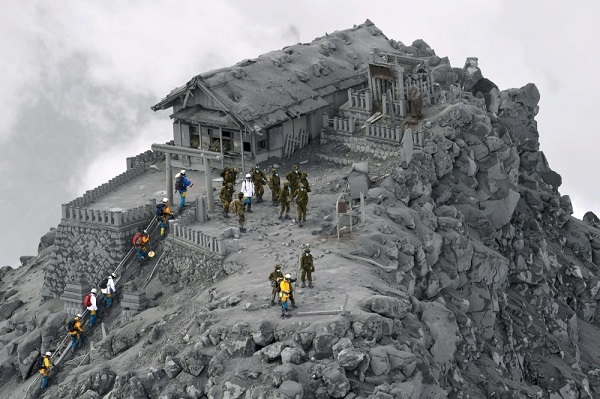

So much humanity, so much pathos there.

**

Brilliant minds in both the arts and sciences focus as much on form as on content — on patterns, repetitions, symmetries for their own sakes, as much as on the particulars of the fields they study and in which they find them. At heart, this is a matter of aesthetic cognition.

We would do well to cultivate this kind of double vision — the awareness of form as well as content — across the board, from education and the arts to the sciences and strategy.

The moment we become polarized, however, in terms of a political or other form of partisanship, content becomes all we see (and agree or disagree with), and form effectively evaporates. In terms of the images above, we see earth or sky, summer or autumn, town or country — left or right — but not — but no longer — the whole.

Recommended Reading, Thanksgiving Weekend Edition

Saturday, November 28th, 2015

[by Mark Safranski, a.k.a. “zen“]

A special feast of recent posts…..

T. Greer at Scholar’s Stage – Vox Will Never Understand Islam… Or Any Religion, Really  and Editorial vs. Coffee House Blogging

The critique was written by a friend of mine in a private forum. I repost it here with his permission. He touches on a few themes that will be familiar to readers of the Stage: the banality of Washington opinion writers, forever stitching new headlines into tired narratives; the limits liberal education in the 21st century, far better at teaching platitudes than exploring the depths of the human condition; and the inability of secular elites to understand religions and the religious masses who earnestly believe in them. He starts his attack with Fischer’s statement, “people get out of [religions] what they bring into them.” The bolded emphasis is my own: 

…If you are not particularly religious, and furthermore do not know much at all about religion — except the assumptions you bring to the topic from your inadequate formal and experiential educations — then you will write, without embarrassment, things like, “religions are big and diverse, and people get out of them what they bring into them.”

Let me amend that, and not in favor of the writer: it is not even necessary to know about religion as such to know this is false — it is simply necessary to know about literature, and not to any real depth. This is the sort of thing that reasonably educated people ought not to say and still less believe, as it is so evidently wrong — but it is also the sort of thing that wide swaths of our media establishment, of course chief among them the powerholder-stenographers at Vox, credulously declare. [….]

Global Guerrillas –Supersoldiers and Autonomous Weapons

Fast forward 20 years (about the age of the WWW).  An aging, schlerotic EU has become the destination for over a hundred million refugees and migrants fleeing the densely populated killing fields of Africa and SW Asia.  

The rapidity of influx has led the EU to take extreme measures.   Tens of millions of these migrants/refugees are roughly housed in relocation camps all across Europe.  

Violence within these camps has risen steadily, leading to an EU-wide Islamic insurgency.

The soldiers sent to counter this insurgency are outfitted with autonomous weapons.  These weapons combine deep learning (making them very smart) and cloud robotics (allowing the military to rapidly share advances in training and technique) to provide these soldiers with capabilities far beyond what we’ve seen in previous wars.    

Here’s an idealized example so you can get the idea.  A human/robot team advances down a street in an urban environment.  [….]

Adam Elkus – ISIS, the Clash of Civilizations and the Problem of Apologetics 

….How did this happen? How did we go from generalized agreement during the Bush administration that the enemy is only the terrorists themselves to calls for a Muslim database? Marc Lynch has a piece up at Monkey Cage in which he talks about the eternal recurrence of “clash of civilizations” narratives and the increasingly disturbing rise of anti-Islam rhetoric among US politicians and the media. Lynch supplies a lot of of valid reasons for why this is the case, who is responsible, and how such filth has been legitimized. However, one important reason is missing?—?the way in which analysts have structurally obsfucated many of the important issues at play regarding the connection between religion and ISIS (and others’ political violence). In attempting to prevent bigots from validating a “clash of civilizations” narrative, analysts have paradoxically helped bring it about.

As a prelude, let’s begin with the phrase “clash of civilizations.” It’s often axiomatic among researchers that Samuel Huntington, the man who coined the term, is guilty of “profound racism.” But very few have ever read the book or the original articles in detail. Huntington had argued publically that civilizations as categories ought to be respected, and that a lack of attention and respect to their civilizational perogatives and differences would lead to unnecessary strife. Huntington argued that the only way coexistence was would be if the West could understand the rest despite grave differences. Huntington’s cultural relativism is not exactly novel; it appears in social psychology and has been a constant in anthropology and sociology to some degree since the founding of those disciplines. It has also found some parallel in area studies and regional international relations.

Martin van Creveld – The Clash of Civilizations and the End of History*

Feral Jundi – Russia: So Where Are Russian PMSC’s Working In The World? and Yemen: UAE Deploys It’s Colombian Mercenaries To Yemen

Peter Turchin – Ultrasociety: How 10,000 Years of War Made Humans the Greatest Cooperators on Earth

The Bridge – #Reviewing The Future of Land Warfare:

Angry Staff Officer – History the Overlooked Military Discipline

OLD AMIGOS…..

The Glittering Eye – Assumptions About the Turkey-Russia Incident

Dr. Chet Richards at the Lean Kanban Conference –  the full length interview.

Dr. Thomas P.M. Barnett has returned to blogging

Shlok Vaidya – On Human Evolution, Personality Disorders and the Environment

ONLINE ZINES & JOURNALS…..

War on the Rocks – How Many Fighters Does the Islamic State Really Have?

Small Wars Journal –The Starfish Caliphate: How ISIL Exploits the Power of a Decentralized Organization

Infinity Journal – D – All of The Above: Connecting 21st Century Naval Doctrine to Strategy

Cicero – Why Are the Religions of the West so Violent?

Aeon – Head to Head

That’s it!

Ideal as cause, real as effect

Saturday, November 28th, 2015

[ by Charles Cameron — a pretty intense little cognitive romp, b’day surprise #2 ]
.

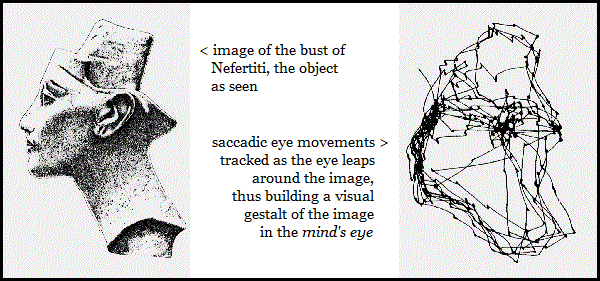
nefertiti saccade cc version
mapping object seen to eye movement, Yarbus via MIT

**

Today I was reading James Harkin, How the Islamic State Was Won, in Harper’s from November last year, and this sentence struck me:

The aim was to wipe out the regime’s armed opponents, but the result was to destroy the country’s social fabric and displace whole communities — leaving millions of Syrians with little to lose. Groups like the Nusra Front took control of towns across the north, and foreign jihadis flooded into Syria to join the fight.

Here’s the thought it prompted:

The aim, purpose, or target of an action will often represent some sort of ideal, and that ideal becomes the cause of the action in question. Like all ideals, it represents a trajectory in a model space, that of the imagination, which like all models, lacks some of the details of the reality it purports to represent. Not only is the map not the territory, it will in all cases not envisioned by Jorge Luis Borges be smaller and less informed than the reality.

The result of that action, its effect, takes place in reality, even thought we then cognize it in a mental comparison with its aim or cause.

Unintended consequences, then, are quasi-mappable as arising in precisely those areas of the real which the ideal fails to map.

Mapping the distinctions between reality and unconscious perception, conscious perception, neural activity, and verbal, visual and matghematical models in mind, brain, and on a napkin or computer is, accordingly, one of the great tasks of the age.

**

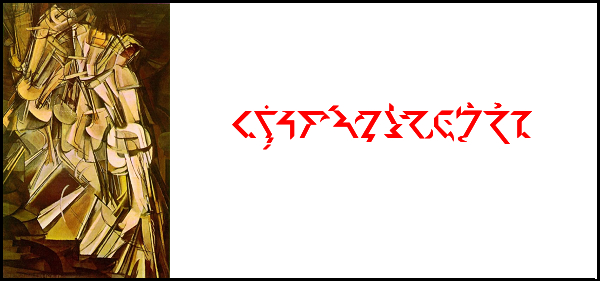
duchamp cc versionDuchamp (image) and Ithkuil (verbal description) via John Quijada, see Birthday surprise

Birthday surprise

Friday, November 27th, 2015

[ by Charles Cameron — the bell just tolled 72 for me, so it’s no longer Thanksgiving, it’s Psalm 90, still early in the “labour and sorrow” zone ]
.

A propos, then, of nothing in particular — and because it is a glorious work of art, here in a tweet is Marcel Duchamp‘s Nude Descending a Staircase, No. 2:

**

And because it shows the paucity by comaparison, not just of language but of constructed languages — and also how finely tuned such languages can be, as in this extraordinary translation into the Ithkuil:

**

Now — how many words are worth a picture?

What the PK Dickens?

Thursday, November 26th, 2015

[ by Charles Cameron — conceptual echoes in a PK Dick bio-flick ]
.

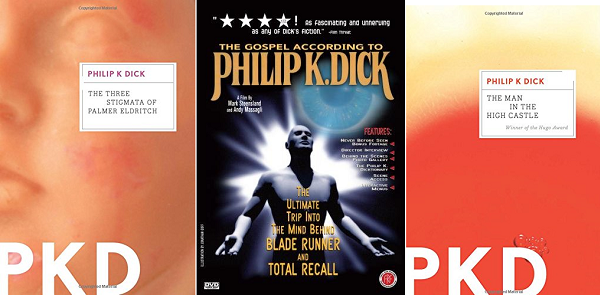
PKD covers 600

**

I have just been watching Mark Steensland’s movie, The Gospel According to PK Dick, and a couple of fine parallelisms – echoes, really – struck me.

I’m going to start with one quote from the Chuang Tzu which is so often quoted it has been dulled for me, like a few other very great very over-celebrated works, Beethoven’s Fifth, and Bach’s Toccata and Fugue in D minor BWV 565, among them. Finding its echo in the words of Robert Anton Wilson in this film breathes new life into it, at least for me, for this moment.

Chuang Tzu, then, from The Complete Works Of Chuang Tzu translated by Burton Watson:

Once Chuang Chou dreamt he was a butterfly, a butterfly flitting and fluttering around, happy with himself and doing as he pleased. He didn’t know he was Chuang Chou. Suddenly he woke up and there he was, solid and unmistakable Chuang Chou. But he didn’t know if he was Chuang Chou who had dreamt he was a butterfly, or a butterfly dreaming he was Chuang Chou. Between Chuang Chou and a butterfly there must be some distinction! This is called the Transformation of Things.

DoubleQuote that with Robert Anton Wilson in the movie:

In 1994, I think it was, somebody put up on internet a report of my death, and no matter how much I’ve denied it, it seems most people accept that I’m still alive, but there’s a die hard minority who insists I’m dead and the CIA has replaced me with an android. And I’d be much happier if I’d never read Philip Dick, because I would just think, “Well, I know I’m not an android,” but having read Philip Dick I realized if I was an android who’s properly constructed, I’d think I am Robert Anton Wilson. So that leaves me perpetually in a predicament of not being sure that I’m Robert Anton Wilson or an android programmed to think it’s Rob– to think, talk, and write like Robert Anton Wilson. I guess I’m really grateful to Phil for that, it gives me a certain agnostic detachment, which I think is necessary for mental health.

**

The echo of Chuang Tzu in the words of Robert Anton Wilson occurs towards the beginning of the movie. Towards the end of the movie, we have Paul Williams, the “father of rock criticism” also talking about his friend PK Dick, who was also the subject of his celebrated 1974 Rolling Stone article:

That particular, unique personality this is Philip K Dick arises, when you and I or the three of us, or any two or three readers of {Philip K Dick, or friends of his, or whatever, get together, then we have the opportunity, as in the ends of those stories, to actually experience his presence, and it’s uniquely him. And, uh, I appreciate that, and I appreciate that in that way, I still have him in my life. And that’s definitely quite a gift.

DoubleQuote those words of Williams with these, from Matthew 18.20:

For where two or three are gathered together in my name, there am I in the midst of them.

**

Gospel, indeed. and Tao, too.


Switch to our mobile site