zenpundit.com » 2015 » March

Archive for March, 2015

Mad Dog Mattis – Blogger

Friday, March 6th, 2015

[by Mark Safranski, a.k.a. “zen“]

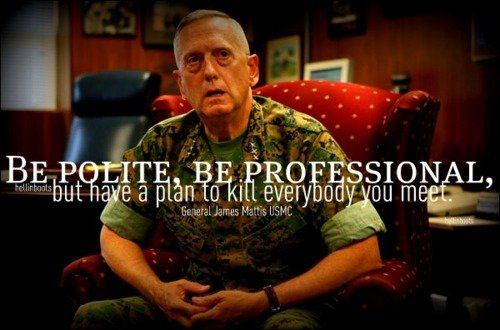
General James N. “Mad Dog ” Mattis, USMC (ret.), the semi-legendary, no-nonsense, fighting general of our recent wars, beloved by his Marines, has accepted a Distinguished Visiting Fellowship at the highly regarded Hoover Institution, where he has been writing an online column. A fancy way of saying that General Mattis has become a blogger.

In fact, he’s quite good at it.

His most recent post can be found here:

Using Military Force Against ISIS

….Following more than a decade of fighting for poorly articulated political goals, the Congress needs to restore clarity to our policy if we are to gain the American people’s confidence and enlist the assistance of potential allies, while sending a chilling note that we mean business to our enemies. With enemy influence expanding rapidly, patience or half-measures cannot replace a coherent strategy for taking measured steps, aligned with allies, to counter the mutating Islamist threat in the Middle East. The AUMF that Congress passes should be constructed as one building block in a coherent, integrated strategy for dealing with a region erupting in crises. Thus the AUMF needs to serve an enabling role for defeating this enemy, and not a restrictive function. Congress’ voice in the AUMF must not reassure our adversary in advance about what we will not do:

  1. We do not enter wars to withdraw; when we must fight, we fight to win. We should not set arbitrary deadlines which would only reveal that our hearts are not really in the game and would unintentionally embolden our enemies with the recognizable goal of outlasting us.
  2. We should not establish geographic limits in a fight against a franchising, trans-national terrorist group and its associates.  Our AUMF must be fit for the purpose of defeating this specific enemy (a non-state entity) and whoever stands with them, but not be hidebound by the rules for how we fought previous wars against nation states.  We must adapt to our time and the threat and not try to fight as we did in the past using rules no longer effective or applicable.
  3. The AUMF should put the enemy on notice that we will deploy all our military capabilities, as well as our diplomatic and economic tools.  If employing our ground forces will help build the international coalition against ISIS, will hasten the enemy’s defeat, will help to suffocate ISIS’ recruiting through humiliating them on the battlefield, or negatively impact their fundraising cachet, then our Commander-in-Chief should have that option immediately available to achieve our war aims.  When fighting a barbaric enemy who strikes fear into the hearts of many, especially those living in close proximity to this foe, we must not reassure that enemy in advance that it will not face the fiercest, most skillful and ethical combat force in the world. 

While I am not enthused about the idea of a large ground deployment back to Iraq – mainly because our national leadership has no idea on how to assemble a constructive political end that a decisive military victory would buy them, nor a willingness to entertain realistic, stabilizing outcomes (like Kurdish statehood) that would mean changing longstanding US policies – I’m very much in tune with Mattis that any warfare should be waged without a set of needless, self-hobbling, anti-strategic restraints. Note what he writes here:

The AUMF must also make clear that prisoners taken from forces declared hostile will be held until hostilities cease. There is no earthly reason for the Congress to acquiesce to funding a war in which we do not hold prisoners until the fight is over, as is our legitimate right under international law. The AUMF should make clear that the same standards that applied to prisoners in Lincoln’s or FDR’s day will be imposed today. This will ensure that we have a sustainable detainee policy instead of the self-inflicted legal quandary we face today, with released detainees returning to the battlefield to fight us.

“Catch and release” by the Bush and Obama administrations – and the latter tightening ROE in Afghanistan into the gray, blurry zone between military force and law enforcement, was self-defeating and probably is responsible for a sizable number of American casualties.

Mattis writes with admirable clarity and focus. More importantly, his military reputation lends invaluable credence toward educating the public and civilian officials about the nature of strategy and the uses and (more importantly) limitations of military force. Hopefully he will gain an even larger platform in time, but for readers at ZP, here are previous posts by the “Mad Dog” :

A New American Grand Strategy

“The Enemy Is Not Waiting”  

The Worsening Situation in the Middle East–and America’s Role   

Pruning the U.S. Military: We Will Do Less But Must Not Do It Less Well
Buddhism and Islam: please note disclaimers

Wednesday, March 4th, 2015

[ by Charles Cameron — on monk Wirathu, also the trickiness of images-with-quotes on social media ]
.

SPEC Wirathu

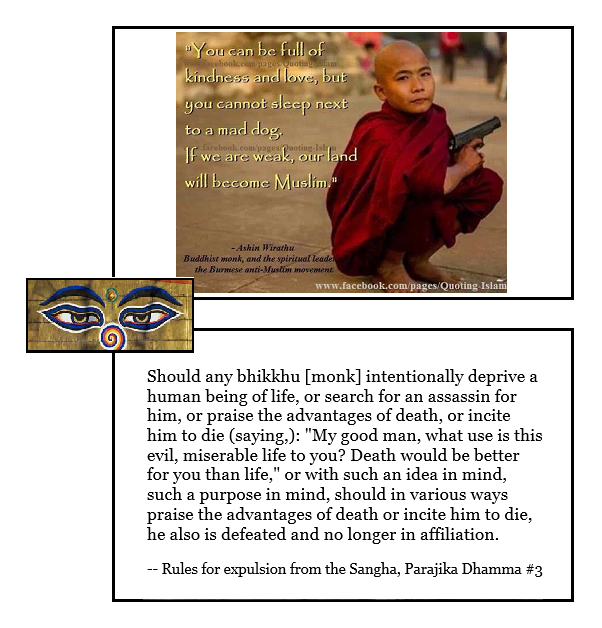
The quote from Wirathu (upper panel, above) is a direct quote from a NYT interview with him:

You can be full of kindness and love, but you cannot sleep next to a mad dog,” Ashin Wirathu said, referring to Muslims.

The image was posted on a FaceBook page which is either his or named for him, but appears to have been taken from a National Geographic contest. The photographer’s note reads:

At the annual Ananda Harvest Festival in Bagan, Myanmar, thousands of monks from all over Myanmar came to receive alms. While walking around the vast temple grounds, I chanced upon this boy monk who was playing with his toy gun. Even though it was only a toy gun, I found this image a disturbing juxtaposition of the peace that Buddhism embodies and the violence that guns symbolise.

So the gun is a toy gun, and the monk a boy monk, not Wirathu.

FWIW, I searched for “wirathu hoax” and didn’t find this image listed, but did find a hoax photo attributed to a Wirathu FB page: Fake image being circulated by monk Wirathu to incite anti-Muslim violence in Burma (Warning: Graphic Content).

Figuring out what’s genuine, what’s propaganda. and what’s fake or a hoax is getting harder and harder these days, and we need more and more skeptical spectacles when taking in both texts and images.

The text from the Parajika (lower panel, above) is genuine.

**

Edited to add:

Lion’s Roard, the Buddhist site, had a great piece which intro’d me to the Wirathu quote with image, Facebook using Buddhist tools to fight hate speech in Burma. Extract:

As Burma is emerging from fifty years of military dictatorship, its citizens are thronging to social media, particularly Facebook, and anti-Muslim extremists are too. Facebook is addressing the problem of Buddhist anti-Muslim activists promoting violence on Facebook with a new set of features.

When Facebook users flag content they “don’t like,” a box pops up asking “Why don’t you want to see this?” The user can select options like “it’s annoying” or “it promotes violence.” In Burma, Facebook now also includes the options “it’s a rumor or has false information,” and “it disturbs social harmony.” According to readwrite.com, the second option was chosen specifically for its resonance with Buddhist precepts.

“We wouldn’t normally use this language in the U.S.,” Said Kelly Winters, whose Facebook’s title is “Product Manager for Compassion.” Facebook employs language that resonates with the local market, which, in Burma’s case, is largely Buddhist-influenced.

Is the Islamic State in fact Islamic?

Tuesday, March 3rd, 2015

[ by Charles Cameron — a couple of nuances for a sometimes stubborn debate ]
.

Tim Furnish, who tweeted this about ten days ago, is of course not the only one to question the wisdom of a non-Muslim head of state fudging the issue of religion with respect to IS / Daesh — I’m using his tweet as a stand-in for the entire debate, and this post is offered as a contribution to that debate.

Here, I would just like to drop in two notes that will hopefully make for a more nuanced discussion of the pros and cons.

**

First, I recently ran across Anthony Flew‘s concept of the true Scotsman:

Imagine Hamish McDonald, a Scotsman, sitting down with his Glasgow Morning Herald and seeing an article about how the “Brighton [(England)] Sex Maniac Strikes Again”. Hamish is shocked and declares that “No Scotsman would do such a thing”. The next day he sits down to read his Glasgow Morning Herald again; and, this time, finds an article about an Aberdeen [(Scotland)] man whose brutal actions make the Brighton sex maniac seem almost gentlemanly. This fact shows that Hamish was wrong in his opinion but is he going to admit this? Not likely. This time he says, “No true Scotsman would do such a thing”.

That explains why a whole lot of Muslims are disinclined to call the islamic State “Islamic” — it may be a fallacy, but it’s a fallacy deeply interwoven with a sense of identity and honor.

My second point comes from Caner Dagli‘s piece in The Atlantic, The Phony Islam of ISIS:

The first thing I teach my undergraduates is that the English word “Islam” has two distinct but related meanings: the “Islam” that corresponds to Christendom (the civilization) and the “Islam” that corresponds to Christianity (the religion). The result is that the term “Islamic” has two separate but related uses, as does “unIslamic.”

It might be wise to bear these two distinctions in mind…

Two new “must read” books

Monday, March 2nd, 2015

[ by Charles Cameron — Hamid & Farrall, Stern & Berger, full reviews coming up shortly ]
.

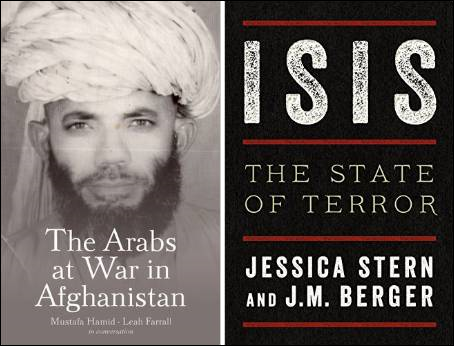
Farrall & Berger

**

I recently received a review copy of Mustafa Hamid & Leah Farrall‘s breakthrough book, The Arabs at War in Afghanistan, courtesy of the publisher, Michael Dwyer of Hurst, and will be writing it up once I’ve finished devouring it:

A former senior mujahidin figure and an ex-counter-terrorism analyst cooperating to write a book on the history and legacy of Arab-Afghan fighters in Afghanistan is a remarkable and improbable undertaking. Yet this is what Mustafa Hamid, aka Abu Walid al-Masri, and Leah Farrall have achieved with the publication of their ground-breaking work.

The result of thousands of hours of discussions over several years, The Arabs at War in Afghanistan offers significant new insights into the history of many of today’s militant Salafi groups and movements.

Huzzah!

An almost unbelievable and very welcome collaboration.

**

And:

Huzzah!

Jessica Stern is terrific, while JM Berger is not only one of our ablest analysts, but also a good friend. This book will be an eye-opener.

Apocalypse Row: Netanyahu, Nukes, and Iranian Eschatology — Tim Furnish

Monday, March 2nd, 2015

[ guest post by Tim Furnish, posted by Charles Cameron ]
.

Blog-friend and occasional guest poster Dr Tim Furnish just posted this very timely piece at his MahdiWatch blog, and I am delighted to post it in its entirety here with Tim’s permission.

**

Israeli Prime Minister Benjamin Netanyahu will speak to a joint session of the US Congress on Tuesday, March 3, 2015.  If his speech earlier today at the American-Israeli Public Affairs Committee (AIPAC) was any indication, the Islamic Republic of Iran and its pursuit of nuclear weapons will be the major topic.  Partisan bickering (about whether the Republican majority in the House and Senate wished to insult President Obama) aside,  the central issue boils down to whether Bibi is correct in his long-held belief that the IRI leadership amounts to a “messianic, apocalyptic, radical cult” which must be stopped at all costs from going nuclear (as he first said six years ago).   

He is not.  

Now as my usual friends and colleague sharpen their knives, allow me to explain.  First off, I am a staunch supporter of Israel, as both a Christian and an American, and have been there three times in the last decade.  Also, now that Turkey, under Sultan Erdoğan, has slipped back into Neo-Ottomanism, Israel is the only truly democratic nation in the Middle East.  Along with the Kurds, the Israelis are our closest allies in that region.  

But that does not mean that everything Israeli is automatically correct.  And this claim that Iran wants nuclear weapons in order to use them on Tel Aviv and thus spark the coming of the 12th Imam al-Mahdi is a gross misreading of Twelver Shi`i doctrines as well as of Iranian politics. 

I examined this issue in depth for the Institute for Near East & Gulf Military Analysis back in 2011, in a paper entitled “A Western View on Iran’s WMD Goal: Nuclearing the Eschaton, or Pre-Stocking the Mahdi’s Arsenal?”  The major points therein follow, after this pictorial message:

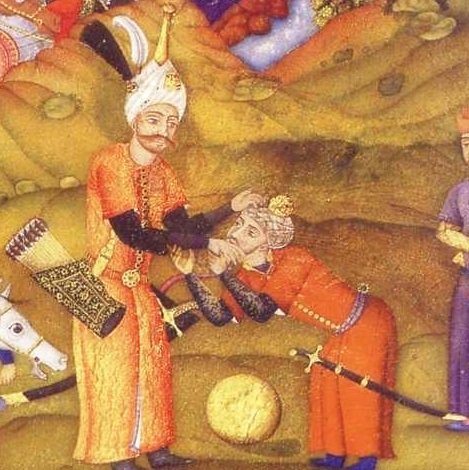
Ismail
Safavid Shah Isma’il (L), founder of the 16th c. dynasty that converted Iran to Twelver Shi`ism. HE would not have hesitated to use nukes (in fact, his turban itself is weaponized). But Khamenei? Not bloody likely.

Z  Belief in the return of the 12th Imam from ghaybah, “occultation,” is not “fringe” or “extremist” but a mainstay of this brand of Islam (just as is the doctrine of Jesus’ return for all orthodox Christians).

Z The 12th Imam’s reappearance is totally up to Allah’s discretion; nothing humans can do will advance his timetable.  “Hotwiring the apocalypse” depends not on WMD usage or any other violent activity but, rather, hinges on creating the Mahdist state in microcosm (i.e., the IRI) and then waiting on Allah to send the Mahdi to rule it.

Z The anjuman-i hujjatiyeh (“Hujjatiyeh Society”) is not some insane group dedicated to destroying Israel but an organization dedicated to re-converting Baha’is to Twelver Shi`ism—and, furthermore, was banned in the early 1980s for being insufficiently supportive of Ayatollah Khomeini’s clerical rule.

Z As per the excellent article by Ze’ev Maghen, “Occultation in Perpetuum: Shi`ite Messianism and the Policies of the Islamic Republic,” the ruling ayatollahs are probably the most vociferous opponents of a true Mahdist claim on the planet—because acknowleding anyone as such would end their rule of Iran, and with it their wealth, power and privilege. 

Z Twelver Shi`i views of jihad mandate that jihad-i ghalaba, “victorious holy war,” be prohibited until the return of the 12th Imam—NOT employed to importune him to appear.  Usage of nuclear weapons is thus really not allowable for the apocalypse-hotwiring which many pundits impute  to Iran.

Z Yes, some Iranian leaders have spoken, repeatedly, of Israel being “erased from the pages of history.”  But I believe that this means they believe in a gradual demographic disintegration of the “Zionist entity,” and not a mushroom cloud over Israel.

Z It is possible for men to have long beards, wear turbans, express eschatological beliefs and yet still be rational political actors. The Supreme Leader and his cronies all know that were Iran to use a nuclear weapon against Israel, their nation would be a radioactive ruin about 15 minutes later. The Mahdi has no desire to rule over such a wasteland. Plus, it would deprive the clerics of their wives and Rolls Royces.

Z All of the above by no means makes the IRI a peaceful or trustworthy state.  The ruling ayatollahs want nuclear weapons not only to hold onto their power (as per the ruling clique in Pyongyang) but to provide immunity against possible American military strikes and to increase Tehran’s regional clout—just not to summon the Mahdi via a nuclear conflagration.  

President Jarrett, er, Obama and SecState John Kerry are fools to think that any written agreement will disabuse Khameini and his ilk of their lust for nuclear weapons.  But attempting to counter the administration’s naiveté with inane bluster that misepresents our enemy’s beliefs and intentions amounts to falling off the horse on the opposite side.  Instead, let’s try sitting upright on a strong horse and avoiding partisan extremes of misapprehension.  


Switch to our mobile site