zenpundit.com » 2015 » April

Archive for April, 2015

Boston: Apocalyptic Hopes, Millennial Dreams and Global Jihad

Sunday, April 19th, 2015

[ by Charles Cameron — “The now defunct Center for Millennial Studies at Boston University (1996-2003) brings to the public one final conference on apocalyptic beliefs” ]
.

If this was a movie, I’d say the speakers at this conference were a “stellar cast”! Will McCants, Graeme Wood, Cole Bunzel, Timothy Furnish, David Cook, JM Berger, Husain Haqqani.. Paul Berman and Ayaan Hirsi Ali..

I participated in several of the old Center for Millennial Studies conferences that Richard Landes organized around the turn of the millennium, and they were intense academic highlights for me. I thought it very short-sighted when CMS funding was cut after the turn of the year 2000, agreeing with Dr Landes that millenarianism was unlikely to go away any time soon — and AQ, and IS even more so, have more than proven his point — hence this “final” conference.

If you can attend, by all means do — highly recommended. I’m delighted to have been invited to attend myself, and hope to keep Zenpundit readers well informed.

**

Apocalyptic Hopes, Millennial Dreams and Global Jihad: May 3-4, 2015, Boston University

Sponsored by the BU History Department and Scholars for Peace in the Middle East

Most Westerners associate the terms apocalyptic and millennial (millenarian) with Christian beliefs about the endtime. Few even know that Muhammad began his career as an apocalyptic prophet predicting the imminent Last Judgment. And yet, for the last thirty years, a wide-ranging group of militants, both Sunni and Shi’i, both in coordination and independently, have, under the apocalyptic belief that now is the time, pursued the millennial goal of spreading Dar al Islam to the entire world. In a manner entirely in keeping with apocalyptic beliefs, but utterly counter-intuitive to outsiders, these Jihadis see the Western-driven transformation of the world as a vehicle for their millennial beliefs, or, to paraphrase Eusebius on the relationship between the Roman Empire and Christianity: Praeparatio Califatae.

The apocalyptic scenario whereby this global conquest takes place differs from active transformative (the West shall be conquered by Da’wa [summons]) to active cataclysmic (bloody conquest). Western experts have until quite recently, for a wide range of reasons, ignored this dimension of the problem. And yet, understanding the nature of global Jihad in terms of the dynamics of apocalyptic millennial groups may provide an important understanding, both to their motivations, methods, as well as their responses to the inevitable disappointments that await all such believers. The now defunct Center for Millennial Studies at Boston University (1996-2003) brings to the public one final conference on apocalyptic beliefs, co-sponsored by the BU History Department and Scholars for Peace in the Middle East (SPME).

**

Schedule:

*All events will take place in the Stone Science Building (645 Commonwealth Ave), room B50

Sunday, May 3

10:00-12:00 Introduction:

1. Richard Landes, “Globalization as a Millennial Praeparatio Califatae: A Problematic Discussion
2. William McCants, Brookings Institute: “ISIS and the Absent Mahdi: Studies in Cognitive Dissonance and Apocalyptic Jazz”
3. Graeme Wood, Yale University, Atlantic Monthly: “On the Resistance to seeing Global Jihad as Apocalyptic Movement”

12:00-1:30 Break for Lunch

1:30-3:30 Panel II: The Millennial Goal: Global Caliphate

1. Cole Bunzel, Yale U.: ISIS: From Paper State to Caliphate: Hotwiring the Millennium
2. Timothy Furnish, Independent Scholar: “Varieties of Transformative (non-violent) Jihadi Millennialism
3. Jeffrey Bale: Monterey Institute of International Studies, “The Persistence of Western ‘Mirror Imaging’ and Ideological Double Standards: Refusing to Take Islamist Ideology Seriously

4:00-5:30 Panel III: Case Studies in Apocalyptic Jihad

1. David Cook, Rice University: “ISIS and Boko Haram: Profiles in Apocalyptic Jihad”
2. JM Berger, Brookings Institute, “The role of communications Technology in mediating apocalyptic communities”
3. Mehdi Khalaji, Washington Institute of Near East Policy: “Apocalyptic Revolutionary Politics in Iran”

Monday, May 4

10:0-12:00 Panel IV: Conspiracy Theory and Apocalyptic Genocide

1. Itamar Marcus, Palestinian Media Watch, “Anti-Semitism, Conspiracy Theory and Apocalyptic Global Jihad”
2. Charles Small, “Ideology and Antisemitism: Random Acts or a Core Element of the Reactionary Islamist Global Jihad?”
3. Richard Landes, BU, “Active Cataclysmic Apocalyptic Scenarios, Demonizing and Megadeath: Taiping, Communists, Nazis, and Jihadis.”
Comments: David Redles, Michael Barkun

12:00-1:30 Break for Lunch

1:30-4:00 Final Panel Discussion

Paul Berman, Independent Scholar
Ayaan Hirsi Ali, Independent Scholar
Jessica Stern, Harvard University
Husain Haqqani, Hudson Institute
Charles Strozier, John Jay College
Brenda Brasher, Tulane University

**

Selected Work

Ayaan Hirsi Ali
Read “Those Who Love Death: Islam’s Fatal Focus on the Afterlife” from Heretic (2015) Here

Jeffrey Bale
Read “Islamism and Totalitarianism” (2009) Here
Read “Political Correctness and the Undermining of Counterterrorism” (2013) Here

J.M Berger
Read “The ISIS Twitter Consensus” (2015) Here
Professor Berger’s latest book, coauthored with Jessica Stern, ISIS: State of Terror, can be purchased Here

Paul Berman
Read “Why is the Islamist Death Cult So Appealing?” (2015) Here

Cole Bunzel
Read “From Paper State to Caliphate: The Ideology of the Islamic State” (2015) Here

Medhi Khalaji
Read “Apocalyptic Politics: On the Rationality of Iranian Policy” (2008) Here

Richard Landes
Read “Enraged Millennials” from Heaven on Earth: The Varieties of the Millennial Experience (2011) Here

William McCants
Read “The Sectarian Apocalypse” (2014) Here

Jessica Stern
Read “The Coming Final Battle” from ISIS: State of Terror (2015) Here

Charles Strozier
Professor Strozier’s book, The Fundamentalist Mindset can be purchased Here

Graeme Wood
Read “What ISIS Really Wants” (2015) Here
April 19th anniversaries & Hegghammer’s “terrorist culture”

Sunday, April 19th, 2015

[ by Charles Cameron — Thomas Hegghammer has an important new piece out, and today’s anniversaries offer an insight into why it’s important ]
.

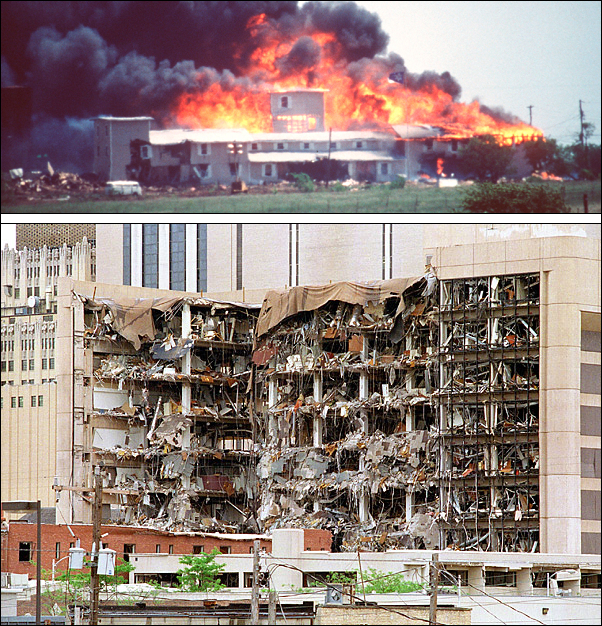
Waco OKC

upper panel: the end of the siege of Mt Carmel, Waco, TX, 19 April 1993
lower panel: aftermath of the Oklahoma City bombing, OKC, 19 April 1995

**

The bombing of the Alfred P. Murrah Federal Building in Oklahoma City took place twenty years ago today. Defense attorneys for Timothy McVeigh, who was execute for the atrocity, suggested to the court that the bombing took place on the date set for the execution of Richard Snell, who had earlier plotted to blow up the same building. From the Denver Post:

A white supremacist executed 12 hours after a bomb ripped through the Alfred P. Murrah Federal Building “was the driving force” behind a plot to bomb the building 12 years earlier, according to a government memo filed by Timothy McVeigh’s lawyers.

The report was filed in U.S. District Court as McVeigh’s attorneys attempted to bolster their appeal of his conviction and death sentence with arguments that people other than McVeigh may have been involved in the bombing.

Richard Wayne Snell was mad at the Internal Revenue Service in 1983 and wanted to blow up the Oklahoma City building as revenge for IRS agents raiding his home, Fort Smith-based federal prosecutor Steven Snyder told the FBI in June 1995.

April 19 1995 was also the second anniversary of the final holocaust in the siege of the Branch Davidian compound at Waco, Texas. Mc Veigh himself told reporters Lou Michael and Dan Herbeck in a letter:

If there would not have been a Waco, I would have put down roots somewhere and not been so unsettled with the fact that my government … was a threat to me. Everything that Waco implies was on the forefront of my thoughts. That sort of guided my path for the next couple of years.

Furthermore, in their book, American Terrorist, Michael and Herbeck report:

The date he chose for the bombing was significant in two ways. Not only was it the second anniversary of the Waco raid, just as important to McVeigh, April 19, 1995, was the 220th anniversary of the Battle of Lexington and Corncord, the “shot heard ’round the world” that began the war between American patriots and their British oppressors. To McVeigh, this bombing was in the spirit of the patriots of the American Revolution, the stand of a mpodern radical patriot against an oppressive government.

**

I hope to put a post up in which I excerpt from and comment directly on Thomas Hegghammer‘s Wilkinson Memorial lecture shortly. I have been in internet hell recently, having difficulty accessing this site to edit and post, and given the date I thought it would be appropriate to post this first, however, as an example (to my mind) of what Hegghammer is talking about.

April 19 — today’s date — was triply significant to McVeigh, then, in a way that corresponds closely to Hegghammer’s definition of jihadi culture:

I define jihadi culture as products and practices that do more than fill the basic military needs of jihadi groups. This is very close to what the anthropologist Edmund Leach called “technically superfluous frills and decorations.” [ .. ]

Now think of a jihadi group. It has certain “basic needs”, such as the capacity to deploy violence and the ability to muster material resources. These needs can, conceivably, be fulfilled in a minimalist, no-frills fashion: you train, fight, raise funds, purchase weapons, write a communiqué, get some sleep, repeat the next day. To put it simply, these are the “functionally essential” elements of rebellion; everything else is culture.

The Oklahoma City bombing was held on a date that meant a great deal to Timothy McVeigh – in terms of Waco, in terms of the shot heard around the world – and on the very day of the execution of a noted white supremacist who had plotted to bomb the Murrah building, and who lived to see McVeigh destroy it shortly before he died.

Putting that another way, we can see the workings of a sort of poetic appropriateness – akin to “poetic justice” – from McVeigh’s point of view, in destroying the Murrah building on this particular day. The timing is not, in Hegghammer’s terms, “functionally essential” — it is cultural.

And what Leach called the “frills” and Hegghammer “culture” may be easily overlooked because the no-frills functional essentials seem at first glance more important –- but such things are not inessential to McVeigh, nor to Hegghammer’s jihadists who sing anasheed and write poems.

They’re essential – to the terrorists, and to our understanding of terrorism.

That’s why today is important – and Hegghammer’s lecture, likewise. I hope to return to a fuller exploration of his text as soon as my computer woes are ended.

Today’s conventional wisdom yesterday

Sunday, April 19th, 2015

[found by Lynn C. Rees]

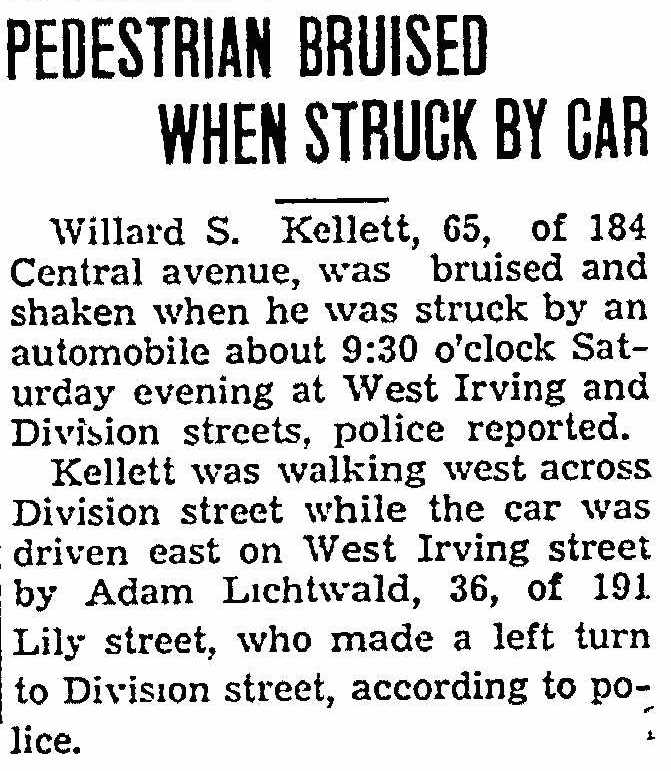
Searching for items on Willard Sidney Kellett (1876-1962), my second cousin twice removed, I found this story in the Oshkosh Daily Northwestern, dateline December 23, 1940:

My eyes drifted to this story on another bruising collision, found on the same page:

roy


UPI war expert Mason was a member of that generation of Americans who elevated this nation to global numero uno, displacing the decrepit Old Enemy:

J. W. T. (Joseph Warren Teets) Mason (1879-1941) was an American who devoted himself to the study of Eastern philosophy and religion. Born on January 3, 1879 in Newburgh, New York, Mason graduated from New York University and decided to become a journalist to follow in his father’s footstep[s]. He worked for the Scripps McRae Press Association as its London Editor, and when the company merged into the United Press Associations in 1907, he became the European Manager. A year after the appointment at the United Press, however, he resigned from the post and returned to the United States. In the following years, he worked for the Daily Express as the New York Editor (1908-1931), specifically as the war writer during the World War I. After the War, he also worked for the United Press as the foreign affairs writer (1918-30). While he was in Europe on his job, he became acquainted with famous philosophers, such as Henri Bergson, Benedetto Croce, and F. C. S. Schiller. He also met Japanese diplomats Suematsu Kenshu and Hayashi Gonsuke, who introduced him to Japanese Shinto, the native religion of Japan, and Confucianism. His interest in Eastern civilization grew, and he published two books, Creative East (1926) in New York and Creative Freedom (1928) in London.

Although he had been already acquainted with many Japanese officials, scholars, and priests both in and out of Japan, a visit to Japan was not realized until 1932. During his stay in Japan, he attended many Shinto ceremonies and lectured on Japanese religions and cultures all over in Japan. He published Kaminagara no michi (1933) (English language edition, The Meaning of Shinto, was published in New York in 1935) and The Spirit of Shinto Mythology (1939) in Tokyo. He was a member of many associations including the Meiji Japan Society, the Asiatic Society of Japan, and the Kyoto Buddhist Association. Although the year he departed Japan is unknown, he died in New York on May 13, 1941.

Mason, whose death preceded Pearl Harbor by seven months, accurately forecasts factors that led to later “axis” defeat:

  • “long endurance of America”? Check.
  • “shipbuilding and defense production” sped up in wartime by “psychological pressure to unprecedented levels”? Check.
  • “fearful risk of complete defeat by extending the war”? Check.

Mason’s forecast is overly generous to “Tokio”. It claims it’s “scarcely” possible that Japan could be drawn into war by “axis arguments based on desperate hopes”. Mason’s forecast is equally overly generous to Berlin in claiming it’s “scarcely” likely it had reached a “state of mental outlook” that would lead to war with the United States. Mason’s working definition of “scarcely” seems to equal one year, plus or minus a few weeks.

It wouldn’t surprise me if Mason’s Japanese acquaintances were among those Japanese who “can be realistic”. Americans often see foreign things through interlocutor eyes with enough shared tics to completely veil the alien. However, Mason’s qualified use of can reflects some awareness that the Japanese did not have to be realistic, at least according to Masonic definitions rooted in American notions of what is realistic under conditions of scarcely. Some Japanese knew that Japan’s chances of victory in a Materialschlacht with the reigning Master of More were materially non-existent. Cue ominous music, background to yet another seemingly prophetic incantation of Yamamoto Isoroku’s supposed quote.

Yamamoto’s supposed compliment is popular in this country, land of the “sleeping giant”. It’s a meditation on our own awesomeness, like listening to the sound of one back slapping. This sketchy acknowledgment impressed some later Americans so much that they sometimes elevate Yamamoto to honorary American, in consciousness if not de jure. Yamamoto was a reverse Mason: he spent time in America. He must have known he would lose as far back as 1919. Tojo and friends must be blockheads if they don’t listen to their Yamamotos and preemptively surrender to American awesomeness.

But some foreign observers were realists even by Masonic standards. They saw American “moral aggression”, felt its potency, and saw that their only realistic counter was to scale up to American economies of scale, even if the scaling up was a gamble on the sleeping giant staying asleep while they carved out American beating lebensraums out of some promising part of Eurasia. Adam Tooze has argued that, after 1916, American power was so overwhelming that other global polities that aspired to greatness were de facto international insurgents against American dominion and its Masons. A Japanese “who can be very realistic” was someone like Lt. Col. Kanji Ishiwara, Imperial Japanese Army. He gambled that Japan could carve its American beating lebensraum out of China, allowing teeny Japan to materially go toe to toe with the American colossus before the colossus scarcely knew what hit it. Ishiwara gambled, a gamble that fathered a cascade of gambles toppling towards Hiroshima.

For Ishiwara, there had to be a shortage of Masons that could see what he or his German mentors were up to as they tried lebensrauming Eurasia if his gamble was to succeed. Unfortunately for Ishiwara, there were enough Masons, some even deigning to write columns read in Oshkosh, Wisconsin and other outposts of America’s trend-setting lebensraum, to frustrate Ishiwaran insurgents of the mid-20th century. These Masons of a new order knew what was up with Ishiwara and ilk. This made Ishiwaran projects unrealistic. For Ishiwara and friends, nemesis was spelled Willard Sidney Kellett: they were cruising for his bruising.

The arc of the moral universe: two versions

Saturday, April 18th, 2015

[ by Charles Cameron — MLK and Cardinal George ]
.

SPEC DQ ML Card George

Both Martin Luther King, Jr and Francis, Cardinal George, know how to turn a well-turned phrase. Both make strong statements, and although they seem to take opposite tacks on the surface, I’m not sure that in the long view they conflict.

Cardinal George died yesterday, may he rest in peace.

Those demned Sunni Shiites

Friday, April 17th, 2015

[ by Charles Cameron — for those unused to the word, and potentially troubled by it, demned is a cussword much favored by The Scarlet Pimpernel ]
.

The Prophet said “War is deceit” according to Sahih al-Bukhari, the most highly respected collection of ahadith — as did Sun Tzu before him, writing “All warfare is based on deception” according to one translator. I shouldn’t have been surprised, therefore, by this reversal of understanding reported by journo Richard Engel, captured, then released, then very surprised himself by what he later discovered about his captors:

SPEC DQ the Sunni Shiites

Source:

  • Both quotes, which we can call “before” (upper panel) and “after” (lower panel) are drawn from Richard Engel’s New Details on 2012 Kidnapping of NBC News Team in Syria

  • Switch to our mobile site