zenpundit.com » 2015 » June

Archive for June, 2015

The Chinese Strategic Tradition: A Research Program (II)

Friday, June 5th, 2015
[by T. Greer]
This post is the second in a series. It was originally published at The Scholar’s Stage on the 26th of May, 2015. I strongly recommended readers start with the first post in this series, which introduces the purpose and methods of this essay. That post focused on what is published in English on Chinese strategic thought. This post focuses on what has been written about Chinese strategic practice–that is, the military, diplomatic, and political history of China’s past. 
A map depicting the most famous military campaign in East Asian history, decided at the Battle of Red Cliffs (208 AD) in modern-day Hubei.
Source: Wikimedia

STRATEGIC PRACTICE 

In the West, the study of traditional China has been the domain of the Sinologists. For reasons that are entirely natural but also too complex and lengthy to explain here, this has meant that historians studying traditional China have focused their efforts on the history of Chinese philosophy, aesthetics, literature, and religion, as well as the closely related fields of archeology, linguistics, and philology. The much lamented decline of political, diplomatic, and military history across the American educational system had little perceivable effect here, for there was not much political, diplomatic, or military history to begin with. [1]

It should not be a surprise that many of the most important books on Chinese military and diplomatic relations have not been written by historians, but by political scientists. The interest political scientists might have in these topics is obvious, for theirs is a field devoted to the scientific and theoretical exploration of politics and international relations. The real mystery is why it took so long for political scientists to start writing about traditional East Asian international relations in the first place (most of the important books are less than a decade old). The answer to that question is not too hard to find if one looks at the books being written. The new crop of scholars writing these books hail from the international relations (IR) side of the science, and are part of a growing critique of the grand IR theories the discipline traditionally used to make sense of international affairs. [2] These theories were for the most part developed and tested in reference to traditional European great power politics.  One of the central barbs of these critiques is that we cannot know if the grand theories of generations past describe truly universal laws  or simply describe patterns unique to European history if these theories have not been tested on case studies outside of the last few hundred years of European politics. In response, scholars have searched for case studies outside of Europe with which they can test these theories or find the data needed to develop new ones entirely. East Asia, a region filled with bureaucratic states thousands of years before their development in the West, was a natural place to start.

The problem these researchers repeatedly ran into was that their fellow political scientists were not familiar enough with East Asian history to follow their arguments and there were no good primers on the topic to refer them to. So theses scholars ended up writing the historical narratives others would need to read before they could assess their theoretical arguments. Thus Victoria Tinbor Hui‘s chapter on the Warring States (453-221 BC) in War and State Formation in Ancient China and Early Modern Europe is one of the best narrative accounts of Warring States great power politics; Wang Yuan-kang‘s Harmony and War: Confucian Culture and Chinese Power Politics contains one of the only accounts of Song Dynasty (old style: Sung, 960-1279 AD) foreign relations and one of the most fluid narratives of the Ming Dynasty‘s (1368-1644) adventures abroad; and David Kang‘s East Asia Before the West: Five Centuries of Trade and Tribute has the most coherent discussion of the Chinese “tributary system” written in the last five decades. Historians have lauded these books for the amount of historical research that was poured into them [3], and I second their appraisal. As a field IR should take Asia more seriously and it should engage with historical sources more thoroughly than is common practice. However, I cannot help but lament the circumstances that pushed IR scholars to adopt these methods. Hopefully historians feel some shame over the sorry state of the field and how difficult it is for outsiders to approach their research.

One example will suffice to prove the point. I mentioned that Wang Yuan-kai’s War and Harmony has one of the few complete accounts of the Song Dynasty’s international relations. As far as scholarship goes, the amount of material devoted to this topic is middle-of-the-road: there are some periods where scholarship is more plentiful–say, the Late Ming, or the Qing (Ch’ing, 1644-1912), and there are some other periods where the scholarship is much more scarce–say, anything about the Tang (T’ang, 610-907 AD) or Han (206 BC-220 AD) dynasties. It is an interesting period to work with, for it is one of the few times in Chinese history when China was faced with external enemies whose military power was undeniably stronger than her own. It was the time of some of the most famous military figures and most horrible military disasters in Chinese history.  It also saw some of the most historically influential debates about how to manage civil-military relations and the relationship between economic prosperity and military power. (more…)
Twitter games: chess and war

Friday, June 5th, 2015

[ by Charles Cameron — more for the fun and war games file ]
.

There’s Aaron Zelin‘s piece,

**

Then there’s this DoubleTweet from Daveed Gartenstein-Ross:

and (brilliantly played!) Phineas Fahrquar:

**

Both the linked pieces are worth your while:

  • Aaron Zelin, The Islamic State’s Saudi Chess Match
  • Giorgio Bertolin. Why chess is not the right metaphor for human conflict
  • On confusing Liberty with Queen Victoria and the Blessed Virgin

    Friday, June 5th, 2015

    [ by Charles Cameron — ’tis but a short skip from iconography to iconoclasm ]
    .

    Apparently it happens:

    SPEC DQ VR BVM

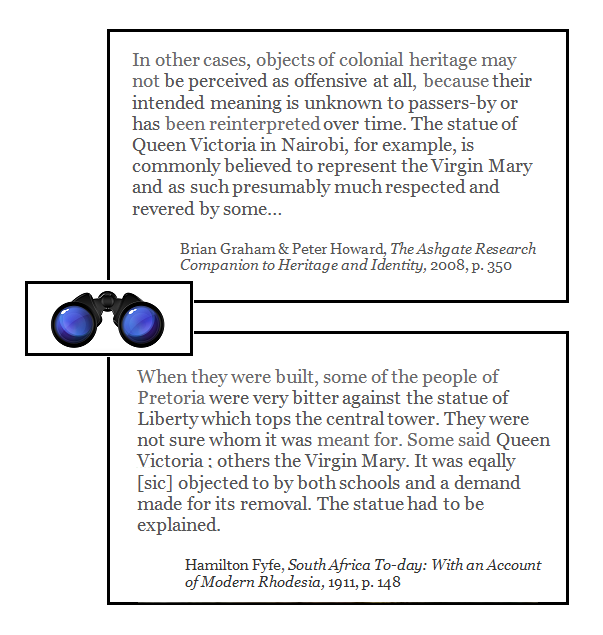
    In the case of Nairobi (upper panel), it is Queen Victoria who is mistaken for the Virgin Mary. In the case of Pretoria (lower panel), Justice is mistaken, variously, for both Her Majesty and Our Lady.

    **

    Is it any wonder people get agitated about graven images?

    How shall “in the box” people think “outside the box”?

    Tuesday, June 2nd, 2015

    [ by Charles Cameron — a gadfly question ]
    .

    We have seen various conversations online in which its is plausibly suggested that YESness leads to upward mobility across an array of silos and disciplines, specifically including the intelligence community and the military — the end result being risk-averse group-think that is pretty much “inside the box” by definition.

    Similarly, we have noted that serious and nuanced issues are frequently debated in the media by those who are known for their general-purpose punditry or seniority, rather than by those with specific knowledge of and insight into the particular issues of concern.

    Question: How shall we get outside the box thinking from inside the box thinkers?

    The Chinese Strategic Tradition: A Research Program (I)

    Tuesday, June 2nd, 2015

    [By T. Greer]
    .

    We’re honored and delighted to announce that blog-friend and commenter T Greer has accepted Zen’s invitation to join us as a member of the Zenpundit team, and trust the following post in two parts will stir fruitful conversation not only here at ZP but across several related blogs.. — Charles Cameron, ZP managing editor

    ____________________________________________________________________________________

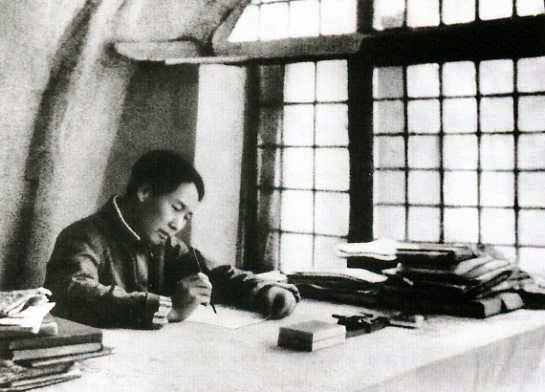
    Mao Zedong writing On Protracted Warfare (Yan’an, 1938)
    Source: Wikimedia.

    This essay was originally published at The Scholar’s Stage on 26 May, 2015. Because of its length it has been divided into two posts, both lengthy in their own right. This–the first of these two posts–is republished here at Zenpundit with little alteration. The second half of the essay shall be posted here later this week.

    INTRODUCTION


    Last fall I wrote a popular series of posts outlining the history of the eight decade war waged between the Chinese Han Dynasty and the Xiongnu (old style: Hsiung-nu) nomadic empire. My posts were a response to a prominent American strategic theorist who misunderstood the history of the Han-Xiongnu relations in his search for enduring patterns in China’s military and diplomatic history relevant to China’s foreign relations today. Unfortunately, this experience was not a singular event. It seems that every month some new book or article is published pushing a misleading version of Chinese history or a strained interpretation of classical Chinese political thought to shore up a new theory of what makes China tick. I could devote this blog solely to refuting these poorly sourced theories and never run out of things to write about.

    Despite these errors, I have a great deal of sympathy for those who pen them. They face a nearly insurmountable problem: many of the thinkers, strategists, and conflicts most important to the Chinese strategic tradition have next to nothing in English written about them. Critical works have yet to be translated, translated works have yet to be analyzed, histories of important wars and figures have yet to be written, and what has been written is often scattered in obscure books and journals accessible only to experienced Sinologists. English speakers simply do not have access to the information they need to study the Chinese strategic tradition.

    This needs to change. It needs to change both for the sake of strategic theory as a discipline, which has essentially ignored the insights and observations gleaned from 3,000 years of study and experience, and for understanding the intentions of our rivals and allies in East Asia, who draw upon this tradition to decide their own political and strategic priorities. But in order to make these necessary changes we need a clear picture of where we are now. This essay attempts to provide this picture. It is not a bibliographic essay per say, for I will freely admit that I have not read all of the books and research articles I will mention below. Some titles I have only read in part; others I have not read at all. However, the goal of this post is not to review the results and conclusions of all these works, but to outline where research has been done and where more research is needed. For this purpose awareness suffices when more intimate knowledge is lacking.

    Mastering 3,000 years of intellectual and military history is a gargantuan task. But in order to find the answers to some of the questions inherent in the study the Chinese strategic tradition, it must be done. I make no such claim of mastery. My expertise is uneven; I am most familiar with both the strategic thought and the actual events of the China’s classical period (Warring States through the Three Kingdoms era, c. 475 BC-280 AD), and am probably weakest when discussing the first two decades of the 20th century, a time critical to the development of the tradition but difficult to master because of the number of political actors involved, the complexity of their relations, and the great intellectual variety of the era. Despite these weaknesses I know enough to chart out the broad outlines of current scholarship, a charge most specialists in strategic theory cannot attempt and most Sinologists would not desire. These biases and proclivities have kept the two disciplines far apart; there is an urgent need for these two scholarly bodies to draw together. If this essay–which is addressed primarily to the first group but should be accessible to second–helps in some small way to bring this to pass I shall consider it a grand success.

    This essay shall have three parts divided over two posts. The final section is a list of recommendations on how to establish and develop the study of the Chinese strategic tradition as an academic sub-field, as well as some thoughts on where individual Anglophone scholars might focus their research. The two earlier sections will review what has been published in English about the Chinese strategic tradition already. The term “the Chinese strategic tradition” is usually used in reference to the thinkers and the theorists of Chinese history, not the commanders and ministers who actually implemented policy. In the West this is almost always how the topic is discussed. Texts like Sun-tzu’s Art of War (hereafter, the Sunzi) are dissected with little reference to the way its thought was consciously implemented by those who studied it most carefully. This is a mistake. Most of the pressing questions in this field can only be answered by looking at how Chinese soldiers and statesmen actually behaved, and most of the errors common to Western punditry can be sourced to this tendency to ignore actual events in favor of theory. [1] In the case of ancient histories–whose account of events were highly stylized and moralizing–this distinction blurs. However, for the sake of organization I shall maintain the distinction between strategic thought (a subset of intellectual history) and strategic practice (a subset of diplomatic, political, and military history), covering each in turn.

    (more…)


    Switch to our mobile site

