zenpundit.com » 2016

Archive for 2016

Profoundly human: body, speech and mind

Wednesday, August 10th, 2016

[ by Charles Cameron — observing a certain universality across traditions ]
.

Tenzin Wangyal Rinpoche BSM
Tenzin Wangyal Rinpoche is a teacher in the Bon tradition,
the native religion of Tibet

Jamgon Kongtrul Rinpoche, a high lama of the Tibetan Buddhist Karma Kagyu lineage, has this to say:

The nature of all ritual is that symbolic devices are used to create a certain mental attitude. When we offer our body, speech, and mind, we do this though a system of gestures that create that particular meaning. But if the ritual is not based on an understanding of emptiness, then it lacks meaning, and the symbolic gestures could cause confusion.

In Tibetan Buddhism, body, speech, and mind are known as the three vajras — variously translated as diamonds or lightning bolts. Tulku Urgyen Rinpoche, another Karma Kagyu teacher, explained:

Buddha-Nature is present just as the shining sun is present in the sky. It is indivisible from the Three Vajras [i.e. the Buddha’s Body, Speech and Mind] of the awakened state, which do not perish or change.

**

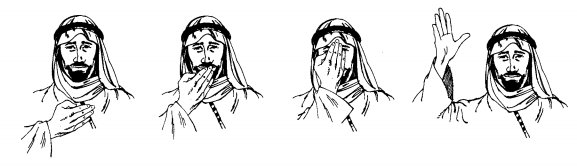
In Arab circles, there’s a formal greeting known as the Salaam, in which to quote Desmond Morris, Bodytalks: A World Guide to Gestures:

Salaam

The hand touches the chest, then the lips, then the centre of the forehead. The action ends with a forward flourish of the hand and is often accompanied by a bow of the head. [ .. ] This is the full version of the salaam, including all three elements. Its message is ‘I give you my heart, my soul and my head.
**

In the United States Catholic Catechism for Adults, we are told to make a triple sign of the cross at Mass:

At Mass when the reading of the Gospel begins, we place the sign of the Cross on our foreheads, lips, and hearts and pray, “May the Lord be in our minds, on our lips, and in our hearts.” Lips, minds, and hearts—these symbolize three kinds of prayer: vocal, meditative, and contemplative. These modes of prayer include formal and informal paths, personal and communal expressions, popular piety, and the liturgical prayer of the Church.

**

Oh, and Gandhi taught:

Gandhi thought word deed4

**

There’s something profoundly human going on here.
The great northern thaw

Tuesday, August 9th, 2016

[ by Charles Cameron — okay, methane, yes, for starters — now add some radioactive waste and anthrax to the brew ]
.

Two recent items that caught my eye:

Tablet DQ Thaw raindeer and radioactivity

Sources:

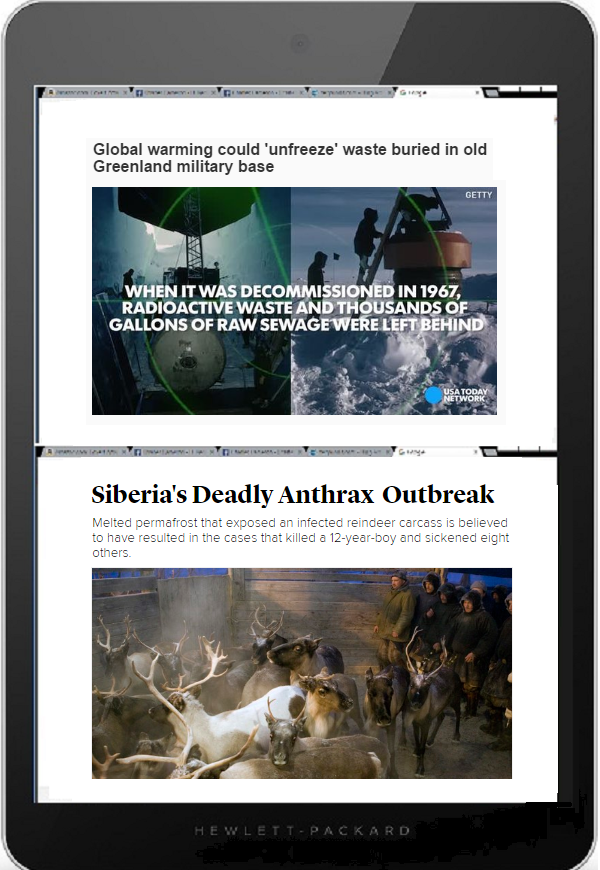
  • USA Today, Global warming could ‘unfreeze’ waste buried in old Greenland military base
  • The Atlantic, Siberia’s Deadly Anthrax Outbreak
  • **

    More generally, we non-expert interested folk have known for a while — assuming, say, we read the New York Times piece, As Permafrost Thaws, Scientists Study the Risks, back in 2011 — that loss of permafrost was hazardous to planetary health:

    Experts have long known that northern lands were a storehouse of frozen carbon, locked up in the form of leaves, roots and other organic matter trapped in icy soil — a mix that, when thawed, can produce methane and carbon dioxide, gases that trap heat and warm the planet. But they have been stunned in recent years to realize just how much organic debris is there.

    A recent estimate suggests that the perennially frozen ground known as permafrost, which underlies nearly a quarter of the Northern Hemisphere, contains twice as much carbon as the entire atmosphere.

    Temperatures are warming across much of that region, primarily, scientists believe, because of the rapid human release of greenhouse gases. Permafrost is warming, too. Some has already thawed, and other signs are emerging that the frozen carbon may be becoming unstable. [ .. ]

    If a substantial amount of the carbon should enter the atmosphere, it would intensify the planetary warming. An especially worrisome possibility is that a significant proportion will emerge not as carbon dioxide, the gas that usually forms when organic material breaks down, but as methane, produced when the breakdown occurs in lakes or wetlands. Methane is especially potent at trapping the sun’s heat, and the potential for large new methane emissions in the Arctic is one of the biggest wild cards in climate science.

    **

    Okay, now we can also think about rotting reindeer carcases and radioactive waste.

    I can’t see Russia from my house, but it looks as though the Russians have the reindeer anthrax issue well in hand, and the “once top-secret subterranean U.S. nuclear base in northern Greenland” with its “radioactive coolant, PCBs, and raw sewage that the military originally believed would stay entombed for millennia” seems to pale in comparison with the possibilities of methane discharge — Cheryl Rofer could no doubt estimate the comparative risks far better than I — so this post is not intended as a scare-alert, but as yet another example of a category that interests me way more than most — which is why I’d like to direct it:

    Attn: Department of Blindspots and Unintended Consequences

    .

    Sunday reprise: of trees and books

    Monday, August 8th, 2016

    [ by Charles Cameron — a brief essay on the Umbertification of texts ]
    .

    There’s an engaging page in the Oxford Dictionaries site called When is a book a tree? which deals, among other things, with the question of whether the origins of the word book and beech are the same.

    In this post, I’d like to quote you a paragraph about books, and several about trees — specifically, in England’s Epping Forest — considering how what you learn about might interestingly relate to the other — trees to books and books to trees.

    **

    Of books:

    A paragraph from Rebecca Solnit‘s The Faraway Nearby via Maria Popova‘s Brain Pickings

    I disappeared into books when I was very young, disappeared into them like someone running into the woods. What surprised and still surprises me is that there was another side to the forest of stories and the solitude, that I came out that other side and met people there. Writers are solitaries by vocation and necessity. I sometimes think the test is not so much talent, which is not as rare as people think, but purpose or vocation, which manifests in part as the ability to endure a lot of solitude and keep working. Before writers are writers they are readers, living in books, through books, in the lives of others that are also the heads of others, in that act that is so intimate and yet so alone.

    **

    Of woods:

    Selected paragraphs from The Secrets of the Wood Wide Web:

    In this way, individual plants are joined to one another by an underground hyphal network: a dazzlingly complex and collaborative structure that has become known as the Wood Wide Web.

    All of these trees will have mycorrhizal fungi growing into their roots. You could imagine the fungi themselves as forming a massive underground tree, or as a cobweb of fine filaments, acting as a sort of prosthesis to the trees, a further root system, extending outwards into the soil, acquiring nutrients and floating them back to the plants, as the plants fix carbon in their leaves and send sugar to their roots, and out into the fungi. And this is all happening right under our feet.

    The implications of the Wood Wide Web far exceed this basic exchange of goods between plant and fungi, however. The fungal network also allows plants to distribute resources—sugar, nitrogen, and phosphorus—between one another. A dying tree might divest itself of its resources to the benefit of the community, for example, or a young seedling in a heavily shaded understory might be supported with extra resources by its stronger neighbors.

    The revelation of the Wood Wide Web’s existence, and the increased understanding of its functions, raises big questions—about where species begin and end? about whether a forest might be better imagined as a single super-organism, rather than a grouping of independent individualistic ones? and about what trading, sharing, or even friendship might mean among plants.

    **

    Trees and books, libraries and forests — interleave them.

    Monastic drums

    Monday, August 8th, 2016

    [ by Charles Cameron — sounds resounding, Romania and Korea ]
    .

    Romanian Orthodox:

    Korean Buddhist:

    Hope as slogan, hope as navigation

    Sunday, August 7th, 2016

    [ by Charles Cameron — a visual DoubleQuote on the difference between artist and politician ]
    .

    As you may have gathered, I’m an admirer of the artist Alyce Santoro‘s work, and yesterday I came across her Existential Navigational Chart, with its little note in the bottom left corner:

    Soundings in the Unfathomable at Mean Low Water (MLW)

    In any case, it reminded me of the enormous difference between a political slogan and an artist’s insight.

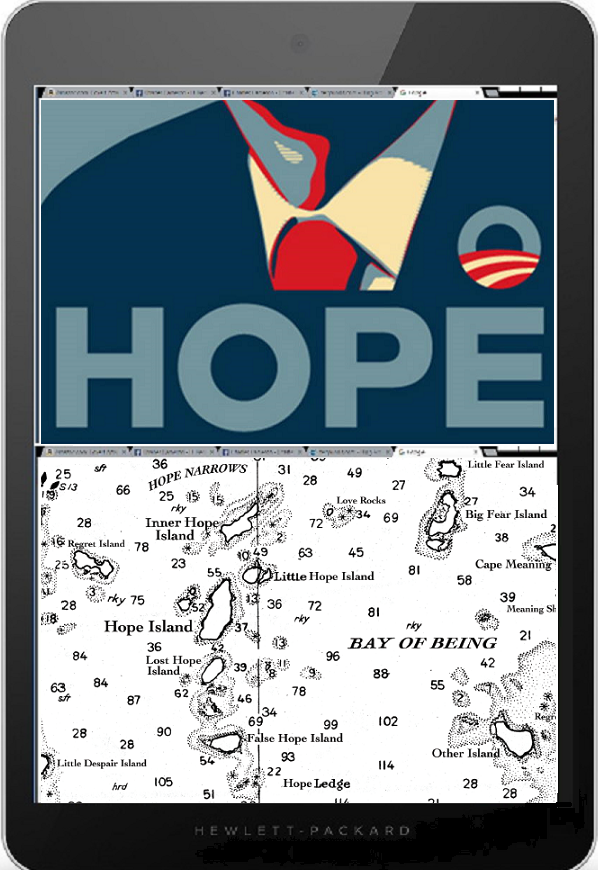
    Obama‘s HOPE (upper panel, below) was a lure, an appeal to an ideal in the sea of practical politics — and opinions are divided as to how well he managed to fulfill that one-word promise:

    Tablet DQ 600 hope and hope islands

    Alyce‘s navigational mapping of area surrounding the the Hope Islands (lower panel, above) on the other hand, is both more fanciful and more realistic — a wonderful combination if you think about it. Notice the nuance she manages to pack into her map, with Inner Hope Island, Little Hope Island, Hope Island, and on southwards to Lost Hope Island, False Hope Island, and Hope Ledge — and all so close to both Little Despair Island, and Love Rocks —

    Who, truly alive, has not been stranded on one or more of those islands, nor dashed against Love Rocks?

    **

    You can download a print quality, high resolution file of Alyce’s chart without cost, or click through to her Philosoprop shop to purchase a signed copy.


    Switch to our mobile site