zenpundit.com » 2016

Archive for 2016

The reversal of Maugham’s Samarra

Tuesday, May 10th, 2016

[ by Charles Cameron — how British and American literature, a Talmudic tale and a Sufi teaching story conspire — twice — to illuminate current events in Iraq and Syria ]
.

Let’s start with Somerset Maugham‘s telling of the Appointment in Samarra, which John O’Hara borrowed as the epigraph of his novel by that name:

The speaker is Death

There was a merchant in Bagdad who sent his servant to market to buy provisions and in a little while the servant came back, white and trembling, and said, Master, just now when I was in the marketplace I was jostled by a woman in the crowd and when I turned I saw it was Death that jostled me. She looked at me and made a threatening gesture, now, lend me your horse, and I will ride away from this city and avoid my fate. I will go to Samarra and there Death will not find me. The merchant lent him his horse, and the servant mounted it, and he dug his spurs in its flanks and as fast as the horse could gallop he went. Then the merchant went down to the marketplace and he saw me standing in the crowd and he came to me and said, Why did you make a threating getsture to my servant when you saw him this morning? That was not a threatening gesture, I said, it was only a start of surprise. I was astonished to see him in Bagdad, for I had an appointment with him tonight in Samarra.

**

Here’s the version of the same story found in the Babylonian Talmud, Tractate Sukkah 53a:

R. Yohanan stated: A man’s feet are his guarantors? they lead him to the place where he is wanted. There were once two Cushites who attended on Solomon, and these were Elihoreph and Ahyah, the sons of Shisha, scribes, of Solomon (I Kings 4:3). One day Solomon observed that the Angel of Death was distressed. He asked him: Why are you distressed? He responded: They have demanded from me the two Cushites who sit here. [Solomon] gave them over to the demons and sent them to the district of Luz. When they reached the district of Luz they died. On the following day he observed that the Angel of Death was smiling He said to him: Why are you smiling? He responded: To the place where they expected them from me, there did you send them!’ Solomon immediately began to say: A man’s feet are his guarantors? they lead him to the place where he is wanted.

**

In February 2014 in the US Jewish magazine Forward, writer JJ Goldberg made fine use of this tale, applying it to a then-contemporary news event in his piece, Lesson of the Talmud in an Iraq School Suicide Bombing:

School massacres have become so commonplace that they scarcely shock us anymore. And yet, occasionally mayhem invades the sanctity of the classroom in a way that can still puncture our complacency. At these moments we’re reminded how fragile is this thing we call civilization. Such was the case February 10 in a rural schoolroom outside Samarra in north-central Iraq, where a terrorism instructor teaching a class in suicide bombing accidentally detonated a live explosive belt. Twenty-one students died along with their teacher. It happened in a training camp run by the Islamic State of Iraq and Syria, the Sunni terrorist group that was recently expelled from Al Qaeda for, of all things, its excessively brutal extremism in the Syrian civil war. [ .. ]

The location of the suicide school in Samarra has layers of poetic resonance, probably unintended by ISIS. Though predominantly Sunni, the city is revered by Shi’ites as the place where the last caliphs are buried and the Mahdi disappeared. Its name resonates in medieval Islamic lore with mysteries of suicide and predestined death, echoed in modern Anglo-American literature and linked to Talmudic legend.

After discussing the Talmudic and Maugham versions, Goldberg concludes:

Thus, the lesson of Samarra. In Arabic lore, we’re drawn helpless to our predestined deaths. In the Talmud, it’s kings who dispatch us with the best intentions to what they assume will be a cakewalk, but it’s we — or, per the Talmud, the king’s black soldiers — who do the dying.

**

The Afghan Sufi writer Idries Shah tells the story in his brilliant little book Tales of the Dervishes, under the title When Death Came to Baghdad:

The disciple of a Sufi of Baghdad was sitting in the corner of an inn one day when he heard two figures talking. From what they said he realized that one of them was the Angel of Death.

“I have several calls to make in this city during the next three weeks,” the Angel was saying to his companion.

Terrified, the disciple concealed himself until the two had left. Then applying his intelligence to the problem of how to cheat a possible call from death, he decided that if he kept away from Baghdad he should not be touched. From this reasoning it was but a short step to hiring the fastest horse available and spurring it night and day towards the distant town of Samarkand.

Meanwhile Death met the Sufi teacher and they talked about various people. “And where is your disciple so-and-so?” asked Death.

“He should be somewhere in this city, spending his time in contemplation, perhaps in a caravanserai,” said the teacher.

“Surprising,” said the Angel; “because he is on my list. Yes, here it is: I have to collect him in four weeks’ time at Samarkand, of all places.”

Shah attributes his telling thus:

This treatment of the Story of Death is taken from Hikayat-iNaqshia (Tales formed according to a design’).

The author of this story, which is a very favourite folklore story in the Middle East, was the great Sufi Fudail ibn Ayad, a former highwayman, who died in the early part of the ninth century.

**

All of which brings me to this Kurdish news story published yesterday, ISIS captive begs Peshmerga to kill him for 4 o’clock appointment

DUHOK, Kurdistan Region — An Islamic State (ISIS) militant caught in fighting near Mosul last week begged his Peshmerga captors to shoot him dead on the spot so he could reach paradise the same day, a frontline Kurdish soldier said.

“The militant’s own suicide vest had failed to explode but he had sustained injuries from his friends’ vest explosions,” Peshmerga Captain Salim Surchi of the Spilk base told Rudaw. “He kept saying, ‘kill me, you infidels kill me.’” Cpt. Surchi said the militant was captured by the Peshmerga during last week’s fighting in the Christian town of Tel Skof, 28km north of Mosul. The militant was eager to be killed on the spot because it was a holy Islamic day known as Isra an Mi’raj, the day that marks Prophet Muhammad’s ascension to heaven as mentioned in the Koran. [ .. ]

Cpt. Surchi lost three of his close friends that day and had others wounded, he said, but he still rushed to help a wounded ISIS militant to save his life. “I was filming the dead ISIS with my cell phone when I saw one of them moving his leg and I placed my hands on his chest trying to help him breathe,” the Peshmerga commander said of the moment following the fighting. “He breathed heavily a few times, he was conscious and he could even speak,” he added. Cpt. Surchi said that despite the militant’s pleas to be shot dead, he went ahead and treated his leg wound.

“When I was treating him I asked, ‘where’re you from?’ and he said, ‘I’m from Samarra and came here for jihad.’ The militant then said, ‘We were 50 suicide bombers altogether and we wanted to be in paradise by 4 o’clock in the afternoon,” Cpt. Surchi recounted. [ .. ]

“The wounded one kept asking us to kill him till the end of the day.”

Which in turn brings us full circle. In Maugham’s telling, our traveller makes his way to Samarra to avoid death, who finds him there. In yesterday’s version, the jihadist leaves Samarra to meet his death, who refuses, on the night of all nights, to oblige him.

A terrible word, -splaining — and a not terribly nice thing

Monday, May 9th, 2016

[ by Charles Cameron — Rebecca Solnit and Donald Hall DoubleQuoted, with a touch of Mallory Ortberg ]
.

11a_Jean-Beraud-Scene-de-cafeJean Beraud, Scène de café, from Women Listening To Men In Western Art
**

I’d have called this piece Youngsplaining if it wasn’t such a terrible word. App-ocalypse, ape-ocalypse, and Apple-ocalypse all arose in response to my Google inquiry about -ocalypses, and I have to say it gets tiresome, especially for a student of apocalyptic — and much the same would be true of -splaining, so I won’t call it that, I’ll just let you know there’s a parallelism.

It was Rebecca Solnit‘s essay Men Explain Things to Me that first hovered around the notion that was later named Mansplaining — a word I can tolderate — and the instance which captured the idea naked was one in which a man, all unknowing, tried to explain to Solnit the importance of one of her own books. It is by now a well-known anecdote, so if you already know it, you can skip it. It’s it’s twin that I want to get to.

But in case you’ve not read it before:We were preparing to leave, when our host said, “No, stay a little longer so I can talk to you.” He was an imposing man who’d made a lot of money.

He kept us waiting while the other guests drifted out into the summer night, and then sat us down at his authentically grainy wood table and said to me, “So? I hear you’ve written a couple of books.”

I replied, “Several, actually.”

He said, in the way you encourage your friend’s seven-year-old to describe flute practice, “And what are they about?”

They were actually about quite a few different things, the six or seven out by then, but I began to speak only of the most recent on that summer day in 2003, River of Shadows: Eadweard Muybridge and the Technological Wild West, my book on the annihilation of time and space and the industrialization of everyday life.

He cut me off soon after I mentioned Muybridge. “And have you heard about the very important Muybridge book that came out this year?”

So caught up was I in my assigned role as ingénue that I was perfectly willing to entertain the possibility that another book on the same subject had come out simultaneously and I’d somehow missed it. He was already telling me about the very important book–with that smug look I know so well in a man holding forth, eyes fixed on the fuzzy far horizon of his own authority.

Here, let me just say that my life is well-sprinkled with lovely men, with a long succession of editors who have, since I was young, listened and encouraged and published me, with my infinitely generous younger brother, with splendid friends of whom it could be said–like the Clerk in The Canterbury Tales I still remember from Mr. Pelen’s class on Chaucer–“gladly would he learn and gladly teach.” Still, there are these other men, too. So, Mr. Very Important was going on smugly about this book I should have known when Sallie interrupted him to say, “That’s her book.” Or tried to interrupt him anyway.

But he just continued on his way. She had to say, “That’s her book” three or four times before he finally took it in. And then, as if in a nineteenth-century novel, he went ashen. That I was indeed the author of the very important book it turned out he hadn’t read, just read about in the New York Times Book Review a few months earlier, so confused the neat categories into which his world was sorted that he was stunned speechless–for a moment, before he began holding forth again. Being women, we were politely out of earshot before we started laughing, and we’ve never really stopped.

**

Okay, here’s the DoubleQuote part: the poet Donald Hall has another essay,Out the Window, in which he recounts a deligiously parallel experience:

I go to Washington to receive the National Medal of Arts and arrive two days early to look at paintings. At the National Gallery of Art, Linda [Hall’s girlfriend] pushes me in a wheelchair from painting to painting. We stop by a Henry Moore carving. A museum guard, a man in his sixties with a small pepper-and-salt mustache, approaches us and helpfully tells us the name of the sculptor. I wrote a book about Moore and knew him well. Linda and I separately think of mentioning my connection but instantly suppress the notion — egotistic, and maybe embarrassing to the guard. A couple of hours later, we emerge from the cafeteria and see the same man, who asks Linda if she enjoyed her lunch. Then he bends over to address me, wags his finger, smiles a grotesque smile, and raises his voice to ask, “Did we have a nice din-din?”

**

To revert to “mansplaining” — it also involves woman listening, at least at first, though not necessarily with much enthusiasm –a fact deliciously illustrated by Mallory Ortberg in one of her Toast pieces, Women Listening To Men In Western Art History.

Too funny, if you don’t mind my saying so.

Njdeh Asisian on Iranian eschatology at SWJ

Monday, May 9th, 2016

[ by Charles Cameron — one selection from a much longer piece, followed by a CAVEAT LECTOR in red and a note about the Houthis ]
.

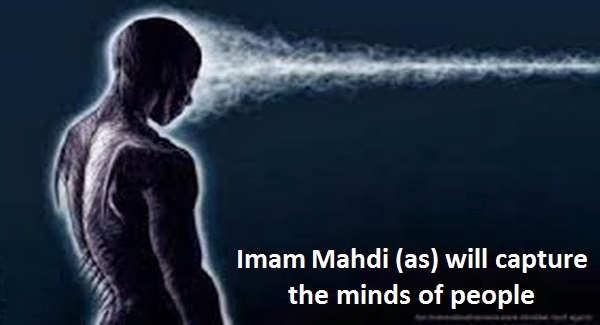
Imam Mahdi will capture minds
Mahdist image from a Haroun Yaha fansite in Pakistan — representing a Sunni variant eschatology in the school of Bediüzzaman Said Nursî, see Yahya’s official website, also an academic analysis of Yahya’s work at The Mahdi wears Armani — a distant cousin to the Shia and Sunni doctrines below

**

Okay, I posted the image above for its delightful AE Van Vogt science-fictionality. Now to the serious topic at hand.

Here’s the “Globalization and Eschatological-Apocalyptical Approach” section of Njdeh Asisian, Shia Iran and Effects of Globalization on State and Religion: The Beginning of Post-Islamism Era:

Eschatological-Apocalyptical analysts, without paying attention to what is going on within their own backyard, believe that the globalization provides tremendous opportunities for the expansion of the global reach of Shia Islam. The other side of this statement is also true when you read carefully between lines. The same Eschatological-Apocalyptical analysts believe that globalization negatively impacts the Islamic Republic because of its influence on Iranian civic society and the continuous weakening of the religious component of the Republic (Shia Islam). In other words, the Islamic Republic’s dilemma cannot be solved unless there is a global Islamic state where secularization and liberal-democratic forces have been defeated by the universal Islamization of the international political system. Consequently, the Islamization of global political system will also put an end to the liberal tendencies of Iranian people. The best possible model for such a scenario is the Soviet Union. With collapse of the Soviet Union, the Marxist-Leninist parties and even countries have collapsed, one after another, due to the failure of ideological legitimacy.

I will examine two types of “eschatological- apocalyptical” approaches to globalization. The first type is the realist approach in which adherents sought to prepare the ground for the political manipulation of the world order. The second type is to consider the globalization process through the Shia Eschatology.

The realist approach searches to find ways and means to establish a structure and thought process which will eventually bring into power an Islamic political and legal system as a dominant power on the world stage. In the realist opinion, the Iranian revolution of 1979 should serve as a serious basis of a new beginning for globalization of Islam as a major power broker in the international political system. They mentioned that, “From the beginning, the nature of revolution and the Islamic movement was based on the culture and return back to our original identity which was based on the religious doctrine. Therefore, we witnessed a fact that the Iranian Islamic Republic’s constitution highly praised the goal of having a global government which governs by Monotheism and hoists the banner of ‘There is no God but Allah’ in all over the world.”

At the same time, the realists promote the nature of global mission of the Iranian Revolution through the Iranian Constitution of 1979. In the constitution, religious identity and values are held in the highest possible place with the promise, made in the constitution, to assist all oppressed people around the world. They have envisioned the Iranian political system as the model for the future global Islamic order. At the same time, these Muslim intellectuals believe that they can offer something more important for human society, without rejecting the very essence of the globalization and technological advancements of our era.

The first step of the realists is to establish the legal framework for the future world order. They consider Islam as the engine of change on the global level and they mentioned that “now days the world turns to religion to fill the spiritual and emotional gaps; further, the world came to acknowledge that liberal-democracy is not useful and it tries to improve the situation through spirituality. This new trend produces a significant opportunity for different religions, and especially for Islam, in order to provide the masses with true teachings.” Further, Shia Jurisprudence is one that can bring serious and positive changes in human life because it has a global nature and it can implement it all over the word; therefore, “One of the distinguished features of Islam that makes it more applicable to the phenomenon of globalization is the existence of political Shia Jurisprudence. The special trait of political Shia Jurisprudence is that it turned Islam [automatically global]; Islam is a pro-active religion that is capable of answering all challenges that human beings can face.”

Besides the applicability of Islamic Jurisprudence at the global level which is theorized by religious scholars, Islamic Jurisprudence must be supported by sets of values that could be easily understandable and approachable by the masses. Therefore, the “Global Quranic Order is a desired system that had been promised to human beings. This system has structure and traits that is far different from the others. Creation of this Islamic Utopia is not possible unless [you] understand and recognize its peculiarities.” The most important pillars of this Islamic Utopia are “Global Quranic Order,” such as “Sovereignty belongs to God, Jurisprudence and Leadership, Unified Muslim Nation [Ummah], Unified Law [Fiqh], Justice, Rationality, Spirituality, Peace and Security, Good Life, Unified Language (Arabic as a Quranic language).”

The theory of Islamic globalization, as described above, is a world that its advocates want to create. They compare and contrast the current globalization with their own Quranic Order. “They do not reject the current technological advancement nor do they reject urbanization, industrialization, development, capitalism, science, and technology, and all that these imply for the organization of society. In this sense they are not anti-modern. They accept modernization, and the inevitability of science and technology and the changes in life-style they bring. However, and most importantly, they are unreceptive to the ideas that they say are Westernized.” They argued that the current Western-style globalization is based on false teachings. Therefore, globalization is taking the wrong route. “In the Alavi culture, technology is used for better living and the perfection of human beings and whatever improves the technological advancement is acceptable. In contrast, in the Western culture the technological advancements are used for profit and the capitalist culture is based on liberalism, individualism and hedonism which concluded in plunder of 99 percent of the population in favor of the 1 percent.”

The above mentioned Muslim scholars are providing theoretical grounds for an Islamic global government or empire. Naturally, these Muslim scholars resent the ideological part of globalization, where the liberal-democratic values have a dominant position in the global system. In other words, they want the technological advancements of the West without the ideology that is attached to it. A question arises here concerning what type of socio-economic system or platform they propose in order to keep up with the technological and economic creativity at the global level. It is obvious that no one can govern the world with just good wishes and ideology.

I move now from the realist theorists, who sought to establish an earthly Islamic Utopia, to the theocratic approach of Islamic globalization, where Shia Eschatology will change the world order beyond repair and establish a heavenly government on earth through the reappearance of the “12th Imam, Mehdi.”

In some Iranian writings regarding globalization and Islam, we see analysis that is a mixture of globalization theories, futurism, and the Shia Eschatology about the Mehdi. Muslims, regardless of whether they are Shia or Sunni, believe that one day the savior of the world or Lord of Ages, Mehdi, will appear in order to reestablish the justice, global governance and expanse of Islam all over the world.

In the Iranian case, we see the Shia version of Mehdi is somehow different from what Sunnis believe. The authors of these articles that call themselves “Mahdavist” have no faith in the current globalization processes. These authors are futuristic; they are analyzing international relations, geopolitics, socio-political relations, and economics of a society that does not exist, at least not yet. (Note: the other importance of this literature lies in the fact that the Iranian regime, due to its religious nature, cannot discount the religious belief system from interfering with what Kissinger called a Westphalian state that has specific commitments against the international community. However, many scholars and pundits do not look at the events in the Middle East through the lens of the religious belief system. Perhaps, this literature can assist them in understanding that the other side is preparing for an Eschatological end and even some activities may directly be connected to preparation for 12th Imams reappearance. The best example of this is Yemen. “Yemen plays a pivotal role in the Shia Eschatology”. Mahdavists have brought into Iranian globalization literature a phenomenon that is strictly religious. However, it is interesting to read and understand the religious scholars who are faithfully trying to analyze the religion through contemporary socio-political events. The other issue with these types of futuristic analysis is that there is no scientific literature or method that one can use to examine the validity of this claim. In other words, it is a religious belief system that one should accept by heart, rather than by scientific reason or methodology. The Mahdavists see the current globalization as a man-made phenomenon that has nothing to do with divine design for human beings.

They consider globalization as being empty of spirituality and human value and it is materialistic. In contrast they consider that real globalization will be achieved through the Mehdi’s revolt against the tyrannical order of the world. In the Mahdavist world, “The true definition of globalization is putting effort into building the world based on the Islamic teachings and governing the world through Islamic values. This goal is the undeniable promise of God. It is a message of the Quran, and the prophecy of prophets. On balance, wisdom of [the Islamic globalization] is doable. All man-made cultures and ideologies are condemned to total defeat and annihilation.”

Mahdavists believe that there is a close correlation between the reappearance of Mehdi and globalization. “The globalization that is based on liberalism, Omanism and secularism that propagated separation of church and state and rejected the system based on justice, is not acceptable for the global government of Mehdi. In contrast, the globalization that is acceptable is the one that does not pursue the domination of a specific culture, because all human beings are members of the global society. This type of globalization accepts multiculturalism, it accepts dialogue between civilizations, cultural understanding and access to shared values, mutual respect, international cooperation, and finally, the belief that global culture cannot swallow the other cultures, national or local”. Further, the global government of Mehdi cannot be considered as deterministic and cruel because it fulfills the prophet’s promises of global universal justice. Based on the Shia teachings, Mehdi will create a central government, a unified leadership and therefore, he will be able to end the main causes of conflict, wars and oppression.

In the final analysis, the universal Islamic government will establish the Islamic Jurisprudence that will put an end to religious and linguistic plurality where everyone is Muslim and speaks Arabic as the Quranic language. At the same time, the religious Eschatological-Apocalyptical approach does not produce a realistic analytical solution for the problems that Iran faces in the globalized world. This is because they are analyzing and looking for an unknown future and there is no set time for the reappearance of Mehdi.

**

I’m offering this here without much commentary, since I lack Farsi and access to the various quoted sources. This footnote, however, may be of interest:

Eschatology is a part of theology concerned with the final events of history, or the ultimate destiny of humanity. This concept is commonly referred to as the “end of the world” or “end time”. The word arises from the Greek eschatos meaning “last” and -logy meaning “the study of”, first used in English around 1550. The Oxford English Dictionary defines eschatology as “The department of theological science concerned with ‘the four last things: death, judgment, heaven and hell’.

**

CAVEAT:

I would however note this next footnote, and particularly the phrase, “According to our numerical analysis of the Quran”:

For Sunni Muslims, the Mahdi (Mehdi) is a unique Muslim leader who will appear in the End Times and act as a Caliph, ruling the Muslim World. According to our numerical analysis of the Quran, it seems that the Mahdi will be fulfilling a divine mission and will act as a Witness, a Warner and a Carrier of Good News, so he could be considered a Messenger.

This numerical anaysis appears to come from a site I’ve mentioned before [1, 2], Discovering Islam, which predicts:

The End Times: Based on Numerical Analysis of the Quran, Hadith, Arabic Words, and Historical Events.

Imam Mahdi in 2016
Jesus Christ (p) in 2022

I’d have to say that anyone quoting that site as though it is representative of Sunni Islam isn’t to be relied on for theological acumen. And that’s a serious defect, when writing about Shia Iran and Effects of Globalization on State and Religion

**

Finally — and bearing that caveat in mind — this footnote too may be of interest:

Based on the Shia Eschatology, the first group of people who will come to 12th Imam’s assistance are Yemenis. Currently the “Shia Houtis” of Yermen are trying to take over the government and establish a Shia state by Iranian assistance. As far as the Iranian theocratic elite concern, the sole purpose of the current Houtis’ agenda is to prepare for 12th Imam’s occultation which will take place in one of the Mosques in Makah Saudi Arabia. 12th Imam will be under siege in Makah until Yemenis come to his assistance. The Yemeni reinforcement will be the beginning of the 12th Imam’s journey.

And a minor point — just a typo — the Twelfth Imam’s occultation (ghayba) has already taken place: what is to be expected is his eventual return from occultation.

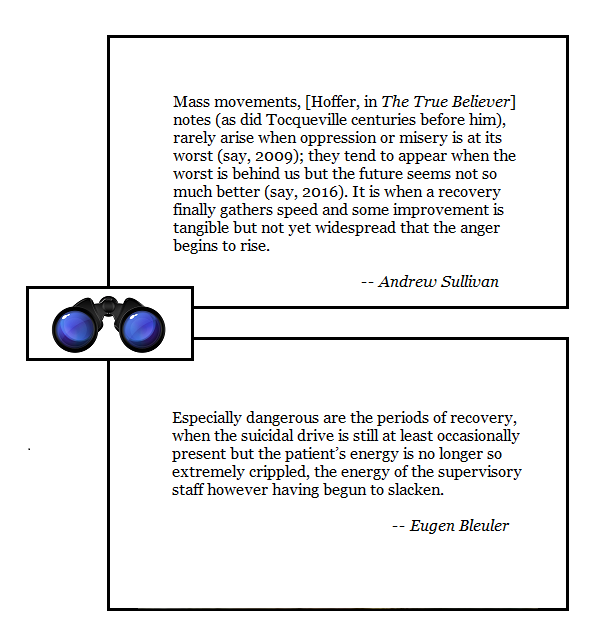
The dangers of recovery?

Sunday, May 8th, 2016

[ by Charles Cameron — just a quick DoubleQuote indicating a pattern in psychology ]
.

SPEC DQ Hoffer & Bleuler

That Bach Chaconne

Sunday, May 8th, 2016

[ by Charles Cameron — JS Bach in Palmyra, in the DC Metro, and variously on YouTube ]
.

I have to applaud Putin and the Russians for bringing the full orchestra of the Mariinsky Theater from St Petersburg to Palmyra now that the Islamic State has departed, with added kudos for choosing Bach‘s towering Chaconne from his Partita No. 2 in D minor, BWV 1004 as one of three works to be played there — by the Tchaikovsky Competition winning soloist Pavel Milyukov:

As I say, I applaud the gesture. OTOH, British Foreign Secretary Philip Hammond, according to Breitbart, called the event “a tasteless attempt to distract attention from the continued suffering of millions of Syrians” and said it “shows that there are no depths to which the regime will not sink.”

**

This may not be the greatest performance of that work musically, but the work itself is extraordinary. Johannes Brahms said of it:

On one stave, for a small instrument, the man writes a whole world of the deepest thoughts and most powerful feelings. If I imagined that I could have created, even conceived the piece, I am quite certain that the excess of excitement and earth-shattering experience would have driven me out of my mind.

**

It was famously this Chaconne that violinist Joshua Bell played — twice — with his violin case open to receive tips, in DC’s L’Enfant Plaza metro station, during a 45 minute anonymous session in which he netted $32. $32 and change, for a man whose upcoming performance with the National Symphony Orchestra at DC’s Kennedy Center (February 11, 2017) is ticketed at $216 or $223, depending on how well seated you wish to be…

Here’s the poorly recorded, hidden videocam account of the second of those performances, which starts at about the 30’15” mark:

Gene Weingarten‘s description of the event in the Washington Post, Pearls Before Breakfast, won the Pulitzer..

**

For the fullest musical appreciation, here is that same Joshua Bell playing the Chaconne in 2014 in the DeLaMar Theater, Amsterdam:

Hillary Hahn, also superb:

The no less beautiful Hélène Grimaud, playing the Busoni transcription for piano:

And last, violinist Christoph Poppen plays the Chaconne, with added chorale motifs as reconstructed by violinist turned musicologist Helga Thoene sung by the Hilliard Ensemble — the culmination of the group’s celebrated album, Morimur:

Post-modern adaptation, or quintessential Bach? Either way, I find the entire project enthralling.


Switch to our mobile site
