zenpundit.com » 2016 » September

Archive for September, 2016

Quick notes on intelligent intelligence, 1

Wednesday, September 7th, 2016

[ by Charles Cameron — I do believe this will be a new series ]
.
brain-ic

**

Intelligence, obviously, can mean something along the lines of bright thinking, but also that which is gathered, usually from the extremities of empire or the most hidden of an opponent’s or ally’s secret secrets — but for my purposes here it means the frst of these (the “intelligent” of my title) as applied in the mind of military, analytic or civilian leadership to the second (my title’s “intelligence” by which I mean “intel”).

**

David Barno and Nora Bensahel, Six Ways to Fix the Army’s Culture:

The Army should also reinstate the requirement for every career officer to develop skills in two specialties, rather than to focus narrowly on one. This would produce officers with a much broader range of talents, who would be educated and then employed effectively across more than one skill to support the Army’s disparate needs. These measures would help rising Army leaders think more creatively about the wide range of challenges facing the Army and contribute more effectively at the strategic level within the Department of Defense or the wider interagency arena.

I’d like to make this more explicit. Not only does the development of skills in two specialties mean that an officer can handle two dofferent kinds of problem set with greater assurance, it also and specfically opens the possibility of cross-fertilization between the two disciplines, in those places where they overlap not on the surface level but at the level of analogy and pattern.

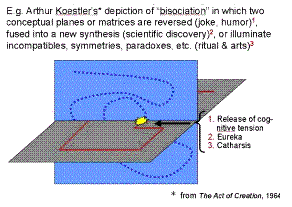
When Barno and Bensahel say the development of skills in two specialties “would help rising Army leaders think more creatively” it’s not just that they’d be better informed and brighter than they would be with only one such skill, and it’s not just that they could handle issues involving the overlap between specialties (and I actually don’t just mean military specialties like “Transportation officer (88A)” and “Chemical, Biological, Radiological and Nuclear officer (74A)” but also realms like cutural anthropology, topology, systems dynamics, art history), it’s that analogies would leap to mind showing that allow insights from one realm, discipline, silo or specialty to illuminate another. As shown in Arthur Koestler‘s image in The Act of Creation, which I never tire of posting:
**

Hey, I’ll follow up immediately with related commentary — on a quote from the eccentric, brilliant mind of a British fellow, Geoffrey Pyke, recently memorialized in Henry Hemming‘s book, The Ingenious Mr. Pyke: Inventor, Fugitive, Spy.
My Latest on Lapido — Mother Teresa

Wednesday, September 7th, 2016

[ by Charles Cameron — writing about Mother Teresa as a balancing act ]
.

My latest post on LapidoMedia, Mother Teresa: the making of a saint, opens thus:

‘MOST blessed Father, Holy Mother Church, beseeches your Holiness to enroll the Blessed Teresa of Calcutta among the saints, that she may be invoked as such by all the Christian faithful.’

With these words, Cardinal Angelo Amato, the Prefect of the Congregation for the Causes of Saints petitioned Pope Francis to declare Mother Teresa of Calcutta a saint.

There are five stages in the Catholic Church’s ‘canonization’ – the declaration that a saint is in heaven, and that their name may be included in the roll of the names of saints.

In my article I write, “As with many people considered especially holy, Teresa’s life has often been discussed in terms of hushed veneration – and also harshly criticised by the unimpressed.” I’m not too convinced either by the hagiography with which the Church tends to surround her, nor with the vituperatuve criticism with which Christopher Hitchens, her chief detractor, attacks her.

I have tried to write Teresa up in a way which balances the two. In my own quiet way, and reading it somewhat between the lines, my article attempts to bridge the two by suggesting that her specific “charism” or gift — the “wavelength” of love of which she is, for the Church, the examplar — was explicitly to bring spiritual, not medical, love to the dying, and that she accomplished this task, while her failure to accompany it with sound, even basic medical care — her clinics, for instance, commonly reused needles without sterilizing them — was the cause of much of Hitchens’ criticism, and has indeed been remedied by her order of nuns since her death.

Christian theological discussion often distinguishes between the Historical Jesus and the Christ of Faith. It may well be that the historical Teresa will stand as a warning to missionaries to be adequately prepared for the proper medical treatment of those to whom they minister, while the Teresa of faith can be a beacon of hope and love in the lives of many. We can hope that the order of nuns she founded, the Missionaries of Charity, will take note of her work at both levels.

Read the whole piece here on the Lapido site.

Gülen a secret cardinal of the Catholic Church? [UPDATED]

Monday, September 5th, 2016

[ by Charles Cameron — a case of Catholic taqiyya? srsly? you jest! ]
.

This tweet about Fethullah Gülen is just too rich in ironies to relegate to the comment section of my earlier posts, Turkey — keeping an eye out for Gülen and its follow-up, Turkey Tweeted, continued:

H/t Bryan Alexander.

I may write this one up for LapidoMedia, in which case I’ll report back here…

**

Update:

Apparently LapidoMedia won’t be covering this, since they already have two pieces from me for this week & next.

Here’s the gist:

The suggestion has recently been made in at least two Turkish media that the Turkish Islamic cleric Fethullah Gülen, now resident in the US, is a secret Catholic, not a Muslim, and that when he met Pope John Paul II in 1988, the latter made him a cardinal “in pectore”.

The Turkish Minute article Indictment claims Gülen secretly made cardinal by John Paul II reports the claim as having been made in a court case, and explains:

The indictment said “in pectore” is a term meaning “in the heart” and that it refers “a person who keeps his religious beliefs secret in their country.”

Shia, under the doctrine of taqiyya, have the right to say that they are Sunni if questioned in a sectarian life-and-death situation, and the Turkish indictment apparently conflated this idea with the authentic Catholic poractice of a Pope making a cardinal “in pectore” — where the secret of the appointment is kept, not because the cardinal keeps his religion a secret, let alone that he claims to be a Muslim cleric while in fact being a high-ranking Catholic — but because the news that the person had been raised to the College of Cardinals might draw unwanted attention to him as a public figure in an area where this might have dire consequences.

So the two ideas have their similarities — but are in fact different.

Add in the fact of the amazing image of Gülen wearing a bishop’s miter and the pallium — an item worn only by major archbishops and the Pope — and you have quite a multitude of ironies in play.

Muhammad Ali, the Navaho and the Tibetans

Saturday, September 3rd, 2016

[ by Charles Cameron — a knockout triple DoubleQuote from Maidu country ]
.

This:

Ali mandala of victory

reminds me of this:

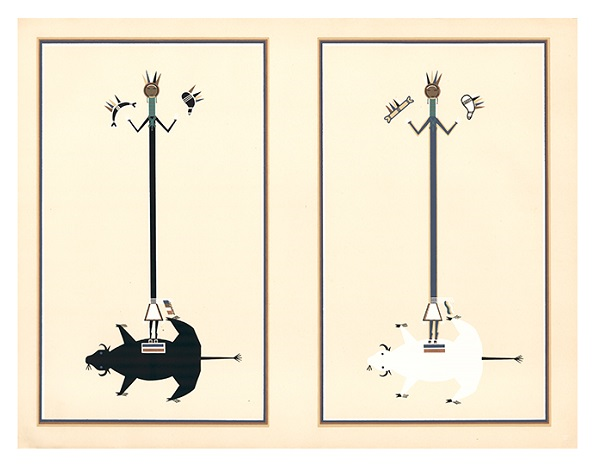
Sand Painting Jeff King

but also of this:

mandala-sand-painting-tibetan-monks-asia-society-texas-696x407

**

In fact, we have three potential DoubleQuotes here:

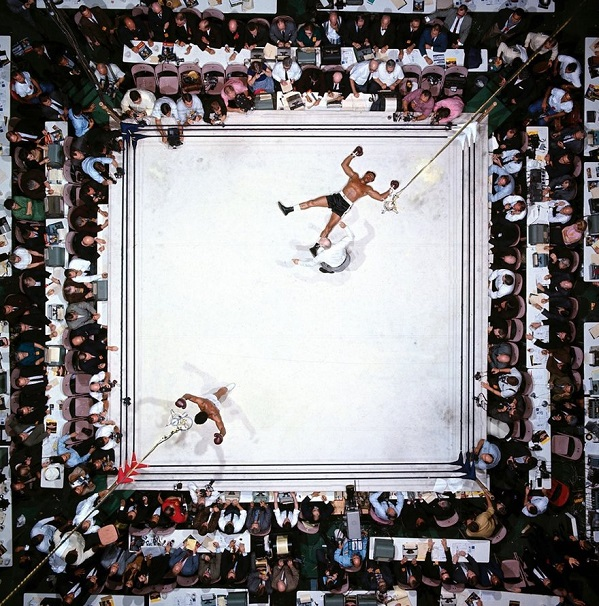
  • the stytlized figures in Neil Leifer‘s celebrated photo of Muhammad Ali evokes the stylized figures of Jeff King‘s sandpainting for the Navaho war ceremonial Where the Two Came to Their Father.
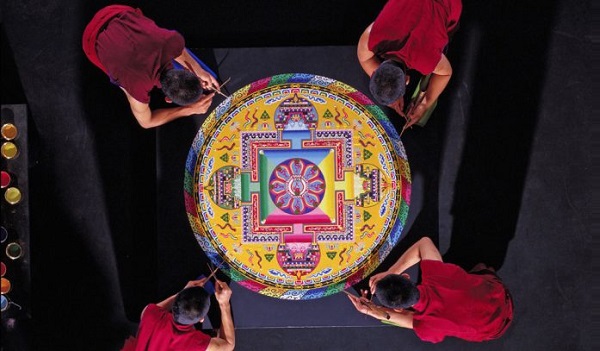
  • Jeff King‘s Navaho sandpaintings in turn easily summon memories of their Tibetan Buddhist equivalents, shown here in a photo of the Drepung Loseling monks.
  • And the symmetries of the overhead shot of Ali and that of the Drepung monks forms yet a third pair.
  • **

    Muhammad Ali at one point wanted “his people” to return to Africa, away from the deadly white man, and no doubt it has occurred to some Navajo from time to time to wish the white man would return to Europe — while Puebloans may on occasions have wished the Navajo had remained with their Athabaskan kin in Canada..

    But then, I’m Scots by heritage, British by subsequent conquest, and have invaded the United States myself in person, with a view to finding what American poet Gary Snyder calls “a sunny spot under a pine tree to sit at” here in California.

    In what I understand to have been Nisenan Maidu country.


    Switch to our mobile site