zenpundit.com

Recommended Reading

November 5th, 2013

[by Mark Safranski, a.k.a. “zen“]

Grand Blog Tarkin – Ender’s Shadow and Offense-Defense Theory 

“Ender’s Shadow” is a 1997 novel by Orson Scott Card, set in the same universe and roughly same time period as his more well-known “Ender’s Game.” “Shadow” centers on a child named Bean, a minor character in “Game,” fleshing out his backstory and trajectory. The setting is a future in which Earth was devastated two centuries prior by an attack from an alien race known as Buggers. Humanity won the war, and then set up an International Fleet to keep peace between states, coordinate future anti-Bugger action, and train the best and brightest children of the world to be military commanders in an off-planet installation known as Battle School, where most of both “Game” and “Shadow” take place.

War on the Rocks – (Frank Hoffman) Tuppence for your COIN Thoughts 

This is not a comfortable book to read for members or friends of the British armed forces.  And it should generate equally discomforting questions for its American readers.  Counterinsurgency in Crisis is a dispassionate and objectively critical evaluation of UK strategic performance in its last two conflicts-Iraq and then Afghanistan.  Both authors have relevant scholarly credentials and prior works on civil conflicts and counterinsurgency.  Ucko (who is a colleague of mine at the National Defense University) and Egnell begin slowly, but end up with an eviscerating indictment of British preparation, strategic direction, and operational practice.  “There is no fig leaf large enough here to cover the deep flaws in the British government’s own approach and conduct in their counterinsurgency campaigns,” they conclude.

Marine Corps Gazette – (Nicholas Joiner) Battle of Belleau Wood 

On the morning of 6 June 1918, in what became the bloodiest day in Marine Corps history, Marines launched an offensive attack against a heavily fortified German position on Hill 142 across an open field to the west of Belleau Wood. Hampered by flat terrain, the Marines advanced with fixed bayonets across open wheat fields swept by German machinegun and artillery fire. Caught in the open, retreating French soldiers advised the Marines to follow suit, where Capt Lloyd Williams was famously quoted as saying, “Retreat? Hell, we just got here!” Despite heavy losses, Hill 142 was taken following bloody hand-to-hand combat.

Selil – Where will the NSA be in 5 to 10 years?


A second effect I see for NSA is splitting off the CyberCom role. There is a lot of internal feuding and “facts” leading to the perception that the new role must be status quo. There is admittedly a lot of cost associated with a split of the two entities. The cost to society and inherent fight that is sure to come is likely even more costly. Arguments that this is new and we must allow it to continue are based on individuals desires to keep the status quo. A lot of people have skin in this game. So, they argue from their personal biases. I admit I’m biased. I want to see NSA and CyberCom succeed. Currently that will not happen if they are linked at the hip. The arguments of keeping them together are specious at best.

I think CyberCom should be severed from the NSA and the 4 star billet with associated staffs sent to at least Texas. Physical distance is needed to separate this war fighting entity from the intelligence entity NSA. The structure of CyberCom should be more like SOCOM. I think that the split will happen. I think the structure as a combatant command will not change

Michael Tanji – Sam and His (not so) Crazy Ramblings 

If intelligence agencies are good at one thing its burying bodies. Is anyone going to find themselves in front of Church Committee 2.0? No. Will the people who were leaning the furthest in the foxhole on efforts that were exposed going to find themselves asked to quietly find their way out the door? Absolutely. This is how it works: the seniors thank and then shepherd those that pushed the envelope to the side, those who take their place know exactly where the line is drawn and stay weeeellll behind it. They communicate that to the generations that are coming up, and that buys us a few decades of sailing on a more even keel…

…until the next catastrophic surprise…

The National Interest – (Michael Vlahos) Why Lists of Greatest Battles Don’t Work 

The first fallacy is our unconscious enshrining of “decisive battle”—not as in, “I won big”—but “I won history and changed the fate of nations, and the course of civilization, to boot”—in one battle. Jim shows us we actually still think this way.

There are actually a very few battles that meet this test: Hülegü’s sack of Baghdad in 1258 comes to mind. But the proliferation of “decisive”—as Jim suggests—may speak more of our bipolar search for, and simultaneous diminution of, ordinary significance in life than it does the role of decisive battles in history.

But such battles are even harder to find at sea.

SWJ  (Prescott) Heeding the Heretics 

Information Dissemination (Galrahn) We Need a Balanced Fleet for Naval Supremacy

Rebane’s Ruminations –Great Divide – ‘America 3.0’  

OPFOR –America 3.0: A Future 

Studies in IntelligenceCounterintelligence in Counterguerrilla Operations :50 Years Since Early Engagement in Southeast Asia

Foreign AffairsGoogle’s Original X-Man 

Forbes49-State Analysis: Obamacare To Increase Individual-Market Premiums By Average Of 41% 

That’s it.
Heavy Metal: When Irregulars Go Armored

November 2nd, 2013

[by Mark Safranski, a.k.a. “zen“]

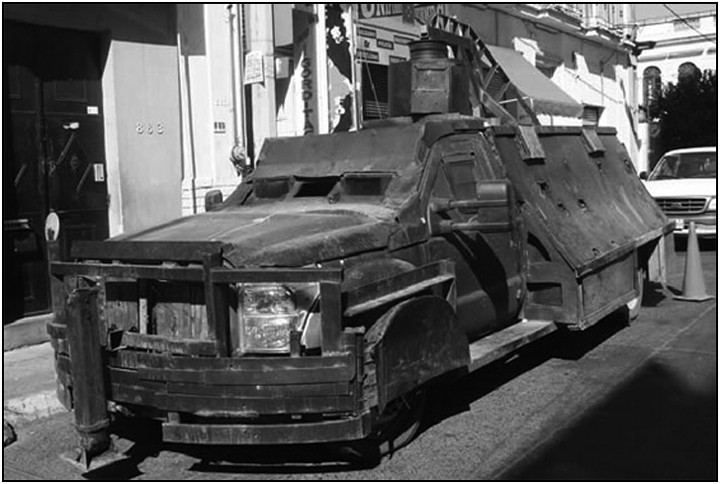
If the symbol of the 20th century insurgent was the AK-47 and a red banner, his 21st century counterpart may someday be recognized by the suicide belt and the “homemade tank”. Irregular fighters have always used light arms, civilian passenger vehicles and armor captured (or donated by) from conventional armies, but the ability to produce serviceable fighting armored cars is a new wrinkle. They could not stand up to an American or Russian tank company, of course, but they are not meant to do so.

Most prevalent and evolved in Mexico’s narco-insurgency where cartels use these “monsters” converted from SUVs and various types of light and heavy trucks to battle one another and as “troop carriers” but these DIY armored vehicles have also appeared in the recent Libyan and ongoing Syrian civil wars. Where heavy anti-tank weapons, air power and real tanks are scarce, these narco-tanks are useful additions to irregular combat power and convey an intimidating image to lightly armed police and the public.

Dr. Robert Bunker and Byron Ramirez, with the support of Small Wars Journal, Borderland Beat.com and the Foreign Military Studies Office at Fort Leavenworth, have a new scholarly compilation on the subject of irregular use of DIY armor in Mexico:

Narco Armor : Improvised Armored Fighting Vehicles in Mexico

….The wave of violence that has left thousands dead began in early 2005, when former Mexican
president Vicente Fox sent government troops to Tamaulipas to fight the cartels. For the past
seven years the government has ordered its military to fight the cartels directly, which, in turn,
has led drug cartels to improvise and develop their own methods of warfare to combat both
government troops and other competing cartels.

The extreme rivalry among various Mexican drug cartels for regional control of the drug trade
market has yielded an arms race. The following collection of articles and images addresses a
segment of the military technology utilized by violent non-state actors during this period: “narco armor” or, more accurately, improvised armored fighting vehicles (IAFV).

….Mexican cartel use of IAFVs and armored sport utility vehicles (ASUV) may yield some
important lessons for military counter-criminal insurgency efforts. Still, many unanswered
questions exist concerning the fielding of narco armor in Mexico. Reports of these vehicles
being fielded span roughly from mid-2010 to the beginning of 2012, with a spike in activity 5
surrounding them taking place around mid-2011. These vehicles had predominantly been utilized

in the Mexican state of Tamaulipas in engagements between the Zetas and Gulf cartels and in a
few other locales (see Map Locations). While it has been said that the Mexican government has
seized well over one hundred of these vehicles, only about two dozen photographic examples
exist per our research (see Picture Gallery).

….Given the apparent cessation of the fielding of narco armor since early 2012, quite possibly these vehicles have reached an evolutionary dead end, with more emphasis once again placed by the cartels on fielding more stealth-masked armored vehicles, such as armored SUVs, that better blend in with civilian cars and trucks so as to eluded identification and targeting by Mexican federal forces. Still, given the ever changing conflict waging in Mexico among the cartels and against the Mexican government, future resumption of IAFV employment will always remain a potential. 

Read the rest here.

During the Russian civil war (1917-1922), armored trains complete with heavy machine guns and artillery were used by both Bolshevik and White armies across the vast expanse of the Eurasian steppe and the armored train subsequently made spotty appearances in civil wars in China and Spain before fading away. This less likely to happen with homemade armor which is smaller and infinitely more mobile and can be created in a sufficiently large garage with time, elbow grease and a supply of scrap metal.

America’s Defense Amnesia

November 1st, 2013

(by Adam Elkus)

Over at The National Interest, Paul Pillar diagnoses America with an “amnesia” about intelligence. The US, like Guy Pearce’s amnesiac character in Memento, does not perceive that it is caught in a larger oscillating cycle:

Attitudes of the American public and elected officials toward intelligence go in cycles. There is an oscillation between two types of perceived crisis. One type is the “intelligence failure,” in which things happen in the world followed by recriminations about how intelligence agencies should have done a better job of predicting or warning of the happening. The recriminations are customarily accompanied by “reform,” or talk of it, which chiefly means finding ways to do things differently from what was done before—not necessarily better, just different. Usually there also are accusations of malfeasance by individuals, even though there is an inherent tension between attributing failure to unreformed institutions and attributing it to individuals who screwed up. Often the response also involves additional empowerment of institutions, in the form of added resources or added authorities.

The other type of crisis involves seeing institutions as too empowered, with the response being to place additional restrictions on them. For U.S. intelligence agencies one of the most conspicuous examples of this phase of the cycle was in the 1970s, with some of the agencies in question already suspect as the nation came out of the Vietnam and Watergate eras, and with the principal response being to erect Congressional and legal checks that are still in place today. Now we are seeing in a somewhat milder form the corresponding phase of another cycle, as the nation comes out of more than a decade of recovery from the 9/11 terrorist attacks, which stimulated the most recent burst of empowerment. There is new talk about reducing the powers and scope of activity of agencies and adding more checks and restraints.

Pillar goes on to explain that the nature of intelligence does not provide easy directions regarding how allied intelligence targets figure into larger geostrategic intelligence factors that impact what policymakers desire out of the intelligence community. It is a great read from a man who is both a veteran of the intelligence world and a consistent critic of US foreign policy and security. However, I’d like to expand Pillar’s metaphor of “amnesia” beyond the intelligence world. We really have defense and national security amnesia.

After the 2003 invasion of Iraq, it was not uncommon to hear sentiments arguing that force-on-force, firepower-centric conventional warfare could not cope with the challenges of a “global counterinsurgency.” Indeed, some argued that the previous high-tech military ideas not only were out of date with the nature of the challenge, but almost lost the war altogether. Both manpower-heavy and manpower-light counterinsurgency campaigns were proposed.  The Surge is still seen today in many quarters as the closest thing America has to a recent military triumph. As Antulio Echevarria noted, critics of conventional warfare argued that opponents had adapted around America’s strategic advantages, but it was less clear that there was any causal relationship.

Circa 2007-2009, however, large-scale occupations in the Muslim world began to go out of style. Critics began to clamor for a light footprint approach heavily based around counterterrorism strike forces and standoff firepower. A presidential candidate promised to hit al-Qaeda hard with flexible counterterrorism forces. Reduce the terrorist threat steadily growing in safe havens, he and his staff argued. The zeitgeist began to turn towards a culture of raiding, characterized by some of the very same assumptions about light and lethal forces that were so widely criticized prior to the counterinsurgency era. Manpower-intensive occupations were out, intensive counterterrorism in the dark was in. Instead of stabilizing failed states, America would use a combination of intelligence, special operations, and statecraft to marginalize and undermine al-Qaeda.

The age of “dirty war”  became a lightning rod for criticism. But one of the most trenchant criticisms was that an obsession with tactical counterterrorism intelligence was harming America’s intelligence agencies’ traditional specialties in strategic intelligence and counterintelligence. The line between military and intelligence was being “blurred.” The larger cost? Focusing so much on short-term, tangible, and easily justifiable counterterrorism intel requirements blinded America to the larger picture that it needed to see. As a result, it would be perpetually surprised by events like the Arab Spring.

In light of today’s furor over spying on allies, it is worth examining how this line of argument cast the difference between strategic intelligence and strike intelligence as a military-industrial complex analog of the classic dichotomy between basic and applied scientific research. Basic scientific research is often difficulty to justify in the short term, and frequently does not result in immediate payoff. But none of today’s scientific discoveries would have been possible without it. Hence, as Pillar noted in his essay, in retrospect it is easy to see “failures of intelligence” in areas where ambiguity regarding the purpose of intelligence, targets, and immediate payoff motivated hesitation. Ironically, as Dan Trombly tweeted, most of the intelligence community’s “counterterrorism obsession” critics were silent (with the notable exception of Joshua Foust) when evidence accrued that foreign spying was conducted for non-counterterrorism purposes.

Returning to Pillar’s opening metaphor, it seems that the American defense and foreign policy community is suffering from a collective case of amnesia. A call for counterterrorism, light footprints, and intelligence leads to an intelligence architecture that supports a raiding posture, and is then promptly and widely criticized for focusing so intensely on counterterrorism. A call for counterinsurgency results in substantial investment in counterinsurgency abilities, and then is promptly and widely criticized for its time and expense.

My analysis is undeniably unfair in some ways. First, the aggregated commentary of the DC defense commetariat consensus as presented here smoothes out meaningful differences, nuances, caveats, and variations. It was not as simple as I make it out to be, but the consensus of a community is not easily described in a single paragraph. Second, each idea also produced data that was (fairly or unfairly) evaluated. Counterinsurgency theory looked very appealing to many analysts in 2006 but was pronounced dead by war-weary Americans in 2011. Compared to Iraqi and Afghan quagmires, drones and special ops seemed compelling . But as the wars drew down and more press attention focused on the ramped-up counterterrorism campaigns, analysts began to have substantial misgivings.

That said, the problem is that while the world certainly changes fast, it has not changed fast enough to justify the kind of analytical mood swings that have frequently occurred since the beginning of the COIN era. If one took the last 12 years of national security commentary as gospel, they would believe that some seismic, worldview-invalidating event occurred every 1-3 years and necessitated a wholesale rejection of the policy the previous worldview-invalidating event spawned. Events have complicated and qualified—but not wholly invalidated–the merits and demerits of COIN, special operations and counterterrorism, and strategic intelligence (which includes spying on allies). While all of the arguments I’ve summarized here contradict each other, I can’t say with confidence that any of them are completely wrong.

The problem with America’s defense amnesia is not “be careful what you wish for.” No one can know exactly how their policy preference will work out. It is not even “remember what you wish for.” Rather, the lesson is to keep in mind that however fast events may move, there are larger and systemic factors and tradeoffs that stimulate day-to-day policy problems. These systemic factors change very slowly, and remain fairly consistent across administrations. Why we cannot comfortably dismiss any of the varying defense memes I’ve cataloged is that each dealt with a segment of a larger problem.

Being conscious of the unchanging challenges of American national security, from the difficulties of maintaining local outposts of American hegemony to how America’s national position produces incentives for perpetual war, has important intellectual benefits. We can avoid calls for dramatic course correction over hysterias of the moment and keep the longer term in mind. And we gain an appreciation for what has changed and what remains the same. A wider view tells us that war is not more complex, the calculus of strategic intelligence is not simple, and there are costs to both counterinsurgency and standoff counterterrorism that must be evaluated.

Moreover, we gain a greater respect for the policymakers who must deal with underlying manifestations of deeper and systemic problems instead of behaving (as even I sometimes do) like we have cracked some secret code unavailable to the idiots in Washington. There is some truth behind the disdainful phrase “good enough for government work.” But if the national security and foreign policy problems that government tackles were as obvious or linear as today’s criticism often implies, would our policy demands oscillate as wildly as Pillar alleges? It seems that unless we start tattooing relevant names, events, and information on our bodies (like Pearce’s Memento character does to help him remember), we won’t remember enough to answer that question. Such is the life of an amnesiac.

New Books and Reading

October 31st, 2013

[by Mark Safranski, a.k.a “zen“]
 

Strategy: A History by Sir Lawrence Freedman  
Out of the Mountains by David Kilcullen

As I promised Professor Freedman a few weeks ago in the comments section, I ordered his book, Strategy: A History and it arrived yesterday, so I am bumping it to the top of my very large and disorderly book pile ( now a desk high stack) and will begin reading it immediately. I believe Scott Shipman is already reading it too, so perhaps when I review it we can have a mini-round table with other people posting or guest posting their impressions, maybe end of November.

Out of the Mountains will be the third book by COIN guru David Kilcullen that I have read. I think he is on the right track here, in big picture terms. If guerrillas need, like fish, to swim in the sea of people, densely packed urban areas, megacities, are needed to thwart aerial surveillance and inhibit freely administered “death from the skies” delivered by drones.  Bombing a hamlet in FATA is a different kettle of fish from taking out a Land Rover speeding on an 8 lane highway outside LA with a Hellfire missile  or targeting a shopping mall in a ritzy Chicago suburb on the Lake.

I am also reading the following books:


The former is giving me a granular view of Fascism in its original form with a social historian’s perspective. I’m 250 pages in and I’m not half finished. Echevarria is always a good read with clear arguments.

This past year, I have not read enough or read seriously with attending marginalia comments and I am feeling the absence. Too many things have been permitted to distract me; while this was not always within my control, honesty compels me to admit that my self-discipline slackened this year. It is time to rectify that – evidence for which will be more frequent book review here.

What are you reading?

Celebrating Orwell Day on ZP

October 29th, 2013

[ by Charles Cameron1984 comes to Venezuela? ]
.

I had just finished posting the somewhat Orwellian DoubleQuote above and a set of quotes from Biblical and Qur’anic sources in my welcoming comments on Adam Elkus‘s inaugural post here, which itself drew on Orwellian dystopia for its imagery, when a friend pointed me to an article about the recent institution of a Vice-Ministry for Supreme Happiness by Venezuelan President Nicolás Maduro.

**

Bingo, Orwell again! Responses on Twitter were quick to invoke 1984:

In Orwell’s 1984, four ministries control Oceania:

  • Minitrue is the Ministry of Truth, which controls literature and oversees propaganda
  • Minipax, the Ministry of Peace, oversees warfare
  • Miniplenty, the Ministry of Plenty, controls rationing of food and other goods, and
  • Miniluv, the Ministry of Love, deals appropriately with heretics and dissidents
  • I disclaim any deep knowledge of Venezuelan politics, although Ahmadinejad‘s claim that Chávez would be resurrected to accompany the Mahdi and Christ when they return certainly caught my attention… but these literary references impress me.

    Specifically, the Venezuelan tweeters above suggest that Orwell “predicted” the Venezuelan Vice-Ministry, and that it will be followed next by Venezuelan versiuons of Minitrue and Miniluv.

    **

    George Orwell, the man of the hour / day / year / century / millennium… ?


    Switch to our mobile site