zenpundit.com

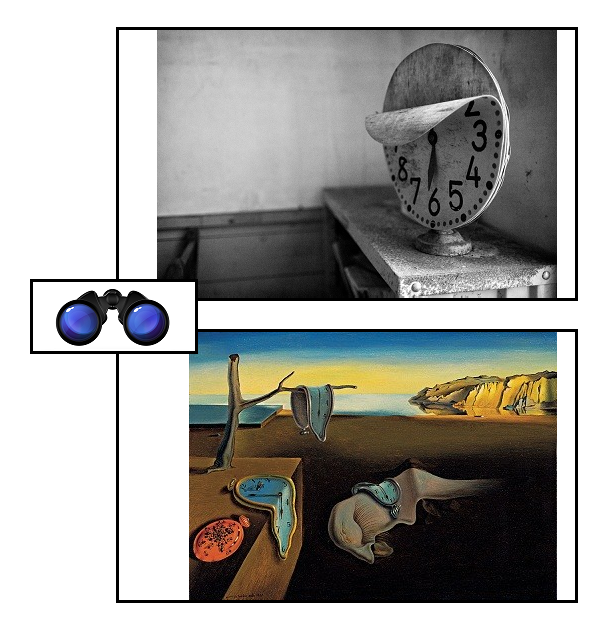
Sunday surprise 9: surreal art imitates real life?

October 20th, 2013

[ by Charles Cameron — my semi-official idiocy to cap the week ]
.

Here, surreal art imitates real life — ahead of time, and or much later.

**

Sources:

  • Tokyo Times, An abandoned and atmospheric Japanese school in the mountains
  • Salvador Dali, The Persistence of Memory

  • A tip of the hat to Bryan Alexander of Infcult
  • **

    Footnote:

    Time itself is a curious business, and the question of its “reality” comes up from time to time. Physicist Sean Carroll talked about it a while back on the pompously named Closer to Truth series, and makes some interesting points. I have to say, though, that I wasn’t overwhelmed — Carroll may be the equivalent of Hawking when it comes to physics, but the equivalent of Wittgenstein when it comes to philosophy he has yet to prove himself.

    But then of course we have never seen Wittgenstein talking off the cuff on YouTube: my sense is that this was a wise decision on his part — although many of the slips of paper on which he typed the aphorisms that go to make up his Zettel might well have been Tweeted, give or take a century.

    Twitter’s immense fan-base does include thousands — and likely hundreds of thousands — of folks who would follow a Witty Wittgenstein twitter-feed among it’s half-billion (2012 estimate) users if wittgenstein were alive and tweeting… Indeed, the entirely posthumous Wittgenstein Tweets feed has more than 4,000 followers, and you might care to join them — although the quotes in the tweets are more than 60 years old at time of tweeting. My own preference for a philosophical feed, btw, runs to Kim Kierkegaardashian.

    But it’s Sunday, we were talking surrealism, and I digress.

    Pattern recognition: backlash

    October 20th, 2013

    [ by Charles Cameron — on human obstinacy, a change of heart, and what seems to me a major piece from Res Militaris ]
    .

    There’s a pattern of backlash that occurs when you present people with facts that don’t fit their preconceptions — they don’t switch, they double up. Here’s the opening of io9‘s report, The Backfire Effect shows why you can’t use facts to win an argument:

    “Never let the facts get in the way of a good story” isn’t just a maxim for shady politicians and journalists. It’s also the way people often live their lives. One study indicates that there may even be a “backfire effect,” which happens when you show people facts that contradict their opinions.

    Then there’s a study — Brendan and Jason Reifler, When Corrections Fail: The persistence of political misperceptions. I won’t go into the details, it’s the pattern it finds that’s of interest to me, but I will note that the title is a tip of the hat to Leon Festinger‘s When Prophecy Fails, a classic study in the same pattern of denial as it applied to a group whose belief in an end time prophecy was not shattered when the day arrived and the world went on as usual…

    Here’s how the pattern works:

    Participants in the experiments were more likely to experience the Backfire Effect when they sensed that the contradictory information had come from a source that was hostile to their political views. But under a lot of conditions, the mere existence of contradictory facts made people more sure of themselves — or made them claim to be more sure.

    Everyone has experienced the frustration of bringing up pertinent facts, in the middle of an argument, and having those facts disregarded. Perhaps the big mistake was not arguing, but bringing up facts in the first place.

    Okay? That’s a veeery interesting pattern to think about any time you’re considering ways to persuade people to change their minds during, for instance, a CVE campaign.

    I’d like to dig into it a great deal more, of course.

    **

    Maajid Nawaz, a former recruiter for Hizb ut-Tahrir who renounced his membership and is now Chairman of the counter-extremist Quilliam Foundation, seems to have persuaded Tommy Robinson, until recently a leader of the English Defence League, to renounce the EDL and join Qulliam — a move whose results and second-order effects have yet to be seen. Both men, however, offer us examples of people who have in fact changed their minds on matters of profound belief, religious and political, and the odd uncomfortable fact may have played some role in those changes.

    The role of anomalies (cf. “outliers”) in Kuhn‘s The Structure of Scientific Revolutions comes to mind.

    And if showing people the error of their ways (a very loose equivalent of telling them unwelcome facts, I’ll admit) doesn’t work, here’s another anomaly that I ran across only yesterday, that “proves the rule” by, well, partially disproving it.

    Dutch ex-politician Arnoud van Doorn, previously a senior member of Geert Wilders‘ fiercely anti-Islamic party, has changed his mind — or his heart was changed for him, within him, depending on your perspective. He has made the Shahada and is henceforth Muslim himself. In this photo, van Doorn is performing the Hajj, the pilgrimage to circumambulate the Kaaba in Mecca:

    Do I detect a hint of enantiodromia here?

    **

    In closing, I would like to offer this link to an article in Res Militaris by Jean Baechler, titled Outlines of a psychology of war. It’s a weighty piece, as befits its grand sweep, and I believe it throws some light on the obstinacies of the mind to which this post is addressed.

    I tried excerpting it, but it appeared to me that each sentence in every paragraph in turn begged to be highlighted, approved, tweaked, questioned, or disagreed with, and I wound up feeling you should read it for yourselves. I’ll be very interested to see if it captures the attention of the ZP readership, and leads to a more extended discussion…

    Boyd & Beyond 2013 Retrospective Day II.

    October 20th, 2013

    To continue the review of the  Boyd and Beyond 2013 Conference, Day II. ForDay I go here.

    0800-0900 Major Jeremy Renken “A Theory of Strategy”

    Photo: Whiteboard.....

    Photo: Major Jeremy Renken. " war is a communicative act"

    “War is a communicative act”

    The theoretical heavy lifting of the conference was done by Major Renken, who filled an enormous whiteboard with diagrams and notes, an address about the nature of strategy that needs to become a journal article. Declaring that “theory must be more than categories” and “explain and predict”, Renken methodically laid out a paradigm he described as a “prism of efficacy” for constructing strategy and engaged in a lively Q&A for more than an hour.  One of the best presentations at Boyd & Beyond 2013 and I hope that Renken goes on to fully develop and publish his thesis or work it into a book. There needs to be more questioning of old assumptions

    0915-1000 LTC Bob Weiman ” Strategic Legalism: Indicator of Bad Strategy According to Boyd

    Photo: LTC Bob Weiman. "Strategic legalism is the use of laws or legal arguments to further larger policy objectives without regard to facts or laws"

    ” If I had a dollar for every time in this room when we talked of ‘commander’s intent’ I could have retired on the Commandant’s pay”

    Another controversial brief. Bob Weiman, one of the original “Dirty Dozen” , blasted the politicization of the military justice system under the Bush and Obama administration and the effects of illegal command influence to try to  secure the “right” verdicts to satisfy domestic civilian political needs – a doctrine he called “Strategic Legalism”. This is a kind of lawfare waged by national leadership against their own troops, defined as “…the use of laws or legal arguments to further larger policy objectives regardless of the facts or laws”. Numerous case studies, but especially the Haditha trials were examined.

    1015-1115 Carlos Balarezo & Robert Paterson ” Get inside your own OODA Loop: A Practical Tool”

    Photo: Carlos Balarezo.  "Just like the evolution of energy, there has been an evolution of   our institutions...." Photo: Rob Paterson. "With the world wide web,what happened 100,000 years ago in a tribe of 35 ppl is now happening globally. ..."

     “With the world wide web,what happened 100,000 years ago in a tribe of 35 ppl is now happening globally.”

    Balarezo and Paterson discussed the meta-history of human society in terms of revolutions in energy systems and their corresponding evolution in institutions and the death or downward spiral  that comes when a tipping point is reached of approximately 15% their prime flows ( revenue, talent etc.) are removed.  The Social network can be leveraged to empower individuals under the thumb of old, machine age, bureaucratic institutions and Balazero and Paterson are developing such a network for health, diet and preventive medicine.

    1145 -1245 Dave Diehl “Boyd and the Cyber Domain”

    Photo: Dave Diehl on Cyber Domain." The tools behind the tools move mountains.....what deep strategic errors have we made?"

    ” The tools behind the tools move mountains…..what deep strategic errors have we made?”

    Diehl, the self-described “tool-using primate’ at his software enterprise ( a post above chief software architect) gave a strategic overview of the inherent tensions in designing cyber security between providing a high assurance system ( incredibly hard, very expensive, constraining) and a low assurance system that permits user creativity and evolving capabilities ( easier, flexible, cheaper but far less secure). Diehl also explained that this mismatch had to be addressed with active defense over three time frames, human, cyber and digital with a correct ( but counter-intuitive to industry) alignment of design capabilities with problems.

    1300-1400 Dr. Jim Roche “Boyd, Neuroscience and the Decision Cycle”

    Photo: Jim Roche. " implicit guidance and control.....is about true

    ” Implicit guidance and control…..is about trust” 

    Roche put the history and structure of Boyd’s OODA Loop in the context of recent findings of neuroscience  and brain research, the automaticity of some decision making, chunking of information and other aspects of neural processing.

    1415-1515 Pete Turner and Dr. Rich Ledet ” Mass Communications in Support of Political Development”

    Photo: Pete Turner "You have to win politically, culturally and socially....we did not test our message with the locals" Photo: Dr. Rich is considering something...can you guess what it is?

    “You have to win politically, culturally and socially….we did not test our message with the locals” 

    Offering a serious dose of “ground truth” at the village, district and provincial level in Afghanistan, Turner and Ledet made a sharp critique of US programs in Afghanistan that was congruent with LTC Dziengeleski’s perspective from Kabul. The interaction between ISAF commanders and local political authorities, provincial notables and elders have been marked by conflicting messages, poorly designed incentives, social distance and insular orientation to satisfying faraway military bureaucracy.  Turner and Ledet call for genuine and independent empiricism in evaluating and modifying assistance programs based on F2F, often qualitative, assessment.

    The conference then, after a wrap-up by Colonel Stan Coerr,  adjourned for a tradition known as “Boyd& Beer” graciously hosted by J. Scott Shipman and his lovely wife Kristen, where the convo continued long into the night over delicious food and drink.

    One of the best Boyd conferences ever.

    Concerning four flags and two tees

    October 16th, 2013

    [ by Charles Cameron — a brief meditation on word and image ]
    .

    Flags have been in the news quite a bit recently. There were the Marine Corps and Confederate flags carried by the protester outside the White House in the upper panel below:

    and the flag some protesting Native American (Lakota?) grandmothers took from the white supremacists who hoped to establish a community of the like-minded in the tiny town of Leith, North Dakota — in what one account called an improv “game” of “capture the flag”.

    So that’s two protests, right there. But the title of this post suggests it will concern “four flags and two tees” — and thus far I have mentioned three flags. The fourth is the flag worn as a tee-shirt decoration by one of the Grandmothers, and as shown below (upper panel) it is in fact the flag of the American Indian Movement:

    while by way of contrast, the tee worn by the confederate-and-marine-flags chap is a logo rather than a flag — it’s a Southern Thread Men’s Special Deluxe Art Tee to be exact. As the ad says:

    Alone or under a snap front shirt or a button down, you can show your southern roots or the vintage inspired western look.

    **

    My mind is a side-winder, as you know, so all this thinking about flags and logos got me thinking too about the Logos (or Word of God) and his standard.

    When the Emperor Constantine, for better or worse, co-opted Christianity or converted to it or both, his battle cry in hoc signo vinces (or in this sign you will conquer in late Barbarian, in case that’s your maternal tongue) raised the chi-rho as the sign, ensign, or battle flag — the logo if you will — of the newly baptised Roman Empire. The chi-rho — ☧ — combining the first two letters of the Greek word Christos, and meaning the Anointed One.

    **

    Flags and mottos are consequential things. Which comes first: the image, or the word?

    Boyd & Beyond 2013 Retrospective Day I

    October 16th, 2013

    “I was an up-and-comer in the Air Force. I was selected early for Major. I was selected early for Lieutenant Colonel. And then I met John Boyd….”
    – Jim Burton


    In terms of depth and intellectual firepower, Boyd & Beyond 2013 was among the best of the conferences dedicated to the memory and strategic legacy of Colonel John Boyd. Every presentation was good and at least four ventured into the realm of outstanding.  Spanning two roughly twelve hour days, there was enough time for speakers to engage in a genuine give-and-take with the audience and for general debate to flow.  Conference organizers LTC  Colonel Stan Coerr and J. Scott Shipman deserve thanks and recognition for the success of the conference that saw participants from all service branches, the intelligence community, the defense industry, academia, the professions, scientists, private sector, retirees, students and special guests Col. Jim Burton and Mary Ellen Boyd, daughter of Colonel John Boyd.

    See a superb photographic presentation of Boyd & Beyond 2013 by John Davis here.

    The two day agenda:

    0730 Introduction – Stan Coerr, master of ceremonies…. 

    Stan kept everything focused and moving, kept us fed and did much of the behind the scenes trouble-shooting

    0800-0900 Michael Niehuser  ” The Colonel John R. Boyd Oral History Project”

    Photo: Dr. Michael Niehuser "do something strikingly original"

    “Do something strikingly original…”

    This was a fantastic kick-off to the conference. Niehuser is interviewing Boyd acolytes, associates and adversaries and creating transcripts of their recollections of John Boyd as a theorist, fighter mafia guru and military reformer. Niehuser discussed his interviews and then let the stories speak for themselves.  This needs to become a book!

    0920-1020 LTC Francis J. H. Park, PhD ” How the USMC Came to Maneuver Warfare” 

    Photo: Maneuver warfare and Gulf War I.

    “Maneuver warfare is a religion….”

    Park, an active duty US Army strategist spoke for an hour plus without notes on the evolution of maneuver warfare in the USMC from an idea to an insurgency by the “Dirty Dozen” ( a group including presenter Bob Weiman and future General James “Mad Dog” Mattis) to doctrine. Then came the test of battle – coalition operations during the Gulf War – and the degree to which a Boyd influenced concept was involved in the first defeat of Saddam Hussein’s Iraq. A tour de force brief!

    1040-1140 Col. Jim Burton “Recollections of John Boyd”

    Photo: Col. Jim Burton" [John Boyd] made generals very nervous"

    [John Boyd] made generals very nervous” 

    Col. Burton is the man who famously challenged the Pentagon over the Bradley Fighting Vehicle and whose dramatic resignation in protest caused Congress to force a re-design on the Department of Defense so that the carrier would be something more than a rolling crematorium for the men inside. A close associate of John Boyd and the subject of nightly Boyd phone calls, Burton spoke on the occasion of his donation of  his private papers to the John Boyd Archive located at the Al Gray Center.

    1215-1315 Michael Moore “Boyd and the Big Picture”

    Photo: Michael Moore. "Magicians fool us when we accept their starting points..

    “Magicians fool us when we accept their starting points. Boyd was not fooled; he did not accept that the superior MiG15 was beaten by the F86 because of some ‘magic’. Boyd dug. And he came up with the OODA. With one way of re-picturing the OODA, we can go beyond what Boyd has left us…” 

    British psychologist Michael Moore’s presentations nudge his listeners to insight, parceling out clues modeled on Boydian theory, moving from physical periphery to moral center.

    1335-1405 LTC Andrew Dziengeleski “Operational Planning in Afghanistan or How John Boyd Rolled Over in his Grave”

    Photo: LTC Andrew Dziengeleski "what we have done in Afghanistan has made zero difference....our orientation was wrong..."

    “What we have done in Afghanistan has made zero difference….our orientation was wrong…”

    In what was the most controversial address of the conference, LTC Dziengeleski spared no one in his blistering critique of American failures in Afghanistan and it’s costs, including himself, apologizing at one point to the audience for not having been able to have done more. His examples were legion and the debate provoked was the most vigorous of the conference and continued online.

    1420-1450 Mark Hart “A Graphics Version of Operating Inside Adversary’s OODA Loops”

    Photo: Mark Hart discussing part of his upcoming book, Developing Winners

    This was different.Previously, use of Power point had been strongly discouraged at Boyd & Beyond but here Hart used animation to elucidate aspects and dimensions of the OODA Loop, including the famous aerial maneuver used by “Forty Second Boyd” to best adversaries in dogfight practices. Hart has an upcoming book soon to be published, Developing Winners.

    1605-1650 Alexander Olesker ” Counter-Deception in the Information Age

    Photo: Alex Olesker "deception and counter-deception are the same....channels are really important"

    “Deception and counter-deception are the same….channels are really important”

    In a brief about the principles of deception in the cyber world, Alex discussed “Hacking the OODA Loop” with unexpected inputs, influencing action,  “Bending the map” and the deception cycle, illustrating his points with humor and case studies.

    End of day 1 – more to come!

    Switch to our mobile site

