zenpundit.com

Manhunt: religion and the director’s eye

June 8th, 2013

[ by Charles Cameron — with an assist from Wm Benzon, under-appreciated and brilliant film and literary critic, musician, author of Beethoven’s Anvil ]
.

Screen-time is valuable: movie directors don’t just throw it away.

Here are screen-grabs of two moments in Greg Barker‘s HBO bin Laden documentary, Manhunt, offered for your consideration:

and:

**

As you know from my review of Battle of Algiers (Pontecorvo) and Black Friday (Kashyap), I’m a film buff.

Screen time is the life-time of story: every second counts. And thus it is that if a director uses the same shot with variations at two or more points in a movie, they don’t just follow along, the way the elements in the narrative through-line follow along, one after another — they stack up. They “mean” cumulatively, synchronically…

Putting that in musical terms, they take on the function of rhythm rather than melody — and it is rhythm that can make the body dance, just as it is melody that can make the heart soar.

So, this repetition, this striking parallelism — why?

**

Here’s my friend Bill Benzon, writing about the use of parallelism in Apocalypse Now:

The Assassin and the Surfer

Now for the less obvious parallel: Willard and Lance, the only member of the boat crew to survive. One can’t miss the parallel killings nor Willard’s statement of kinship with Kurtz. This parallelism, on the other hand, is easy to miss. That is to say, it may well elude conscious notice. Unconscious notice, on the other hand … Well, what is that?

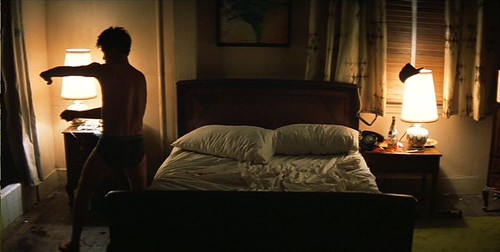
Here’s three frame-grabs that point up the parallel. The first is from the opening montage of Willard in Saigon just before he gets his orders:


Montage AN 19 martial arts

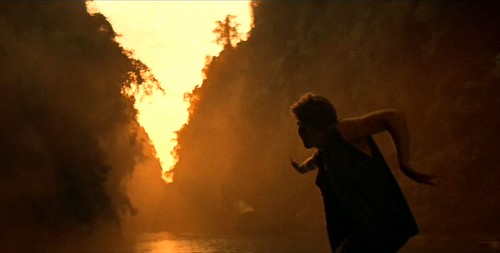
The second shot comes much later in the film. Clean has been killed (bullet), then the Chief (spear). Lance is the one who floated the Chief’s body down the river. Now they’re heading upriver toward Kurtz again, with Lance in the bow of the boat:


AN Lance dance1

He’s doing a martial arts dance. Not the same one as Willard did in the opening montage, but a martial arts dance. No one else in the film does such a thing. Clean does some dance moves while listening to the Rolling Stones, but they’re in an entirely different style; faster, jerkier, more angular.

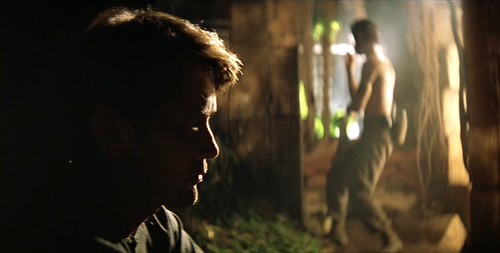
Finally, we have this scene in Kurtz’s compound. Willard’s in the foreground, and Lance is in the background:


AN Lance dance2

One might suggest that this parallel is a mere accident, one might. And perhaps it is. In cases like this, however, my default assumption is that it is not an accident. It may not be there by conscious intent and deliberate plan; but it is not there by accident. The people who made this movie are too skilled to do such things inadvertently.
That final remark of Benzon’s makes exactly the point I was hoping to make here, before commenting on those two screen-grabs from Manhunt:

The people who made this movie are too skilled to do such things inadvertently.
**

There’s actually a third shot in Manhunt with a view of a dangling rear-view-mirror ornament — let’s take a look:

This one’s from the van Peter Bergen and his cameraman, Peter Jouvenal, took in the docu’s re-enactment / flashback to their CNN interview with bin Laden, back in 1997. I don’t think this one is a rosary-like thing though it might be — I think it’s just the sort of tassel decoration you’ll find on saddle-bags, or decorating a camel or a car in Afghanistan.

The other two, however, seem clearly religious, both of them are shots of the cars in which American counter-terrorist folks would have gone to work during their efforts to track down bin Laden — and I find it significant that one features a (Christian) cross while the other very likely shows (Muslim) prayer-beads.

I say “very likely” because the beads could be (secular, Greek) worry-beads — but they look more like a tasbih to me. And why would that be interesting — why would a film-maker be interested in such a parallelism?

Besides the fact that these shots allow voice over and show us the various folk involved going to work, they specifically point up the fact that those working to defeat bin Laden were not all kuffar but included Ali Soufan of the FBI and “Roger” — the fellow described by Greg Miller in this March 2012 piece in WaPo, At CIA, a convert to Islam leads the terrorism hunt.

Am In right? I don’t know. But the subliminal message, if I am, is that the manhunt for bin Laden was indeed not a “Crusaders against Islam” affair.

**
May I recommend Wm. Benzon’s Beethoven’s Anvil to all who read here who have an interest in cognition and / or music?

For more on parallelism in cinema, see David Bordwell, Julie, Julia, & the house that talked, to which Benson also pointed me.

Manhunt: Radicalization, & comprehending the full impact of dreams

June 8th, 2013

[ by Charles Cameron — how do you intercept messages that come via dreams? I’m thinking of al-Balawi ]
.

My little graphic (below) may be kidding — but what of reality?

**

In the bin Laden documentary, Manhunt, which I mentioned before seeing it here, and discussed briefly here, another passage (at 1.22.31) that is missing from the CNN transcript concerns the dream which radicalized Humam al-Balawi, the Khost bomber. Balawi speaks, the subtitles translate for us:

God blessed me to have this dream. I dreamed I saw Zarqawi. He was in my house. His face was like a full moon. He was busy. Preparing an attack. I wishes I could fight with him. Be killed with him. I am your humble brother from Jordan. I am 32 years old and a medical doctor.

I’m not suggesting there was no prior fertilization of Balawi’s mind and heart, nor that he was influenced by no other drivers: I just wonder what the impact of such a dream would be, given that intense smuggling goes on between our waking and dream lives, of a kind that no intercepts can capture for analysis.

**

How powerful can influence can a dream exert?

Consider this example, taken from Marie-Lousie von Franz, On Dreams & Death: A Jungian Interpretation, p. 64:

She sees a candle lit on the window sill of the hospital room and finds that the candle suddenly goes out. Fear and anxiety ensue as the darkness envelops her. Fear and anxiety ensue as the darkness envelops her. Then, the candle re-lights on the other side of the window and she awakens. She died the same day.

**

If I may borrow a bit from some unpublished writings of mine…

Dreams as early indicators:

The western secular paradigm considers dreams to be of little or no significance, and it is therefore entirely possible that intelligence gleaned from the recounting of dreams will seem of little interest to western analysts. In the Islamic view, however, certain dreams are of considered to be of real significance, their importance being indicated by the hadith reported by Bukhari:

Narrated Ibn ‘Umar: Allah’s Apostle said, “The worst lie is that a person claims to have seen a dream which he has not seen.”

— Sahih Bukhari, book 87: Interpretation of Dreams, #167.

One early indicator of a Mahdist tendency in a given population, therefore, would be the presence of dreams about the Mahdi in a given discourse — in jihadist chat rooms, for instance — while the frequency of such mentions would be a useful heuristic measure of the development of such a movement. Thus Yaroslav Trofimov reports [Siege of Mecca, hb. p.50.] that in the run-up to the 1979 siege of the Grand Mosque and Ka’aba in Mecca, many followers of Juhayman al-Otaibi, the leader of the raid, dreamed dreams:

Then, one after another, hundreds of Juhayman’s supporters experienced detailed, vivid dreams. Mohammed Abdullah’s sister appears to have been the first, quickly followed by others. In their sleep, they all had the same vision: Mohammed Abdullah standing by the sacred Kaaba in Mecca’s Grand Mosque, accepting allegiance as the blessed Mahdi amid multitudes of believers. Militants from as far away as Lebanon who never encountered Mohammed Abdullah in person claimed to have had the same dream.

It is worth noting here that while, as Trofimov suggests, much of the dreaming “must have been caused by self-suggestion” this in no way invalidates their significance as indicators. Indeed, Reuven Paz writes of the mediaeval scholar Ibn Sirrin‘s still-popular Interpretation of Dreams that “high selling rates of this book can provide us an indicator for rising apocalyptic notions”. Paz also notes a “sizable number” of jihadis publishing their dreams and visions on Jihadist forums on the web [p.4..

Dream narration of this sort certainly corresponds to hikayat as discussed by Michael Vlahos in his essay Terror’s Mask: Insurgency Within Islam — still one of the most necessary pieces I have read on al-Qaeda..

**

Closer to home, in one sense, than the siege of the Grand Mosque, is the 9/11 attack on the Twin Towers and Pentagon. This too had its dream precursors, as we can tell from the video transcript of bin Laden‘s taped meeting of mid-November 2001:

UBL: He [Abu-Al-Hasan Al-Masri] told me a year ago: “I saw in a dream, we were playing a soccer game against the Americans. When our team showed up in the field, they were all pilots!” He said: “So I wondered if that was a soccer game or a pilot game? Our players were pilots.” He didn’t know anything about the operation until he heard it on the radio. He said the game went on and we defeated them. That was a good omen for us.

Shaykh: May Allah be blessed.

Unidentified Man: Abd Al Rahman Al-Ghamri said he saw a vision, before the operation, a plane crashed into a tall building. He knew nothing about it.

Shaykh: May Allah be blessed!

and notably:

UBL: We were at a camp of one of the brother’s guards in Qandahar. This brother belonged to the majority of the group. He came close and told me that he saw, in a dream, a tall building in America, and in the same dream he saw Mukhtar teaching them how to play karate. At that point, I was worried that maybe the secret would be revealed if everyone starts seeing it in their dream. So I closed the subject. I told him if he sees another dream, not to tell anybody, because people will be upset with him.

(Another person’s voice can be heard recounting his dream about two planes hitting a big building).

For your in-depth reading pleasure, see Iain R. Edgar, The Inspirational Night Dream in the Motivation and Justification of Jihad if you can get past the paywall…

**

Vlahos quotes Albert Hourani, A History of the Arab Peoples, on this point — I’ll present my own version of that quote here, because it describes a mindset that, mutatis mutandis, many of our opponents share to this day:

It was commonly held, in all cultures before the modern age, that dreams and visions could open a door into a world other than that of senses. They might bring messages from God; they might disclose a hidden dimension of a person’s own soul; they might come from jinns or devils. The desire to unravel the meaning of dreams must have been widespread, and was generally regarded as legitimate; dreams told us something which it was important to know.

Dreams are “outside the box” of waking reality — and we need to learn to appreciate the force of dream logic, if we want to think outside our own western prejudices, and inside our adversaries’ heads…

“We will start the war from right here.”

June 6th, 2013

[collated by Lynn C. Rees]

My Fellow Americans,

Last night, when I spoke with you about the fall of Rome, I knew at that moment that troops of the United States and our Allies were crossing the Channel in another and greater operation. It has come to pass with success thus far.

And so, in this poignant hour, I ask you to join with me in prayer:
Read the rest of this entry »

Human beings a whole lot more interesting than expected

June 6th, 2013

[ by Charles Cameron — human beings are a whole lot more interesting than was previously thought, evidence suggests ]
.
First, you should know that the English Defence League is, by its own account, “an inclusive movement dedicated to peacefully protesting against Islamic extremism.”

Now read on..

Or as Qur’an 49.13 puts it:

O mankind, We have created you male and female, and appointed you races and tribes, that you may know one another.

**

The Gospel suggests, Matthew 5.44:

Love your enemies, bless them that curse you, do good to them that hate you, and pray for them which despitefully use you, and persecute you…

and I am put in mind of this pair of images, both of which feature people I learned about for the first time in just the last couple of days:

**

Rev. Will D Campbell is the one shaking hands with Rev. Ralph D. Abernathy after the MLK assassination, in the top panel of the DoubleQuote above. He was a rare man — as the NYT puts is, “one of the few white clerics with an extensive field record as a civil rights activist” — which naturally reminds me, too, of my own mentor, Fr. Trevor Huddleston.

C.P. Ellis was a Ku Klux Klan leader until he met civil rights worker Ann Atwater, with whom he is pictured immediately below Abernathy and Campbell.

**

Wait, there’s more —

The first pair of images, above, comes from the UK, and the second pair from the US. So what’s the difference?

Apparently, the Brits serve tea while the Americans sip whiskey

Abernathy’s reverend friend is the gentleman described in the lower panel here, the one who drinks whiskey with Klansmen. Go figure: love trumps hate.

**

To get the full charge of these various stories, you might want to read:

  • Woolwich Attacks: Muslim Leaders At York Mosque Invite EDL In For Tea
  • EDL March With Muslims In Ipswich In Memory Of Lee Rigby
  • Rev. Will D. Campbell, Maverick Minister in Civil Rights Era, Dies at 88
  • The Ann Atwater approach
  • **

    Of course, the type of beverage you offer on these occasions must depend to some extent on the dietary habits and restrictions of both parties…

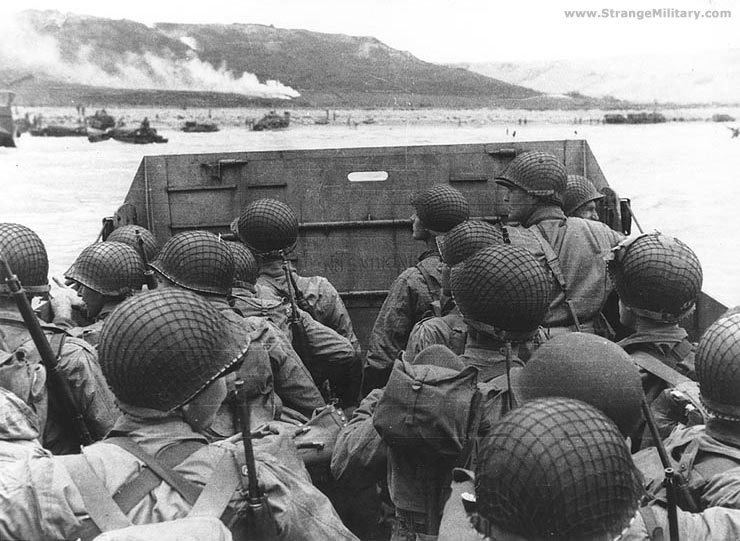
    D-DAY, June 6, 1944

    June 6th, 2013

    “Soldiers, Sailors and Airmen of the Allied Expeditionary Force! You are about to embark upon a great crusade, toward which we have striven these many months. The eyes of the world are upon you. The hopes and prayers of liberty loving people everywhere march with you. In company with our brave Allies and brothers in arms on other fronts, you will bring about the destruction of the German war machine, the elimination of Nazi tyranny over the oppressed peoples of Europe, and security for ourselves in a free world.

    Your task will not be an easy one. Your enemy is well trained, well equipped and battle hardened, he will fight savagely.

    But this is the year 1944! Much has happened since the Nazi triumphs of 1940-41. The United Nations have inflicted upon the Germans great defeats, in open battle, man to man. Our air offensive has seriously reduced their strength in the air and their capacity to wage war on the ground. Our home fronts have given us an overwhelming superiority in weapons and munitions of war, and placed at our disposal great reserves of trained fighting men. The tide has turned! The free men of the world are marching together to victory!

    I have full confidence in your courage, devotion to duty and skill in battle. We will accept nothing less than full victory!

    Good Luck! And let us all beseech the blessings of Almighty God upon this great and noble undertaking.

    — Gen. Dwight D. Eisenhower “

    Sixty-nine years ago over 9,000 American men, some hardly older than boys, laid down their lives on the beaches of Normandy in the greatest military operation in the history of the world. The white crosses stand row upon row in Colleville-sur-Mer,  in silent testimony of their supreme sacrifice.

    Others who scrambled ashore on bloody Omaha Beach, or who climbed the rocky cliffs of Pointe du Hoc or who parachuted behind enemy lines with the 82nd and 101st Airborne lived to fight their away across France and across the Rhine into the heartland of Germany to break the power of the Third Reich forever. Others who survived the terrible ordeal of D-Day and fought on were not so lucky and did not come home.

    The median age of WWII veterans now stands at 92. The “Greatest Generation” is receding into history in increasing numbers with each passing year but their deeds are destined to become legend.

    ….The men of Normandy had faith that what they were doing was right, faith that they fought for all humanity, faith that a just God would grant them mercy on this beachhead, or on the next. It was the deep knowledge – and pray God we have not lost it – that there is a profound moral difference between the use of force for liberation and the use of force for conquest. You were here to liberate, not to conquer, and so you and those others did not doubt your cause. And you were right not to doubt.

    You all knew that some things are worth dying for. One’s country is worth dying for, and democracy is worth dying for, because it’s the most deeply honorable form of government ever devised by man. All of you loved liberty. All of you were willing to fight tyranny, and you knew the people of your countries were behind you.

    The Americans who fought here that morning knew word of the invasion was spreading through the darkness back home. They fought – or felt in their hearts, though they couldn’t know in fact, that in Georgia they were filling the churches at 4:00 am. In Kansas they were kneeling on their porches and praying. And in Philadelphia they were ringing the Liberty Bell.

    Something else helped the men of D-day; their rock-hard belief that Providence would have a great hand in the events that would unfold here; that God was an ally in this great cause. And so, the night before the invasion, when Colonel Wolverton asked his parachute troops to kneel with him in prayer, he told them: “Do not bow your heads, but look up so you can see God and ask His blessing in what we’re about to do.” Also, that night, General Matthew Ridgway on his cot, listening in the darkness for the promise God made to Joshua: “I will not fail thee nor forsake thee.”

    …..Here, in this place where the West held together, let us make a vow to our dead. Let us show them by our actions that we understand what they died for. Let our actions say to them the words for which Matthew Ridgway listened: “I will not fail thee nor forsake thee.”

    Strengthened by their courage and heartened by their value [valor] and borne by their memory, let us continue to stand for the ideals for which they lived and died.

    Thank you very much, and God bless you all. ”

    – Ronald Wilson Reagan, President of the United States, June 6, 1984


    Switch to our mobile site