zenpundit.com

Returning from NSS, Brief Note

June 10th, 2011

En route from Carlisle, where I met a host of smart, imaginative and highly capable men and women from our armed forces, State Department, Intelligence community and other agencies, dedicated to protecting our national interests. It was a great week of strategy, national security and the occasional adult beverage.

Going out of fashion, fast…

June 9th, 2011

[ by Charles Cameron — humor, analytic indicators, fashion, dictators ]
.
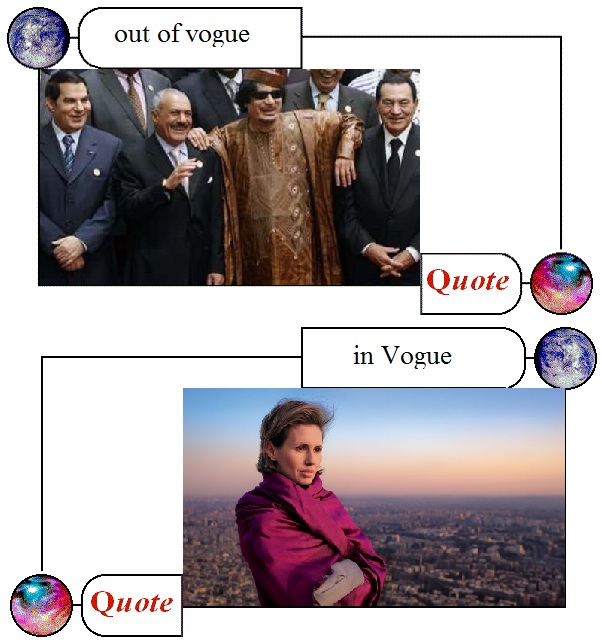
It seems likely from the first of these two images [Ben Ali, Saleh, Qaddafi, Mubarak, April] that manner of dress may be a valuable early indicator of how long a given dictator can hold onto power in the Middle East —

quo-vogue.jpg

— but where does that leave the lovely Asma al-Assad [in Vogue this February] today?

Answer:

oops.jpg

Patterns, Language, and Knowledge

June 6th, 2011

[by J. Scott Shipman]

John Boyd’s work led me to zenpundit a few years ago, and I am flattered and grateful to be small part of such an intellectually stimulating community.

One Boydian theme that has driven my reading is the “observe” node of his OODA (observe, orient, decide, act). While “orientation” gets most of the attention in Boydian circles, I have come to consider “observe” to be the foundation of knowledge, thus action.  “What” we see, or as my friend Dr. Terry Barnhart points out, what we “sense” directs orientations, decisions, and actions.

This short post is something of a preview (and an opportunity to try-out WordPress which does not like Safari—I’m using an old laptop that is slower than slow). I’d like to share four books that have influenced my thinking and I plan to review the first two of them here in the coming weeks.

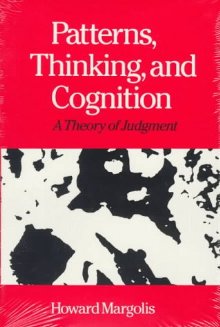
patterns.jpg

Patterns, Thinking, and Cognition, A Theory of Judgment, by Howard Margolis

Margolis’ thesis is “thinking and judgment…everything is reduced to pattern recognition.” Accordingly, he offers what he calls a P’ Cognition spiral, where the “spirals” represent a cognitive cycle and at the tops of the cycles represent a pattern recognition process. A review is in the works.

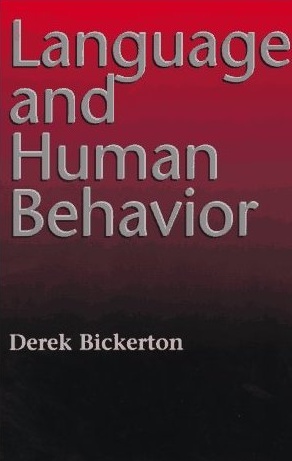
language.jpg

Language and Human Behavior, by Derek Bickerton Bickerton’s thesis is that “human cognition came out of language.” In this work, he defines language, explains the connection of language and evolution, and how language is integral to intelligence and consciousness. A review is in the works.

The final two books are  Personal Knowledge: Towards a Post-Critical Philosophy, and Meaning, by Michael Polanyi

“We know more than we can tell.” Michael Polanyi

There are several points of intersection between Polanyi’s work and that of Margolis and Bickerton, but what I found interesting were Polanyi’s treatment of what he refers to as two types of awareness; subsidiary and focal awareness. In Personal Knowledge, he offers an example of driving a nail, “I have a subsidiary awareness [also called from awareness in Meaning] of the feeling in the palm of my hand which is merged into my focal awareness of my driving the nail.” Subsidiary and focal awareness, according to Polanyi, are mutually exclusive where if one diverts one’s attention to the “feeling in the palm” one is likely to miss the nail. Musicians will recognize the distinction of “looking” at one’s hands will almost always divert from the music on the sheet.In Meaning, Polanyi goes further and assembles what he calls “three centers of tacit knowledge: first, the subsidiary particulars; second, the focal target; and third the knower who links the first to the second. We can place these three things in the three corners of a triangle. Or we can think of them as forming a triad, controlled by a person, the knower, who causes the subsidiaries to bear on the focus of his attention.”

Synthesis: I believe these ideas connect. For if Margolis is correct, then the “awareness” expressed by Polanyi would be apprehended using pattern recognition; recognition of patterns using Bickerton’s ideas with respect to language. Language is pattern-based, and we use language patterns in sense-making/creation of meaning.

More to come.

With Greco: two views of Toledo

June 6th, 2011

[ by Charles Cameron — perception, painting, pre-modern, modern, post-modern, heaven, sky, simulation, John Donne, El Greco ]

.

It is Sunday.

I find it powerfully interesting that the sky as perceived by painters (our “seers” par excellence) used to be filled with supernatural beings and is currently filled with natural ones — a clear sign that our culture has effectively moved from what one might call a theological vision of the world to a meteorological one (with astronomical trimmings under a clear sky)…

And I see that transition captured very precisely in four words, when John Donne writes:

At the round earths imagin’d corners, blow
Your trumpets, Angells, and arise, arise
From death, you numberlesse infinities
Of soules, and to your scattred bodies goe…

The “round earth” is that of modern science, the “imagin’d corners” those of pre-modern maps – and angelology.

*

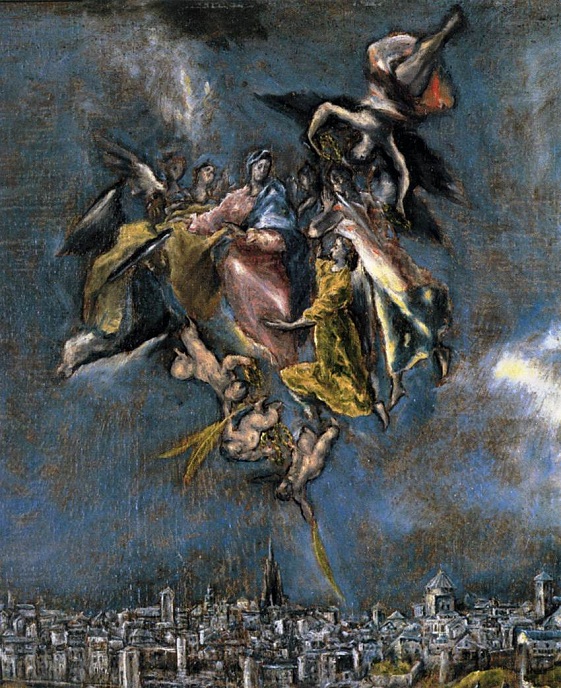
I have to admit, therefore, that I was surprised yesterday evening to come across an El Greco painting of Toledo that featured the blessed Virgin Mary over the city.

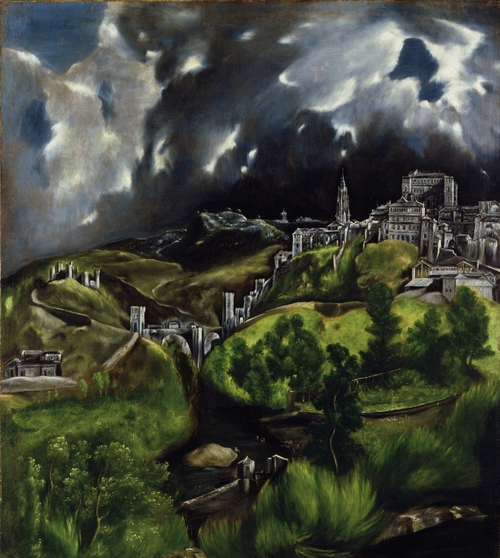
I have long been familiar with his better known View of Toledo, which is entirely naturalistic unless you want to consider storm-clouds as portents of a divine presence —
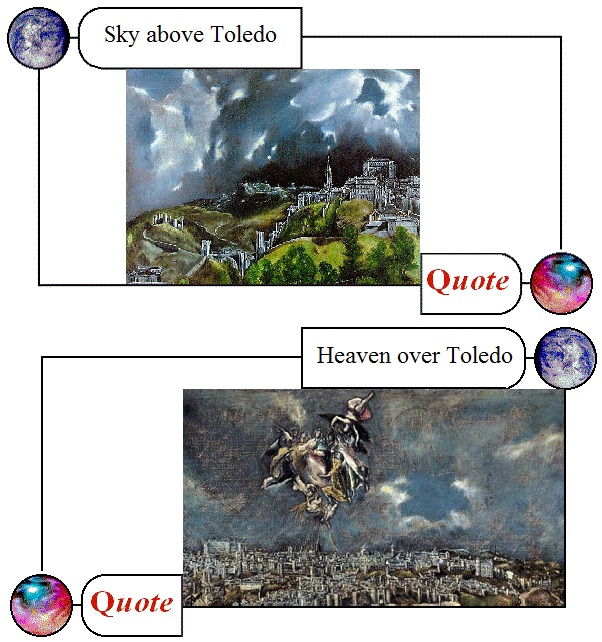
quo-sky-over-toledo.jpg

but the second of these images, from the View and Plan of Toledo, came as quite a surprise…

Here is a detail of the Virgin taken from it, to illustrate the point:
el-greco_view-and-plan-of-toledo_detalhe2_c1610.jpg

*

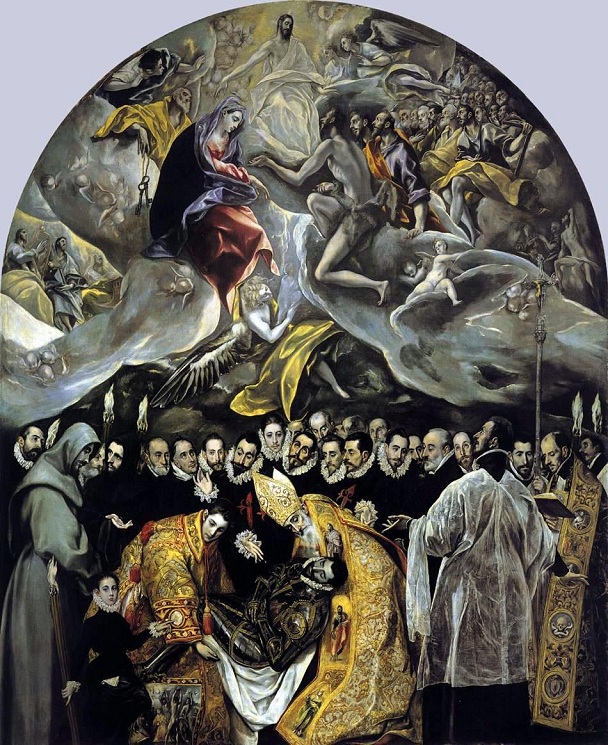
El Greco is famous for painting heaven-and-earth as a continuum – his great masterpiece, the Burial of Count Orgaz, catches the release of the soul from its bodily sheath as directly as Donne’s “to your scattred bodies goe” does to the return of those souls to corporeality at the General Resurrection:
entierro-del-conde-de-orgaz-sm.jpg

*

And yet El Greco, like Donne, sees both – Toledo under storm-clouds, Toledo under the shelter of the blessed Virgin…

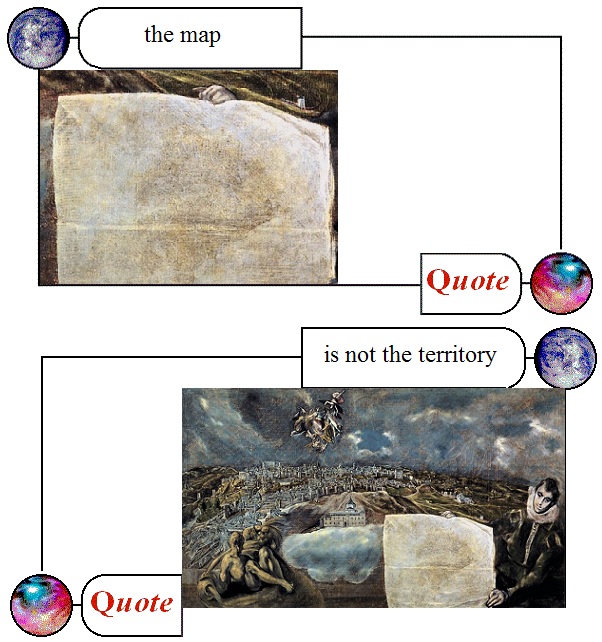
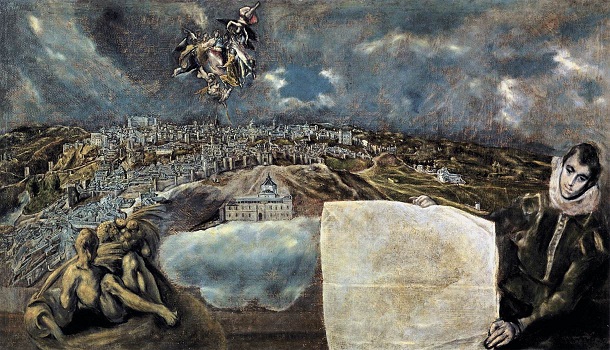
But there is more here, in this extraordinary painting. There is a map of the territory

quo-greco-toledo.jpg

*

If I could say in a nutshell what post-modern is, I would say it is recursive. It recognizes our perceived reality to be a simulation, and is thus always playing with maps and models, as Shakespeare was when he penned the words “All the world’s a stage” to be spoken in a theater whose sign and motto was “Totus mundus agit histrionem” – the whole world enacts a play.

Think of Hofstadter‘s Godel Escher Bach. Of Escher himself, and his image of himself holding his own small world in a glass sphere in his hand…

Think of Korzybski, and his dictum: the map is not the territory.

Think of Gregory Bateson, who wrote:

We say the map is different from the territory. But what is the territory? Operationally, somebody went out with a retina or a measuring stick and made representations which were then put on paper. What is on the paper map is a representation of what was in the retinal representation of the man who made the map; and as you push the question back, what you find is an infinite regress, an infinite series of maps. The territory never gets in at all. […] Always, the process of representation will filter it out so that the mental world is only maps of maps, ad infinitum.

Astoundingly, presciently – prophetically? – El Greco is already alluding to this, around 1610, in his View and Plan of Toledo.
11777-view-and-plan-of-toledo-el-greco-sm.jpg

*

El Greco’s Burial of Count Orgaz is in the Church of Santo Tomé in Toledo.

El Greco’s View and Plan of Toledo is in the Museo de El Greco, Toledo.

Here is the complete text of Donne’s sonnet:

At the round earths imagin’d corners, blow
Your trumpets, Angells, and arise, arise
From death, you numberlesse infinities
Of soules, and to your scattred bodies goe,
All whom the flood did, and fire shall o’erthrow,
All whom warre, dearth, age, agues, tyrannies,
Despaire, law, chance, hath slaine, and you whose eyes,
Shall behold God, and never tast deaths woe.
But let them sleepe, Lord, and mee mourne a space,
For, if above all these, my sinnes abound,
‘Tis late to aske abundance of thy grace,
When wee are there; here on this lowly ground,
Teach mee how to repent; for that’s as good
As if thou’hadst seal’d my pardon, with thy blood.

El Greco’s View of Toledo is in the Metropolitan Museum of Art in New York:
29_1006.jpg

Here we find no blessed Virgin, no angels with their final trumpets — and yet this painting can be viewed as analogous to his Vision of Saint John and the opening of the Fifth Seal — which owes its power to its “otherworldly stormy light” — and thus seen as yet another apocalyptic scene, one which “recalls St. John’s vision of the New Jerusalem in the Book of Revelations … a landscape of unearthly power and drama: a dialogue between heaven and earth conducted appropriately by the cathedral spire…”

On the Road

June 4th, 2011

In a few days, I will be headed to the US Army War College to become a new member of their National Security Seminar, an honor I owe entirely to the kind offices of Dr. Steven Metz, as Big Steve saw fit to nominate me. Once at Carlisle, I will have the opportunity to participate with AWC students in a variety of sessions and discussions related to national security and strategy and hear speakers who are top experts in their field. The keynote, if I understand correctly, will be given by General David Petraeus. The liason assigned to me, Col. Richard “Flip” Wilson, has been gracious and friendly and I am very much looking forward to visiting the War College, meeting new friends and learning a thing or two.

My blogging here at ZP may be erratic next week, though Charles and Scott will carry on in my absence, but I will try to put up a few items or pictures as time and internet connectivity permits. Twitter may be a much better bet for frequent updates and I can be followed @zenpundit for readers who are interested.


Switch to our mobile site