[ by Charles Cameron — care and feeding of authors and publishers, secrecy and transparency, Abu Muqawama, New Yorker ]
.
I am a writer.
I somewhat understand the need for writers to be supplied with books and food, and that publishers of various sorts, online and off, take on the costs of finding us and giving us a public hearing – but I also think it’s idiotic for the best of our thinking to take place in gated communities.
On matters concerning national security, for instance…
*
Two quick DoubleQuotes with a touch of that old time hacker religion…
And specifically…
*
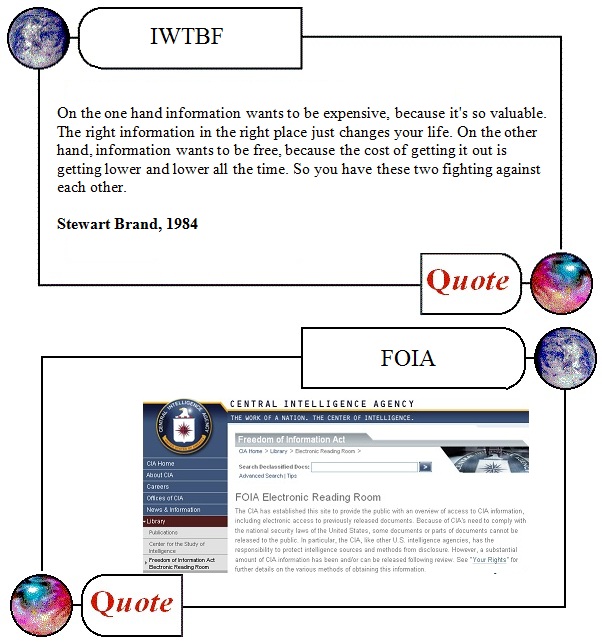
Certain things need to remain secret, I accept that. And there’s an inevitable tension, an ongoing tug-of-war between secrecy and transparency that even Stewart Brand, who coined the phrase “information wants to be free” admits, and that even the intelligence community responds to with CIA’s declassified search box, its responses to FOIA requests, and publications such as the unclassified extracts from Studies in Intelligence.
But here’s where I’m with Abu Muqawama:
The New Yorker has locked this article, which is silly, because this article has real policy relevance yet most of the people who need to read the article do not subscribe to the New Yorker.
Thankfully, Abu Muqawama / CNAS have summarized the piece in question, so you can read what it’s about and figure out for yourself whether you need to read the whole thing…
*
So here’s a round of applause for all those who do bright thinking about world affairs in public view – or make such thinking available.
You are doing us all – I gasp to think of it – a public service.
A kindergarten teacher in Mexico seeks to protect her students and calm their fears as narco-cartel fighters conduct a raging gun battle outside the window of her school. The woman has nerves of iron.
But hey…..Mexico can’t have an “insurgency” because the narcos don’t have “political” goals. Or a unified political goal. Or because there are still good vacation deals there at all-inclusive resorts. Or….Or…Or…. whatever flimsy rationale helps policy makers continue to punt the war next door.
[ by Charles Cameron — Ahmadinejad vs Khamenei, Jungian enantiodromia ]
.
*
The western press, on the whole, has covered the recent tussle between Iranian President Ahmadinejad and his superior, the Ayatollah Khamenei, in political terms — as a power struggle between a President who wants increased authority for the Presidency and a Supreme Authority who isn’t about to relinquish his Supremacy.
It is also a theological struggle, and the LA Times nicely weaves the two strands together in commenting:
At its heart is a possible future struggle for power between the firebrand president and Khamenei’s conservative clergy, who are wary of Ahmadinejad’s messianic strain of Islam and his incendiary populism. They worry his tendency for explosive talk could threaten their long-term interests, if not render them obsolete.
Putting it bluntly, the arrival of the Mahdi – or a strong populist current holding the opinion that Ahmadinejad is the Mahdi’s trusted lieutenant, chosen to prepare the way for his coming – would disenfranchise the clerics of Qom, who ultimately derive their authority from the Imam Mahdi’s absence.
The fairly recent discovery of a video, apparently prepared by Ahmadinejad’s supporters and proclaiming the Mahdi’s “soon coming”, seems to have heightened the tension…
Having said that, it’s my impression that Ahmadinejad is losing this tug-of-war, that he doesn’t have the popular groundswell of support he would need to go up against the Supreme Authority and win, and that consequently, his Mahdist “messianic strain” is losing power and credibility.
Which in turn should mean that the West has less to fear from Iranian Mahdism…
Glenn Beck, take note.
*
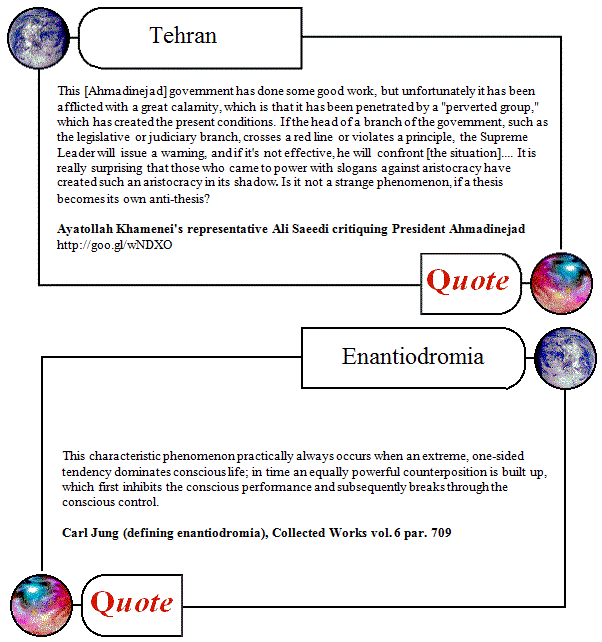
Putting that another way, it seems that the extreme Mahdism of Ahmadinejad is resulting – ironically enough, by enantiodromia – in a backlash from Khamenei that appears likely to depotentiate and dissipate it.
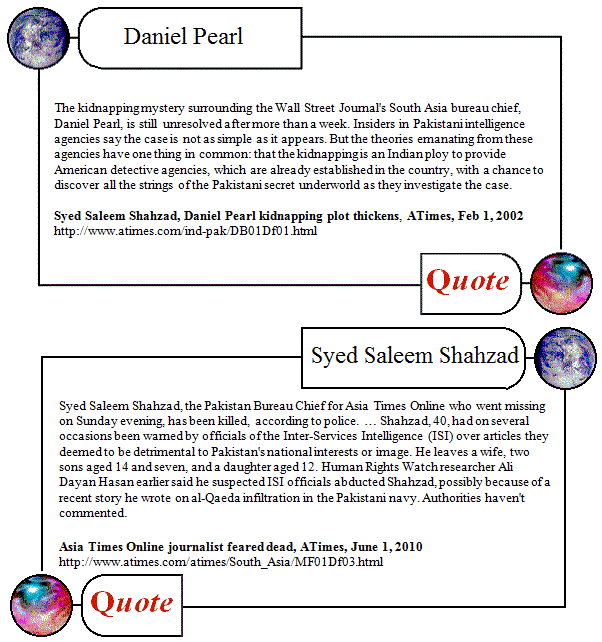
I must have been reading Saleem Shahzad for almost as long as he was reporting for Asia Times online – the first piece of his I could find on my hard drive is, ironically enough, a piece he wrote on the disappearance of Daniel Pearl:
And now Shahzad too is dead.
According to today’s ATimes report of his death, “Shahzad, who has been writing for Hong Kong-based Asia Times Online for nearly 10 years, failed to show up for a scheduled appearance on a television talk show in the capital Islamabad”…
So the Shahzad piece on Daniel Pearl must have been one of his earlier reports for ATimes, and here we are almost ten years later, with Shahzad himself in the role of the disappeared journalist.
*
Shahzad had interviewed the likes of Sirajuddin Haqqani and Ilyas Kashmiri on the jihadist side of things, and been recently interviewed himself by Rear Admiral Adnan Nazir and Commodore Khalid Pervaiz…
Joshua Foust sums up our reasons to regret his passing on Registan:
This is a serious loss—not just for his family, which must mourn a senseless death, but for people trying to understand the inexplicable militancy in Pakistan. He often had incredible sources, embedding with the insurgency inside Pakistan and Afghanistan and bringing to light narratives, perspectives, and stories no one could even hope to touch. Shahzad also seemed to have close ties to the ISI, and he performed an invaluable service reflecting those views to the outside world.
Shahzad, in other words, helped us start to understand why things happen in Pakistan and Afghanistan. Beyond his value as a human being—which means already that he couldn’t ever deserve to be abducted off the road and tortured to death—Syed Saleem Shahzad lived his life reporting things no one else would or could. And for that, we should celebrate what he accomplished.
In the 1990s, journalists in Pakistan used to refer to members of the ISI as farishtas, which in English means “angels.” “The angels are at work,” they used to remark, when election results were delayed, a reference to the ISI rigging the polls to achieve a desired result. For journalists, reporting on these angels increasingly means exposing yourself to great danger, and the ever-present threat of disappearing in the middle of the night, perhaps never to be seen again.
We distribute an extensive listing of small wars related events in our monthly newsletter – Number 2 to be distributed on Wednesday, 1 June. Sign up here for the newsletter and visit our Facebook page for an alternate SWJ events listing.
Zenpundit is a blog dedicated to exploring the intersections of foreign policy, history, military theory, national security,strategic thinking, futurism, cognition and a number of other esoteric pursuits.