zenpundit.com

April 27th, 2005

INTRODUCING…

I had intended to put up Part III. of the Cognition series this evening but the Son of Zenpundit desperately needs his elaboate birthday present assembled. So, instead, please check these fine, hand-selected, additions to the blogroll.

Transatlantic Intelligencer

Simon World

Random Probabilities

Peter Lavelle

April 27th, 2005

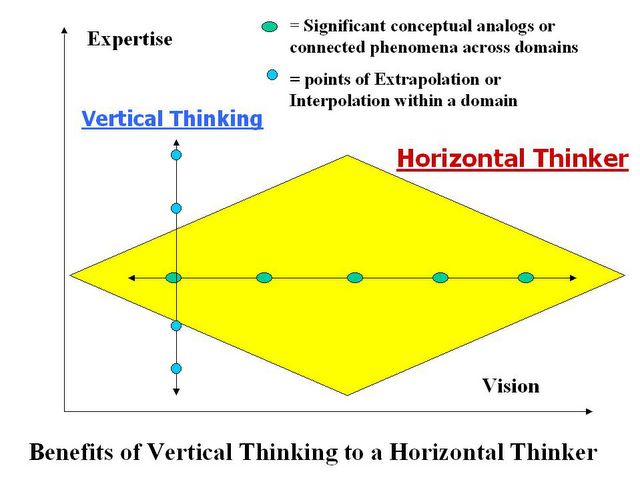
UNDERSTANDING COGNITION: PART II. – BENEFITS OF VERTICAL THINKING TO HORIZONTAL THINKERS Posted by Hello

Modern society is organized around Vertical thinking, a condition implicitly understood as far back in time as Adam Smith ,in his Wealth of Nations, where he took note of the emergence of specialization and division of labor in manufacturing. Society is completely dependent upon highly specialized experts, spending their time working within relatively narrow domains, to run a technocratic state and create products and services for an advanced information age economy.

Howard Gardner has written about two types of “ extraordinairy minds” that he calls ” Masters” and ” Makers”. Masters are the Vertical thinking experts, they keep the system running and try to advance the knowledge base of their specialty. We literally have armies of them and though some are more adept than others, all are heads and shoulders above the average layman in terms of their command of information. Makers by contrast are relatively rare. They are the Horizontal thinking visionaries – Gardner uses Freud as his archetype – who create new fields of endeavor and new paradigms with which to view the world.

Young children by default, as anyone who has listened to a pre-schooler describe a sudden realization knows, are natural Horizontal thinkers. For most of us, this capacity falls into disuse during years of formal schooling as we train our brains to organize and manipulate knowledge in terms of categories of vertical hierarchies. While virtually anyone can re-learn Horizontal thinking skills, some of us retain and develop Horizontal thinking to an unusual degree and become the great creative intellects of history. Such people, like Aristotle, Leonardo Da Vinci, Isaac Newton, Thomas Jefferson, Winston Churchill or Albert Einstein often either become accomplished in multiple fields or tend to revolutionize those in which they concentrate.

It is the true world-shaking,Horizontal thinking, visionaries who benefit most from the assistance of top level, Vertical thinking, experts. The Visionary sees lines of connection – a pattern or perhaps an overarching principle – across domains that not only eludes most experts but goes far beyond the Visionary’s own disciplinary competence . Almost all great visionaries are also experts at something in particular – it is hard to have superior vision while operating without any reference points. They may not even be at the absolute top of their field – Einstein had his critics who condemned him on technical grounds, such as Schrodinger – but they see far beyond the normal constraints of their discipline.

The Vertical thinking experts measure the validity of the Horizontal thinker’s conceptual vision by either testing it empirically or extrapolating or interpolating the concept to see if it
” fits” harmoniously within the existing Rule-set of the expert’s field. If it does fit, the Vertical thinker usually can correct any mistaken aspects and take the concept far beyond what the Horizontal thinker had even realized to be possible.

It is this cognitive partnership that is driving human progress.

In Part III. we examine evidence that the combination of Horizontal and Vertical thinking is the catalyst of human insight.

April 26th, 2005

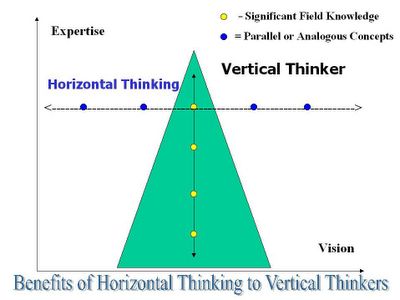
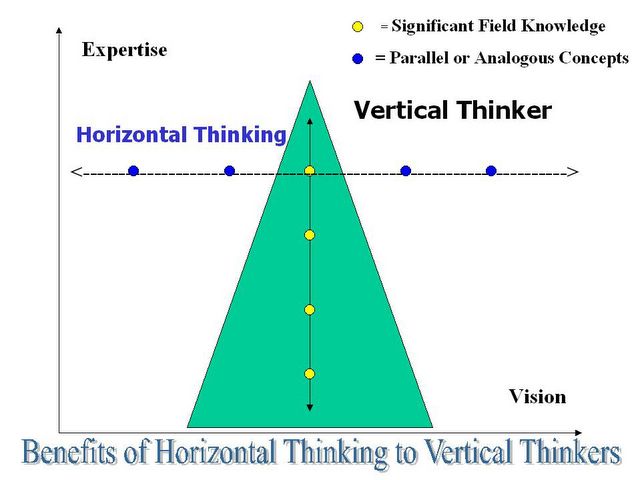
UNDERSTANDING COGNITION: PART I. BENEFITS OF HORIZONTAL THINKING Posted by Hello

Those who follow PNM theory already know that Dr. Thomas Barnett is an advocate of Horizontal Thinking and dedicated a section of his first book, The Pentagon’s New Map, to that process which he entitled ” How I Learned to Think Horizontally”. Barnett credited this technique and outlook of mind with making him a global strategist and enabling him to develop PNM theory by seeing the interconnections.

Horizontal thinking is an extremely powerful tool. In fact, I will later argue in this series that it is the required catalyst for the generation of insight but Horizontal thinking alone won’t do it in terms of cognition. Instead, Horizintal Thinking works best in conjunction with
“traditional “Vertical Thinking the way your right hand works with your left. Or as creativity theorist Edward DeBono originally summarized the relationship:

” Some people are unhappy about lateral thinking because they feel it threatens the validity of vertical thinking. This is not so at all. The two processes are complementary, not antagonistic. Lateral thinking enhances the effectiveness of vertical thinking by offering it more to select from. Vertical thinking multiplies the effectiveness of lateral thinking by making good use of the ideas generated .” (1)

The unhappiness to which Dr. DeBono refers is a result of the nature of modern, Western, education which is designed, at the apex of the system, to develop people with rarified skill-sets and a very high degree of expertise, usually in an aspect of a subfield of a much larger discipline in say science, medicine, engineering or law. Practitioners take the broadest view when they are initially introduced to the general principles of their field but as their knowledge base deepens, vision narrows as the professional perspective shrinks to the most complex problem or leading edge of field knowledge.

At this stage there are relatively few people at this level with the competency to act as a peer or offer competing ideas or correct errors. The field’s Rule-set which includes principles as well as habits of mind becomes for the high-level practitioner, a two edged sword. They define the expert but they also create a psychological frame that screens out much vital data from the expert’s awareness – this is the educated incapacity phenomenon decribed by Herman Kahn. The expert actually becomes more efficient at ruling out possibilities, in light of the field’s Rule-set, than in generating them. A frustrating cognitive trap that John Boyd called ” paralysis by analysis” where all potential moves are seen to have so many downsides that they become less attractive choices than remaining still.

Horizontal thinking can get the expert out of that mental cul-de-sac by setting aside analysis in favor of synthesis, intuitive pattern recognition, suspension of judgment, reversing/challenging premises, counterfactual thought experiments and brainstorming alternatives. These exercises are intended specifically to get he expert to look outside the confines of their field and into others in search of parallels and analogies. An important first step toward the realization that the field Rule-set is a tool and not – as is usually the case with experts – something to be regarded as an end in itself.

In Part II we examine how using Vertical Thinking helps the horizontal thinker.

Footnotes:
1. De Bono, Edward Lateral Thinking: Creativity Step by Step, p. 50, Harper Perennial, 1970
April 26th, 2005

RECOMMENDED READING

A collection of good topics tonight:

The ubiquitous praktike (who was kind enough to link here) on the limits of democracy promotion.

Stuart Berman gets down with a battle of the Toms – Barnett vs. Friedman !( I think I hear Dr. Barnett wincing all the way from here).

Dr. Demarche on how unreasonable environmentalism kills African children.

Pundita on the Mandarins of State and John Bolton.

Prometheus6 on machines that can read your state of mind.

Lord Curzon on the agony of Nepal.

April 26th, 2005

THE RUSSIA HOUSE [ UPDATED]

Brace yourself for a good deal of rubbish in the next few days regarding Putin’s address to the Russian people, particularly regarding his grandiosely ahistorical claim that the demise of the USSR was “the greatest geopolitical catastrophe of the century.” MSM psuedo-experts and talking heads are going to pop up next Sunday morning with Tim and George to engage in ominous, arm-waving, hysterics over that line.

It was a phrase designed to raise an emotional red flag ( pun intended) but at home, not in the West. It is dubious that Putin himself really believes that – at least to that extent – since if the USSR were still around he’d still be trying to recruit the local girlfriends of the Marine guards at the American Consulate in some Bulgarian backwater, instead of being President of Russia. There are millions of patriotic Russians who miss the days when their country was the feared superpower and they like to hear that kind of rhetoric from Putin.

Trust me, these quasi-nationalists are also the same people who used to tell jokes about Brezhnev being a walking corpse. These people don’t want the Bolsheviks to come back, they want to stop feeling humiliated about the condition in which Russia finds itself. By speaking as he does, Putin sucks all the political air away from the extreme Right and the hardline Communists who would be waving the ultranationalist bloody shirt for all they were worth if they could. They can’t though, so long as Putin is seen as a ” respectable” outlet for conservative sentiments.

These Russians, muzhik-descended, second-generation urbanites, older for the most part and living in outlier cities and towns are Putin’s equivalent of Nixon’s ” Silent Majority” and Putin plays to them in a similar way. The beneficial aspect in terms of American interests is that Putin prevents their radicalization with his blunt talk. The extremists on Russia’s political margins on the right and left are a scary, anti-semitic, wildly anti-American and anti-capitalist bunch. We really don’t want them riding a populist wave to power, we want to help Putin where he takes positive steps and help the real Russian liberals build truly credible, democratic, alternatives to authoritarian rule.

But get the U.S. to loudly push the case of the check-writing, ” democratic”, mafia Oligarchs and you can paint what is left of Russia red and brown.

UPDATE: The text of Putin’s speech.


Switch to our mobile site