zenpundit.com » Uncategorized

Archive for the ‘Uncategorized’ Category

Who would you trust more at CIA?

Monday, May 7th, 2018

[ by Charles Cameron — seeking to emphasize what may be at base a spiritual / psychological question ]
.

First, the context, courtesy Washington Post:

Trump had signaled as a presidential candidate that he would consider reestablishing agency prisons and resuming interrogation methods that President Barack Obama had banned. Trump never followed through on that plan, which was opposed by senior members of his administration including Defense Secretary Jim Mattis.

Sen. John McCain (R-Ariz.), who was tortured while imprisoned in Vietnam, said Haspel’s Senate confirmation should be conditioned on securing a pledge to block any plan to reintroduce harsh interrogations. “Ms. Haspel needs to explain the nature and extent of her involvement in the CIA’s interrogation program,” ­McCain said.

Haspel ran one of the first CIA black sites, a compound in Thailand code-named “Cat’s Eye,” where al-Qaeda suspects Zayn al-Abidin Muhammed Hussein, better known as Abu Zubaida, and Abd al-Rahim al-Nashiri were subjected to waterboarding and other techniques in 2002.

An exhaustive Senate report on the program described the frightening toll inflicted. At one point, the report said, Zubaida was left “completely unresponsive, with bubbles rising through his open, full mouth.”

Internal CIA memos cited in a Senate report on the agency’s interrogation program described agency officials who witnessed the treatment as distraught and concerned about its legality. “Several on the team [were] profoundly affected,” one agency employee wrote, “.?.?. some to the point of tears and choking up.”

Haspel later served as chief of staff to the head of the agency’s Counterterrorism Center, Jose Rodriguez, when he ordered the destruction of dozens of videotapes made at the Thailand site.

Rodriguez wrote in his memoir that Haspel “drafted a cable” ordering the tapes’ destruction in 2005 as the program came under mounting public scrutiny and that he then “took a deep breath of weary satisfaction and hit Send.

**

In light of the above, who would you trust more?

Someone who has overseen torture, deeply regretted / repented of it (metanoia), and wouldn’t repeat the crime / error / sin / shame / pick your word and its accompanying implications under any circumstances — or someone who was against torture from the first?

As I understand it, Gina Haspel claims to fall in the former class, thought I’m not sure whether she views her earlier actions with regret and / or remorse — and these /// differences are important.

There’s little doubt that as an administrator of Agency business, she’d more than qualified, so our “only remaining question” is whether someone who once oversaw a black site (and destroyed potentially incriminating evidence) can be trusted never to permit CIA to practice torture, under whatever name or cover it may hide, ever again.

Does she regret / repent, or does she feign regret / repentance?

And would you expect a newspaper reporter or cable news pundit — indeed, anyone short of her confessor or Haspel herself — would know?

**

Once again, mortals must decide, and quickly — our continuing koan or paradox — while the most relevant information of all is tangled up in the knots of human psychology / hidden deep in the heart of God..
New category: Extremier than Extreme

Monday, May 7th, 2018

[ by Charles Cameron — possibly simple-minded, but offered to our mentor JM Berger — includes a horseshoe & a neat paradox, too ]
.

Today’s example:

Trumpier than Trump. Okay..

**

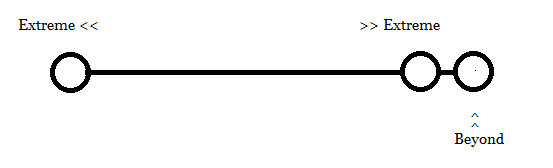
Let’s generalize from here, and diagam this:

Extremier than the Extreme.

This isn’t the first time I’ve seen this. I’m pretty sure ISIS was AQier than AQ in the day, and that even earlier, there was a splinter group within AQ that was “more extrem”. Might have been Zarqawi, in which case our two examples collapse into one..

“Extremier than the Extreme” — within its own extreme context, it can be one helluva claim to make!

**

While we’re on the subject..

There’s also the oft-noted Horseshoe effect, whereby opposite expremes come to resemble one another:

This one, Revolutionary > Dictator > Dictator is well known because of the frequency with which Revolutionaries come to resemble the Dictators they overthrew.

A concatenation of horseshoes of this sort would give you Revolution > Dictatorship > Dictatorship > Dictatorship ad nauseam, with a Dictatorship currently in power, and a Revolution constantly brewing.

**

Oh, and by the way, an intriguing paradox:

Wittgenstein’s language games and the public sphere

Monday, May 7th, 2018

[ by Charles Cameron — suggesting a lessening of TV Trumpery and its critiques ]
.

In a tweet earliee today, I suggested that the close reading of a text can be highly rewarding, a point I made most forcefully in Close reading, Synoptic- and Sembl-style, for parallels, patterns.

Key to a close reading is the “language” in which a given writer or speaker clothes their words.. “language” here being used both in the sense of their metaphors and forms (which is why I’ve been collecting sports and other metaphors, ouroboroi and other forms) and in the sense formulated by Witty Wittgenstein in his Philosophical Investigations (PI).

The Stanford Encyclopedia of Philosophy offers us a list of regular language games as Wittgenstein uses the term in PI:

reporting an event, speculating about an event, forming and testing a hypothesis, making up a story, reading it, play-acting, singing catches, guessing riddles, making a joke, translating, asking, thanking

I want to suggest that we could usefully think of language games in terms of the philosophical, ideological, partisan, religious or psychological drivers that propel them.

Further, in the case of Trump, we might observe that the language game he is playing is not the one his critics on, say, MSNBC, are basing their own critiques on.

And here’s the great advantage: once we’ve analyzed the differences between Trump’s language game and aims and those of his critics, we could close shop. We wouldn’t need this constant barrage of Fox and MSNBC news on the topic — any new utterance of his or Giulianis of note could simply be indexed to the sub-para describing that particular disjunction in language game, and basta! — the rest of the news “oxygen” would be available for the discussion of other topics.

As a subset of that para — I don’t suppose Mueller xxwill want to take every piece of “off the cuff” Trumpery as intended as real “truth” — “all that is the case” –he’ll surely see it as entertainment and distraction — chuff and chaff — and zero in on the key statements of the President’s worldview, viewing them as exemplars not of “truth” but of a language game to be analyzed and evaluated as such. Having zeroed in on these relatively few key phrases, many of the many critiques offered by Trump’s accusers.

**

Wittgenstein asks what all that we consider to be games have in common, and decides they share a family resemblance but — in my words, here — the cousins on one side of the family have little (a polite word for “nothing”) in common with the cousins at the other end of thr spectrum.

If the Olympic Games included language games in their list of sports, Giuliani‘s reference to FBI agents as stormtroopers wight win long jump gold.

Here’s Jonathan Chait in Giuliani’s FBI ‘Stormtroopers’ Smear Is the Key to Trump’s Authoritarian Mind-set”>:

In 1995, National Rifle Association president Wayne LaPierre signed his name to a fundraising letter referring to Bureau of Alcohol, Tobacco and Firearms agents as “tjack-booted government thugs.” The implicit association of American federal law enforcement with fascists provoked a furor. Former president George H. W. Bush publicly resigned his NRA membership in protest; LaPierre had to apologize.

Last night, in the midst of a long, deeply incriminating interview, Rudy Giuliani called FBI agents “stormtroopers.” Here was the president’s lawyer, not an outside lobbyist, comparing federal law enforcement to Nazis directly, rather than indirectly.

Stormtrooper vs jack-booted government thugs is an interesting comparison (& makes a fine DoubleQuote), and Chait’s “implicit association of American federal law enforcement with fascist” in hth cases exemplify just the kind of language extremism we should be avoiding in our policy debates.

Chait’s continuing half-paragraph illminates the arcane workings of the media machine in processing such things:

The Washington Post’s account of Giuliani’s interview noted the remark in a single sentence, in the 30th paragraph of its story. The New York Times, Wall Street Journal, and Politico accounts of Giuliani’s interview did not even mention the stormtrooper remark at all.

There are times I wish for sanity.

**

Okay, that was third and last in this series.. Previously:

  • On negative space in the painting..
  • On negative space, private morality in the public square
  • This:

  • Wittgenstein’s language games and the public sphere
  • On negative space, private morality in the public square

    Monday, May 7th, 2018

    [ by Charles Cameron — not entirely keen about Judgment, me, but.. ]
    .

    Continuing on from my discussion of negative space in the painting, here’s the MSNBC clip I overheard waas on about:

    **

    The clip, in other words, is about private morality in the public square.

    Raw Story picks up there thread in a piece titled ‘Where are the preachers of America?’:

    Evangelical leaders slammed for hypocrisy of Trump support:Former New York Times White House correspondent Howell Raines, who rose to executive editor of newspaper, called out the evangelical community during a Friday appearance on MSNBC’s “The Beat with Ari Melber.”

    “I want to ask you about the negative space in the painting, the thing that’s not happening — that we are always told would happen — because the Christian right and the conservative values organizations and the evangelical right cared deeply about the personal behavior of politicians and especially the president,” Melber observed.

    “The president now has squarely admitted to paying this woman in direct connection to the allegations of this extramarital affair,” the host continued. “I ask you for your view of why we’re not hearing any outrage for any of those groups affiliated with Donald Trump and the Republican Party.”

    “Where are the preachers of America when morality is legitimately at the center of our national life?” Raines wondered. “I think Director Comey was correct today on CBS when he said this is about values and supporting our institutions and it’s imperative that Americans who believe in the normal political process and the rule of law start speaking out.”

    “That’s what’s missing in the picture to me,” he concluded.

    **

    That’s a significant question, to which various answers have been given — from a quick Google search:

  • The Nation, Why Evangelicals—Still!—Support Trump
  • Time, Why Evangelicals Support President Trump, Despite His Immorality
  • Atlantic, A Match Made in Heaven
  • but I’d like to leave — indeed emphasize — it as a question.

    How come the hypocrisy?

    And I think we should ask this, not as a question requiring a political answer, but as a moral question, hanging in the air, for the individual consciences of evangelicals to ponder..

    I have my own hyposcrisies to consider..

    On negative space in the painting..

    Monday, May 7th, 2018

    [ by Charles Cameron — where might mist be the opposite of tree? ]
    .

    When I heard the words “negative space in the painting” on MSNBC a couple of days ago I was intrigued — was this an unanticipated art program? Terrific! Next thought: the use of negative space is particularly noted in Japanese art:

    In Japanese, ma, the word for space, suggests interval. It is best described as a consciousness of place .. the simultaneous awareness of form and non-form deriving from an intensification of vision.

    Here’s Wiki’s visual exmple:


    .

    The Pine Trees screen is a pair of six-panel folding screens by the Japanese artist Hasegawa Tohaku. .. The screens are held by the Tokyo National Museum, and were designated as a National Treasure of Japan in 1952.

    The ink-on-paper work depicts a view of Japanese pine trees in the mist, with parts of the trees visible and parts obscured, illustrating the Zen Buddhist concept of ma and evoking the Japanese wabi aesthetic of rustic simplicity.

    Japanese classical aesthetics are subtle where Western modern aesthetics are obvious, deep where their Western cousins tend to the superficial, and while I wouldn’t care to elaborate on the definitions of ma and wabi, I don’t think “rustic simplicity” catches much of the resonance of wabi, and the phrase “Zen Buddhist concept” is on the clumsy side IMO — well, however.

    **

    DT Suzuki‘s Zen and Japanese Culture was among my early purchaases as a young Oxford scholar with book money and BH Blackwell’s to plunder — and ma and wabi, along with sabi and yugen, rasa and raga, duende, lachrimae and mutabilitie — are among the art-induced mind-&-heart-states I’ve long found of impassioned interest.

    For what “negative space” referred to on MSNBC, see the second post in this series of three..


    Switch to our mobile site