zenpundit.com » theater

Archive for the ‘theater’ Category

Games heroic and tragic: gaming St Crispin’s Day

Saturday, January 30th, 2016

[ by Charles Cameron — busy tidying away six or more posts before Spring Break delivers my college-age son to me — here’s one ]
.

We observe Shakespeare gaming — staging — playing — the Battle of Agincourt:

**

A play, a game, a gamble. The odds are “fearful”..

WESTMORELAND
Of fighting men they have full three score thousand.
EXETER
There’s five to one; besides, they all are fresh.
SALISBURY
God’s arm strike with us! ’tis a fearful odds.
WESTMORELAND
O that we now had here
But one ten thousand of those men in England
That do no work to-day!

**

Medieval 2 Total War also games Agincourt:

Sadly, the voice over doesn’t seem to get any more rousing than this:

Henry’s longbowmen will be the key to defeating the French, striking them down as they traverse the muddy field. To protect his longbowmen from cavalry, Henry has ordered them to plant sharpened stakes in front of their positions…

An earthy voice shouts, “For Saint George!” a couple of times, but that’s about the level of inspiration offered. I haven’t played the game, I’m going by the video overview — but there’s no mention there of Crispin — though we do hear a yokel shout:

Once more unto the breach, my Lord

— a line swiped (and then tweaked) from King Henry himself, earlier in the play — at the siege of Harfleur, not at Agincourt, to be exact.

**

It seems to me that the novel (Tinker, Tailor, Soldier, Spy), film (Kagemusha, say) and television on occasion (The Honourable Woman) rise to their respective occasions — but games I think, not so much, thus far.

I look forward (on behalf of future generations, I suppose) to the Kurosawa of the game genre — and to its Jean Cocteau.

Analogies of game and play, life and death

Tuesday, September 8th, 2015

[ by Charles Cameronno trump — a situation in which no suit is designated as trump ]
.
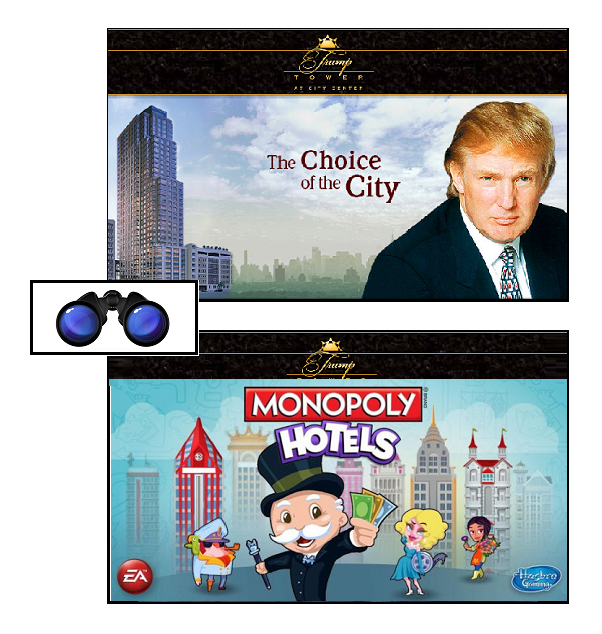
SPEC DQ Trump & Monopoly

Sources:

  • Trump, Trump Tower at City Center
  • Monopoly, EA Brings iOS Hit Monopoly Hotels to Google Play
  • **

    There are at least three major analogies for life to be found within life itself: dreams, games, and plays — and in each case, there’s the possibility of an infinite regression, of dreams within dreams, games within games, and plays within plays.

    Shakespeare has the play within a play motif down nicety, but it traces back if I’m not mistaken to Plotinus, if not before. There’s that favorite remark of mine in the Enneads:

    Murders, death in all its guises, the reduction and sacking of cities, all must be to us just such a spectacle as the changing scenes of a play; all is but the varied incident of a plot, costume on and off, acted grief and lament. For on earth, in all the succession of life, it is not the Soul within but the Shadow outside of the authentic man, that grieves and complains and acts out the plot on this world stage which men have dotted with stages of their own constructing. All this is the doing of man knowing no more than to live the lower and outer life, and never perceiving that, in his weeping and in his graver doings alike, he is but at play; to handle austere matters austerely is reserved for the thoughtful: the other kind of man is himself a futility. Those incapable of thinking gravely read gravity into frivolities which correspond to their own frivolous Nature. Anyone that joins in their trifling and so comes to look on life with their eyes must understand that by lending himself to such idleness he has laid aside his own character. If Socrates himself takes part in the trifling, he trifles in the outer Socrates.

    **

    We can move from theater to dream with almost suspicious ease via Pedro Calderón de la Barca, whose play La Vida es Sueño plays (in what is more a “game” sense than a “theatrical” one) with the idea of life as a dream — the idea embodied in his play’s very title.

    Indeed, as the translator Michael Kidd suggests in his Introduction to the play:

    To emphasize the illusory nature of this existence, the Spanish Baroque relied on three central metaphors: life as art, life as theater, and, most important for Calderón, life as a dream.

    Here, then, is the heart of Calderón:

    We live in such an exceptional world that living is no more than dreaming; and experience teaches me that he who lives dreams what he is until waking. The king dreams that he’s king, and he lives under this deception commanding, planning, and governing; and his acclaim, which he receives on loan, is scribbled in the wind and turned to ashes by death. What grave misfortune! To think that anyone should wish to govern knowing that he will awaken in the sleep of death! The rich man dreams of more riches, which only bring him more worries; the poor man dreams that he suffers in misery and poverty; the man who improves his lot dreams; the man who toils and petitions dreams; the man who insults and offends dreams. And in this world, in short, everyone dreams what he is although no one realizes it. I dream that I’m here, weighed down by these chains, and I’ve dreamt that I found myself in more flattering circumstances. What is life? A frenzy. What is life? A vain hope, a shadow, a fiction. The greatest good is fleeting, for all life is a dream and even dreams are but dreams.

    And for recursion — an earlier translator of those lines about anyone who might “wish to govern knowing that he will awaken in the sleep of death” renders them thus:

    Who would wish a crown to take,
    Seeing that he must awake
    In the dream beyond death’s gate?

    Why, we are almost in the realm of Chuang Tzu..

    Once Chuang Chou dreamt he was a butterfly, a butterfly flitting and fluttering around, happy with himself and doing as he pleased. He didn’t know he was Chuang Chou. Suddenly he woke up and there he was, solid and unmistakable Chuang Chou. But he didn’t know if he was Chuang Chou who had dreamt he was a butterfly, or a butterfly dreaming he was Chuang Chou. Between Chuang Chou and a butterfly there must be some distinction! This is called the Transformation of Things.

    **

    Oho — do we imagine we have escaped moral necessity by viewing life as a dream?

    Calderón again:

    I want to do what’s right, for it pays to do what’s right even in dreams.

    **

    Ah, but games.

    It was the quote that follows, about death and games, that drove me to write this post, and I believe it takes us deeper into the mystery of these analogies of life and death: Gabby DaRienzo is writing about “ussing game mechanics to encourage players to think about death and mortality” in her piece, Death Positivity in Video Games:

    Death serves multiple mechanical roles in videogames — it is most commonly used as a thing you want to avoid, a goal you need to accomplish, or as a narrative device. While death is prominent in many videogames, we generally give it much less thought and treat it with much less seriousness than actual death, especially when it comes to the player.

    And there we have it — the recognition that we care less or more, proportionately, about some things in games than we do in “RL”.

    Some of that difference, it would seem is to do with the mechanics and “inworld” motivations of particular games — but it would be an interesting landscape to plot, game by game or genre by genre. Flight simulators need to be in close correspondence with the realities they are represnting in terms of turbulent air flows, fuel consumption, and landing strips, for iunstance — but if their clouds are visually a bit less than realistic, it’s no big deal. A Tibetan mandala-based game, on the other hand, might want to get the scrolled cloud-work so characteristic of Tibetan art and the Thirty-two Excellent Signs of a Buddha’s Enlightening Body exactly right — in Tibetan cultural terms. Strage, but true:

    Each hair of a Buddha’s eyebrow is exactly the same length.

    **

    Money, then.

    In Monopoly, it’s everything — and life?
    PR Beckman tweets on bridges and analogy

    Sunday, January 25th, 2015

    [ by Charles Cameron — cross-posted from Sembl — this post is for Cath Styles, who has been thinking bridges ]
    .

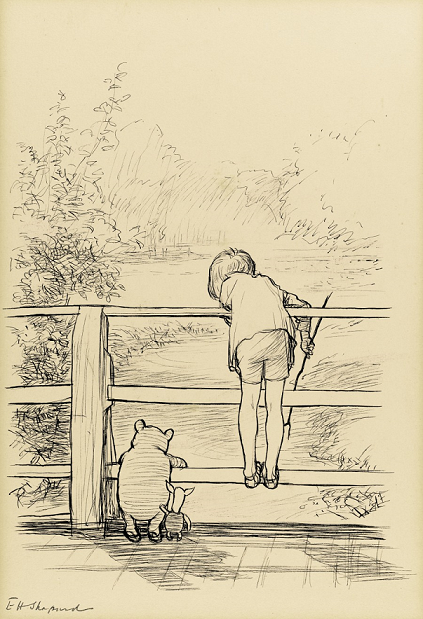
    Pooh bridge

    **

    My blog-friend PR Beckman, on a roll, has been tweeting Octavio Paz and Martin Esslin.

    I’ve taken Beckman’s tweets out of 140 characters and put them back into paragraphs, and given a little more context to some of them, but greatly though I admire Octavio Paz and much though I have puzzled over the Theater of the Absurd, I wouldn’t have run across these particular passages if I hadn’t found them in my Twitter feed today. Important.

    **

    Octavio Paz, Children of the Mire: Modern Poetry from Romanticism to the Avant-garde:

    Analogy is the science of correspondences. It is, however, a science which exists only by virtue of differences. Precisely because this is not that, it is possible to extend a bridge between this and that. The bridge does not do away with distance: it is an intermediary; neither does it eliminate difrerences: it establishes a relation between different terms. Analogy is the metaphor in which otherness dreams of itself as unity, and difference projects itself illusively as identity. By means of analogy the confused landscape of plurality becomes ordered and intelligible. Analogy is the operation nby means of which, thanks to the play of similarities, we accept differences. Analogy does not elimiate differences: it redeems them, it makes their existence tolerable.

    Martin Esslin, The Theatre of the Absurd, pp 419:

    the Theatre of the Absurd is concerned essentially with the evocation of concrete poetic images designed to communicate to the audience the sense of perplexity that their authors feel when confronted with the human condition

    and 428:

    The realization that thinking in poetic images has its validity side by side with conceptual thought and the insistence on a clear recognition of the function and possibilities of each mode does not amount to a return to irrationalism; on the contrary, it opens the way to a truly rational attitude.

    **

    Let me add a quote of my own choosing, this one from Winnie the Pooh:

    Sometimes, if you stand on the bottom rail of a bridge and lean over to watch the river slipping slowly away beneath you, you will suddenly know everything there is to be known.

    Illustration: Original, 1928 Illustration Of Pooh, Christopher Robin and Piglet Could Fetch Over $200K

    The Art of Future War?

    Sunday, November 23rd, 2014

    [ by Charles Cameron — coloring outside the lines of the challenge ]
    .

    http://www.desura.com/mods/dune-wars/images/new-soldier-and-infantry-units
    Civ4 Dune mod, “Worm attack”, from Desura

    **

    I’m all in favor of the Atlantic Council‘s Art of Future War Project:

    It is a moment to seek out new voices and ideas from artists who can range much farther out into the future. Artists are adept at making sense of disorder while also having the ability to introduce a compelling chaos into the status quo. In other words, they are ideally suited to exploring the future of warfare. Writers, directors and producers and other artists bring to bear observations derived from wholly different experiences in the creative world. They can ask different kinds of questions that will challenge assumptions and conventional ways of tackling some of today’s toughest national security problems. Importantly, they can also help forge connections with some of most creative people in the public and private sectors who otherwise struggle to find avenues for their best ideas.

    That’s excellent, and as a poet and game designer with a keen interest in war and peace, I hope to contribute.

    **

    Funny, though, their first challenge looks, to my eyes, just a little bit back to the future:

    The Art of Future Warfare project’s first challenge seeks journalistic written accounts akin to a front-page news story describing the outbreak of a future great-power conflict.

    Why would we want to produce something “akin to a front-page news story” at a time when news stories are already more web-page than front-page, and perhaps even tweet before they’re breaking news?

    In any case, the good people at Art of Future War offered some clues to those who might want to take up their challenge, and I took their encouragement seriously —

    The historical creative cues included below are intended to inspire, not bound, creativity.

    **

    Their first clue did indeed inspire me, though not to write anything akin to a front-page news story, “between 1,500 and 2,500 words long”. The clue they gave was the Washington Times lede I’ve reproduced in the upper panel below —

    SPEC DQ slomo death

    while the lower panel contains the quote their clue led me to, by an associative leap of the kind artists are prone to — drawing on the vivid imagery of Peter Brook‘s play, The Mahabharata, which I had the good fortune to see in Los Angeles, a decade or three ago.

    **

    My own leap backwards — to an ancient and indeed originally oral epic, the Mahabharata, rather than to century-old newsprint — won’t win me the challenge, since it doesn’t answer to the rules, nor will it provide useful hints as to what war will look like a decade from now.

    The sage Vyasa, who wrote the Mahabharata at the dictation of the god Ganesh, might have been able to predict the future of war — I certainly cannot.

    What I can do, and hope to have done, is to suggest that the whole of human culture has a bearing on war and how we understand it.

    James Aho‘s Religious Mythology and the Art of War should be on every strategist’s reading list, as should Frank Herbert‘s Dune (see gamer’s mod image at the top of this page), JAB van Buitenen‘s Bhagavadigita in the Mahabharata and Brigadier SK Malik‘s The Qur’anic Concept of War — and Akira Kurasawa‘s Kagemusha on the DVD shelf, too:

    There, I have managed to contribute something useful after all.


    Switch to our mobile site

