zenpundit.com » japan

Archive for the ‘japan’ Category

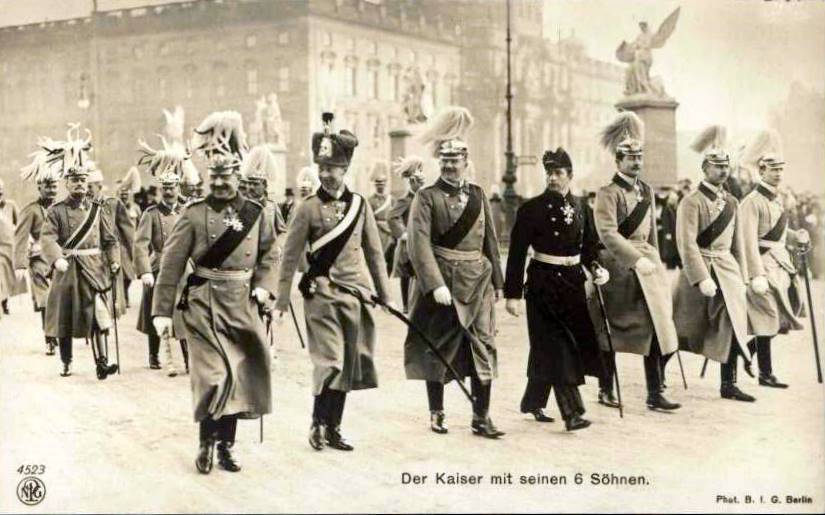
Making Historical Analogies about 1914

Friday, January 10th, 2014

[by Mark Safranski, a.k.a. “zen“]

The Independent has a short, quasi-sensationalist, article featuring historian Margaret MacMillan discussing what is likely to become the first pop academic cottage industry of 2014….making historical analogies about 1914 and World War I! MacMillan is a senior scholar of international relations and administrator at Oxford ( where she is Warden of St Antony’s College)  with a wide range of research interests, including the First World War on which she has published two books.  I am just going to excerpt and comment on the historical analogies MacMillan made – or at least the ones filtered by the reporter and editor – she’s more eloquent in her own writing where each of these points are treated at greater length:

Is it 1914 all over again? We are in danger of repeating the mistakes that started WWI, says a leading historian 

Professor Margaret MacMillan, of the University of Cambridge, argues that the Middle East could be viewed as the modern-day equivalent of this turbulent region. A nuclear arms race that would be likely to start if Iran developed a bomb “would make for a very dangerous world indeed, which could lead to a recreation of the kind of tinderbox that exploded in the Balkans 100 years ago – only this time with mushroom clouds,”

…..While history does not repeat itself precisely, the Middle East today bears a worrying resemblance to the Balkans then,” she says. “A similar mix of toxic nationalisms threatens to draw in outside powers as the US, Turkey, Russia, and Iran look to protect their interests and clients. 

Several comments here. There is a similarity in that like the unstable Balkan states of the early 20th century, many of the Mideastern countries are young, autocratic, states with ancient cultures that are relatively weak  and measure their full independence from imperial rule only in decades.  The Mideast is also like the Balkans, divided internally along ethnic, tribal, religious, sectarian and linguistic lines.

The differences though, are substantial. The world may be more polycentric now than in 1954 or 1994 but the relative and absolute preponderance of American power versus all possible rivals, even while war-weary and economically dolorous, is not comparable to Great Britain’s position in 1914.  The outside great powers MacMillan points to are far from co-equal and there is no alliance system today that would guarantee escalation of a local conflict to a general war. Unlike Russia facing Austria-Hungary over Serbia there is no chance that Iran or Russia would court a full-scale war with the United States over Syria.

On the negative side of the ledger, the real problem  is not possible imperial conquest but the danger of regional collapse. “Toxic nationalism” is less the problem than the fact that the scale of a Mideastern Sunni-Shia sectarian conflict is so enormous, as are the implications . Nothing in the Balkans after the turn of the century compares to Syria, then Iraq and then other states sliding into a Muslim version of the Thirty Year’s War. An arc of failed states from Beirut to Islamabad is likelier than, say, a new Persian empire run by Tehran’s mullahs.

Modern-day Islamist terrorists mirror the revolutionary communists and anarchists who carried out a string of assassinations in the name of a philosophy that sanctioned murder to achieve their vision of a better world

Agree here. The analogy between 21st revolutionary Islamists and the 19th century revolutionary anarchists is sound.

And in 1914, Germany was a rising force that sought to challenge the pre-eminent power of the time, the UK. Today, the growing power of China is perceived as a threat by some in the US.

Transitions from one world power to another are always seen as dangerous times. In the late 1920s, the US drew up plans for a war with the British Empire that would have seen the invasion of Canada, partly because it was assumed conflict would break out as America took over as the world’s main superpower.

Imperial Germany’s growing power was less troublesome to Edwardian British statesmen than the strategic error of the Kaiser and von Tirpitz to pursue a naval arms race with Great Britain that did not give Germany’even the ability to break a naval blockade but needlessly antagonized the British with an existential threat that pushed London into the French camp.

As to military plans for invading Canada (or anywhere else), the job of military planning staffs are to create war plans to cover hypothetical contingencies so that if a crisis breaks out, there is at least a feasible starting point on the drawing board from which to begin organizing a campaign. This is what staff officers do be they American, French, Russian, German, Chinese and even British. This is not to be taken as serious evidence that the Coolidge or Hoover administrations were hatching schemes to occupy Quebec.

More importantly, nuclear weapons create an impediment to Sino-American rivalry ending in an “August 1914” moment ( though not, arguably, an accidental or peripheral clash at sea or a nasty proxy conflict). Even bullying Japan ultimately carries a risk that at a certain point, the Japanese will get fed-up with Beijing, decide they need parity with China, and become a nuclear weapons state.

Professor MacMillan, whose book The War That Ended Peace was published last year, said right-wing and nationalist sentiments were rising across the world and had also been a factor before the First World War

In China and Japan, patriotic passions have been inflamed by the dispute over a string of islands in the East China Sea, known as the Senkakus in Japan and Diaoyus in China. “Increased Chinese military spending and the build-up of its naval capacity suggest to many American strategists that China intends to challenge the US as a Pacific power, and we are now seeing an arms race between the two countries in that region,” she writes in her essay. “The Wall Street Journal has authoritative reports that the Pentagon is preparing war plans against China – just in case.” 

“It is tempting – and sobering –to compare today’s relationship between China and the US with that between Germany and England a century ago,” Professor MacMillan writes. She points to the growing disquiet in the US over Chinese investment in America while “the Chinese complain that the US treats them as a second-rate power”.

The “dispute” of the Senkakus has been intentionally and wholly created by Beijing in much the same way Chinese leaders had PLA troops provocatively infringe on Indian territory, claim the South China Sea as sovereign territory and bully ships of all nearby nations other than Russia in international or foreign national waters. This is, as Edward Luttwak recently pointed out, not an especially smart execution of strategy. China’s recent burst of nationalistic bluffing, intimidation and paranoia about encirclement are working along the path of self-fulfilling prophecy.

Another similarity highlighted by the historian is the belief that a full-scale war between the major powers is unthinkable after such a prolonged period of peace. “Now, as then, the march of globalisation has lulled us into a false sense of safety,” she says. “The 100th anniversary of 1914 should make us reflect anew on our vulnerability to human error, sudden catastrophes, and sheer accident.

Agree that globalization is no guarantee against human folly, ambition or the caprice of chance.

What are your thoughts?

Fukushima: which is worse for you, radiation or paranoia?

Monday, January 6th, 2014

[ by Charles Cameron — frankly, I’m more concerned about the spiritually and socially corrosive impact of fear, myself ]
.

**

I know, technically radiation and paranoia are incommensurables. But still…

Blog-friend Cheryl Rofer posted today at Nuclear Diner, pointing out the fallacies in some recent reports about Fukushima, spreading like wildfire on the web:

I particularly like the “Fukushima melt-through point” in one of the illustrations in that apparently original source, reproduced here. That’s referring to the China Syndrome, in which the melted reactor core melts down through the earth. But once it gets to the center, does it keep climbing, against gravity, to that “melt-through point”?

How much outrageous or stupid stuff does it take to discredit a source? For me, the misuse of the tsunami map and the belief that a core could melt clear through the earth, against gravity, are quite enough.

Boom!

I recommend Chery’s whole piece, both to read and to circulate. And she includes a number of other more specific sources worth takeing a look at, including:

  • Radiation Basics
  • True facts about Ocean Radiation and the Fukushima Disaster
  • Is the sea floor littered with dead animals due to radiation? No.
  • Three Reasons Why Fukushima Radiation Has Nothing to Do with Starfish Wasting Syndrome
  • **

    So: which does more harm to us in the long run, radiation — or paranoia?

    Sunday surprise 9: surreal art imitates real life?

    Sunday, October 20th, 2013

    [ by Charles Cameron — my semi-official idiocy to cap the week ]
    .

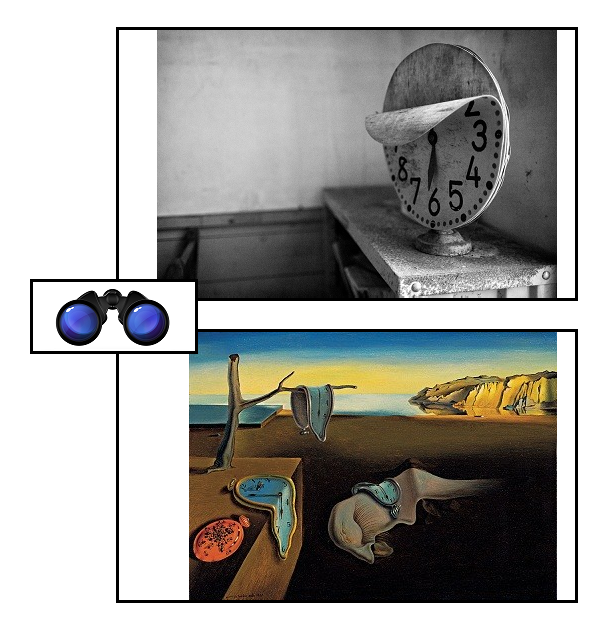
    Here, surreal art imitates real life — ahead of time, and or much later.

    **

    Sources:

  • Tokyo Times, An abandoned and atmospheric Japanese school in the mountains
  • Salvador Dali, The Persistence of Memory

  • A tip of the hat to Bryan Alexander of Infcult
  • **

    Footnote:

    Time itself is a curious business, and the question of its “reality” comes up from time to time. Physicist Sean Carroll talked about it a while back on the pompously named Closer to Truth series, and makes some interesting points. I have to say, though, that I wasn’t overwhelmed — Carroll may be the equivalent of Hawking when it comes to physics, but the equivalent of Wittgenstein when it comes to philosophy he has yet to prove himself.

    But then of course we have never seen Wittgenstein talking off the cuff on YouTube: my sense is that this was a wise decision on his part — although many of the slips of paper on which he typed the aphorisms that go to make up his Zettel might well have been Tweeted, give or take a century.

    Twitter’s immense fan-base does include thousands — and likely hundreds of thousands — of folks who would follow a Witty Wittgenstein twitter-feed among it’s half-billion (2012 estimate) users if wittgenstein were alive and tweeting… Indeed, the entirely posthumous Wittgenstein Tweets feed has more than 4,000 followers, and you might care to join them — although the quotes in the tweets are more than 60 years old at time of tweeting. My own preference for a philosophical feed, btw, runs to Kim Kierkegaardashian.

    But it’s Sunday, we were talking surrealism, and I digress.

    Paging John Arquilla & David Ronfeldt

    Thursday, May 9th, 2013

    [ by Charles Cameron — on the West Coast ]
    .

    Sources:

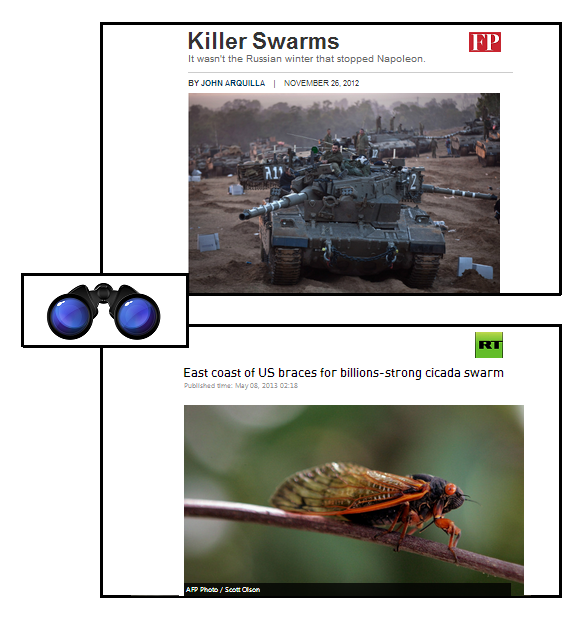
  • John Arquilla, Killer Swarms
  • RT, East coast of US braces for billions-strong cicada swarm
  • **

    Exodus 10. 3-6:

    And Moses and Aaron came in unto Pharaoh, and said unto him, Thus saith the Lord God of the Hebrews, How long wilt thou refuse to humble thyself before me? let my people go, that they may serve me. Else, if thou refuse to let my people go, behold, to morrow will I bring the locusts into thy coast: And they shall cover the face of the earth, that one cannot be able to see the earth: and they shall eat the residue of that which is escaped, which remaineth unto you from the hail, and shall eat every tree which groweth for you out of the field: And they shall fill thy houses, and the houses of all thy servants, and the houses of all the Egyptians; which neither thy fathers, nor thy fathers’ fathers have seen, since the day that they were upon the earth unto this day.

    Qur’an, 7. 133:

    So We let loose upon them the flood and the locusts, the lice and the frogs, the blood, distinct signs; but they waxed proud and were a sinful people.

    And the Eastern seaboard of the US is way more sinful than the ill-reputed West?

    **

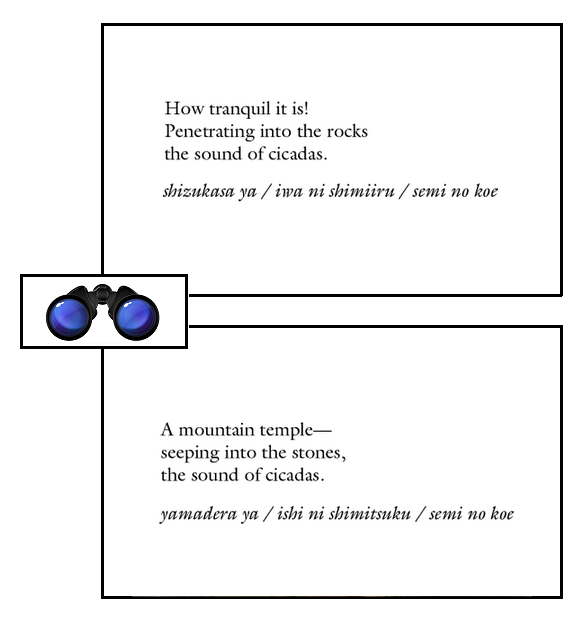
    For a different view, we turn to Basho. Here are the earlier and later forms of one of his poems:

    Source:

  • Eleanor Kerkham, ed., Matsuo Bashô’s Poetic Spaces: Exploring Haikai Intersections
  • Fire walking and the intensity of apocalyptic arousal

    Monday, April 22nd, 2013

    [ by Charles Cameron — in response to Steve Engel ]
    .

    Phpto credit: MDeeDubroff

    .

    My friend Steve Engel wrote regarding the Boston bombers and my elucidation of a Mahdist video that Tamerlan Tsarnaev had seen and “liked”:

    Thank you, Charles, for your close examination of nuances that may underlie the actions of people who envision themselves as warriors for the sake of ancient prophecy. Those among us who feel that they dwell in meaningless sorrow make likely customers for purveyors of self-hypnosis–whether of this brand or some other flag-waving, self-justifying cruelty.

    I’ve been pondering how to express my reasons for paying particular attention to religious and a fortiori eschatological motives for terror for some time now. The varieties of end times thinking have been an interest of mine for decades, to be sure, and both religion and its specifically end times variants tend IMO to be easily ignored in our so rational post-Enlightenment and high-tech times — so I have both personal and analytic reasons to be keenly interested. But there’s more, and I believe StevE’s comment may be just the thing to pry loose a better explanation than I have given up till now.

    I’ll use the well-worn phrase, “work expands to fill the time available” as my starting point.

    **

    Turning to StevE’s point about potential recruits to terrorism or other crimes…

    It’s easy, it seems to me, to think that just any old ideology would do, that the disgruntled simply pick one and use it as a cover or rationalization — but I suspect that emotions can “intensify to fill the ideology available” to paraphrase the other phrase, and that certain ideologies have structural features equivalent to high ceilings in an architectural space, so that “intensifying to fill the ideology available” can have a certain fierce purity when the ideology is a religious one and pious self-dedication a possibility — even more so when “martyrdom” can be aspired to — and yet more so again where one perceives oneself under divine sanction in the culminating battle of all time, immediately prior to judgment.

    I’ve been to two “fire walkings” in my life — the first at Mt Takao, where crowds gather for a yearly ceremony in which one writes one’s sins on a sliver of wood and cast it into the fire, the coals of which which the Yamabushi mountain monks then walk across (see image above), followed by intrepid amateur ascetics…

    The second — ah, the second was pitched as an occasion where you could “prove the power of mind over matter” for yourself, and come away from the experience “knowing you had achieved the impossible”. And when the instructor went around the room afterwards and asked people, “Now you know you can do the impossible, what’s next for you?” he got answers like, “I’ll have the courage to ask my boss for a $25 a month raise…”

    Times are hard for many of us, and I don’t want to knock either the courage it takes to ask or the value of a $25 monthly raise — but if you’ve just “done the impossible”, is this the most you can ask?

    Apocalyptic arousal hopes for more than $25 a month — in most cases it longs for the sudden and immediate reversal of all the good fortune that appears to befall “bad” people right now, and the no less sudden reapportionment of all those blessings on the heads of the “good” people — oneself prominent among them. It shakes the world to its foundations, and it cleanses it.

    **

    I’ll let Richard Landes give you a sense of how believing oneself a participant in apocalypse can make the everyday moment deeply significant, and give the “end times we live in” importance beyond measure — with an excerpt from his great book, Heaven on Earth: The Varieties of the Millennial Experience:

    For people who have entered apocalyptic time, everything quickens, enlivens, coheres. They become semiotically aroused — everything has meaning, patterns. The smallest incident can have immense importance and open the way to an entirely new vision of the world, one in which forces unseen by other mortals operate. If the warrior lives with death at his shoulder, then apocalyptic warriors live with cosmic salvation before them, just beyond their grasp.

    **

    Image source:

    http://www.weirdasianews.com/2009/08/27/firewalking-festival-hot-japanese-ritual/

    Thanks again to Steve Engel for prompting these reflections.


    Switch to our mobile site