zenpundit.com » war

Archive for the ‘war’ Category

Book Review: Lords of the Sea by John R. Hale

Tuesday, November 6th, 2012

Lords of the Sea: The Epic Story of the Athenian Navy and the Birth of Democracy by John R. Hale 

“I cannot tune a harp or play a lyre, but I know how to make a small city great.” – Themistocles

Nautical archaeologist Dr. John R. Hale, an expert on bronze age shipbuilding and seafaring, has written a delightful and robust popular history of the navy of ancient Athens, but more importantly, a poignant political history of the Athenian navy’s  intrinsic relationship to radical Democracy and Empire.  A page turner with enough detail about triremes and warfare in the Aegean to leave you crying “The Sea! The Sea!”,  Lords of the Sea will be enjoyed by naval buffs and philo-Hellenes alike.

As you would expect, there is much in Lords of the Sea about the design, construction and care of triremes, Piraeus and the Long Walls, the shipsheds at Zea Harbor, the financing of the Athenian navy, trierarchy, naval tactics, rowers and rowing, superstitions of Athenian sailors on campaign, the deforestation of Athens for ship timber, comparisons with Spartan, Persian and Macedonian naval prowess and the great sea battles of the ancient world. Plenty, in fact, to keep naval aficionados happy while reading Lords of the Sea and all of which I am spectacularly unqualified to comment upon. I can say that in regard to ancient navies, I learned much that was new to me.

What was of greater relevance to me was Hale’s major theme of the political nature of the Athenian navy. That the imperial glory and thalassocracy was irrevocably bound up with democracy itself and bitterly opposed by the wealthy, would-be, oligarchs who consistently preferred a much diminished Athens they controlled as Sparta’s vassals to a democratic Athenian empire where they shared power with the people:

….The resumption of work on the Long Walls jolted Athens’ oligarchs into action. A small group of upper-class citizens still hoped to destroy the radical democracy. These men feared that once Athens was permanently and inseparably linked to its navy by the Long Walls, the common people would never be unseated from their rule. Before the walls had been completed, the oligarchs sent secret messages to a Spartan army that was at that moment encamped not far from the frontiers of Attica. The oligarchs invited the Spartans to attack Athens, promising to assist in the overthrow of the current regime. In their own minds, these men were patriots, pledged to restore the ancestral consitution.

Traitors are always heroic in their own minds.

Hale was a student of Donald Kagan, whom he credits with inspiring him toward an investigation of the naval prowess of Athens, however in covering the history of Athens, including the Persian and Peloponnesian wars, Hale is more evenhanded in his assessments than Kagan. The  faction of oligarchs come off quite badly, except for the rising to the occasion of the Areopagus, patriotism and sacrifice is to be found  by Hale primarily in the demos, especially the thetes and newly freed and enfranchised slaves who rose to the call to defend the city in the hours of Athens’ maximum  danger. However, the demos in the Assembly were not without fault; rule by the people also proved to be impetuous, arrogant, capricious toward Athenian generals and cruel toward allies and enemies alike. The Athenian empire was, in short,  afflicted with hubris and this caused their downfall.

Hale ties both democracy and Athens’ unparalleled cultural creativity to thalassocracy. When the political will to maintain Athenian naval dominance and independence as a power faded among the Athenian upper-classes, the spirit of oligarchy ignominiously surrendered Athens to a foreign king, despite a mighty navy and eagerly betrayed their own countrymen:

….The Assembly sent Phocion and Demades and Xenocrates, the head of the Academy, to ask Antipater [ Alexander the Great”s regent and successor ]  about terms: a war hero, an orator, and a philosopher to negotiate the fate of a once-great city. Antipater demanded a payment of indemnity equal to the full cost of the war, the handing over of Demosthenes and other enemies of Macedon, and the evacuation of Samos. The thetes of the demos, defined as all citizens with a net worth of less than two thousand drachmas, were to be expelled from Athens. The wealthier citizens who remained must surrender the fort on Munychia Hill in the Piraeus to a Macedonian garrison.

…..So the Athenian envoys returned to Athens with the terms of surrender that gave up Athenian independence and, for all practical purposes, Athenian identity. The incredible had happened. Almost three-fifths of the citizens – 12,000 out of 21,000 – failed to pass Antiper’s test of wealth. They were the rabble, the mob, the radical democrats who were everywhere blamed for all the crimes of restless, ambitious, and expansionist Athens. They were now to be banished for the good of all, not merely from Athens but for the most part from Greece itself

The Athenian Assembly would have been far better off keeping Demosthenes, executing the trierachs who had cravenly surrendered to Cleitus the White and his Macedonian fleet, ostracizing Phocion, Demades and Xenocrates and resuming the war. From this defeat, there was no recovery for Athens, nor did the new oligarchy, secure in their power now, seek any. Without the thetes there were no crews to man the ships or skilled laborers to build them at Zea. Athens was broken as a power and a polis forever.

Strongly recommended.
Does Culture Trump Strategy?

Thursday, November 1st, 2012

The always interesting John Hagel tweeted a link recently to an old post at  Mill’s-Scofield Innovanomics, a blog run by a business strategist and consultant with a science background, Deb Mills-Scofield.

Summer’s Trump Cards 

….Culture Trumps Strategy: The best made plans are worthless if they’re not aligned with the culture. Sometimes the strategy can help transform the culture (for good or bad), but if the culture doesn’t support it, it won’t happen.  Perhaps that’s why I think CEOs need to be CCS’s – Chief Culture Stewards.

Challenge:  Start to check the health of your culture – really, be brutally honest -before the end of August.

This was interesting to me.

Obviously, Mills-Scofield was concerned here with “business strategy” and organizational theory and not strategy in the classical sense of war and statecraft. As Dr. Chet Richards has pointed out, unlike a military leader in war, businessmen are not trying to destroy their customers, their employees or even their competition, but while not the same kind of “strategy”, the underlying cognitive action, the “strategic thinking”,  is similar. Perhaps the same.

So, shifting the question back to the original context of war and statecraft, does culture trump strategy?

On twitter, I had a brief twitter discussion on this with Marc Danziger who was sympathetic to the proposition of cultural supremacy. I am not so sure, though I think the relationship between culture and strategy is an iterative one, the degree to which culture matters in strategy is highly contextual and is determined by how broadly you define cultural values as being directly operative in driving the scenario. Some disjointed comments:

  • Your own cultural-societal worldview shapes politics, policy and politik. So indirectly, culture will be a determining factor in conceiving “Ends” worth spilling blood and dying for – particularly in wars of choice. When war, especially existential conflict is forced upon a state by an enemy attack, some of the initiative and room for constructing artful or limited “Ends” has been lost and becomes secondary to survival. Even Stalin’s normally overweening and murderous ideological preferences mattered somewhat less in Soviet policy and strategy the day after Operation Barbarossa began than the day before.
  • If the Ends in view imply forcing a political settlement upon the enemy – “compelling him to do our will” – than the enemy’s culture matters a great deal. All the moreso, if the war entails COIN, military governance of an enemy population and reconstructing an enemy state to our liking. The enemy culture is part of the operational environment because our use of military force (destruction) is going hand in glove with substantial political activity (construction) – mere physical control of the population is not enough, though it is a precondition for success. MacArthur’s role as SCAP in post-war Japan demonstrated an exceptionally shrewd blend of coercion and concession to traditional Japanese cultural touchstones.
  • If our Ends are much more limited – degrading enemy operational capacity and/or simple, spasmodic, punitive expeditions to impose costs on an enemy state or entity in retaliation for aggression; or, if we intend to stand off-shore and strike with air and naval superiority – than the enemy culture matters far less. Force is being used to “bargain” at a very primitive level that does not require much cultural nuance to understand and the message of “we will hit back” . Likewise, if the war is an unlimited one of extermination and Carthaginian peace, enemy culture matters far less than your military capacity to execute your strategy.
  • Your cultural worldview shapes your grand strategy or statecraft because great and lesser powers are not coldly playing chess for material interests alone when they engage in geopolitical conflict and warfare but are establishing, evolving and protecting a national identity on the world stage. What Thucydides called “Honor”, the British “Paramountcy”, Richard Nixon “Credibility” and Joseph Nye “Soft Power” may all have been intangible expressions, difficult to quantify, but are very much part of the strategic calculus of war and peace.
  • Finally, it is important to note that strategic employment of brute force has a large role in setting the parameters of where and when cultural nuance and interpretation matter and exercise political leverage during war. Extreme violence disrupts and warps the cultural norms of belligerents, usually for the worse. It was the wars of the French Revolution and Napoleon that awoke the romantic pan-German nationalism of the 19th century that eventually united Germany and transformed it into the terror of the world in the 20th. The First World War ushered in a century of ideological monstrosities and revolutionary state terrorism on an epochal scale of murder unequaled even by the butchery of the Romans or Mongols. War is often the Abyss that looks into you.

Thoughts?

The war and peace paradox, take 2: of wolves and music

Tuesday, October 30th, 2012

[ by Charles Cameron — second take on the paradox, this time featuring wolves, poetry, lions, honey, and Bach ]
.

eye-catching headline & image from the New York Times, 2008

.

I’m always trying to see war and peace — violence and gentleness, if you like — in counterpoint rather than in opposition. The distinction is a subtle one, I know, but that’s the task. I tackled it from one angle a few days ago in this earlier post, and imagine I’ll return to it again from time to time.

**

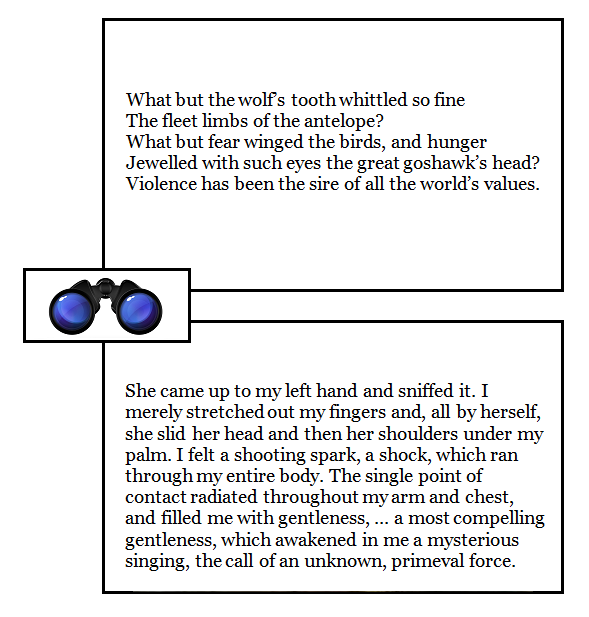
I was fascinated to run across two very different artists talking about wolves these last few days. Robinson Jeffers, in his great poem The Bloody Sire, sees the wolf’s violence (upper panel) as bringing speed and grace to the antelope:

while the extraordinary pianist Hélène Grimaud describes her first encounter with a wolf (lower panel) in terms of gentleness.

After that striking first encounter with a wolf, Grimaud went on to found the Wolf Conservation Center in upstate New York (see NYT article by clinking on image at top of this post).

**

There’s a longish and fairly erotically, religiously and violently charged story in chapter 14 of the book of Judges. Samson, so the story goes, took a liking to a woman of the Philistines, and despite his parent’s urgings went down to see her because, as he delicately put it, “she pleaseth me well.” Along the way he meet a young lion, and “rent him” — tore him apart with his bare hands — “as he would have rent a kid” — here meaning a young goat. Samson continued to like the look of the women of the Philistines, we are told, and on his next visit down to see her, “he turned aside to see the carcase of the lion: and, behold, there was a swarm of bees and honey in the carcase of the lion. And he took thereof in his hands, and went on eating, and came to his father and mother, and he gave them, and they did eat…”

Samson, it seems, was a gambling man, and he soon proposed a bet and a riddle to his bride’s companions — for somewhere around that time they had married, a fact that the story teller omits to tell us in so many words — giving them seven days to solve it:

Out of the eater came forth meat, and out of the strong came forth sweetness.

The companions, of course, could not solve the riddle, since they had not seen the lion, nor its carcase with its swarm of bees and honey… but they pleaded with his new wife so piteously that she pleaded with her new husband so piteously that he revealed the secret to her, and on the seventh day her Philistine companions won the bet and answered Samson’s riddle:

What is sweeter than honey? And what is stronger than a lion?

To which poor Samson replied:

If ye had not plowed with my heifer, ye had not found out my riddle.

The marriage didn’t last — and, we are told, “his anger was kindled…”

**

I certainly heard this story intoned in chapel at one school or another, but recognized neither the eroticism nor the violence nor the significance of the religious enmity between monotheistic Jew and pagan Philistine…

But my mother did make us pancakes on rare and wonderful occasions, and on them I lavished farm butter and Tate and Lyle‘s glorious Golden Syrup, with its image of Samson’s lion and the honey bees:

and the Tate and Lyle motto: Out of the strong came forth sweetness.

It’s that sweetness — that image of the lion and those bees more than the Biblical story itself — that I remember…

**

I am grateful to Steve Engel for bringing Robinson Jeffers’ poem to my attention this last week, and to J Scott Shipman of this blog for introducing me to Hélène Grimaud’s playing of the Bach Chaconne on YouTube:

Out of the strong came forth sweetness indeed.

The war and peace paradox

Saturday, October 27th, 2012

[ by Charles Cameron — a paradox in two graphics ]
.


.
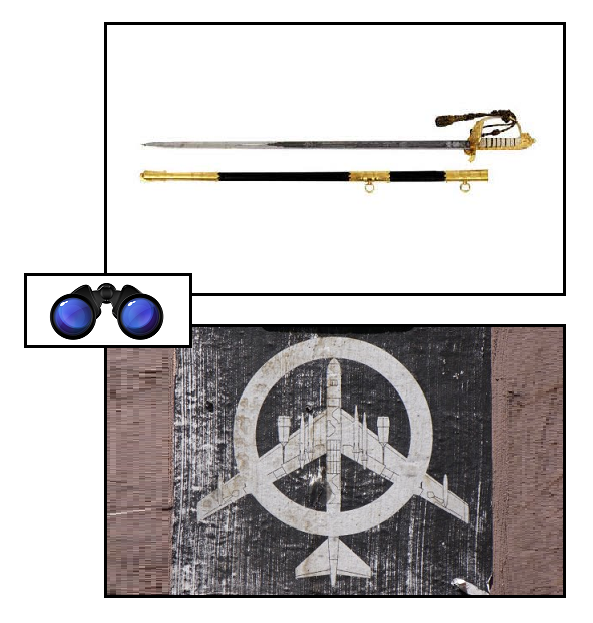
The upper image shows the British “Firmin Sword of Peace” which was awarded this week to the 15 (UK) Psychological Operations Group (15 POG) for their work in Afghanistan. The Ministry of Defence news report described the award thus:

The prestigious Firmin Sword of Peace is given to the unit or establishment of each Service judged to have made the most valuable contribution to humanitarian activities by establishing good and friendly relations with the inhabitants of any community at home or overseas.

The lower image shows an artistic rendering of the peace symbol, seen on a wall in Melbourne, Australia, which is consonant with the old Strategic Air Command motto: Peace is our Profession.

**

Here there be paradox.

A Light at the End of the Tunnell

Tuesday, October 23rd, 2012


Colonel Harry Tunnell 

Michael Yon recently published a remarkable and courageous letter by US Army Colonel Harry Tunnell to the Secretary of the Army regarding deficiencies in our military operations in Afghanistan.  Colonel Tunnell is now retired, but the letter was sent while he was on active duty in 2010. Yon calls it “stunning” and I wholeheartedly agree. It is a “must read“.

Colonel Tunnell is a controversial figure in the Army. A bluntly outspoken critic of COIN with strong views on military professionalism and tactical leadership, he served as a commander of combat troops in Afghanistan and in Iraq, where he was badly wounded. Overcoming his injury, Colonel Tunnel returned to command a Stryker brigade in Afghanistan and clash with his ISAF superiors over his use of older Army doctrine on counter-guerrilla operations instead of the pop-centric COIN of FM 3-24.  Tunnell aggressively and repeatedly attacked the Taliban in his area of operations, pressing them, which resulted in frequent combat and casualties on both sides – something that was out-of-step with ISAF’s tactical guidance. Several enlisted soldiers in the Stryker brigade were convicted of the infamous “Kill Team” murders which led to Tunnell being investigated and cleared by the Army which found no causal responsibility from Tunnell’s advocacy of aggressive tactics but nonetheless reprimanded him for “poor command climate”.

In light of  Tunnell’s letter to the Secretary of the Army, interpret that administrative action as you wish. Afterwards, Colonel Tunnell continued to be a harsh critic of COIN and the focus of periodic,  extremely one-sided, negative stories in the media.

When Yon published his piece on Tunnell’s letter, I commented to him on a private listserv and he asked permission to use it, which I gave:

Mark Safranski Comments Col (ret.) Harry Tunnell 

The following email came from Mark Safranski subsequent his reading this letter from Colonel (ret.) Harry Tunnell.  The letter.

===Email from Mr. Safranski:===

Interesting, this part in particular:

“”A gross lack of concern for subordinates,” Tunnell wrote, “manifests itself in guidance that ‘zero’ civilian casualties are acceptable and coalition soldiers may have to be killed rather than defend themselves against a potential threat and risk being wrong and possibly resulting in injury or death of a civilian.”
….Tunnell’s memo exhibits particular disdain for British Maj. Gen. Nick Carter, commander of NATO forces in Regional Command South, which includes the Arghandab District where Sitton was killed.

It was Carter, Tunnell wrote, whose verbal order led commanders to risk their own troops rather than Afghan civilians – something Sitton complained about two years later in an email to his wife.”

Very helpful. I finally get it now.

I was always curious, reading threads [on private listserv] here on Afghanistan, how Colonel Tunnell was able to openly pursue counter-guerrilla operations in Afghanistan when pop-centric COIN was the heavy-handed, top-down and rigidly enforced tactical paradigm; Harry, IMHO, could do this because the *verbal* orders being issued went far beyond FM 3-24 theory into an unauthorized and unofficial but *politically desired* British policing model used in Northern Ireland. A kind of tactical guidance that could not be put in writing and enforced through the UCMJ because the American people would have found that guidance to be politically intolerable and morally outrageous – and rightly so.

Unlike Catholics in Ulster who are subjects of the Crown, Afghans are not American citizens and American soldiers and Marines are not cops in a bad neighborhood. Nor is the Taliban the IRA. Minimizing civilian casualties is a good and worthy goal; valuing political atmospherics over American lives is a sign of gross incompetence, at best.

Hence the anonymous leaks and smears about Harry to politically connected  Beltway scribes instead. Tunnell’s superiors were afraid to air their real dispute…..

Read the rest here.

In my view, Tunnell’s letter raises critical questions that every officer has a duty to raise with his superiors in the chain of command if, in their view, operations are not properly being carried out, which endangers the campaign and the lives of the troops. Moreover, if the United States military is to adhere to some bizarre, complicated, unworkable “law enforcement model” ROE not required by the Laws of War, or even our own COIN doctrine, then this is a subject for Congressional hearings and testimony from the administration, not something to be instituted on the sly using allied foreign officers.

Wanting to police the world is hard enough without making our soldiers into policemen.


Switch to our mobile site