zenpundit.com » recommended reading

Archive for the ‘recommended reading’ Category

Recommended Reading

Monday, August 8th, 2011

Have not done this in a while…

Top Billing! Thomas P.M. BarnettRogoff’s “second great contraction” and why I’m mad as hell at Washington

….Worse, I have a White House that claims I’m the problem because I don’t pay enough taxes and so it wants to soak me because that’s an evil state of affairs.  Funny thing is, I pay the Fed a whopping sum every year – about three times as much as my dad ever made in a year while he supported us seven kids.  So naturally, when more than one out of every three dollars I make goes to the government, I feel like I’m supporting all sorts of programs for the needy, plus I’m doing the right thing by the mortgage, plus I keep up my charity donations, plus I pay 3 private grade school tuitions (saving the public schools) and two public college tuitions (eldest daughter and wife).  I don’t ask for any hand-outs from the government.  Hell, I fund them and am glad to do so.  But then I’m told I’m the reason why the government is so in debt (not enough taxes from the “rich”) and yet I’m the dupe who continues honoring that mortgage from another era while paying for the bail-outs of those who can’t. And you know, I don’t feel like I’m the problem – or evil for doing all that.

In short, I’m doing everything I can to help this economy. I’m working my ass off, I’m honoring all long-term debts and keeping myself out of any short-term credit. But you know what that takes in this economy?  It means I am as stingy as possible on consumer spending. It means I put off business investments for as long as possible.  It means I’ve got nothing for venturing investments.  It means I’m more incentivized than ever to stuff as much into retirement funds to avoid the tax man.  It means I will vote for anybody who seems to spell reasonable restraint and relief – and that sure as s–t ain’t Obama.

I’m not a Tea Partier.  I’m very middle-of-the-road: a conservative Democrat on domestic and a liberal Republican on foreign. I crave compromises in Washington because our political elite’s inability to make those deals happen reasonably means I compromise across the board.  They do nothing to lift the economy out of its doldrums and I reciprocate. Everything I read from them says, “Screw you” and I can’t help wishing them the same.

President Obama is managing to lose foreign policy experts from his own party who were invited to his inauguration festivities. That’s a neat political trick I don’t think I have seen since Jimmy Carter.

Small Wars JournalInterviews with Stephen P. Cohen and C. Christine Fair

Octavian Manea continues his outstanding series of interviews with leading COIN, strategy and foreign policy experts

Two new blogs on the blogroll, The Mellow Jihadi and iRevolution.

Sultan KnishThe Warrior’s Tale

…Before there were cities or nations, and railways and airports, computers and telephones– the tale was told around campfires. Acted out in pantomime, dressed up in animal furs and cave paintings. But the tale was the same. The people were confronted with a threat and they called upon the best and strongest of their men to go out and fight it. These were their warriors. What they did in the face of that threat is the tale.

Hat tip to Morgan.

Metamodern –My next book: Radical Abundance, 2012

Radical Abundance will integrate and extend several themes that I’ve touched on in Metamodern, but will go much further. The topics include:

  • The nature of science and engineering, and the prospects for a deep transformation in the material basis of civilization.
  • Why all of this is surprisingly understandable.

This country needs a book with some kind of optimistic narrative. 

SEEDFull Steam Ahead on CS-STEM

Mark CubanIf you want to see more jobs created – change patent laws and My Suggestion on Patent Law

How “innovations” in patent law keep lawyers employed, Americans out of work and real innovations off the market

Recommended Viewing:

Steven Pressfield on creativity and writing.

That’s it.
Oslo and Utoya: further readings II

Friday, August 5th, 2011

[ by Charles Cameron — various angles on Breivik, continuing ]

.

“There’s always a mystery.”

Dr. Dalrymple is holding forth on what we can — and can’t — know about the mind of a mass murderer like the Oslo shooter, Anders Behring Breivik. “I don’t think we’ll ever understand” what makes a person capable of this kind of premeditated murder, Dr. Dalrymple tells me over lunch. What’s more, he says, “we don’t even know what it is to understand. At what point do you say, ‘Aha! Now I understand!'” he asks.

That’s a [pseudonymous] British prison psychiatrist, interviewed in the Wall Street Journal.

*

A few things have happened since my previous batch of posts on Oslo and Utoya: some other reading – I’m betting one of them is that a lot of people have arrived that their “Aha! Now I understand!” moment on Breivik, and aren’t particularly interested in alternate views. Their eyes may still be caught by a sensational headline, perhaps, they may still be fascinated by police procedural accounts of the investigation and trial – but they’ve arrived at closure on “who he is and why he did it” and that’s it, case closed.

Dr. Dalrymple’s suggests there is “always a gap between what is to be explained and your alleged explanation. So there’s always a mystery, and I think that’s going to remain.”

In this post, I’ll begin to list some of the more remarkable and/or worthwhile reading I’ve come across since my previous post. Let’s begin with Thomas Hegghammer:

When Thomas Hegghammer writes about Breivik, which he has finally done, we get the chance to read one of the world’s finest Al Qaeda scholars writing about one of his fellow Norwegians. I mentioned his tweets as passed along by Will McCants in my first “some other reading” post. Hegghammer’s NYT op-ed, The Rise of the Macro-Nationalists, claims that Brevik’s 2083 manifesto “reveals a new doctrine of civilizational war that represents the closest thing yet to a Christian version of Al Qaeda”. If anyone should, Hegghammer should know.

So that would be my number one pick.

And then…

An American Apology to Norway . . . sorry about that, from MilPub.  Written by Seydlitz, a friend of — and recent guest poster on — this blog.  Personal and touching.

Moving farther afield, this one caught my eye:

Joan Acocella, Stieg Larsson and the Scandinavian Right, on the New Yorker’s Book Bench: “The major subplot of the stories on the massacre is what many people are now describing as the indifference of the government and press corps in Norway — and, by extension, in Scandinavia and the West as a whole — to native right-wing movements and their potential for violence.” Acocella closes with the words, “Larsson died before those developments, but he’s up there somewhere saying, ‘I told you so.'”

Of all the people on that Scandinavian right, Breivik quoted the blogger known as Fjordman most frequently – so this interview with Fjordman (under his own name, Peder Jensen) is key. Most telling quote, strangely enough: “After the terrorist attack and his blog being cited as an influence, Jensen says he will never use the alias «Fjordman» again.”

I wasn’t intending to use this post to do much in the way of propagating my own ideas, bur many of the items that follow have to do with who influenced or inspired Breivik, and thus with the issues of free speech, inspiration, incitement, and slippery slopes. Earlier today I responded to a ZP comment with an aphorism playing off the phrase “correlation is not causation” – so that phrase was already prepped and ready in my head, and what nudged its way into consciousness as I was tapping out this quick write-up for Fjordman was another:

Quotation is not causation.

I think that’s important in a way that parallels the importance of “innocent until proven guilty”.

Back to my list.

Oslo anthropologist Thomas Hylland Eriksen, Anders Behring Breivik: Tunnel vision in an online world, in The Guardian, comments on Norway’s “subculture of resentment”:

Breivik must willingly have allowed himself to be brainwashed by Islamophobic and extreme rightwing websites. However, had he instead been forced to receive his information through a broadsheet newspaper, where not all the stories dealt with Europe’s loss of confidence and the rise of militant Islam, it is conceivable that his world would have looked slightly different. Perhaps one lesson from this weekend of shock and disbelief may be that cultural pluralism is not necessarily a threat to national cohesion, but that the tunnel vision resulting from selective perusal of the internet is.

Okay, Stormfront next. I won’t link there, but I visited, and they had a thread titled Please post ALL items about the “Oslo killer” in this thread! which already ran to 51 pages shortly after the event. Conspiracy is stranger than fiction – consider this intriguing suggestion from the first page:

White Brothers from Norway, let us know the truth. It sounds like a Mossad operation to me. Another, 9/11, Mumbai, 7/7, Spain, Shoe Bomber or Ball bomber. This has the tell tale signs of a Mossad operation.

Pastebin / Anonymous. Worth quoting in full:

Operation UnManifest:

As Anders Behring Breivik wants to use the cruel action of killing over 90 young people to promote his 1516-page manifesto, also with the help of the internet, Anonymous suggests following action:

1. Find the Manifest of Anders Behring Breivik : 2083 – A European Declaration of Independence
2. Change it, add stupid stuff, remove parts, shoop his picture, do what you like to…..
3. Republish it everywhere and up vote releases from other peoples, declare that the faked ones are original
4. Let Anders become a joke, such that nobody will take him serious anymore
5. Spread this message around the internet and real life, translate it
6. Have a moment for the victims of his cruel attacks

We all are anonymous,
We all are Legion,
We all do not forgive murder,
We all do not forget the victims.

Time for a quick detour on Anonymous? — in the words of NYU’s Garbriella Coleman, in the most detailed account I’ve seen (h/t Shannon Trosper) of that curious entity, Anonymous: From the Lulz to Collective Action:

Anonymous functions as what Marco Deseriis defines as an improper name: “The adoption of the same alias by organized collectives, affinity groups, and individual authors.”

And while we’re on the subject of names — “We are Legion” is likely an echo of the response a biblical demon gave to Jesus when commanded to leave a crazed man: “My name is Legion; for we are many” (Mark 5.7).

Back to our Breivik materials…

Anders Sandberg is someone I respect and have been reading for years – currently at a futuristic tank at Oxford I believe, an old-time gamer, well acquainted with heremetic and kabbalistic traditions, and pretty clear-headed in not always expected ways. His piece here — Blaming victims, individuals or social structures? — is worth reading in full, but the sting is in its tail:

It is worth considering that the number of victims of terrorism and individual hate-crime over the past century (perhaps of the order of hundreds of thousands) is minuscule compared to the number of victims of institutionalized democide and war (of the order of hundreds of millions victims). While terrorism is horrific and personal, it is when mistrust or hatred of out-groups become institutionalized they become truly dangerous. In this regard any political ideology or institution that does not try to reduce its out-group bias ought to be viewed as far more potentially dangerous than any individual, no matter how hate-filled or destructive.

*

Okay, I clearly need more than one post to do justice to my materials, so I’ll leave it at that for now, and be back soon.

Reviews coming up shortly

Tuesday, August 2nd, 2011

[ by Charles Cameron — so many really good books, eh? ]

.

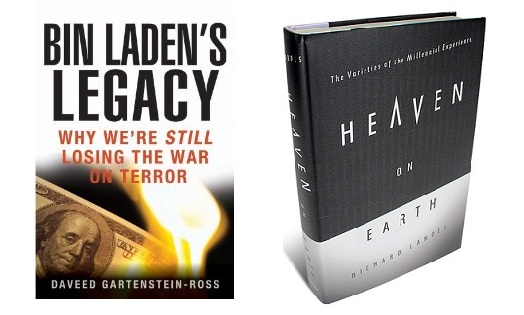
daveed-cover.jpg

Two very important books:

Daveed Gartenstein-Ross brings us up to speed on Al Qaeda by understanding what they say and do. Richard Landes gives a breathtakingly wide-angle view of the critical importance of apocalyptic — secular versions included.

Oslo and Utoya — some other reading

Monday, July 25th, 2011

[ by Charles Cameron — round-up of commentary, varied sources ]

.

There has been a great deal written already about the events in Oslo and Utoya, and some of the most interesting materials are to be found in slightly out of the way places — and places can be “out of the way” for people because they’re ideologically opposed to one’s own central reading, as Valdis Krebs once notably showed with a social network graph of political book purchases on Amazon.

Accordingly, I am posting a slightly annotated list of pieces that I’ve found interesting over the last couple of days, not including much in the way of major news media, and slanting a bit left since the ZP readership arguably slants a bit right — although as a monarchist jungian zenman myself, I find the whole idea of birds flying with only one wing imaginatively implausible, morally reprehensible and biologically unsound.

In alphabetical order as organized by the titles of the relevant files on my own computer, then, to avoid favoritism:

Breivik and Al-Qaeda by Will McCants on Jihadica. McCants has come in for some unjust criticism recently, this piece is important because he’s among out best AQ specialists, and highlights Breivik‘s interest in AQ which at times amounts to “mirroring” ( see Abu Muqawama quoting Marc Sageman below)

Anders Behring Breivik: Soldier in the Christian Right Culture Wars, by Chip Berlet on Talk to Action. Berlet is an astute analyst from the left, one of the few political analysts with keen insight into apocalyptic and millennial thinkin, and a colleague from Center for Millennial Studies days.  He has various other relevant posts up at Talk to Action.

Why right-wing domestic terrorists are our big blind spot: Let’s start with the media, by David Neiwert on Crooks & Liars features a totally mistaken attack on Will McCants (see above), and included here for that reason. Niewert is best as a monitor of far right militia groups and generally worth reading.

Thomas Hegghammer via Will McCants on Twitter. Hegghammer is a first-class Norwegian terrorism analyst, and his tweeted comments to McCants can be found in McCants’ twitter feed, but will soon disappear — replaced by other tweets worth noting.

What did the Oslo killer want? by Blake Hounshell at Foreign Policy — listed here for the brilliant quip quotation from Breivik: “Just like Jihadi warriors are the plum tree of the Ummah, we will be the plum tree for Europe and for Christianity.”  That’s a killer quote.

In response to Norway attacks, right-wing bloggers suddenly demand nuance, by Adam Serwer on the Washington Post’s Plum Line blog. Key quote, slightly redactedfor my purposes: “[ that ] school of analysis, which puts the blame on all Muslims for acts of terrorism perpetrated by Islamic extremists, has been fully discredited – … – terrorist acts are committed by individuals, and it is those individuals who should be held responsible.” That’s not the whole picture, but it’s a consideration.

Initial Plagiarism Test of Breivik’s Manifesto w/ the Unabomber’s by Jarret Brachman. I’m glad Brachman is doing “plagiarism analysis” of Breivik’s texts — I suggested to Chris Anzalone that he might try some if his university has the facilities — and Brachman has also been “Wordling” Breivik and the Unambomber. If the Open Source Center has translated Musab al-Suri by now, there’s another Wordle project that might prove interesting — and more generally, someone ought to compare al-Suri’s 1500 page A Terrorist’s Call to Global Jihad with Breivik’s similarly extensive manifesto — after all, both of them are espousing what Louis Beam called “leaderless resistance”…

Technological and Lone Operator Terrorism: Prospects for a Fifth Wave of Global Terrorism, a paper by Jeffrey D. Simon. I don’t know if this has been published yet, but it picks up on David Rapoport‘s seminal “The Four Waves of Modern Terrorism”. Blog-friend Jean Rosenfeld might like to comment further.

JOURNAL: Knights Templar, by John Robb at Global Guerrillas.  John makes the connection between Breivik’s Templars and the Mexican narco-gangs we’ve discussed several times at ZP recently, a connection which David Ronfeldt also made in a comment here.  Sharp guys, sharp eyes.

Is Norway’s Suspected Murderer Anders Breivik a Christian Terrorist? by Mark Juergensmeyer at Religion Dispatches.  Juergensmeyer is one of the pre-eminent scholars of religious violence, someone who has interviewed a wide variety of activists from half a dozen religious traditions at least, east and west. His book, Terror in the Name of God, is a must read. Key conclusions here — read him to get his reasons for saying these things — “If bin Laden is a Muslim terrorist, Breivik and McVeigh are surely Christian ones” and “in an imagined cosmic warfare time is suspended, and history is transcended as the activists imagine themselves to be acting out timeless roles in a sacred drama.” All in all, a powerful piece.

Quote of the Day by Abu Muqawama at CNAS:

Marc Sageman, a former C.I.A. officer and a consultant on terrorism, said it would be unfair to attribute Mr. Breivik’s violence to the writers who helped shape his world view. But at the same time, he said the counterjihad writers do argue that the fundamentalist Salafi branch of Islam “is the infrastructure from which Al Qaeda emerged. Well, they and their writings are the infrastructure from which Breivik emerged.”

“This rhetoric,” he added, “is not cost-free.”

Oslo Shooter A Frightening Reminder of Radical Right Terrorist Threat, by Heidi Beirich at SPLC’s HateWatch. Like them or not, SPLC keeps tabs on “homegrown” violence and the rhetoric that arguably enables it in the US context.

Amy Winehouse and the Norway Tragedy: Being More like God, by the Tailor of the Good Garment. The Tailor has a unique “Tailorite” angle on Islam and Sufism, is highly intelligent and highly unorthodox, and recently issued his own book which I look forward to reading — and probably won’t entirely understand. This post should be of interest especially to religious experts.

The Irrelevance of the Knights in a Global Society, by Juan Cole at Informed Comment. If Cole is irreverent enough to have had the White House on his tail, he’s probably (a) a familiar name to Zenpundit readers and (b) worth reading.  This is quite a pair of sentences:

Breivik’s medieval romanticism, his artificial European nativism, his pan-Christian vision, his hierarchical, racist view of society, all belong to bits and pieces of past dark episodes in European history. It is as though he has picked through the trash heap of history and attempted to resurrect broken icons, toys and ruined weapons.

The Terror Attacks in Oslo: Anders Behring Breivik on the Middle East and Islam, by Reidar Visser on Iraq and Gulf Analysis. Keeping the best for last, am I? Well, almost. Visser is one of the foremost analysts of Iraq, and as you’d expect, he gets into some fine detail.  Writing of the 2083 text, he says:

There is also more detailed commentary on the Middle East, with quotes supportive of the idea of a Christian federal region in Iraq as well as the Syrian Baathist, Allawite-led regime, because of its protection of Christians! But the action plan in this second document is far more chilling and foreshadows the violence that was unleashed in Oslo on 22 July.

Whether today’s alleged mass murder already coexisted with the armchair generalist who wrote far-fetched but moderately eloquent postings on document.no in October 2010 or whether Breivik was subject to a subsequent process of radicalisation that concluded with his violent attempt at declaring “European independence” remains to be seen.

Finally, Why the European Right Can’t Be Blamed for the Tragedy in Norway, by Joshua Foust at The Atlantic. Foust is another excellent and informed analyst, with a focus on Afghanistan and environs. I have my doubts about some readings of his conclusion here — “To really answer the question of why Breivik committed such atrocity, we have to move beyond his politics and his carefully placed manifesto” — but his point about the rhetoric of the right is a powerful antidote to other articles in my list.

And kudos to Kevin I Slaughter, who brought the Manifesto to our attention. He found it on Stormfront

That’s it — gotta run.  My freshly-minted 13-yr-old awaits his dad.

Wylie’s Military Strategy

Saturday, July 23rd, 2011

 by J. Scott Shipman

Wylie

Military Strategy, by Rear Admiral J.C. Wylie, Jr., USN (1911-1993)

This is a very brief review and recommendation for a book that I discovered recently. Admiral Wylie’s short Military Strategy (about 85 pages in the original edition) was published in 1967, but written in the mid-fifties while Wylie was “at sea in a single-screw low-speed amphibious cargo ship.” He remarked these ships were “not demanding  of a captain’s attention as is, for instance, a destroyer.”My copy was published in 1989 by the  Naval Institute Press  as part of their Classics of Seapower series and has an excellent preface by John B. Hattendorf that will give those unfamiliar with Wylie’s life experience a good foundation. This copy also has a postscript written by Wylie “twenty years later” and three related essays published previously in Proceedings magazine.

Given Military Strategy’s brevity, I’ll resist the urge to provide long quotes. Wylie and an associate’s search for articulating the relevance of the navy in the never-ending budget battles brought them in contact with the famed mathematician John von Neumann of Princeton. Wylie used a paraphrase of von Neumann as a starting point: “With respect to strategy as a subject of study, its intellectual framework is not clearly outlined, and its vocabulary is almost nonexistent. These two primary tasks are badly in need of doing…” He sets out to do just that and does a nice job.

Wylie defines strategy as: “A plan of action designed in order to achieve some end; a purpose together with a system of measures for its accomplishment.” He discusses the military mind and strategy, and how often the military focuses on principles to the exclusion of real strategy. Wylie outlines methods of studying strategy that are simple and well thought-out. Wylie makes a compelling case for a general theory of strategy. He says: “A theory is simply an idea designed to account for actuality or to account for what the theorist thinks will come to pass in actuality. It is orderly rationalization of real or presumed patterns of events.” Further, he continually stresses the importance of assumptions being based in reality, and not wishful thinking or the last war/battle.

His chapter on existing theories is worth the price of the book. He provides a type of Cliff’s Notes overview of the four theories he sees as core: the maritime, the air, the continental, and the Maoist. Of the last, he masterfully lifted sections from Mao’s On Guerilla Warfare, Che Guevera on Guerilla Warfare, and Vo Ngugen Giap’s People’s War People’s Army. He observed of the later, “these books are not only theory, the portray a hard reality of contemporary warfare.” To our people in uniform, in particular, unfamiliar with these books, Wylie provides an accessible and informative introduction to the type of war being waged by Islamic jihadists and how they attempt shape the battle field.

He develops a brilliant point that destruction doesn’t necessarily translate into control, and that often destruction is driven more by emotion than strategy.

Wylie goes on to provide a general theory of strategy that, using his words, has “substance and validity, and practicality.” As Seydlitz89 said in a recent comment thread here: “Wylie is amazing.  So many ideas in such a small book!  He misread Clausewitz and overrated Liddell Hart – which are probably connected, but overall?  He comes up with some very basic ideas about strategic theory which are ever sooooo useful.  I’ve re-read his small book several times and always come up with something that either I’d forgotten or that I had missed earlier.  Wylie’s basic approach to theory is as a practitioner, not as an academic, much like Clausewitz before him.”

Indeed, Wylie provides a nice scaffold for any type of strategy, military or business. For me his approach was refreshing in a genre where, more often than not, dogma and ego walk hand-in-hand.  Time and again, he offers that his ideas may be wrong and encourages readers to think and wrestle with the concepts provided. Wylie writes in his postscript: “As far as I know, no one as ever paid attention to it [the book]. I don’t know whether this is because it is so clear and obviously valid that no one needs to, or because it is of no use at all. I suspect it could be the latter, but I really do not know.”

This little book comes with my highest recommendation. If you’re in uniform and just getting started with strategic concepts/thinking, this is an excellent place to start.

Interesting referenced titles:

Military Concepts and Philosophy, Henry E. Eccles 

The Military Intellectuals in Britain, 1918-1939, Robin Higham 

An Introduction to Strategy, General Andre Beaufre 

Theory of Games and Economic Behavior, John von Neumann 

Strategy in Poker, Business and War, John McDonald 


Switch to our mobile site