Book III for Thomas Barnett
Friday, June 20th, 2008
Congratulations Tom!
Congratulations Tom!
DINNER WITH THE NEW MAPMAKER

Last night, I enjoyed a delicious meal at Fogo de Chao in the company of Dr. Barnett, his very bright and spirited daughter, Emily, fellow Chicago Boyz blogger Lexington Green and his gracious wife…umm…”Mrs. Green“. As Brazilian cuisine is basically a salad followed by about seven pounds of meat, we may all still be in the process of digestion even as I write this post (Special thanks to Sean ” Jack Bauer” Meade and Mrs. Zenpundit for facilitating the communication logistics of this get-together).
This was my first occasion meeting Tom and he was pretty much as I had expected him to be, except taller. An interesting aspect of the discussion was that if you have seen Dr. Barnett’s televised brief, that represents a modulated pacing, of his sometimes rapid-fire conversational delivery, highly energized by ideas and their prospective implementation. The discussion was wide-ranging and intriguing, though some elements of it have been or will be posted on Tom’s blog as they related to his recent Central Asian tour with Admiral Fallon, chief of CENTCOM, but good books, politics, Japanese anime, various public intellectuals and writing all came up as topics of conversation.
The food was excellent, as was the company. I’d like to thank Dr. Barnett for taking the time out of a very busy travel schedule with Emily for a social engagement with the Greens and myself, as well as for dinner. The generous gesture is much appreciated. It was also a pleasure to see Lex and his wife again. Hopefully, we can all sit down again sometime in the future.
THE COMING OF AFRICOM: THE DEPARTMENT OF EVERYTHING ELSE VS. EMBRACING DEFEAT*

* image and title shamelessly “liberated” from the multidisciplinarily creative Dan of tdaxp who previously posted an excellent series by the same name.
Two articles with diametrically opposed worldviews of American intervention overseas.The path to error lies in the simplification of both approaches:
“Africa Command: The Americans Have Landed” in Esquire by Dr. Thomas P.M. Barnett
(This article is currently only available in dead tree format)
“Rethinking Insurgency” (PDF) at Strategic Studies Institute by Dr. Steven Metz (hat tip to Danger Room)
Tom Barnett’s Esquire article on the newly created AFRICOM is one of his best pieces in “journalist” mode and it demonstrated the dire need for establishing true ( and not primarily “kinetic”) “operational jointness” in interagency cooperation in Africa. This means accepting the inherent complexity of the Gap and answering with synergistic connectivity to globalization in order to engage in societal-building and state-building .
AFRICOM

Dr. Metz also accepts the complexity and interconnectivy of globalization but prescribes defusing conflicts by disengagement, accepting the co-option of aggrieved insurgencies into the national power structure even when they are resolutely hostile to American interests. A graceful retreat does less damage, in Metz’s view, than would sustained conflict fueled by American aid enhancing the power of states to resist insurgencies.
Unsurprisingly, I am in favor of Barnett’s approach but recognize that it is best employed judiciously, with an economy of force and minimalist platforms where aid gives the biggest bang for the buck. Likewise, while I see the Metz approach, if raised to a general rule, as a prescription for strategic erosion of American primacy and the decline of globalization, used with discretion, it is a useful “means-test” for evaluating the strategic importance of failing states and avoiding of the waste of American blood and treasure.
Malawi is not as important as Pakistan, even if al Qaida can be found in both countries. That doesn’t mean ignoring Malawi but that we engage it differently than we do Pakistan.
ADDENDUM:
Steve DeAngelis is also discussing AFRICOM at ERMB
BARNETT ON EURO-AMERICAN -SINO COMPARATIVE HISTORY
Dr. Barnett had a post that used an WSJ op-ed as a launching pad for some big picture historical analysis:
In turn, I want to use Tom’s post in much the same manner. Here are a couple of quotes and my kibbutzing:
“But first the Euros need to catch up with history: they are not the first multinational state or economic union. They did not invent the first unified currency. They were not the first continent to experience insane civil war and thereupon reason their way to a Kantian peace of transparency, free markets, free trade and collective security. “
Very true. Tom is pointing to America here but Europe itself experienced much the same process during the late Roman Republic. Roman citizenship was once so tightly guarded that it was denied even to the traditional Italian allies of Rome ( who played a role in the Republican empire of akin to that of the Scots in Britain’s first great expansion during the 18th century – businessmen, colonial soldiers, in rare instances, minor officials) until after the Social Wars and the civil wars of Julius and then Augustus Caesar. After that, one could find Roman citizens who were Gauls, Iberians, Greeks, Germans, Jews, Arabs and peoples more obscure. The empire in many ways proved to be more a meritocratic, ” open system” than did the insular city-state republic beloved by Cato.
China too went through not one but many periods of unification and renewal. Had the Ming dynasty and their Q’ing successors not turned toward resolutely inward, we might be talking today about the legacy of Chinese colonization of the Mideast, Africa and the Pacific rim of the Americas ( disconnection imposes heavy costs).
“America made that journey in the latter half of the 19th century, thanks to our Civil War and the bloody build-out of the American West (actually, most of the blood spilled long earlier). We got to our emergent point (much like China’s today, but along a very different path) around 1890, following a 25-year healing period after the Civil War (China reaches its emergent point around 2000, 25 years of healing after the Cultural Revolution).”
There’s a great number of historical tangents buried in this paragraph. One can draw a comparison between American dollars flowing to China today and the postbellum surge of British and Dutch investment in American railroads and corporations. Or you can look at America as the Not Quite United States from 1787-1865; not unlike China from 1911 – 1989. Or you can compare the administrations of McKinley-Roosevelt with Jiang Zemin-Hu Jintao. Are there modern Chinese intellectual equivalents to the influential role played by Frederick Jackson Turner, Brooks Adams and Alfred T. Mahan ?
“Europe had a far longer healing point, reflecting the depths to which it sank in its massive civil wars of 1914-1945. It’s main problem is that its healing occurred in a very artificial sort of civilizational separateness, which is no longer tenable due to demographics”
Underneath its culture and civilization, Europe remains atavistic. While France has a different and more open tradition because of the French Revolution, many Europeans view their national citizenship primarily in terms of ” blood and soil”. Third generation Arab and North African citizens are still considered to be “immigrants” as are Turkish descended “gast arbeiters” in Germany.
Historically, China has taken a similar ethnocentric view of citizenship ( it is rare though not impossible, for a foreigner not of Chinese ancestry to become a citizen of China); Beijing’s ability to change this and welcome Indians, Americans, Japanese, Koreans and Latins as future “Chinese” will in part, determine China’s future role in world affairs.
THE VIRTUAL STATE OF KURDISTAN
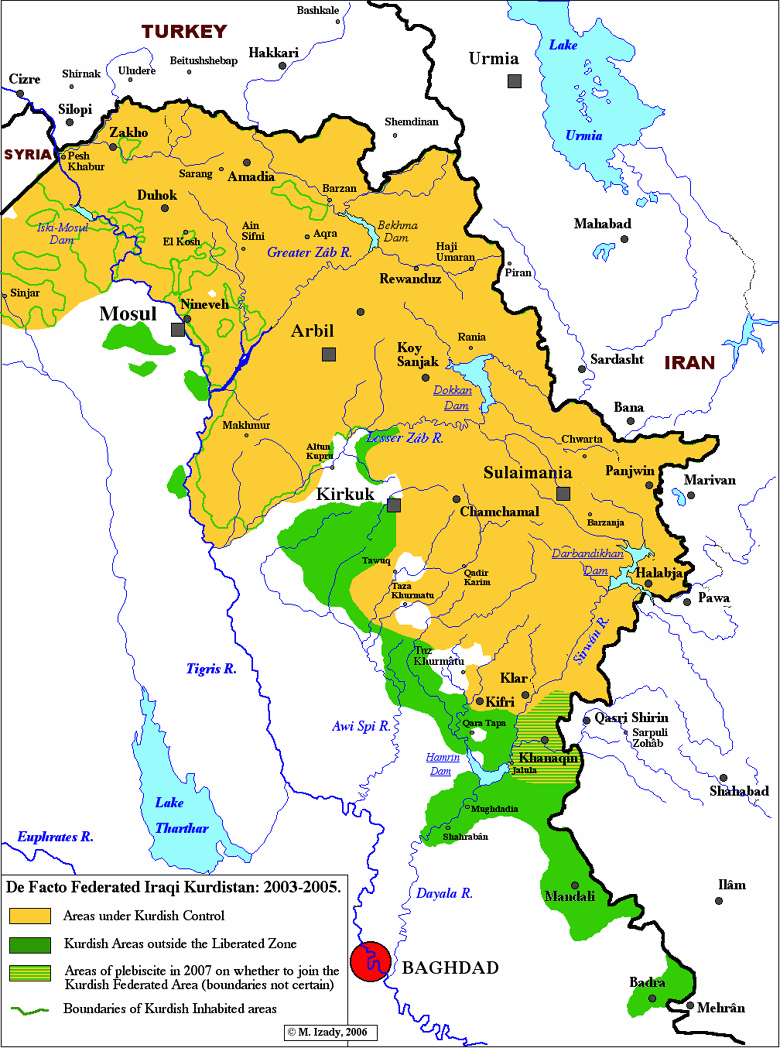
Steve DeAngelis of ERMB has been posting from (and about) Kurdistan in Iraq the past week while on a visit for Enterra Solutions. Collectively, Steve’s posts provide in- depth, on-site, analysis of Kurdistan’s present and future prospects with an emphasis on regional and global economic integration, security and systemic resilience; here they are in chronological order:
3. 3 days in Iraq from the Syrian/Turkish border to the Iranian border
(There were also several other Iraq-related posts “Interagency Feuding Over Iraq Reconstruction” and ” Coffee for the Troops“)
It would be difficult for me to briefly summarize in a mere paragraph what DeAngelis has impressively written about Kurdistan being on the ” Edge of Globalization” in roughly 6000 words. Therefore, I’m going to pick out a number of select excerpts that give the feel of the sum of Steve’s observations, followed by my commentary:
“We then headed further west to the border crossing checkpoint with Turkey. We entered a small U.S. military post on the border and saw how this border is managed. Completely full trucks, stretching for miles into Turkey loaded with any product you can imagine are seeking to deliver their products to buyers in Iraq. However, on the opposite side of the border another story unfolds. There is a two week wait (yes, I said two weeks!) for trucks coming from Iraq to cross into Turkey. Along the road are makeshift housing facilities equipped with satellite dishes that drivers can use during their two-week wait along a dusty and dirty road that moves trucks from one holding pen to another as they creep up to the border inspection stations in Iraq and then to their equivalent inspection stations in Turkey….
I’d be curious to know how much of this Turkish inefficiency is explicable due to legitimate security issues with the PKK, how much is due to local corruption, understaffing and incompetence and how much is calculated policy on the part of Ankara to choke Kurdish economic growth.
….Virtually all of the trucks crossing back into Turkey from Iraq are completely empty. If there were robust manufacturing and other commercial business operations in Iraq, these trucks would be full of products to be sold in Turkey and to the rest of the world as they transit through Turkey’s ports. The only kind of trucks that do cross fully loaded are 3,000 gallon tankers filled with Iraqi oil destined for a Turkish power generation facility just over the border. The electricity produced by the plant is sold back to the Iraqi’s at western market rates. What this obviously says is that Iraq has the raw materials but does not possess the production capability to turn oil into electricity and as such pays a tremendous financial and strategic price for this lack of capacity. The net result of this border crossing reality is a Current Account trade imbalance of almost 100% between Turkey and Iraq”
Steve is correct that this ad hoc mercantilist trade scenario is problematic for Kurdistan. Historically, nations that are raw commodity exporters, regardless whether it was cotton, rubber, oil, strategic minerals or foodstuffs end up in a unfavorable position vis-a-vis value-added production trading partners or merchant capital states. This applies whether we are discussing Ptolemaic Egypt and ancient Rome or the Gulf states today and the Core.
One caveat on the negative trade balance issue for Kurdistan would be the financial flows of Black Globalization. Lacking orderly markets and effective governance, ordinary Iraqis rely upon the black market for access to desired luxuries as well as necessities such as medicines or spare parts for machinery. Controlling a long border with Turkey, Iran ans Syria gives Kurdish actors the ability to become middlemen in the flow of goods and money which does not show up on the legal balance sheet. Ultimately, Barzani and Talabani’s regional Kurdish government must bring this trade above ground and normalize the economic relationships ( include taxes and customs duties).
“The Peshmerga welcomed U.S. forces and fought side-by-side with them in the effort to overthrow Saddam Hussein. It is estimated that there are between 80,000 and 100,000 active Peshmerga in Kurdistan. As the attached picture of a Peshmerga soldier taken near Dohuk shows (click to enlarge), the Peshmerga are a modern and well-equipped fighting force. The Peshmerga also allow women to serve. This tradition began when the Peshmerga were a guerilla force fighting to make the Kurdish area of Iraq a safe haven. Women also fought alongside coalition forces at the beginning of the current conflict. The attached picture shows female Peshmerga celebrating the fall of Kirkuk. “
The Peshmerga have been a coherent military force(s) far longer than I have been alive. Or Steve Deangelis for that matter. Or probably any of my readers. (The ferocious and mercurial Mustafa Barzani, sire of Massoud Barzani, the Kurdish president and KPD chieftain, was once the darling of American conservatives who hated Henry Kissinger. And long before that, tribal lord Barzani was the protege of… Joseph Stalin ! History has made the Kurds the ultimate realists). Former CIA field operative in Kurdistan Robert Baer put the Peshmerga fighting credibly toe to toe with Saddam Hussein’s best Republican Guard divisions during the 1990’s. That ain’t hay folks. Even in the 1990’s decline the Republican Guard was heavily armed and well-trained, despite being hamstrung by Saddam’s increasing paranoia.
The Peshmerga are perfectly suited for 4GW warfare as they combine tight military discipline, clan networks and strong primary loyalties with concurrent conventional and guerilla warfare skills. They also benefit from American patronage and a leadership that has proven unusually adept at presenting an image and engaging in politics in the international arena.
“Another new friend, Subbas Sircar, who is the regional vice president of AIG for the Middle east, Mediterranean and South Asia, had an interesting morning meeting with local bankers. They are seeking to expand and strengthen local banks as I discussed earlier. This group craved exposure to current international banking best practices, core banking information technology and know-how that would allow them to connect to the global banking industry as well as the training and education that would allow staff members to raise themselves up to a minimal level of maturity so they can foster commerce in their region. This experience with bankers in Sulaimaniyah and in Erbil, along with the telecommunications companies seeking the same capability in their industry, are proof positive of the need for Development-in-a-Box™.”
I think Steve is identifying a critical tipping point for Kurdistan. Leapfrogging the bazaari mentality to create a financial structure that inspires enough confidence to attract and sustain legitimate foreign investment and diversify Kurdish reliance on Turkish capital and American aid would be a milestone. This probably would not mean ” best practices” in the sense of Chase Manhattan so much as ” best enough practices” relative to the region. ” Good enough” is what gets a healthy level of local economic growth going. ” Best” can wait for the day the Republic of Kurdistan applies for admission to the WTO and the EU.
Today, Kurdistan is a nation with a virtual state shepherding its interests. More than Hezbollah in Southern Lebanon, the regional government in Kurdistan is less than Taiwan. But like Taipei, the Barzani-Talabani regional government seeks to negotiate or leverage de jure status and the full sovereignty of statehood over the virulent objections of a powerful neighbor and a nervous American patron. Economic development and integration with other global power centers ( EU, China, India, Japan, Russia) will be the key for the Kurds to create a scenario where Ankara can swallow – however bitterly, even with with ironclad security guarantees – Kurdish independence, because it will be in Turkey’s economic best interests to do so.
LINKS:
“Kurdistan Rebalancing the Middle-East” and “Iraq Travel Guide” by Chirol
“The Kurdistan Problem: Part I “, “The Kurdistan Problem: Part II“, “The Kurdistan Problem: Part III“ by midtowing at ProgressiveHistorians
“Response to Virtual Nations Will Shape World Order or Disorder“ by Adrienne Redd
“The Rise of the Virtual StateWealth and Power in the Coming Century” by Richard Rosecrance
“Market-state vs. Virtual State” by John Robb

Zenpundit is a blog dedicated to exploring the intersections of foreign policy, history, military theory, national security,strategic thinking, futurism, cognition and a number of other esoteric pursuits.
Customized Web Site & Blog Design



