zenpundit.com » national security

Archive for the ‘national security’ Category

New Book – Threats in the Age of Obama

Tuesday, January 27th, 2009

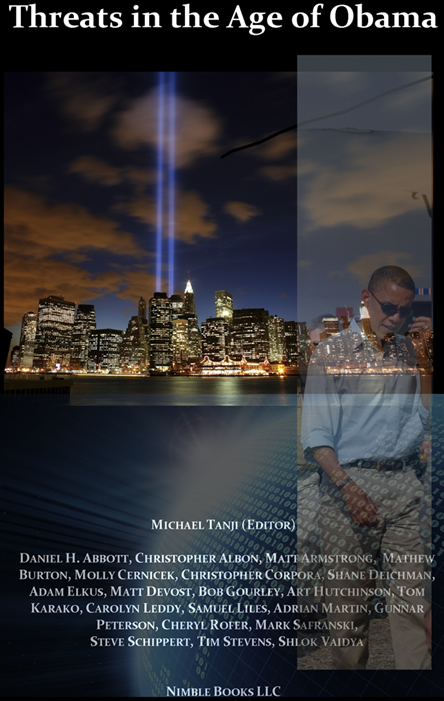
tttaob_cover_cropped.jpg

I am both excited and very pleased to announce the release of Threats in the Age of Obama by Nimble Books

Edited by my friend Michael Tanji, a former senior member of the intelligence community, the volume is a 224 page  A-Z anthology on the cutting edge security challenges faced by the United States in the 21st century and the strategic thinking required to deal with them. Tanji recruited an impressive stable of experts, many with high level USG and private sector experience, in intelligence, cyberwarfare, terrorism, pandemics, nuclear proliferation, human terrain, information operations, public diplomacy, foreign policy and national security. It was a high honor for me to be included among the authors, who are:

Dan tdaxp, Christopher Albon, Matt Armstrong, Matthew Burton, Molly Cernicek, Christopher Corpora, Shane Deichman, Adam Elkus, Matt Devost, Bob Gourley, Art Hutchinson, Tom Karako, Carolyn Leddy, Samuel Liles, Adrian Martin, Gunnar Peterson, Cheryl Rofer, Mark Safranski, Steve Schippert, Tim Stevens, and Shlok Vaidya. And last, but really first, editor, contributor and chief cat-herder, Michael Tanji.

“….If you are on a mission to change the way government works, particularly in the national security arena, this is one a place where some independent and intellectually diverse thinking is to be found. In these essays, we offer our view of some of the more pressing threats the Obama administration will have to deal with in these early days of the 21st century.”

If support the idea that the national security establishment needs to embrace change, then this is the book for you.

New Book on Hugo Chavez

Monday, January 19th, 2009

slide1.JPG

The Threat Closer to Home: Hugo Chavez and the War Against America by Douglas E. Schoen and Michael Rowan

I just received a review copy of The Threat Closer to Home courtesy of FSB Associates ( hat tip to Julie H. ) and the two authors have done some spadework on the “Bolivarian” regime of crypto-Communist, plebiscitary strongman, President Hugo Chavez. Dr. Schoen is a biographer and a longtime political and communication consultant to the Democratic Party as well as a former adviser to President Bill Clinton and is a member of the Board of Trustees for the International Crisis Group. Mr. Rowan is a a regular columnist for El Universal and Veneconomia of Venezuela and is also a political consultant for the Democratic Party and an array of overseas clients ranging from politicians to economic development programs. This is Rowan’s second book on Hugo Chavez and he is currently researching political economy issues in Latin America.

I have not read the book yet but thumbing through the pages I see numerous topics of interest, including Chavez support for FARC, alliance building with rogue states, ties to Hezbollah and known terrorists on the Treasury Department’s list of figures banned from conducting business within the United States. The authors have keyed into Chavez’s autarkic strategy of state managed commodity exports (oil) to both fund his regime and leverage foreign policy advantages – a historic  economic policy for aggressive, authoritarian, regimes. The book jacket carries blurbs by heavyweights in the foreign policy establishment including Congressmen Connie Mack ( R- Florida) and Ike Skelton (D-Missouri) as well as Richard Holbrooke and CFR’s Leslie Gelb.

I’m going to give this a close read and then perhaps try to schedule a short interview with Rowan and Schoen for Pajamas Media or another platform.

Barnett’s Great Powers: The Cutting Room Floor

Thursday, January 15th, 2009

Tom’s new book Great Powers: America and the World After Bush is not out yet but I have read two different versions. A first draft, chapter by chapter more or less as fast as Dr. Barnett was able to write it and then a near finished but yet to be finally edited penultimate version. The second incarnation I read had significant structural differences from the first draft manuscript, as it should when an author works with a professional editor and publisher on a major book.

Tom has just released some of the material that had been cut during the editing process and it’s worth a look. It’s interesting and it gives you an idea of thoughts in process for writing a large work even if ultimately, these sections received the axe:

GP: the lost chapters

Remember when Tom wrote that the deleted chapters from Great Powers would appear online? Two are now up on International Relations and Security Nework.

The original Chapter One is now Creed of an American Grand Strategist: I am a great power. And so can you!

The subtitle was Mark Warren’s idea (an obvious link to Colbert’s book), which Tom thought was pretty funny.

The original Chapter Two, ‘A-to-Z of American Grand Strategy’ is now broken into four parts:

+ A lexicon deconstructed: A-G
+ A lexicon deconstructed: H-M
+ A lexicon deconstructed: N-S
+ A lexicon deconstructed: T-Z

For now, we’re just linking to ISN. We’ll be reprinting both of these lost chapters in their entirety later in the month.

Having been both writer and an editor on a small scale, I think the natural tendency of every writer is to cling to every word. Frequently though, in making an important point, less really is more to the reader. A good editor clears away the clutter and let’s the writer’s best shine through with clarity.

Say 5GWhaaaat ?

Tuesday, January 13th, 2009

David Axe of War is Boring has a piece in World Politics Review on 5GW that summarizes the extended journal article “Fifth-Generation War: Warfare versus the nonstate” in the Marine Corps Gazette by LTC Stanton Coerr that I linked to previously:

War Is Boring: U.S. Wages First Battles in New Generation of War

War has evolved rapidly in the last 100 years, prompting historians and strategists to come up with new terms for new ways of fighting. They call mechanized warfare, which originated in the early 20th century, the third “generation” of war, and ideological warfare waged by guerilla groups the fourth.But what about guerilla-style warfare waged by non-ideological groups against traditional states — pirates, for instance, whose attacks can destabilize trade-dependent nations, but who don’t have strategic goals beyond just getting rich? Free-for-all violence, with indirect global effects, represents a fifth generation of war, according to some experts. And when it comes to defeating fifth-gen enemies, “the old rules of warfare do not apply,” declared Marine Lt. Col. Stanton Coerr, writing in Marine Corps Gazette, a professional journal.

So the U.S. military and its government partners are writing new rules, and putting them to the test on the first of the fifth-generation battlefields emerging in Africa.

Fifth-gen enemies do not have traditional “centers of gravity” — armies, governments, factories, charismatic leaders — that can be destroyed by military attacks. By their mere survival, these enemies undermine the notion that nation-states, their ideals and their economies are viable in the modern world.

To the extent that 5GW can be characterized at all, I think both Axe and Coerr are incorrect here because the term “Fifth-Generation War” makes little sense except in relation to “4GW” and the strategic school of thought associated with William Lind, Col. Thomas X. Hammes and others in the circle of DNI. As Axe and Coerr use “5GW” it is indistinguishable from how Lind has described “4GW” since 1989. To follow the logic of the 4GW theory, as Hammes did in The Sling and the Stone: On War in the 21st Century
, 5GW would be the strategy and tactics that developed in opposition to 4GW as 3GW “Blitzkrieg” emerged from the “Stormtroop tactics” used to counter static and linear 2GW of the Western Front in WWI. Without this context “5GW” is just a placeholder term.

That said, the articles by Coerr and Axe are otherwise praiseworthy for bringing the many nuances and potential dangers of rapidly evolving irregular warfare and associated concepts to describe it, to the attention of a wider audience. That’s useful for generating further debate and bringing more sharp minds to the table.  Complex, “hybrid” wars of mixed regulars, insurgents, terrorists and criminals will be here for some time to come and the entire panopaly of the national security establishment needs to come to grips with that threat, regardless of what we ultimately choose to call it. Labels matter less than substance.

Dan of TDAXP, who has voiced his own skepticism about Coerr’s and Axe’s pieces, has issued a call for papers on behalf of Nimble Books to debate the scope and legitimacy of 5GW which will be assembled into an anthology on this subject. It would be nice to have those people who have writtten previously on fifth -generation war a list that includes Thomas P.M. Barnett, John Robb, Thomas X. Hammes, William Lind as well as myself, the cast of Dreaming5GW and others, contribute old or new pieces to that project. Let’s bring it all under one roof for interested readers instead of having posts and articles scattered all over the internet.

ADDENDUM:

Bibliography – The Timeline of 5GW Theory
Op-Ed at Pajamas Media: Panetta and the CIA

Thursday, January 8th, 2009

Here’s the PJM piece I mentioned yesterday:

Why Leon Panetta May Be The Right Man For CIA Chief

Given the extent to which President-elect Barack Obama previously positioned himself on the left wing of the Democratic Party, his appointments in the areas of national security and defense have been remarkable in the degree to which the worst fears of conservatives have not come to pass. Robert Gates as secretary of defense would have been a dream pick for a McCain administration and former commandant of the Marine Corps Gen. James Jones is someone I wish President Bush had chosen as his wartime national security adviser. The immediate howls of protest from liberal Senate Intelligence Committee members and chairmen that greeted Leon Panetta’s nomination to head the CIA are genuine in their rage. For many reasons, conservatives and advocates of a reinvigorated, reinvented, depoliticized CIA may end up being quite happy with the tenure of Director Panetta

….The truth is that the CIA has been in an existential crisis since at least 1991 that has waxed and waned, but it never recovered the competence in clandestinity or the esprit de corps it enjoyed in its glory years under Allen Dulles or the brief revival ushered in by William Casey and Ronald Reagan in the 1980s. The CIA now bleeds talent to better-paying private military companies like CACI or Blackwater and engages in domestic political intrigue and gross waste like any other government agency. Post-9/11 “intelligence reforms” badly battered the CIA as an institution without building up its original core mission of HUMINT collection and strategic influence operations to a robust and dynamic capacity

Read the whole thing here.

There are of course, respected bloggers and experts with views of their own on Panetta’s appointment. Here is a sample:

The Glittering Eye:

…As I’ve noted before the incoming administration’s managerial experience is extremely limited and, frankly, I think they’re underestimating its importance. Now it may well be that lawyers and politicians are the best possible picks for these important roles to achieve the confidence of the departments they’ll head, the American people’s, and President Obama’s. If that’s right, we’ll be in for an interesting ride with the new administration. If it’s wrong, the downside risk is probably minimized by the civil bureaucracy.

Steve Coll:

As to the Panetta appointment itself, it is unconvincing. The C.I.A. directorship is a diminished post, no longer in charge of the full intelligence community and subordinate to the Director of National Intelligence (who will apparently be Dennis Blair, a retired admiral.) Still, the C.I.A. director has four important jobs: manage the White House relationship; manage Congress, particularly to obtain budgetary favor; manage the agency’s workforce and daily operations; and manage liaisons with other spy chiefs, friendly and unfriendly. Panetta is thoroughly qualified for the first two functions but unqualified for the latter two. He seems to have been selected as a kind of political auditor and consensus builder. He will make sure the White House is protected from surprises or risks emanating from C.I.A. operations; he will ensure that interrogation and detention practices change, and that the Democratic Congress is satisfied by those changes; he will ensure that all of this occurs with a minimum of disruptive bloodletting. All good, but it is not enough

Dr. Ron Radosh

…The point I was trying to make about the Panetta appointment was that although his hands are not tainted by any acceptance of torture, that alone is hardly a sufficient reason to appoint him. I have learned that our fellow blogger and my friend Michael Ledeen has said Panetta is a good choice, as have Richard Perle and Douglas Feith. Their arguments, that he is a good manager and can possibly clean up a highly ineffective and politicized CIA, hopefully has merit. Counterpoints, however, have been effectively made by J.G. Thayer, who writing on the Commentary magazine’s Contentions, blog…


Switch to our mobile site

