Just received a courtesy review copy of Spinning the Law from Ruby at FSB Associates. This is not the genre of books that I typically review and I was initially hesitant that it would just be a pop culture title, but in skimming, I am pleased to report that the author, former US. Attorney Kendall Coffey, is engaged in an analysis of how public opinion, shaped by the media, impacts the justice system.
Coffey explains the strategies and tactics that prosecutors, defense lawyers and their clients employ as well as the hazards and mistakes made in playing to the media. Coffee’s reach includes the trials of Joan of Arc, Socrates and Aaron Burr as well as more recently infamous characters as the American Taliban, John Walker Lind, Jose Padilla and Governor Rod Blagojevic. Spinning the Law would seem to have a great deal of applicability to those readers interested in IO and public diplomacy, as well as those with conventional interest in the legal system and American politics.
I look forward to reading this and eventually posting a full review.
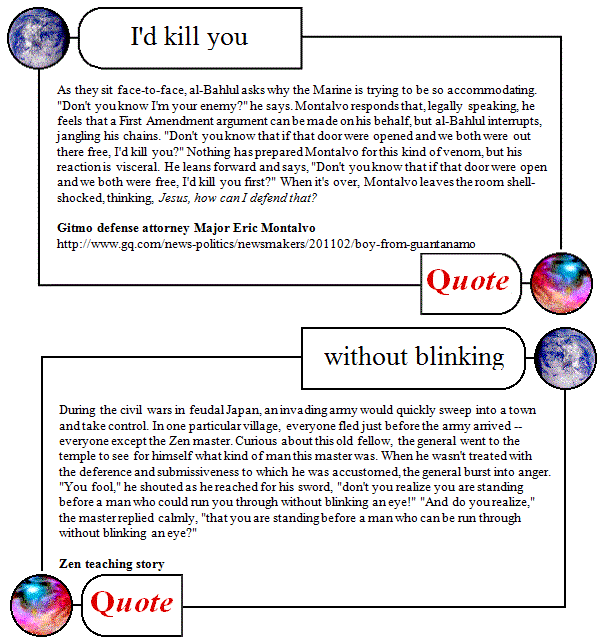
Two stories — continents, centuries and cultures apart — yet as remarkable for their similarities as for their differences. The first concerns a US military defense attorney’s first meeting with a defendant at Gitmo, the second a zen monk…
I already knew the zen story, so the Gitmo version positively flew off the page at me.
I suppose some people will prefer one story, some will prefer the other: for me it’s the almost stereophonic effect of knowing the pair of them that I find more interesting than knowing either one of them separately.
I reviewed Jones’ 2008 book here on chicagoboyz in April, and followed it up more recently with a late September review of a similar book by Canadian “Michael Ross” on his time with Mossad.
I found both books surprisingly revelatory about the organizational culture of these two intelligence organizations, but found little that would interest the James Bond crowd, or be of much value operationally to foreign governments.
Jones’ book was by far the most damning, however, because he illustrated (with incidents from his own deep-cover career) the extent to which the CIA now operates for its own bureaucratic benefit with minimal attention to its central mandate – gathering actionable intelligence. All the most virulent criticisms of the Tea Party against big government are understatements when it comes to how national security has been subordinated to the HR nostrums of the day at CIA. Jones effectively outlined how “the emperor has no clothes.” Not so much inept as indifferent. As someone operating under “deep cover” in the clandestine branch, away from the support and comforts of consular life, he was certainly qualified to note the career paths and day-to-day obsessions of the “home office” and his colleagues. While he didn’t name names, he described enough duplicity and lassitude in the CIA’s management and staffing to earn the undying enmity of “tap dancers” and “clock watchers” alike.
Most notably, Jones outlined in some detail how the vast number of clandestine officers that were supposedly hired and deployed by the CIA post 9/11 (at huge expense) were posted to the continental US. Numbers were further bulked up by counting support staff as “officers.” Meanwhile, CIA clandestine officers already in the field overseas at the time were being methodically hindered and removed to avoid bureaucratic risk. Jones contrasted this institutional predilection with his time in Iraq as part of a largely Army team of intelligence agents.
Apparently the Panetta CIA will now conduct lawfare against one of its own, after having done so much to limit his success when he was overseas secretly working on WMD proliferation. No good deed goes unpunished. Execute the messenger when the news is bad.
It’s still early days in the legal matter. I’ve not seen any indication that Jones’ legal team has formed a strategy for protecting or saving their client. Goodness knows Jones’ pocketbook will necessarily take a massive hit, as may well be the intent of the suit in the first place. Having spent years delaying out-of-pocket reimbursements during Jones’ active clandestine career (to the tune of tens of thousands of dollars), it’s only appropriate that the CIA would try to take back what they did pay him. Pour encourager les autres.
After risking his life overseas, there’s some irony that his own employers will hold him accountable for leaking their institutional dysfunction, rather than any actual secrets.
Will a change in control of the House mean that the CIA finds itself under Congressional scrutiny for misleading elected representatives about how they were spending billions of dollars? One would imagine that Jones’ defense lawyers will be dropping hints about the potential perjury committed by his CIA managers testifying on the Hill over the last decade. Be a shame if something should happen to all those shiny careers. Horse-trading ahead, I assume.
The intelligence agency that works safest, works not at all. And a CIA entirely based in the US or ensconced behind the walls of embassies can look busy without actually being busy. The current CIA bureaucracy, for entirely understandable reasons, has preferred Potemkin villages and iron rice bowls to aggressive intelligence-gathering. Jones’ misfortune is to have been a witness to it all. I hope this all turns out OK for him.
My mini-book review offers additional details for those with an interest in intelligence organizations.
Tomorrow, a bank-not your bank, but any bank-could evict you from your home. Even if you didn’t know the bank was foreclosing. Even if your mortgage is paid off. Even if you never had a mortgage to begin with. Even if the bank doesn’t hold a single piece of paper that you signed. And major banks not only know this fact, but have spent millions of dollars to defend it in court. Why? The answer starts with a Jacksonville homeowner named Patrick Jeffs.
In 2007, Deutsche Bank sued Jeffs for his home, which is a necessary step in the process of foreclosing on a homeowner in the state of Florida. Curiously, despite the fact that he immediately hired a law firm to defend his property when he found out about the foreclosure, neither Jeffs nor his attorneys were at the trial. That’s because it had already happened. Deutsche won by default because Jeffs wasn’t able to travel backwards in time to attend, even though the trial featured a signed affidavit indicating that he had been served his court summons.
The only problem with the summons Jeffs supposedly received was that it had been conjured out of thin air.
In June of this year, a Florida court ruled that the document was fraudulent, as the person who was supposed to make sure Jeffs was served had mysteriously received a copy of the summons before the lawsuit had even been filed, and Jeffs never even saw the copy. The text of that ruling was posted on various financial news websites in September. The lawyers that Jeffs hired to defend his case say that fraud such as this is not uncommon. It’s a widespread problem, and it has cost countless families their homes.
“I think it’s safe to say that 95% of the foreclosure cases in Florida involve some form of fraud on the part of the bank,” David Goldman of Apple Law Firm, PLLC told The Daily Caller in a phone interview. “It’s probably closer to 99%. And the court system is helping them get away with it.”
Banksters should not only be going to prison for intentionally destroying the lives of people who are not only NOT in default on their mortgages, but have never transacted a mortgage with the institutions attempting to illegally seize their property, these guys should be made to face an angry mob composed of the people they have defrauded.
This is the Oligarchy in action. They intend to hollow this country out and move their loot offshore just like in Russia during the 1990’s
Blogfriend Fabius Maximus, who often blogs on economics, would like to offer a counterpoint and i have agreed to let him put up his perspective here and some excerpts:
….The real estate title system in the US is complex, with safeguards protecting debtor and creditor (for details see this by Barry Ritholz). It’s also local (rules and data are not national). This system worked well for generations, but collapsed during the housing boom.
Loan volume accelerated, overloading key parts of the system. Appraisals were often corrupted, as loan originators routed business to compliant appraisers.
Massive securitization of mortgages ignored these constraints, and erected a pseudosystem on top of it that cheaply processed the high volume of both mortgage origination and securitization (e.g., the Mortgage Electronic Registration System – a faux version of security clearing corporations; see this explanation). Securitization also broke the link between the originator and end owner, with many ill consequences. Among other things, this put great pressures on the servicing firms to lower costs.
During the RE boom years recoveries on foreclosed mortgages were zero or positive, which meant a low rate of foreclosures (homes could be sold by the owner rather than default on the mortgage). So the institutional apparatus for foreclosures atrophied.
The the default bust hit. Massive flow, overwhelming the system – which was never configured for such an event. Remember, experts believed home prices never decline for more than a calendar year. The worst scenario considered by the most experts was flat prices for 3 years.
The servicers (sometimes the bank originating the mortgage, often not) reacted by cutting corners (seethis Reuters story). Finding the original loan documents was too expensive, so they used lost document procedures designed for extraordinary circumstances (e.g., fire, flood, or misfiling – see this at Calculated Risk and here at Reuters). Some servicers hired law firms set up as foreclosure mills (e.g., FL), processing incredible numbers of foreclosures. It’s not clear how, but clearly proper procedures were not followed.
As a result there have been many claims that foreclosure notices were never served (an easy way to make serving a high-margin profit center). Employees have admitted under oath in depositions to fraudulently signing thousands of notarized affidavits.
This took place in the 23 states with judicial foreclosures only with the cooperation of Judges. A few Judges protested when shown that their banks and their agents were committing perjury. But the process ran smoothly for the past few years. Now the wheels are coming off. This might be difficult for the financial sector to conceal or mitigate, despite their de facto control over the government’s regulatory machinery.
….Despite the oft-hysterical analysis, there is as yet insufficient public information about the scale of the problem. Quite likely even key players (e.g., banks, their law firms, government regulators) lack the necessary information. Deliberately, as all prefered to “see no evil.” But now that the problem has erupted into the daylight, this leaves them ill-prepared to respond. Especially as any adequate response will reveal their incompetence and malfeasance in creating the situation. (Here are Wells Fargo’s procedures regarding creditors’ complaints; nothing available for their procedures to debtors’ complains).
Political factors, not legal or economic, probably will control the evolution of this crisis. Hence the likelihood of modest impact to the national economy. More than the small impact expected by Wall Street; less than expected by the increasingly rabid doomsters. Over a longer horizon, a year or more, the economy will affect the political dynamics. For a good analysis of the current political situation see “Congress Taking Cautious Approach with Foreclosure Mess“, American Banker, 14 October 2010. The Republicans, as usual, eagerly support the banks – despite any violations of the law, despite the interests of the American people.
The economic impact looks to be minimal and probably less than the political effects. New home sales are unaffected by this crisis. The title problems are solvable. New home finance is unaffected, and in any case are now 90% government financed or guaranteed. Interruptions in sales of existing homes will have severe effects for those affected, but little for the overall economy (despite the massive attention to the volume of existing home sales, they have minimal economic effect).
What could change this forecast? A second dip would radically change the situation, as more links in US and global economy “unexpectedly” break. As would a long foreclosure moratorium, although this is unlikely under the current political regime. It could happen as part of system change, of such magnitude that the moratorium would be one of the lesser results.
Zenpundit is a blog dedicated to exploring the intersections of foreign policy, history, military theory, national security,strategic thinking, futurism, cognition and a number of other esoteric pursuits.

 security has been subordinated to the HR nostrums of the day at CIA. Jones effectively outlined how “the emperor has no clothes.” Not so much inept as indifferent. As someone operating under “deep cover” in the clandestine branch, away from the support and comforts of consular life, he was certainly qualified to note the career paths and day-to-day obsessions of the “home office” and his colleagues. While he didn’t name names, he described enough duplicity and lassitude in the CIA’s management and staffing to earn the undying enmity of “tap dancers” and “clock watchers” alike.


