Military Robotics….Deep in the Singularity Zone
Wednesday, February 18th, 2009I’m as big a fan of technofuturistic science as the next reader of Danger Room but National Defense Magazine ‘s article really is breezily optimistic:
Reverse Engineering the Brain May Accelerate Robotics Research
….Machines that walk upright will assist civilians and the military alike, said Stefan Schaal, associate professor of computer science and neuroscience at the University of Southern California.“We should at some point be able to create an artificial human being and I think humanoid robots are currently the first step toward that,” he said at the Army Science conference.“This is going to happen,” he predicted. “And it’s going to happen in this century.”It may not be as “polished” as the iRobot movie, he added.While other experts noted that there are huge technological hurdles to overcome, basic research continues on several critical technologies such as vision, movement and computational models that will allow robots to “think” like humans.
A parallel effort to map – or reverse engineer – the human brain is going to give robotics experts inspiration that will allow them to create these advanced models, researchers at the conference said.The National Academy of Engineering is spearheading this “Grand Challenge.” Just as researchers successfully mapped the human genome earlier in the decade, the engineering community – not normally thought of as being a part of the life science discipline – says there will be a clear benefit to a Herculean effort to figure out exactly how the human mind works.“If we could determine the software of the human brain, we could embed all sorts of systems so as to provide human like quality for machines,” said John Parmentola, director of research and laboratory management at the Army office of the deputy assistant secretary for research and technology.Neural models will enable robots to better perceive, think, plan and act, said James Albus of the Krasnow Institute at George Mason University, Va.
“Significant economic and military applications will develop undoubtedly early in this century and in fact are already developing,” he said.
Read the rest here.
The part that makes me a tad skeptical is the “reverse engineering” of the brain. This is no small task. “Wetware” isn’t hardware and the wetware here is dynamically adaptive and to an extent individualized within parameters we do not yet fully understand. Unless I am missing something ( please correct me if I am) in terms of difficulty, reverse engineering the brain would appear to be harder than almost any other question that could possibly be related to the whole field of robotics itself.
While scientists have learned more about the human brain in the last 10 years that the previous 10,000, brain science is still in it’s infancy. The exciting MRI scan studies are primarily exercises in positively identifying correlation of brain activity with specific cognitive and physical tasks; what these studies mean in terms of application requires extrapolative speculation and experimentation.
By all means guys, go for it! I’m behind the effort 100 % as the spillover benefits are going to be enormous. However, I’d wager that this strategy is not the fastest route to functionally useful, autonomously acting, robots on a societal scale.
ADDENDUM:

I just picked up P.W. Singer ‘s new book Wired for War: The Robotics Revolution and Conflict in the 21st Century
ADDENDUM II.
Jeff Hawkins at TED.com on the revolutionary potential of brain science:
 not recovered because it doesn’t have the ability, unless it undergoes a revolution.”Naveh, who established OTRI together with Brigadier General (res.) Dov Tamari, draws on imagery from the world of construction to explain the project. “We wanted to create an intermediate level between the master craftsman, the tiling artisan or the electrician, who is the equivalent of the battalion or brigade commander, and the entrepreneur or the strategist, the counterpart of the high commander, who wants to change the world, but lacks knowledge in construction.”Between the two levels, he continues, is the architect/commander-in-chief, whose role is “to enable the system to understand what the problem is, define it and interpret it through engineers.” In the absence of this link, he maintains, armies find themselves unable to implement their strategic planning by tactical means. “Entrepreneurs and master craftsmen cannot communicate,” he says.Already in his first book, “The Operational Art,” published in 2001 and based on his doctoral dissertation, he described the level of the military architect: “The intermediate level is the great invention of the Russians. [The military architects] occupy the middle, and make it possible for the other fields, from politics to the killers, to understand, plan and learn.”
 Stalin’s maniacal insistence that Germany was not going to attack and that assertions to the contrary were evidence of “wrecking” and “provocation” – crimes liable to get one immediately shot. Even a high ranking NKVD official, Dekanazov, whom Stalin made ambassador to Berlin, was personally threatened by Stalin for daring to warn the Soviet dictator about Hitler’s imminent attack.
 .
.



 by Adrian Goldsworthy
 by Adam Tooze
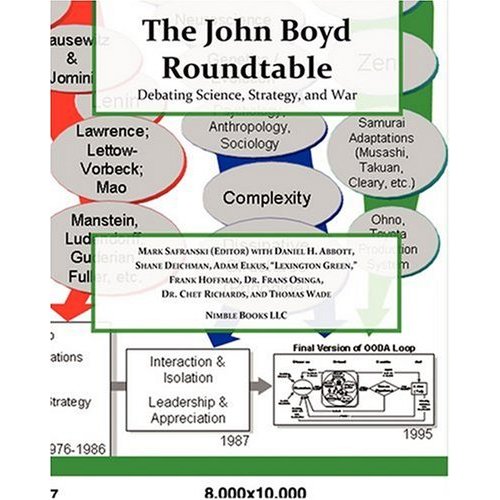
 by Mark Safranski, Daniel Abbott, Chet Richards, Shane Deichman, Thomas Wade, Frans Osinga, Adam Elkus and Frank Hoffman. Foreword by Thomas P.M. Barnett
 by Frans Osinga


 by Martin van Creveld
 by Nassim Nicholas Taleb
 by Carl von Clausewitz
 by Fred C. Ikle
 by John Lewis Gaddis
 by Simon Sebag Montefiore
 by Richard J. Evans
 by Robert Dallek