zenpundit.com » science

Archive for the ‘science’ Category

On form and beauty

Saturday, November 28th, 2015

[ by Charles Cameron — capable photographers capture “form” in their viewfinders, not just “content” ]
.

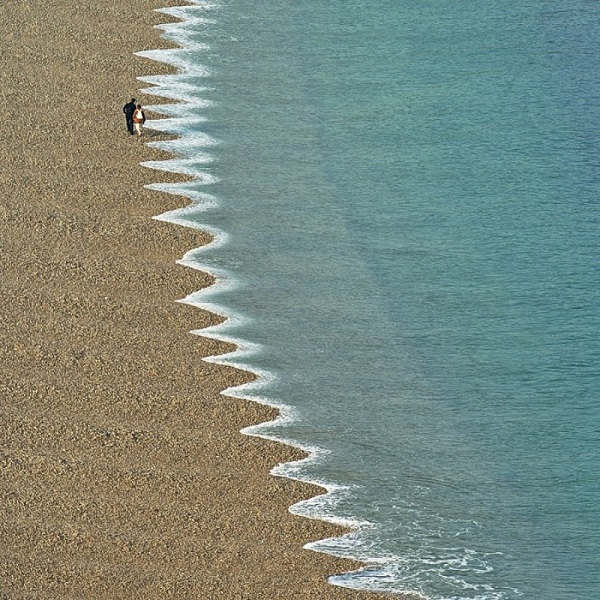
A toothy sea
A toothy sea

**

I have just been browsing someone’s choice of the “100 best photographs ever taken without photoshop”, and was struck by the ways in which form in general, and contrasts in juxtaposition more specifically — two of my recurring interests, form and the DoubleQuotes respectively — kept cropping up. I’ll get to them, and offer some stepped-down images from the series —

but first, take a look at the whole series as posted at The 100 best photographs ever taken without photoshop. Even the reduction to 60% of published size necessitated by the ZP column width loses much of the beauty — and imagine how they’d be as actual framed prints, in their original full sizes!

Someone’s choices? Yes, and by no means necessarily the best choices — this selection no doubt answers to a selection bias in the individual who put the series together — so the patterns I’m seeing here may belong either to that individual, or to the general human delight in contrasts, parallelisms and oppositions.

**

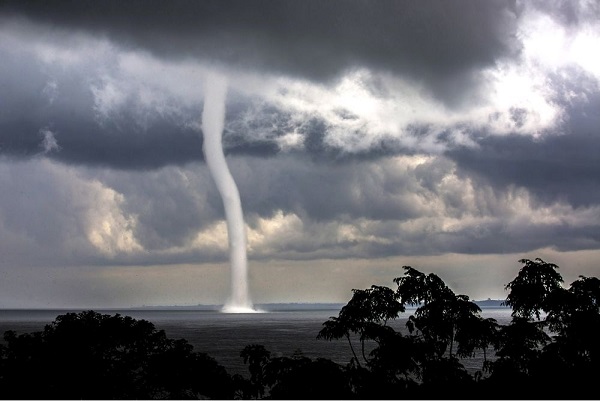
Earth and Sky, Heaven and Earth:

Waterspout on Lake Victoria, Uganda

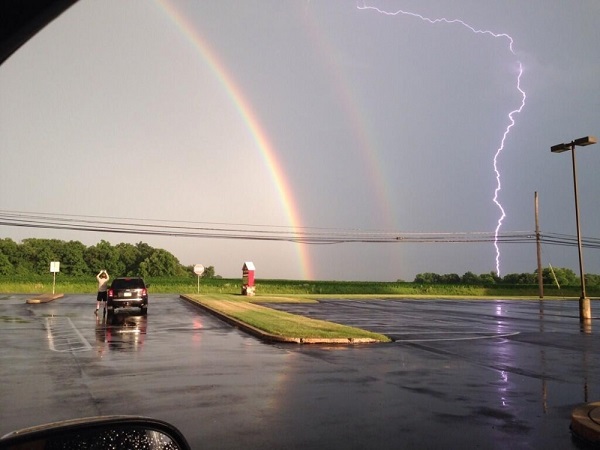
Fickle moods
Fickle moods

Volcanic eruption in IcelandVolcanic eruption in Iceland

**

The seasons: time as change

An autumn forest. 50 percent Downloaded

Autumn and winter meet in Colorado, USA

Autumn and winter meet in Miklukhin, Rostov region, Russia

**

Human impact observed:

Two worlds divided, New York, USA

Celebrating the 100th anniversary of the birth of Kim Il-sung, North Korea’s founder

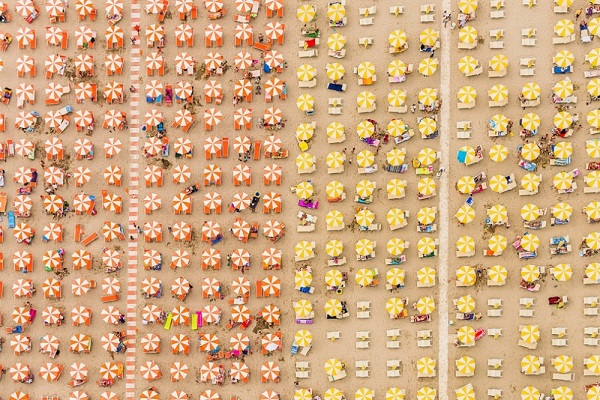
An Italian beach
An Italian beach

**

On reflection, sheer, simple symmetries:

The aftermath of a flood in Ljubljana, Slovenia

An eagle soaring over a lake in Canada

**

And that’s only a fraction of what the whole series of a hundred photos offers us. Each of these, I’d submit, is what I’d term a DoubleQuote in the Wild.

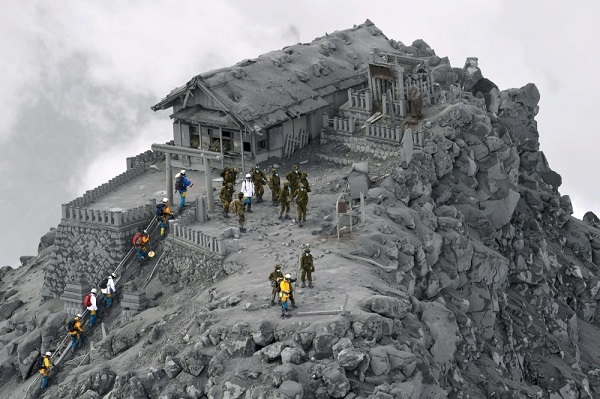
One final shot, color against grey — perhaps the loveliest of all:

A temple covered in ash from the Ontake volcanic eruption, Japan

So much humanity, so much pathos there.

**

Brilliant minds in both the arts and sciences focus as much on form as on content — on patterns, repetitions, symmetries for their own sakes, as much as on the particulars of the fields they study and in which they find them. At heart, this is a matter of aesthetic cognition.

We would do well to cultivate this kind of double vision — the awareness of form as well as content — across the board, from education and the arts to the sciences and strategy.

The moment we become polarized, however, in terms of a political or other form of partisanship, content becomes all we see (and agree or disagree with), and form effectively evaporates. In terms of the images above, we see earth or sky, summer or autumn, town or country — left or right — but not — but no longer — the whole.

Red mercury as scam and symbol

Friday, November 20th, 2015

[ by Charles Cameron — CJ Chivers, nuclear nonsense, faux chemistry, and the alchemical imagination, with hat-tip to Cheryl Rofer ]
.

CJ Chivers, conflict journalist extraordinaire and author of a book about the Kalashnikov assault rifle, The Gun, today posted a remarkable account of what he terms The Doomsday Scam, with the subtitle “For decades, aspiring bomb makers — including ISIS — have desperately tried to get their hands on a lethal substance called red mercury. There’s a reason that they never have.”

A taste:

The Islamic State, he said, was shopping for red mercury.

Abu Omar knew what this meant. Red mercury — precious and rare, exceptionally dangerous and exorbitantly expensive, its properties unmatched by any compound known to science — was the stuff of doomsday daydreams. According to well-traveled tales of its potency, when detonated in combination with conventional high explosives, red mercury could create the city-flattening blast of a nuclear bomb. In another application, a famous nuclear scientist once suggested it could be used as a component in a neutron bomb small enough to fit in a sandwich-size paper bag.

and:

To approach the subject of red mercury is to journey into a comic-book universe, a zone where the stubborn facts of science give way to unverifiable claims, fantasy and outright magic, and where villains pursuing the dark promise of a mysterious weapon could be rushing headlong to the end of the world. This is all the more remarkable given the broad agreement among nonproliferation specialists that red mercury, at least as a chemical compound with explosive pop, does not exist.

Indeed, there’s a sidebar in Chivers’ post which sums the topic up nicely:

The shadowy weaponeer’s little helper, red mercury was the unobtainium of the post-Soviet world.

There’s much more, of course — with red mercury rumored to be found in old Singer sewing machines, which briefly raised the price of such machines in Saudi Arabia a thousandfold to $50,000 — and the whole extraordinary piece is more than worthy of your attention. It is also about a concrete, if counter-factual, reading of the term “red mercury.”

Cinnabar, aka mercury sulphide, anyone?

**

A centuries-old debate concerning alchemy has concerned the literal and metaphorical interpretations of alchemical texts.

Scholars up to and including Isaac Newton theorized about and practiced alchemy in their aptly named lab-oratories, at a time when literal and metaphorical “readings” were much less easily considered separately than is the case today. Alchemy was then for a while widely ridiculed as proto- and indeed pseudo-science — a tendency still prevalent in many circles today. And more recently, alchemy has been explored by Carl Jung and followers (and his predecessor, Silberer) as a field of imaginative, metaphorical inquiry illuminating spirituality, psychology and literature.

  • BJT Dobbs, The Foundations of Newton’s Alchemy
  • BJT Dobbs, The Janus Faces of Genius
  • Herbert Silberer, Problems of Mysticism and its Symbolism
  • CG Jung, Psychology and Alchemy
  • CG Jung, Alchemical Studies
  • CG Jung, Mysterium Coniunctionis
  • Marie-Louise von Franz, Aurora Consurgens
  • Titus Burckhardt, Alchemy
  • Jung’s reading of alchemical texts is a symbolic reading — in accordance with the principle “the stone which the builders rejected Has become the chief corner stone” (Psalm 118.22, cf Acts 411), he has taken precisely those materials in the alchemical tradition which modern chemistry rejected as ridiculous, and reclaimed them as symbolic, richly metaphorical expressions of psychological truth.

    **

    It is in that spirit that I turned from Chivers’ fascinating treatment of “red mercury” as an allegedly physical, albeit spurious, substance, with its intriguing narratives of scams from the Cold War to the present day and IS, to take a look at what I might find via a brief search in the Jungian literature. I say “quick” because I have neither the appropriate library nor the time for a more intensive search, but here’s what little I found:

    There’s a “red mercury” reference in Stanton Marlan, The Black Sun: The Alchemy and Art of Darkness, on p. 22:

    The idea is that the raw solar energy must darken and undergo a mortificatio process that reduces it to its prime matter. Only then can the creative energies produce a purified product. In this image the sperm of gold refers not to the ordinary seminal fluid of man but rather to “a semi-material principle,” or aura seminales, the fertile potentiality that prepares the Sun for the sacred marriage with his counterpart, darkness, which is thought to produce a philosophical child or stone and is nourished by the mercurial blood that flows from the wounding encounter of the Lion and the Sun. The blood — called red mercury — is considered a great solvent.

    Marlan then gives us what is effectively a translation of the paragraph above into contemporary therapeutic language:

    Psychologically, there is nourishment in wounding. When psychological blood flows, it can dissolve hardened defenses. This then can be the beginning of true productivity. In dreams the imagery of blood often connotes moments when real feeling and change are possible. The theme of the wound can also suggest a hidden innocence, which is also a subject of mortification. The green color of the lion, which is referred to as “green gold,” suggests something that is immature, unripe, or innocent, as well as growth and fertility. The alchemist imagined this innocence, sometimes called virgin’s milk, as a primary condition, something without Earth and not yet blackened. Typical virgin-milk fantasies are often maintained emotionally in otherwise intellectually sophisticated and developed people.

    **

    And then there’s what Jung would term synchronicity..

  • CG Jung & Wolfgang Pauli, The Interpretation of Nature and the Psyche
  • In my twitter stream within 3 minutes of my posting my first tweet re Chivers’ piece, & before I’d tweeted my follow up, I ran across this tweet containing the phrase “Drawing Blood will eat the sun”:

    Drawing Blood will eat the sun — just how synchronistically alchemical can Molly Crabapple and Twitter get?
    Let’s get metaphysical — a quick sequence of tweets

    Thursday, November 19th, 2015

    [ by Charles Cameron — From Elkus to Furnish, Tolkien to Feynman, — too tired to write, not tired enough to sleep — ripe for the twitter feed ]
    .

    The occasion of mirth:

    **

    Adam Elkus identifies the zone:

    The mirth:

    and:

    and:

    **

    Meanwhile, Tim Furnish was there ahead of time, defending Tolkien & attacking IS:

    And now let’s get back to those laws of physics:

    It is more important to have equations in your beauty..

    Tuesday, November 10th, 2015

    [ by Charles Cameron — musings on PAM Dirac and Hedy Lamarr ]
    .

    PAM Dirac once famously said, “it is more important to have beauty in one’s equations that to have them fit experiment.” I was reminded of that quotation while musing over this DoubleQuote in the Wild celebrating the birthday yesterday of Hedy Lamarr — stunningly symmetrical movie star and frequency-hopping inventor:

    Hedy Lamarr DQ Wild

    To the left, the beauty herself, and to the right, the equations in the beauty — if one may take the liberty of saying that thoughts are “in” their thinker’s body — shown here in the form of the patent application Lamarr and composer George Antheil submitted fora “a system for the radio control of airborne torpedoes”.

    I put that last phrase in quotes because that’s the way a New York Times piece described their joint invention. Me, I haven’t the foggiest about their inner workings, whereas the outer face of Hedy Lamarr I can see with utmost clarity.

    Patricia, the gathering storm

    Friday, October 23rd, 2015

    [ by Charles Cameron — spiral storming in the atmosphere, spiral vertiginous in the mind, inbound ]
    .

    Visual and verbal expressions of computational cognition:

    SPEC Patricia visual verbal

    Which conveys the most, which is most easily grasped, and how much do the models know?

    Sources:

  • Slatest, Patricia, Strongest Hurricane in History, Nears Mexico Landfall
  • Tribune, Forecasters: Patricia is strongest hurricane ever recorded in Western hemisphere
  • **

    Need to know, and why?

    SPEC Patricia need to know

    The zoom in, from need to know to why, exactly?

    Sources:

  • New York Times, Hurricane Patricia: What You Need to Know
  • New Scientist, Did climate change set the scene for hurricanes like Patricia?
  • **

    Cognitive dissonance:

    SPEC Patricia cog diss

    Cognitive dissonance, the human condition — or counterpoint, as understood by Bach and Glenn Gould?

    Sources:

  • NPR, Why Hurricane Patricia Can’t Be Blamed On Climate Change
  • Wired, Thank El Niño and Climate Change for Huge Hurricane Patricia

  • Switch to our mobile site