zenpundit.com » virtual states

Archive for the ‘virtual states’ Category

When 4GW Forces Weigh Becoming a State

Thursday, June 26th, 2008

At the most excellent site Jihadica, I found this obscure gem:

Interview with Umarov, North Caucasus Amir

More interesting is Kavkaz Center’s newly-released interview with Dokka Umarov, the amir of the North Caucasus Emirate that he declared at the end of 2007. Here’s what stands out:

  • The decision to declare an emirate was not taken lightly and occurred after much debate.
  • Umarov acknowledges that he has taken a lot of heat from fellow travelers for aligning himself ideologically with al-Qaeda and declaring war on the world.
  • The mujahids do control some territory, but their control is not absolute. Therefore, he does not want his supporters rushing to form a state.

The two translations, Arabic and English, diverge over what sort of state Umarov is talking about. In Arabic, he says he doesn’t want his supporters rushing to form an “actual state” (dawla fi`liyya). In English, he says he doesn’t want them rushing to form a “virtual state.” The difference is significant and if anyone can download the video and make out the right translation, I’d appreciate it

Almost two years ago, William Lind, musing on the prospects of the much more militarily and politically formidible HAMAS terrorist group, pointed to the question for 4GW entities “To Be or Not to Be a State”:

Normally, that captured Israeli would be a Hamas asset. But now that Hamas is a state, it has discovered Cpl. Gilad Shalit is a major liability. Israel is refusing all deals for his return. If Hamas returns him without a deal, it will be humiliated. If it continues to hold him, Israel will up the military pressure; it is already destroying PA targets such as government offices and arresting PA cabinet members. If it kills him, the Israeli public will back whatever revenge strikes the Israeli military wants. Hamas is now far more targetable than it was as a non-state entity, but is no better able to defend itself or Palestine than it was as a Fourth Generation force. 4GW forces are generally unable to defend territory or fixed targets against state armed forces, but they have no reason to do so. Now, as a quasi-state, Hamas must do so or appear to be defeated.

….Hamas faces what may be a defining moment, not only for itself but for Fourth Generation entities elsewhere. Does it want the trappings of a state so much that it will render itself targetable as a state, or can it see through the glitter of being “cabinet ministers” and the like and go instead for substance by retaining non-state status? To be or not to be a state, that is the question – for Hamas and soon enough for other 4GW entities as well.

Statehood appears to be a risky tipping point for an irregular movement to cross.  A strong insurgency only makes for a vulnerable state and a targetable, semi-disciplined, conventional force unless the new state can devote years and resources to consolidating it’s fragile position. For that reason, in the era of State vs. State warfare, guerilla armies were careful to create separate civilian political wings or, better yet, “governments-in-exile” that could safely operate in some remote capitol, playing the diplomatic game of winning legitimacy under the protection of a foreign power. This is not an option for 4GW movements because being an overt pawn of foreign powers conflicts with the ability of the 4GW entity to compete on the moral level of warfare with the regime.

What about “virtual statehood” ?

This is easier to manage, being mostly free of the responsibilities of governance of fixed territory. A virtuual state is still targetable, being composed of social and economic networks but it is a highly elusive target, very adaptive, quickly evolving and with a propensity toward symbiotic behavior, grafting itself onto a host nation-state, willing or unwilling, such as Pakistan in the case of al Qaida ( and before Pakistan, Afghanistan. And prior to that, Sudan).

Wielding sophisticated information networks, the virtual state can cultivate primary loyalties anywhere on Earth that is within range of an ISP or area of mobile phone reception.

Monday, September 17th, 2007

THE 4GW ANTI-STATE


“al Qaidastan” Rising

Fourth Generation Warfare, according to it’s leading theorists, is designed to challenge the legitimacy of the state. It’s “kinetic” attacks are really a form of ju-jitsu designed to strike the enemy society at the mental and moral levels and thereby cripple the state apparatus through which modern nation-states govern themselves.

Repeated successful mitary forays by 4GW entities, perhaps in alliance with local ethnic and criminal organizations, can create a “TAZ” or temporary autonomous zone, outside the rule of law. “Temporary” is a useful descriptor because, frequently, police, paramilitary or Army units are able to “re-take” the TAZ from 4GW control because these decentralized forces melt away, go underground or shift to a less direct form of conflict such as system disruption or the use of IED type munitions.

However, there are now enough examples of recent vintage to tentatively answer the question of what happens when a TAZ under the domination of a 4GW group slides toward permanency? Al Qaida, is now doing so for the second time in it’s history, as detailed by Pramit Pal Chaudhuri:

Confederation of Terror

On September 6 the Islamic Emirate of Waziristan marked the first anniversary of its de facto recognition. On that day last year, the Taliban used the name when it signed a ceasefire agreement with the Pakistani government. The ceasefire is in tatters, but the terror trail of the recent plots in Germany and Denmark indicates that the Emirate is doing fine.

The Emirate’s writ is spreading among the mountainous areas that make up the Federally Administered Tribal Areas (FATA) that run along the Pakistan-Afghan border. Going by trends, the Emirate is more than just a safe haven: It is on a nightmare path of nation-building. Osama bin Laden will be its sultan; Mullah Omar its spiritual leader; heroin and smuggling its economic drivers; and terrorism its primary export. “Al Qaeda is building a mini-state, an enclave, in the FATA,” says Rohan Gunaratna, author of Inside al Qaeda.

Besides the heartland of South and North Waziristan, “al Qaedastan” also encompasses a belt of tribal land going up to Mohmand and Bajaur areas. Its sphere of violent influence, says a former member of the Afghan National Security Council, includes bordering Afghan provinces like Loya Paktia and, increasingly, Nangarhar…

…The malik, a local chief who helped keep the peace since the British Raj, and represented an older secular Pashtun nationalism, has been marginalized. The mullah now holds sway. “The Durrani tribal maliki that once dominated these areas is being physically eradicated,” says Michael Shaikh of the International Crisis Group.

Some argue this is nothing more than Durrani nobility being replaced by an upstart subtribe, the Ghilzai. But the spread of Islamicism is blurring tribal distinctions. “Today’s Taliban are fighting for an extremist ideology, not for Ghilzai supremacy,” says an Afghan official. An example of how this ideology is taking root is how it has ended the centuries-old feuds between the Waziri and Mehsud subtribes.

The “al Qaedaization” of the Taliban can be seen in their use of suicide bombing, human shields and bloodier kidnappings, practices abhorrent in traditional Pashtun culture. The Afghan government has no doubt this represents foreign tutelage. Says the Afghan ambassador to the U.S., Said Tayeb Jawad: “Al Qaeda is the commander, the Taliban the foot soldier. Al Qaeda provides strategic guidance

William Lind, during the Israeli-Hezbollah War, suggested that after having attained a critical mass of legitimacy through sustained political-military success, 4GW organizations faced a choice of “To Be or Not To Be, a State“. Lind argued that statehood was equivalent with vulnerable “targetability” and that Westphalian-era mummery was something that 4GW forces could best do without.

To an extent, Lind was correct. Neither Hezbollah, nor the Islamic Courts Union, HAMAS, al Qaida or even the Taliban during the period of their rule of Afghanistan, have ever formed a proper and recognized state apparatus. Nor have they, when enjoying longer-term territorial control, remained covert guerilla-terrorist networks either. Instead, they have tried to lock in their comparative advantages with an Anti-State model existing alongside or symbiotically integrated with, the sovereign state.

The 4GW Anti-State has certain recognizable characteristics or tendencies:

*Corporative: The 4GW organization openly lives by it’s own codes, not the state’s, with final authority for enforcement. The 4GW entity may impose these codes on the people over whom they exist (Taliban), or apply them primarily to their own membership (HAMAS) but the state has de facto ceded that prerogative.

*Post-Westphalian: The borders and claims of the nation-state are irrelevant, whether we are discussing a Pushtunistan-based “al Qaidastan” that crosses the Durand Line or a Transnational Criminal Organization network like a Russian mafiya clan with cells under discipline from Novgorod to Brighton Beach to Budapest to Tel Aviv. The 4GW Anti-State can be geographic or virtual as the primary loyalty attachment for the membership is a psychological and social one.

*Hegemonic Governance: The 4GW entity frequently, as HAMAS and Hezbollah have amply demonstrated, provide a sophisticated array of public goods and other services, often free of charge, in order to cultivate political legitimacy among the larger population. They do not accept all of the de jure responsibilities for the local population that are normally traditional for a rcognized sovereign and suppress rival authorities or independent-minded individuals with arbitrary force. In matters outside of the interests of the 4GW entity, residents are left to their own devices ( or the mercy of smaller predators) so that resources are conserved.

*Symbiotic Coexistence: The 4GW group is shielded, to a degree, from international intervention by coexisting within the confines of a recognized and sovereign nation-state that is unwilling (Sudan, Iran) or unable (Afghanistan, Pakistan, Lebanon, Iraq) to bring them to heel and even more unwilling to let outsiders do so. Like a parasite, a 4GW entity, if unchecked, is capable of hijacking it’s host nation-state to serve it’s own needs as al Qaida did in Afghanistan before 9/11.

The Anti-State model is useful for 4GW forces at a certain threshold of magnitude because it offers some of the defensive advantages of statehood with far fewer of the responsibilities or liabilities with running a state.

UPDATE:

John Robb was kind enough to link and had this comment:

“Mark, over at ZenPundit, has an excellent (!) post on the virtual-state (not sure that 4GW, as a description of a form of warfare, works as a label for this). “

Thanks, John! I’m not sure it works either – LOL! An explanation though:

I used “4GW” primarily because I was interested in how such movements are developing semi-permanent, alternative, forms of governance to the nation-state. Bobbitt’s “Virtual-State” could work well in many instances for what 4GW forces are in a structural or behavioral sense but the term also has broader application.

Then there is also the issue where 4GW entity is overlapping pre-modern (at times, ancient), subnational, territorial/tribal identities that are the very antithesis of “the state”. A schizoid hybrid, if you will. The analogy can be misleading because these phenomena have aspects that are very unlike the state of Max Weber, despite usurping some of the functions, so I used ” Anti-State”. I’m not wedded to the term yet as the whole issue needs more fleshing out and discussion (and as Fabius noted in the comments, empirical investigation).

Monday, May 21st, 2007

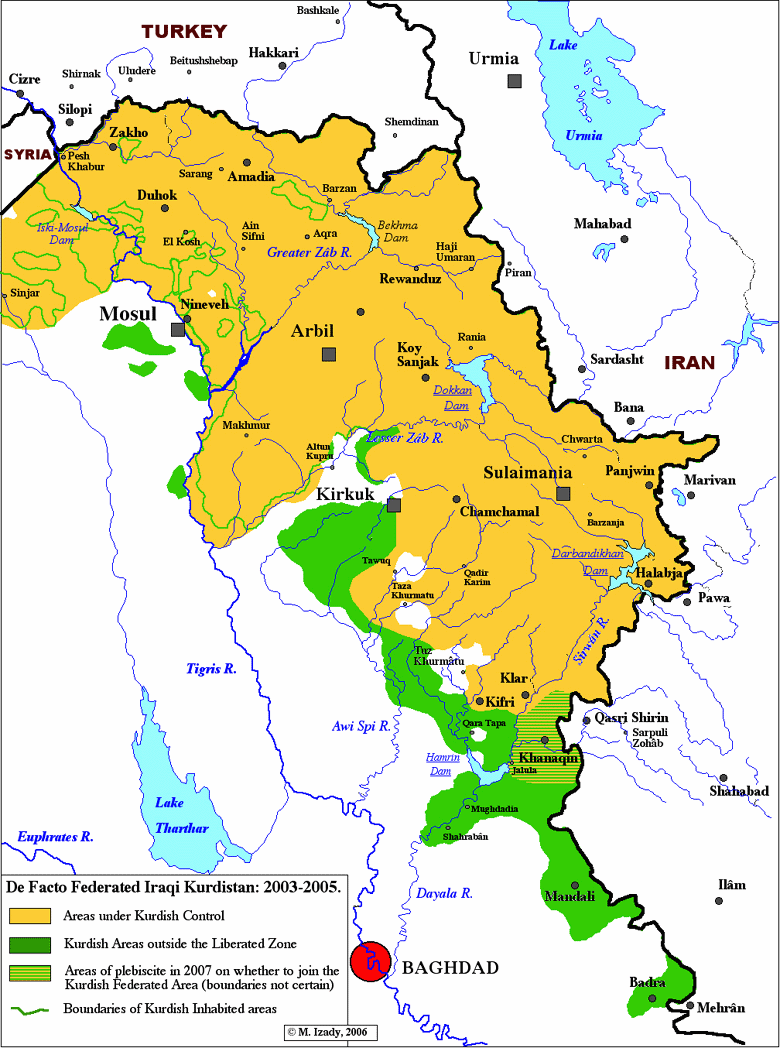
THE VIRTUAL STATE OF KURDISTAN

Steve DeAngelis of ERMB has been posting from (and about) Kurdistan in Iraq the past week while on a visit for Enterra Solutions. Collectively, Steve’s posts provide in- depth, on-site, analysis of Kurdistan’s present and future prospects with an emphasis on regional and global economic integration, security and systemic resilience; here they are in chronological order:

1. An Overview of Kurdistan

2. Resilience in Kurdistan

3. 3 days in Iraq from the Syrian/Turkish border to the Iranian border

4. Lessons from the Edge of Globalization: 3 days in Iraq from the Syrian/Turkish Border to the Iranian Border

5. Security in Kurdistan

(There were also several other Iraq-related posts “Interagency Feuding Over Iraq Reconstruction” and ” Coffee for the Troops“)

It would be difficult for me to briefly summarize in a mere paragraph what DeAngelis has impressively written about Kurdistan being on the ” Edge of Globalization” in roughly 6000 words. Therefore, I’m going to pick out a number of select excerpts that give the feel of the sum of Steve’s observations, followed by my commentary:

“We then headed further west to the border crossing checkpoint with Turkey. We entered a small U.S. military post on the border and saw how this border is managed. Completely full trucks, stretching for miles into Turkey loaded with any product you can imagine are seeking to deliver their products to buyers in Iraq. However, on the opposite side of the border another story unfolds. There is a two week wait (yes, I said two weeks!) for trucks coming from Iraq to cross into Turkey. Along the road are makeshift housing facilities equipped with satellite dishes that drivers can use during their two-week wait along a dusty and dirty road that moves trucks from one holding pen to another as they creep up to the border inspection stations in Iraq and then to their equivalent inspection stations in Turkey….

I’d be curious to know how much of this Turkish inefficiency is explicable due to legitimate security issues with the PKK, how much is due to local corruption, understaffing and incompetence and how much is calculated policy on the part of Ankara to choke Kurdish economic growth.

….Virtually all of the trucks crossing back into Turkey from Iraq are completely empty. If there were robust manufacturing and other commercial business operations in Iraq, these trucks would be full of products to be sold in Turkey and to the rest of the world as they transit through Turkey’s ports. The only kind of trucks that do cross fully loaded are 3,000 gallon tankers filled with Iraqi oil destined for a Turkish power generation facility just over the border. The electricity produced by the plant is sold back to the Iraqi’s at western market rates. What this obviously says is that Iraq has the raw materials but does not possess the production capability to turn oil into electricity and as such pays a tremendous financial and strategic price for this lack of capacity. The net result of this border crossing reality is a Current Account trade imbalance of almost 100% between Turkey and Iraq”

Steve is correct that this ad hoc mercantilist trade scenario is problematic for Kurdistan. Historically, nations that are raw commodity exporters, regardless whether it was cotton, rubber, oil, strategic minerals or foodstuffs end up in a unfavorable position vis-a-vis value-added production trading partners or merchant capital states. This applies whether we are discussing Ptolemaic Egypt and ancient Rome or the Gulf states today and the Core.

One caveat on the negative trade balance issue for Kurdistan would be the financial flows of Black Globalization. Lacking orderly markets and effective governance, ordinary Iraqis rely upon the black market for access to desired luxuries as well as necessities such as medicines or spare parts for machinery. Controlling a long border with Turkey, Iran ans Syria gives Kurdish actors the ability to become middlemen in the flow of goods and money which does not show up on the legal balance sheet. Ultimately, Barzani and Talabani’s regional Kurdish government must bring this trade above ground and normalize the economic relationships ( include taxes and customs duties).

“The Peshmerga welcomed U.S. forces and fought side-by-side with them in the effort to overthrow Saddam Hussein. It is estimated that there are between 80,000 and 100,000 active Peshmerga in Kurdistan. As the attached picture of a Peshmerga soldier taken near Dohuk shows (click to enlarge), the Peshmerga are a modern and well-equipped fighting force. The Peshmerga also allow women to serve. This tradition began when the Peshmerga were a guerilla force fighting to make the Kurdish area of Iraq a safe haven. Women also fought alongside coalition forces at the beginning of the current conflict. The attached picture shows female Peshmerga celebrating the fall of Kirkuk. “

The Peshmerga have been a coherent military force(s) far longer than I have been alive. Or Steve Deangelis for that matter. Or probably any of my readers. (The ferocious and mercurial Mustafa Barzani, sire of Massoud Barzani, the Kurdish president and KPD chieftain, was once the darling of American conservatives who hated Henry Kissinger. And long before that, tribal lord Barzani was the protege of… Joseph Stalin ! History has made the Kurds the ultimate realists). Former CIA field operative in Kurdistan Robert Baer put the Peshmerga fighting credibly toe to toe with Saddam Hussein’s best Republican Guard divisions during the 1990’s. That ain’t hay folks. Even in the 1990’s decline the Republican Guard was heavily armed and well-trained, despite being hamstrung by Saddam’s increasing paranoia.

The Peshmerga are perfectly suited for 4GW warfare as they combine tight military discipline, clan networks and strong primary loyalties with concurrent conventional and guerilla warfare skills. They also benefit from American patronage and a leadership that has proven unusually adept at presenting an image and engaging in politics in the international arena.

“Another new friend, Subbas Sircar, who is the regional vice president of AIG for the Middle east, Mediterranean and South Asia, had an interesting morning meeting with local bankers. They are seeking to expand and strengthen local banks as I discussed earlier. This group craved exposure to current international banking best practices, core banking information technology and know-how that would allow them to connect to the global banking industry as well as the training and education that would allow staff members to raise themselves up to a minimal level of maturity so they can foster commerce in their region. This experience with bankers in Sulaimaniyah and in Erbil, along with the telecommunications companies seeking the same capability in their industry, are proof positive of the need for Development-in-a-Box™.”

I think Steve is identifying a critical tipping point for Kurdistan. Leapfrogging the bazaari mentality to create a financial structure that inspires enough confidence to attract and sustain legitimate foreign investment and diversify Kurdish reliance on Turkish capital and American aid would be a milestone. This probably would not mean ” best practices” in the sense of Chase Manhattan so much as ” best enough practices” relative to the region. ” Good enough” is what gets a healthy level of local economic growth going. ” Best” can wait for the day the Republic of Kurdistan applies for admission to the WTO and the EU.

Today, Kurdistan is a nation with a virtual state shepherding its interests. More than Hezbollah in Southern Lebanon, the regional government in Kurdistan is less than Taiwan. But like Taipei, the Barzani-Talabani regional government seeks to negotiate or leverage de jure status and the full sovereignty of statehood over the virulent objections of a powerful neighbor and a nervous American patron. Economic development and integration with other global power centers ( EU, China, India, Japan, Russia) will be the key for the Kurds to create a scenario where Ankara can swallow – however bitterly, even with with ironclad security guarantees – Kurdish independence, because it will be in Turkey’s economic best interests to do so.

LINKS:

Kurdistan Rebalancing the Middle-East” and “Iraq Travel Guide” by Chirol

The Kurdistan Problem: Part I “, “The Kurdistan Problem: Part II“, “The Kurdistan Problem: Part III by midtowing at ProgressiveHistorians

Response to Virtual Nations Will Shape World Order or Disorder by Adrienne Redd

The Rise of the Virtual StateWealth and Power in the Coming Century” by Richard Rosecrance

Market-state vs. Virtual State” by John Robb


Switch to our mobile site

