zenpundit.com » art

Archive for the ‘art’ Category

The Israeli election: in the balance

Tuesday, March 17th, 2015

[ by Charles Cameron — the election itself a one day affair, and may even be settled by the time you read this — but the impact lingers, and the complex balancing of forces in the region remains ]
.

Calder

**

Nothing is ever black-and-white, it seems to me — but there are moment of exceptional clarity, and with the Israeli election (as best I can tell from afar) still in the balance as I write this, two quotes from Herzog (upper panel, below) and Netanyahu (lower panel) strike me as encapsulating the koan facing the Israeli people:

SPEC DQ Israeli elex koan

**

Still in the balance.

I was discussing the Middle East earlier in the day, an the issue of balance came up. Cheryl Rofer had said, “The big issue with KSA and Israel is balance of power” and I commented that if you throw Iran into the mix, the issue becomes one of a “balance of balances of power” — which could then be extended on out to include other interested parties.

This brought me to the idea of Alexander Calder mobiles, and the sense that they offer a kinetic equivalent to the static formalism of my own HipBone Games — their precarious balances and homeostases representing by analogy the tensions and resolutions between stakeholders and / or ideas, ideologies, approaches, in a way that features both “equilibrium and its discontents”. Fascinating.

To which Cheryl responded with gnomic accuracy:

Multibody problems are hard.

Ain’t that the truth!

**

Sources:

  • NYT, Netanyahu Says Never to a State for Palestinians
  • Fathom, We must divide the land: an interview with Isaac Herzog
  • Mobile, Alexander Calder in Gemeentemuseum Den Haag
  • Sunday surprise addendum: Magritte and Montparnasse

    Monday, March 9th, 2015

    [ by Charles Cameron — Lawrence Weschler in the same NYorker issue as Fredric Dannen ]
    .

    In the same issue of the New Yorker as Fredric Dannen‘s piece on the Green Dragons referenced in my earlier post, as it happens, and indeed printed on the same pages, is one of Lawrence Weschler‘s brilliant Convergences — his term for what I call DoubleQuotes.

    I’ve composed my own version out of the same two images, here:

    Magritte Montparnasse

    **

    William Routt, in his The Madness of Cinema and Thinking Images, has this to say:

    Writing under the heading “Convergences” in The New Yorker of November 16th, 1992, Lawrence Weschler explains that a train photographed dangling alongside a brick building “overshot the Gare Montparnasse, in Paris, on October 22, 1895”. What he cannot explain, and what he only points to in the way I have pointed to the coincidence between Lindsay and Deleuze, is the coincidence between this photograph and René Magritte’s well-known 1938 painting of an engine coming out of a fireplace (which is called “Time Transfixed”). The photo hallucinates the painting and the painting the photo. Their connection is delirious.

    Delirious or delicious, I couldn’t let the occasion of my discussing that New Yorker issue pass without praising Weschler’s eye for the telling matcvh of images.

    Image sources:

  • Rene Magritte, Time Transfixed, 1938
  • Levy & fils, Train wreck at Montparnasse Station
  • Unholy: perhaps it’s a useful word

    Friday, January 30th, 2015

    [ by Charles Cameron — when religion casts a long and violent shadow ]
    .

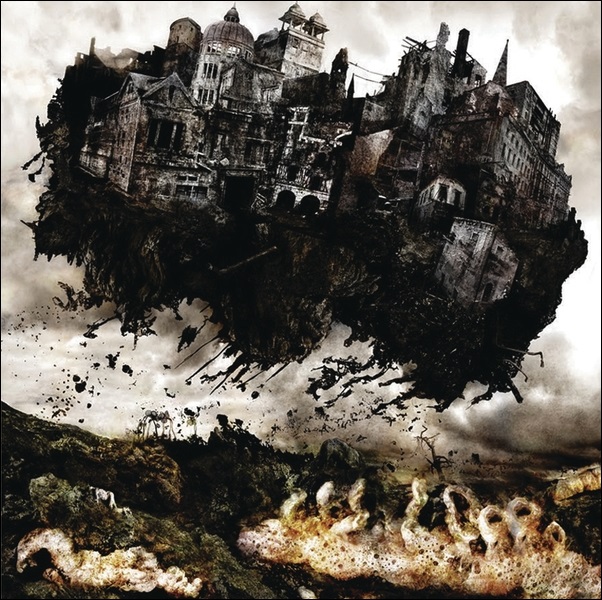
    unholy cover
    cover art for the Unholy album, New Life behind Closed Eyes

    **

    Unholy may prove to be a very useful word, I think.

    It’s not secular, it’s not irreligious, it doesn’t lack for some sort of supernatural influence — in fact it fits right in with the metaphysical implications of such Biblical phrases as (Revelation 12.7):

    there was war in heaven: Michael and his angels fought against the dragon; and the dragon fought and his angels

    and (Ephesians 6.12):

    we wrestle not against flesh and blood, but against principalities, against powers, against the rulers of the darkness of this world, against spiritual wickedness in high places

    **

    Because, I am arguing, it is neither secular nor irreligious, it fits perfectly, I’d say, the kinds of situation we’re in so freuqnetly, globally, of religiously motivated group violence.

    The word jihad — besides focusing entirely on Islamic variants, when in fact Buddhist, Hindu and Christian militians are also in evidence — concedes too much to those who regard their warfare as holy, divinely sanctioned, while other terms make things sound secular and almost normal, as if politics without the religious booster was all we are talking about.

    BrutaL and spiritual, spiritual and brutal on both sides — in the Central African Republic, for instance:

    It was March 2013 when the predominantly Muslim rebel coalition Séléka swept into the riverside capital, Bangui, from the northeast. President François Bozizé fled as a vicious campaign of looting, torture and murder got underway. Séléka leader Michel Djotodia soon proclaimed himself the successor; he would later lose control of his ranks and an attempt that fall to disband them would do little to stop the atrocities.

    At the same time, groups of militias called anti-balaka had begun to form and train and retaliate against Séléka. Their name in the local Sango language means “anti-machete”; their fighters are comprised of ex-soldiers, Christians and animists, who think magic will protect them. They’re adorned with amulets to ward off attacks and fight with hunting rifles, poison-tipped arrows and machetes.

    Amulets and machetes.. warriors and angels.

    **

    Maybe we should say “unholy warriors” and “unholy wars” rather than “holy warriors” or “jihadis” — and “unholy monks” for the Burmese mobsters in saffron robes.

    And I’d reserve the use of the term for situations in whiuch at least one side in a conflict openly avows religious motivation. Someone making a treaty someone else feels is foolish or dangerous simply doesn’t meet the bar.

    **

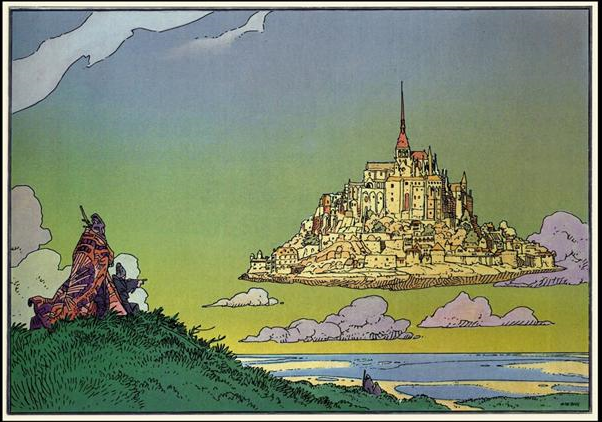
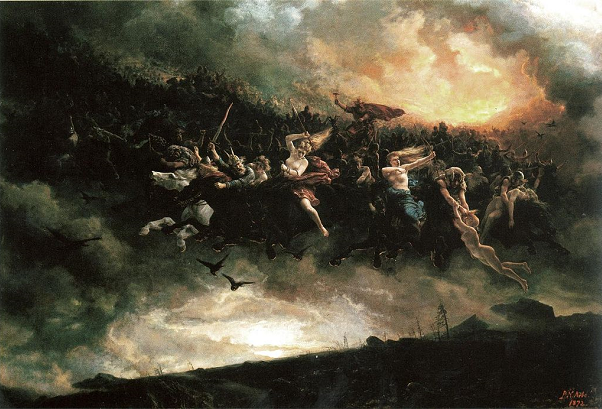
    It’s worth considering the Unholy CD cover art alongside two other recent images:

    Moebius Floating City

    and:

    Wild-Hunt-602

    And about that top image from the Unholy album, just so you know:

    UNHOLY present their Prosthetic Records debut, a metal massacre fueled with down-tuned guitars, double bass and deep grooves akin to the sounds of Entombed, Crowbar and later Carcass, with members having been in bands like Santa Sangre, Another Victim and Path Of Resistance.

    Pinker, Blake and Moebius

    Thursday, January 29th, 2015

    [ by Charles Cameron — looks like I’ll have an “Author’s blog” up soon to accompany a book I’m working on, and it’ll be called “Seeing Double” — which is what this post is about ]
    .

    Steven Pinker, I’m sorry to say, appears to be one of those

    One can imagine a world in which oracles, soothsayers, prophets, popes, visionaries, imams, or gurus have been vouchsafed with the truth which only they possess and which the rest of us would be foolish, indeed, criminal, to question. History tells us that this is not the world we live in. Selfproclaimed truthers have repeatedly been shown to be mistaken — often comically so — by history, science, and common sense.

    The characters I’m interested in here are the visionaries — and my point is that truth as fact is not the only truth there is.

    **

    Can “history, science and common sense” really detract from the “truth” of this image by Blake?

    Blake_De_antro_nympharum_Tempera_Arlington_Court_Devon

    or this, by Moebius?

    Moebius Floating City

    **

    Pinker is interesting — that single para of his just gave me a chance to rant — so let me return you to his whole piece.

    I have other disagreements with him, no doubt, but he’s a mind to be engaged with.

    Takfir squared, Prisoners Dilemma and MC Escher

    Friday, January 16th, 2015

    [ by Charles Cameron — call it backlash, backfire, or blowback, somewhere they’re dclaring takfir on the takfiris ]
    .

    Ali Minai at BrownPundits has a worthwhile take on what he calls, paradoxically enough, Unreal Islam, from which I’ve excerpted this paragraph:

    However, another version of takfir is now afoot in the world. Call it “reverse takfir”. Unlike the militant version, it is well-intentioned and self-consciously humane, but it is also dangerous. This “benign” version of takfir is epitomized by the idea that the acts of violence being committed by self-proclaimed holier-than-thou Muslims are not the acts of “real Muslims” and do not represent “real Islam”. In effect, it declares the terrorists to be infidels! The idea is widespread, and is espoused in three different contexts: By well-meaning non-Muslims (such as Presidents Bush and Obama) seeking to avoid stereotyping and the implication of collective guilt; by ordinary Muslims wishing to dissociate themselves from the beheaders; by Muslim sectarians wishing to separate their brand of orthodoxy from that espoused by terrorists; and – most ironically – by Muslim governments and security forces seeking an “Islamic” justification for attacking extremist fellow Muslims, thus implicitly buying into the central jihadi argument of apostasy as a capital offense. The urge to do this reverse takfir is understandable and not without factual basis: Most Muslims are indeed not violent extremists who wish to kill infidels. And it does help protect innocent Muslims from backlash, which is rather important. The problem, however, is that it also feeds the narrative of denial and deniability that allows the militancy to thrive.

    **

    Call it reversal, call it backlash, backfire, blowback, call it enantriodromia, eye-for-an-eye, tit-for-tat — the return of violence for violence seems both instinctual, in the sense that a desire for vengeance seems to spring unprompted in the individual, and culturally embedded, in that it can be found in Torah and Pashtunwali alike, and elsewhere, and elsewhere.

    Whether the individual instinct can usefully be separated from cultural instinct is at least a question, perhaps a koan — but it was Axelrod‘s insight, working on the Prisoners Dilemma in game theory, that the “strategy” of tit-for-tat may best be considered as an iterative process, .. for-tit-for-tat-for-tit-for-tat-for .. rather than as an isolated instance, tit-for-tat-period.

    Gandhi made the same leap to iterative thinking when he said:

    An eye for an eye makes the whole world blind

    — or did he?

    **

    Iteration requires that we pull back, to see not just “my / our” response — which is probably self-evident, if not so all-consuming as to be omnipresent and invisible — but to see “both sides”.

    We move from:

    Escher one hand drawing

    — which is the natural or “default” view, equivalent to the righteous indignation of one’s own side in a conflict, to:

    Escher drawing_hands

    — which definitely seems paradoxical on the face of it, and which notably doesn’t give preference to one side or one hand over the other — Doug Hofstadter‘s celebrated diagram illustrates the process thus:
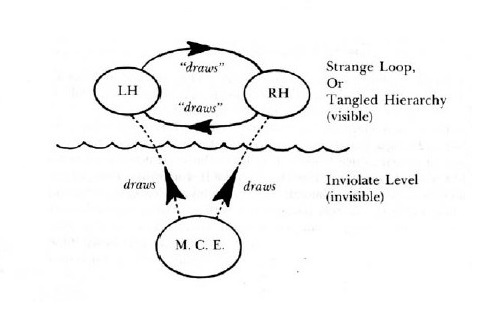
    Hofstadter Escher hands

    **

    Lincoln uses this strategy in his Second Inaugural, in describing the Civil War:

    Each looked for an easier triumph, and a result less fundamental and astounding. Both read the same Bible and pray to the same God, and each invokes His aid against the other. It may seem strange that any men should dare to ask a just God’s assistance in wringing their bread from the sweat of other men’s faces, but let us judge not, that we be not judged. The prayers of both could not be answered. That of neither has been answered fully.

    It is to a large extent the elevation of Lincoln’s comments above partisanship into inclusivity, surely, which gives that great speech its greatness.

    **

    For your further consideration:

    Robert Axelrod:

  • The Evolution of Cooperation, 1984
  • The Complexity of Cooperation, 1997
  • The Evolution of Cooperation, revised 2006
  • Doris Schattschneider:

  • M.C. Escher: Visions of Symmetry
  • Switch to our mobile site