zenpundit.com » arab world

Archive for the ‘arab world’ Category

Tim Hetherington, RIP

Thursday, April 21st, 2011

timrestrepo.jpg

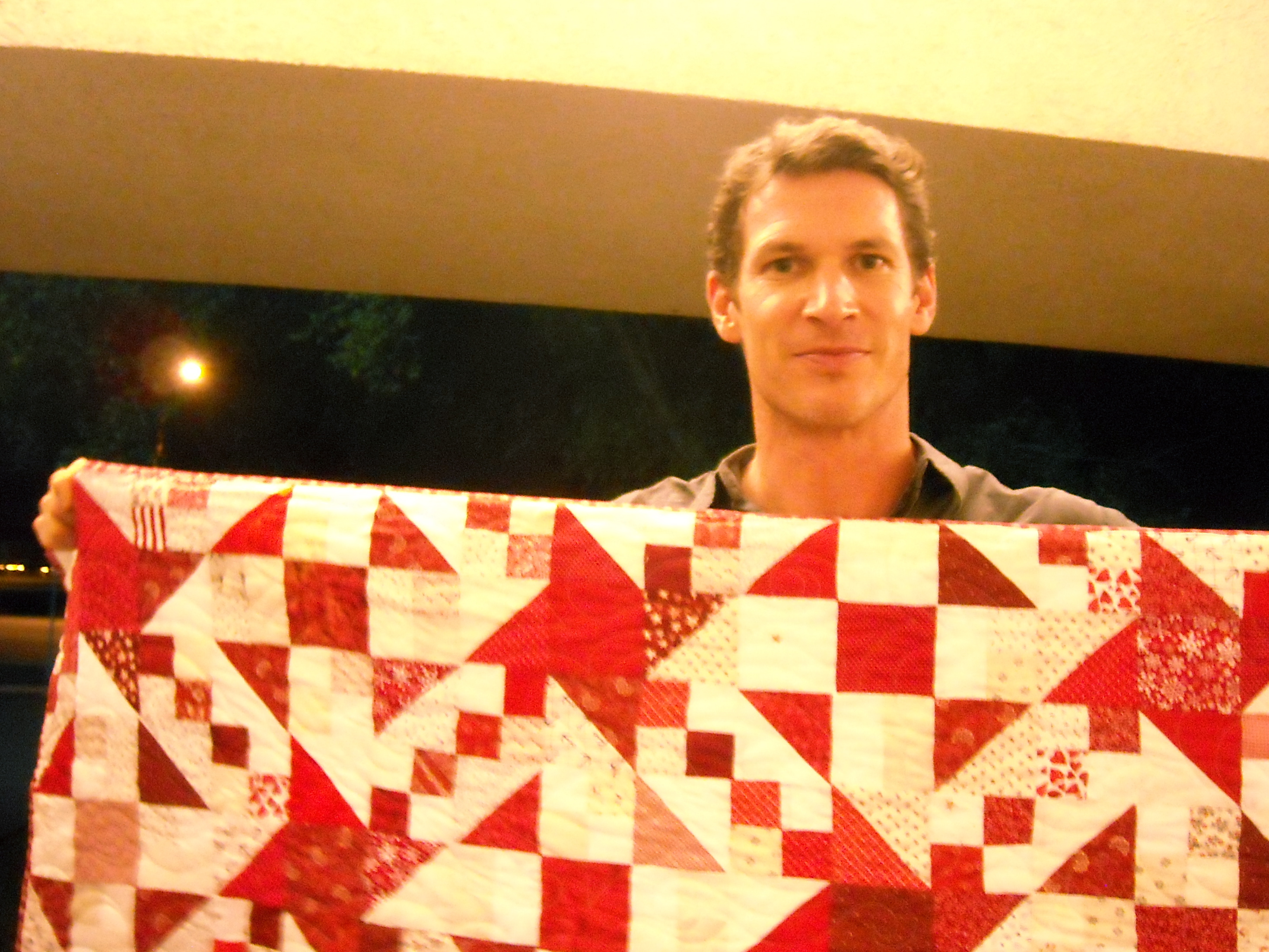
Tim Hetherington after being presented with a Quilt of Valor by the Quilts of Valor Foundation

I was saddened to hear the news from Kanani Fong that Tim Hetherington, the gifted documentarian and journalist who made the critically acclaimed film RESTREPO was killed today in MisrataLibya. Preliminary details are sketchy but early reports had Tim and another reporter suffering shrapnel injuries from an RPG during an attack by Gaddafi forces on Libyan rebels:

Leila Fadel, a Washington Post reporter who was at the hospital, reported that Hetherington was rushed from the battle by ambulance along with rebel fighters. He was taken to a triage tent next to the hospital, she said, and appeared pale and was bleeding heavily. He was pronounced dead some 15 minutes after his arrival, according to her account in The Washington Post.

Story: ‘Restrepo’ presents agonizing war closeup

“Tim was in Libya to continue his ongoing multimedia project to highlight humanitarian issues during time of war and conflict,” Hetherington’s family said in a statement. “He will be forever missed.”

Hetherington was best known as co-director of the documentary film “Restrepo” with Sebastian Junger, author of “The Perfect Storm.” The film tells the story of the 2nd Platoon of Battle Company in the 173rd Airborne Combat Team on its deployment in Afghanistan in 2007 and 2008. It was nominated for an Academy Award for best documentary. The title refers to the platoon outpost, named after a popular soldier, Juan Restrepo, who was killed early in the fighting.

I did not know Tim personally, though I attended an early screening of RESTREPO where the audience included soldiers who had been at Restrepo and their family members. The documentary was powerful and touched the lives of many people and was a testament to the physical bravery of Tim Hetherington and Sebastian Junger who stood alongside American soldiers in the firefights of the Korengal Valley. That was Ernie Pyle journalism at it’s best.

Sincere condolences to the friends and family of Tim, who are numerous in this corner of the blogosphere

A two part meditation, part ii: of monks and militants

Wednesday, April 20th, 2011

[ by Charles Cameron ]
See also part I: Scenario planning the end times

*

Today I received a book in the mail from Powell’s: C Christine Fair and Sumit Ganguly‘s Treading on Hallowed Ground: Counterinsurgency operations in Sacred Spaces. That covers the spread of my interests pretty concisely. I’m reminded that Dietrich Bonhoeffer, the German theologian who was complicit in several attempts to assassinate Hitler, once said, “Only he who cries out for the Jews may sing Gregorian chants” – again, the intersection of the sacred and harsh “facts on the ground”.

I am interested in this intersection partly because my father was a warrior and my mentor a priest and peace-maker, and partly because that mentor, Fr. Trevor Huddleston CR, taught me to anchor my life in the contemplative and sacramental side of things, then reach out into world with a view to being of service – an idea that he movingly expressed in this key paragraph from his great book, Naught for your comfort:

On Maundy Thursday, in the Liturgy of the Catholic Church, when the Mass of the day is ended, the priest takes a towel and girds himself with it; he takes a basin in his hands, and kneeling in front of those who have been chosen, he washes their feet and wipes them, kissing them also one by one. So he takes, momentarily, the place of his Master. The centuries are swept away, the Upper Room in the stillness of the night is all around him: “If I, your Lord and Master, have washed your feet, ye ought also to wash one another’s feet.” I have knelt in the sanctuary of our lovely church in Rosettenville and washed the feet of African students, stooping to kiss them. In this also I have known the meaning of identification. The difficulty is to carry the truth out into Johannesberg, into South Africa, into the world.

A few days ago I saw a film that encompasses that same range – from the contemplative to the brutal – telling the story of the Cistercian (Trappist) monks of Tibhirine in the Atlas mountains of Algeria, the warmth of affection that existed between them and their Muslim neighbors, the mortal threat they came under from Muslim “rebels” whose wounded they had cared for, their individual and group decisions to stay there in Tibhirine under those threats, and their eventual deaths.

*

It is an astonishing story, and my copy of John Kiser‘s book, The Monks of Tibhirine: Faith, Love and Terror in Algeria, which also tells that story, already has more tabs in it noting phrases and whole paragraphs I’ll want to return to than any altar missal – and I’m only two-thirds of the way through it.

I don’t wish to retell the story – I’d rather you saw the film, Of Gods and Men, in the theater if possible, on DVD if not, or read the book, or both – but a few of those book-marked passages stand out for me.

First, Algeria – in the words of Albert Camus:

Algeria is land and sun. Algeria is a mother, cruel and yet adored, suffering and passionate, hard and nourishing. More than in our temperate zones, she is proof of the mix of good and evil, the inseparable dialectic of love and hate, the fusion of opposites that constitute mankind

That sets the scene – and I am inescapably reminded of that comment of Solzhenitsyn, which I quoted at the end of my first response to Abu Walid:

Gradually it was disclosed to me that the line separating good and evil passes not through states, nor between classes, nor between political parties either – but right through every human heart – and through all human hearts. This line shifts. Inside us, it oscillates with the years. And even within hearts overwhelmed by evil, one small bridgehead of good is retained. And even in the best of all hearts, there remains … an uprooted small corner of evil.

Algeria brings that separation into sharp relief – the monks of Tibhirine knew and acted on their knowledge that it passes through each and every human heart.

Next, the Qur’an. When the monks first meet the militants, their prior, Fr. Christian de Chergé, begins to quote from Sura 5, and the militant leader completes the verse:

The nearest to the faithful are those who say “We are Christians.” That is because there are priests and monks among them and because they are free of pride

The view I wish to present here in describing the monks of Tibhirine is not a view from left or right but from a contemplative perspective — and while I do not believe it the only perspective to be considered, I think we do well to heed the insights of Christian monks — a group to whom even the Muslim scriptures give praise.

Then, the Rule of St Benedict:

Just as there is the zeal of bitterness that is evil and separates us from God and leads to hell, so also there is a good zeal which removes vices and leads to God and eternal life.

This, then, was the spirit in which the monks of Tibhirine served and loved their God – and their neighbors as themselves.

And finally, the Bible, from the book of Job:

My face is flushed from weeping and on my eyelids is the shadow of death; although no violence is in my hands and my prayer is pure.

*

It was with that shadow playing on his eyelids that Fr. de Chergé penned these words of immense generosity:

Facing a GOODBYE …

If it should happen one day — and it could be today — that I become a victim of the terrorism which now seems ready to engulf all the foreigners living in Algeria, I would like my community, my Church and my family to remember that my life was GIVEN to God and to this country.

I ask them to accept the fact that the One Master of all life was not a stranger to this brutal departure.

I would ask them to pray for me: for how could I be found worthy of such an offering?

I ask them to associate this death with so many other equally violent ones which are forgotten through indifference or anonymity.

My life has no more value than any other. Nor any less value. In any case, it has not the innocence of childhood.

I have lived long enough to know that I am an accomplice in the evil which seems to prevail so terribly in the world, even in the evil which might blindly strike me down.

I should like, when the time comes, to have a moment of spiritual clarity which would allow me to beg forgiveness of God and of my fellow human beings, and at the same time forgive with all my heart the one who would strike me down.

I could not desire such a death. It seems to me important to state this.

I do not see, in fact, how I could rejoice if the people I love were indiscriminately accused of my murder.

It would be too high a price to pay for what will perhaps be called, the “grace of martyrdom” to owe it to an Algerian, whoever he might be, especially if he says he is acting in fidelity to what he believes to be Islam.

I am aware of the scorn which can be heaped on the Algerians indiscriminately.

I am also aware of the caricatures of Islam which a certain Islamism fosters.

It is too easy to soothe one’s conscience by identifying this religious way with the fundamentalist ideology of its extremists.

For me, Algeria and Islam are something different: it is a body and a soul.

I have proclaimed this often enough, I think, in the light of what I have received from it.

I so often find there that true strand of the Gospel which I learned at my mother’s knee, my very first Church, precisely in Algeria, and already inspired with respect for Muslim believers.

Obviously, my death will appear to confirm those who hastily judged me naive or idealistic:
“Let him tell us now what he thinks of his ideals!”

But these persons should know that finally my most avid curiosity will be set free.

This is what I shall be able to do, God willing: immerse my gaze in that of the Father to contemplate with him His children of Islam just as He sees them, all shining with the glory of Christ, the fruit of His Passion, filled with the Gift of the Spirit whose secret joy will always be to establish communion and restore the likeness, playing with the differences.

For this life lost, totally mine and totally theirs, I thank God, who seems to have willed it entirely for the sake of that JOY in everything and in spite of everything.

In this THANK YOU, which is said for everything in my life from now on, I certainly include you, friends of yesterday and today, and you, my friends of this place, along with my mother and father, my sisters and brothers and their families — you are the hundredfold granted as was promised!

And also you, my last-minute friend, who will not have known what you were doing:

Yes, I want this THANK YOU and this GOODBYE to be a “GOD BLESS” for you, too, because in God’s face I see yours.

May we meet again as happy thieves in Paradise, if it please God, the Father of us both.

AMEN! INCHALLAH!

Algiers, 1st December 1993
Tibhirine, 1st January 1994

Christian +

*

I note with sadness today the death of Tim Hetherington, photo-journalist and co-director of the film Restrepo, together with that of his colleague Chris Hondros, in Misrata, Libya. Their cameras, and those of others like them, brought and will bring the grimness of war home, into the living rooms of peace.

Porter at Infinity Journal

Friday, April 8th, 2011

Infinity Journal has added a more “blog-like” or “column-like” section to cover events within a contemporaneous frame in addition to their peer-review articles which come out quarterly (or perhaps bimonthly) more contemporaneous peer reviewed articles, oriented toward current events, in addition to their quarterly publication of the journal . Dr. Patrick Porter of Offshore Balancer ( and King’s College) has the maiden post with a provocative piece:

Exclusive: Lost in Libya: The UK does not understand strategy

The limited war of 2011 would refuse to be quarantined. After all other options were exhausted, it could culminate in a land war against Tripoli. Distressingly, we would shoulder the burden of invading, pacifying and administering this country. Occupation would probably lead to resistance – and Libya propelled more foreign-born jihadi volunteers into Iraq than any other nation. A new front in the War on Terror would open up. Idealists now calling for humanitarian rescue would discover that all along they opposed Western imperial hubris….

Free registration required. 

Admittedly, I stole the excerpt above from SWJ Blog – the online format of IJ makes it difficult for bloggers to quote sections of articles by copying and pasting into blog posts. This probably cuts down on the velocity and extent of IJ articles circulating in the .mil/strategy/foreign policy online world (blogosphere, twitter, listservs). OTOH the editors may not care as it probably reduces the amount of inane vs. informed criticism as well 🙂

In any event. Dr. Porter’s article is worth reading.

The Year of Living Memory

Wednesday, April 6th, 2011

[ by Charles Cameron ]

*

Some people’s — and more to the point, some peoples’ — living memory appears to be longer than others. China, for instance, has what you might call long term living memory.

*

But first, the Crusades. When Bush 43 first used the word “crusade” in reference to the US response to 9/11, I went to Google and checked, and the first listing for “crusade against” that came up was to The Crusade Against Dental Amalgam. I’m the suspicious type, and as I suspected, the word “crusade” simply doesn’t have the same valence for most twenty-first century Americans that it has for many in the twenty-first century Arab world. In the US, a crusade is a concerted effort to change just about anything, the use of mercury in dental fillings being just one example.

Across the Arab world, however, the word has very different connotations: thus Amin Maalouf writes in The Crusades through Arab Eyes:

The Turk Mehmet Ali Agca, who tried to shoot the pope on 13 May 1981, had expressed himself in a letter in these terms: I have decided to kill John Paul II, supreme commander of the Crusades. Beyond this individual act, it seems clear that the Arab East still sees the West as a natural enemy. Against that enemy, any hostile action — be it political, military, or based on oil — is considered no more than legitimate vengeance. And there can be no doubt that the schism between the two worlds dates from the Crusades, deeply felt by the Arabs, even today, as an act of rape.

That’s long term living memory for you.

*

I’m writing this because I just read a fascinating article by Robert Barnett on the New York Review of Books blog titled The Dalai Lama’s ‘Deception’: Why a Seventeenth-Century Decree Matters to Beijing — need I say more?

The title will suffice for those who don’t have much time today — I understand, we’re all under the fire-hose one way or another — while those with the ability to sneak in ten or fifteen minutes laterally while the clock’s not watching can and should definitely read the whole thing…

*

I have just one side-observation though — the article tells us, among many other things directly relating to Tibet and the history of the Dalai Lamas:

And again, when Jiang Zemin made a brutal decision to annihilate the basically harmless Falungong cult in 1999, it is believed that he saw it as analogous to the religious movement that had started the Taiping Rebellion and nearly toppled the Qing in the mid-19th century.

I think that’s right — but what Barnett doesn’t mention, since Taiping is only an aside for him, is that the rebellion was only eventually quelled at the cost of between twenty and thirty million lives…

I mentioned my own hunch that memories of Taiping were behind the Chinese government’s fierce response to Falun Gong in question time after Ali A Allawi‘s talk on Mahdist movements in Iraq at the Jamestown Foundation a few years back, and he responded that similarly, the reason the Iraqi government took such fierce action against a small Mahdist uprising near Najaf — even calling in US air support as I recall, for an incident perhaps best compared in US terms with Waco — was that they remembered the Babi movement in their own neck of the woods, and the tens of thousands who died back in the 1850s, around the same time as the Taiping in China.

*

Living memory — which could almost be a definition of history, or at least of what historical research aims to create — can itself be long term or short, perishable or perennial.

And then there’s Psalm 90, which declares “For a thousand years in thy sight are but as yesterday when it is past, and as a watch in the night.”

Now (and I’m being playful here, albeit with a touch of serious intent) does that suggest a Memory that reaches back in perfect detail through the eons to the Big Bang and perhaps before it? Or … “twentieth century? nineteenth? the Crusades?.. it’s all a bit of a blur, I’m afraid — it all rushes by so fast…”

*

There seems to be a choice set before us as individuals — and more to the point, as peoples:

Shall we choose Lethe, and the restfulness of oblivion, or Mnemosyne — the mother of all Muses? There are, you know, immediate educational implications, and serious geopolitical implications down the road, for the choice we make…

On Libya

Friday, April 1st, 2011

I thought it might be interesting to look at some views of the Libyan War and then offer some remarks of my own. Of course, readers are encouraged to read each source in full rather than just my excerpt: First up….

CNAS (Andrew Exum & Zachary Hosford)Forging a Libya Strategy: Policy Recommendations for the Obama Administration

….The most dangerous outcome for the United States is also the most likely, which is a stalemate that prolongs U.S. and allied military intervention in Libya. The relative lack of sophistication and organization among rebel fighting forces means they may be unable to regain the momentum in Libya and defeat Gadhafi’s forces in open combat absent significant direct and indirect support from U.S.and allied militaries – which is not explicitly authorized by UNSCR 1973 and might not be supported by the U.S. Congress.

A stalemate in Libya would effectively result in a de facto partition of the country with a severely underundergoverned and disorganized safe haven in eastern Libya for the rebels that could provide refuge for various militant and criminal groups capable of exporting violence and instability to other countries in North Africa and the Middle East. Such a scenario would prolong U.S. and allied military intervention as only a major Western investment in developing the independent governance, economic and security force capacity of eastern Libya would be likely to forestall this outcome. However, such an investment is highly unlikely due to the overarching fiscal constraints facing the United States and NATO countries and competing priorities.

Nice work on a very important policy brief by Exum and Hosford. This one was “tight”, written to the point, properly focused on strategic variables rather than getting bogged down in debatable specialist minutia and delivering clear policy option scenarios. Written in exactly the right mode for a White House/NSC staffer or deputy to SEC to digest and disseminate to their boss or peers. Kudos, gents.

I think Ex and Hosford have correctly diagnosed Libya as a potential albatross for the US from which we stand to gain very little benefit even in the best case scenario. I disagree with their assertion that it would be a tolerable outcome to leave Gaddafi in power. No, that ship has already sailed and we have had enough Lockerbies. To imagine that there will not be ongoing blowback from a rump Gaddafi regime in a fragile neighborhood with which the US will repeatedly have to deal is just not at all realistic.

The Allies badly wanted Gaddafi out. They will have to be pressured now to follow through and the US needs to make it clear that we will neither babysit an enraged, cornered, Gaddafi for the next seven years, tying down an aircraft carrier group and costing the US taxpayer billions, nor we will accept the Brits and French hanging Gaddafi’s triumphant survival on our doorstep as an “American defeat” while skating away diplomatically (which is their Plan B if we refuse to do a Panama type operation for them). They will have to finish the job on the ground themselves and ensure Gaddafi’s death or departure with our support, but not the reverse. Or Paris and London can help build a real rebel army, salted liberally with PMC units and SOF “advisers” to stiffen spines.

CRS Report ( Christopher M. Blanchard) – Libya Unrest and US Policy

….The complexity of these factors and the stress that ongoing fighting places on their interrelationships creates challenges both for Qadhafi supporters and opposition groups. As both parties seek to navigate the political waters of the upheaval and look ahead to potential postconflictscenarios, they face difficult questions about current tactical choices and future means for promoting national reconciliation and governing effectively.

For the opposition, the question of foreign military intervention is complicated by opposition leaders’ desire for external assistance and their appreciation for the strong nationalist, anticolonial sentiment shared by most Libyans. Internally, political differences and competing demands among the opposition’s constituent groups may complicate the maintenance of a united front against Qadhafi counterattacks and complicate efforts to speak with one voice in dealings with the international community. Other regional examples suggest that such internal differences may prove even more challenging for any transitional authority in the aftermath of the conflict…

In a sea of government waste and middling competence, the Congressional Research Service stands out as a gem, giving the taxpayers a tremendous informational “bang for the buck” in reports prepared by experts on a vast array of subjects. While not an advocacy piece, the report is a valuable “backgrounder” on the Libyan War of a kind that you cannot get from the MSM.

Marc Lynch – Why Obama had to act in Libya

….And my conversations with Arab activists and intellectuals, and my monitoring of Arab media and internet traffic, have convinced me that the intervention was both important and desirable.  The administration understood, better than their critics, that Libya had become a litmus test for American credibility and intentions, with an Arab public riveted to al-Jazeera.  From what I can see, many people broadly sympathetic to Arab interests and concerns are out of step with Arab opinion this time.    In the Arab public sphere, this is not another Iraq — though, as I’ve warned repeatedly, it could become one if American troops get involved on the ground and there is an extended, bloody quagmire.  This administration is all too aware of the dangers of mission creep, escalation, and the ticking clock on Arab and international support which so many of us have warned against.  They don’t want another Iraq, as Obama made clear…. even if it is not obvious that they can avoid one. 

Lynch is an Arabist, and while the internet traffic aspect is skewing the demographic, al-Jazeera coverage is a dominant information effect in Arab public with limited literacy. It is sort of the Walter Cronkite effect from the 60’s in play again, if the primary trusted source is broadcasting an interpretation, it takes on the air of truth for a majority of viewers. That said, it matters very little whether al-Jazeera is giving kudos to the US if the average rebel can’t fire an RPG, quickly unjam and reload his AK-47 under fire, get water or food in the field or dig simple trench and sandbag defenses. Guys milling about nervously out in the open road, brandishing weapons and arguing amongst themselves will get their clocks cleaned by any opponent with even marginal military training and leadership. Gaddafi’s military forces are fourth rate – this is not Saddam’s army of 2003, much less of 1991 – but they can handle untrained and leaderless groups easily enough.

Which brings us to…..

Thomas P.M. BarnettArming the Libyan rebels

…There’s also al-Qaeda in the Islamic Maghreb (AQIM), but that group has frankly struggled to be taken seriously as a force, as it’s mostly a relabeling of an existing group that was going nowhere (bigger the territory in the title, more likely, in my mind, that it’s not exactly succeeding anywhere). Up to now, no one has portrayed that group as Libyan-centric.  Yes, they will show up, but that’s standard.  The reality, as noted in the piece, is that you have to train on what you provide, so we’ll have people on the ground (besides the CIA already there).  If things go really sour, then we burn that bridge when we come to it.  But this is not a logical showstopper.  A Libyan long divided in two and suffering civil conflict will do the same – or far better – for AQIM than a concerted arms push to dethrone the guy.  So, again, factor them in as the cost of doing any sort of business here, but do not elevate them into the decision-tilting bogeyman, because they’re not, and speculating in the press doesn’t make them so.

Going the Reagan Doctrine route was my original preference on Libya and I am still in favor of sponsoring an insurgency war against Gaddafi, with a couple of caveats.

First, SECDEF Robert Gates’ strong aversion to doing this gives me some pause, given his background as a former head of the IC and his access as SECDEF to our best current intelligence (which, admittedly, may not be that much). His judgment should be given considerable weight. Secondly, where are the Arabs? A hundred or so experienced NCO’s and junior officers from Egypt and KSA would be of immense help in establishing unit discipline and basic training for the rebels. The Saudis very well might be contributing substantial amounts of cash but that’s no longer good enough. The Arab League needs to show it’s alleged support for helping the rebels and removing Gaddafi with boots and not just empty words.

Reflexively, American policy makers face a great temptation to “own” the crisis and micromanage the Libyan War against some impossibly unrealistic standard of success. Let’s resist it. We should help drive nails in Gaddafi’s coffin but we don’t need to be the main hammer. Sometimes less is more and the Libyan rebels getting rid of their tyrant badly is better than us doing it for them well.


Switch to our mobile site
