[ by Charles Cameron — I wish to acknowledge the impact Prem Rawat has had on my thinking during the course of this lockdown ]
.
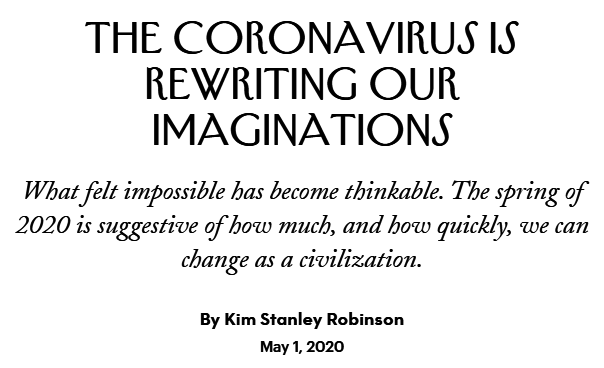
A sequence of headlines says it all:
The Question:
**
Ouch:
**
To be Specific:
**
The Opportunity:
**
The Answer:
Science gives a patina of the factual, the tested, the proven, the real, and fiction allows both the extrapolation of strict science to future possibilities (Larry Niven, Ringworld, if I remember correctly), but also the intrusion of the magical (RA Lafferty, Narrow Valley).
The question is both obvious and pressing, but of all those writing about it, and the essays above are a decent sample, Kim Stanley Robinson is the one with heart and mind most attuned to possible futures — so of all the above essays, hers is the one I’d trust, and would offer you for your consideration. Her thesis, in the small italic print above:
What felt impossible has become thinkable. The spring of 2020 is suggestive of how much, and how quickly, we can change as a civilization.
Chew on that for a while.
**
I suspect this is likely to become a series: I’ve accordingly labelled it #1. This is just setting the scene.
**
A hint from Maa Ganga, the goddess of India’s most sacred river Ganges:
The ganga, which flows through five states and is most polluted in Varanasi — Prime Minister Narendra Modi’s constituency — is now regaining all its lost glory, slowly. Pollution in the sacred river has come down by over 40 per cent and is likely to increase as the lock down continues across the country. Though successive governments including the present Modi government spent thousands of crores in cleaning the ganga and still failed miserably, looks like nature always finds its own way of healing.
**
Sources:
Offered here so you can read in detail according to your interests and time
availability:
[ by Charles Cameron — two book compilations on the virus — one about Christianity, one about world religions — and a handful of articles, plus one paper on cartel use of coronavirus, non-religious but still of interest ]
.
I was introduced to two books on the coronavirus pandemic and its impact on religions via the New Religions Movement mailing list. The more interesting by far, from my own point of view, since it is more diverse and yet precise in pinpointing many of its topics, is:
Freedom of religion is certainly one of the areas in which the coronavirus confronts religion, and in which on occasion religion may confront the coronavirus — as the breadth of papers here clearly illustrates:
Note in particular, of very specific Christian interests:
Enrica Martinelli, Orthodox Easter Covid-19: Israel allows the opening of the Holy Supulcher to receive the “Light of Resurrection
Pierluigi Consorti, Coronavirus emergency in the monastic autonomous republic of Mount Athos. Contagion without covid-19
Matteo Carni, Vatican City State and Covid-19 emergency
And addressing non-Christian religions:
Caterina Gagliardi, Saudi Arabia’s caution in times of health emergency
Chiara Lapi, The Saffron Wave Against Virus. The Hindu Nationalists and the Covid-19 Emergency
Vasco Fronzoni, In Pakistan the mosques will remain open for Ramadhan but with restrictions
Enrica Martinelli, The Talmud teaches: “When pestilence is in the city, stay inside”
This, as you might imagine from its title, is exclusively concerned with Christianity, albeit globally and across denominational boundaries:
Contributors to this eBook come from ten different countries—within North America, Europe, and the Antipodes—and represent 12 different Christian denominations including Mainline, Catholic, and Nondenominational churches.
**
It remains only for me to list a few articles from news sources detailing Saudi and Indian responses to COVID-19:
The Hajj — the major pilgrimage to and circumambulation of the Kaaba in Mecca’s Grand Mosque, obligatory on all Muslims with the means to support it — has been cancelled this year on account of the coronavirus. The most useful account I have run across is:
Perhaps the most significant disruption of the Hajj occurred in
One of the earliest significant interruptions of the hajj took place in A.D. 930, when a sect of Ismailis, a minority Shiite community, known as the Qarmatians raided Mecca because they believed the hajj to be a pagan ritual.
The Qarmatians were said to have killed scores of pilgrims and absconded with the black stone of the Kaaba – which Muslims believed was sent down from heaven. They took the stone to their stronghold in modern-day Bahrain.
Hajj was suspended until the Abbasids, a dynasty that ruled over a vast empire stretching across North Africa, the Middle East to modern-day India from A.D. 750-1258, paid a ransom for its return over 20 years later.
Also of note is the hadith quoted:
If you hear of an outbreak of plague in a land, do not enter it; but if the plague breaks out in a place while you are in it, do not leave that place.
Compare the title of Enrica Martinelli‘s piece above: The Talmud teaches: “When pestilence is in the city, stay inside” — DoubleQuote !! The hadith is “agreed as authentic” and found in two of the central collections of ahadith, S?ah?i?h? al-Bukha?ri? 5396, and S?ah?i?h? Muslim 2218.
**
Varanasi:
I have sung aarti myself in Haridwar, one of the sacred cities beside the Ganges: “Twameva Mata” — “You are my Mother” — appropriate for Mother’s Day. Ah Well, Aarti in Varanasi, the ceremonial depicted above, has been shut down by reason of the coronavirus.
Also largely stopped in Varanasi is cremation at the burning ghats — taken to be a sure route to paradise, with bodies brought in from around India. The Ganges, which carried away
[ by Charles Cameron — what’s unprecedented here is and isn’t the serpent biting its tail, depending on which end of the metaphor you’re contemplating ]
.
[ by Charles Cameron — the plague as precursor to COVID-19 and other intersections in art and devotion ]
.
The Plague Mariyamman temple, see below
**
It’s quite a strong double-barreled question: Will Religion Deliver Us From or Doom Us to the Pandemic? We don’t think of such questions too much in the secular west, so I’m encouraged to keep on looking at examples of the intersections of coronavirus with religion, in this “episode #11” of my series — this one based on reports from the Indian news and opinion website The Wire.
The article focuses first on “the gathering of the Islamic sect Tablighi Jamaat in Delhi at Markaz, Nizamuddin” in early March this year, which the Washington Post termed India’s first “super-spreader event” — but goes on from there to make analogies:
As the pandemic continues, people practicing their faith have become unwitting but powerful vectors in the spread of the virus. A cultlike church helped fuel the pandemic in South Korea. A synagogue north of New York City was at the center of an early outbreak. An evangelical congregation in France was the source of hundreds of infections.
You can dismiss this — hey, religion is one of the drivers that brings folk together in numbers — or you can note that is has extremely deep roots, calling on a spectrum of “calls” from the primordial to the contemporary. Epidemiology, medicine, sociology, political science may be the obvious disciplines of the moment, but cultural anthropology, depth psychology and comparative religion are the disciplines intent on the roots..
**
Let’s zoom in on the analogy from the Indian perspective:
During these times, it is perhaps easy to forget that just over a month ago another country was similarly captivated by its own religious hotbed of contagion. South Korea, on February 17, appeared to have its number of coronavirus infections under control at 30. But the very next day, in came Patient Number 31, a 61-year-old woman who was a member of the Shincheonji Church of Jesus, which mainstream churches considered a cult.
Within days the number of infections soared into the hundreds at both the church and neighbouring areas of Daegu, a city of 2.5 million. It is believed Patient 31 was able to transmit her infection so efficiently thanks to some of the church’s practices which included praying in close proximity in an enclosed space and prohibiting the wearing of glasses and face masks. As per the Korea Centre for Disease Control and Prevention, as of March 7, 63.5% of all confirmed cases in the country were ‘related to Shincheonji.’
And then, zooming in further on how the religious aspect plays out — in bigotry and conflict:
The Shincheonji case, it’s worth noting, is analogous to the Nizamuddin one in another respect too. Given that they were religious minorities, both groups bore the brunt of majoritarian prejudices. Just as the Presbyterian Church of Korea claimed that the founder of the Shincheonji church held “heretical” and “anti-Christian” views, WhatsApp forwards in India accused the Tablighi Jamaat – the orthodox Muslim group who organised the ‘super-spreading’ meeting at Nizamuddin – of waging a “Corona Jihad”.
**
Another perspective on the coronavirus comes from Tamil culture in the south of India:
It seems there’s a temple — or perhaps I should say,a a group of temples — going by the name the Plague Mariyamman temples:
“There are at least two more Plague Mariyamman temples in Coimbatore, besides this one,” says 62-year-old G. Rajasekaran, an administrative committee member of Plague Mariyamman Temple at Venkatapuram in Coimbatore.
The story has survived. “My grandmother used to say how she had left home with five kids and spent three months in the wild, to escape the plague. People would leave their houses if they saw a dead rat. It was the sign that the plague was coming for them.”
The family decided that they would worship at the already existing Mariyamman temple – maintained by them – by rebranding it the Plague Mariyamman temple, if they survived the plague. The temple [ image above ] continues to be busy though the disease itself no longer threatens.
**
Finally, let me return to the theme of pilgrimage, and its minor subset, procession, which has long interested me.
A chariot pulling ritual in the Kalaburagi district of Karnataka on Thursday saw the participation of many devotees who violating the lockdown imposed to contain the spread of COVID-19 in the country. Kalaburagi has been deemed a COVID-19 hotspot and reported the first death in the country.
There were apparently thousands in the crowd accompanying the procession: coronavirus meets religion.
**
The Indian singing legend S.P.Balasubrahmanyam sings devotional Songs On Siddalingeshwara:
[ by Charles Cameron — establishing the proper connections between words and realities — things, places, persons, emotions, actions — has long been a preoccupation for poets, philosophers and the curious more generally ]
.
From a New Yorker piece, titled Seattle’s Leaders Let Scientists Take the Lead. New York’s Did Not
By Charles Duhigg The initial coronavirus outbreaks on the East and West Coasts emerged at roughly the same time. But the danger was communicated very differently. —
— here’s the relevant context:
The first diagnosis of the coronavirus in the United States occurred in mid-January, in a Seattle suburb not far from the hospital where Dr. Francis Riedo, an infectious-disease specialist, works. When he heard the patient’s details—a thirty-five-year-old man had walked into an urgent-care clinic with a cough and a slight fever, and told doctors that he’d just returned from Wuhan, China—Riedo said to himself, “It’s begun.”
For more than a week, Riedo had been e-mailing with a group of colleagues who included Seattle’s top doctor for public health and Washington State’s senior health officer, as well as hundreds of epidemiologists from around the country; many of them, like Riedo, had trained at the Centers for Disease Control and Prevention, in Atlanta, in a program known as the Epidemic Intelligence Service. Alumni of the E.I.S. are considered America’s shock troops in combatting disease outbreaks. The program has more than three thousand graduates, and many now work in state and local governments across the country. “It’s kind of like a secret society, but for saving people,” Riedo told me.
And here’s the key —
Upon learning of the first domestic diagnosis, he told his staff—from emergency-room nurses to receptionists—that, from then on, everything they said was just as important as what they did. One of the E.I.S.’s core principles is that a pandemic is a communications emergency as much as a medical crisis.
**
D’oh — coronavirus is a communicable disease..
On second thoughts.. that’s the point, isn’t it? We call diseases “communicable” because they spread in a manner that’s analogous with the spread of ideas — or fears, for that matter — through human communications networks.
Zenpundit is a blog dedicated to exploring the intersections of foreign policy, history, military theory, national security,strategic thinking, futurism, cognition and a number of other esoteric pursuits.