zenpundit.com » games

Archive for the ‘games’ Category

Numbers by the numbers: three / pt 1

Monday, September 10th, 2012

[ by Charles Cameron — I thought it might be timely to consider trinary thinking in light of Zen‘s recent post featuring Clausewitz‘ Trinity ]
.

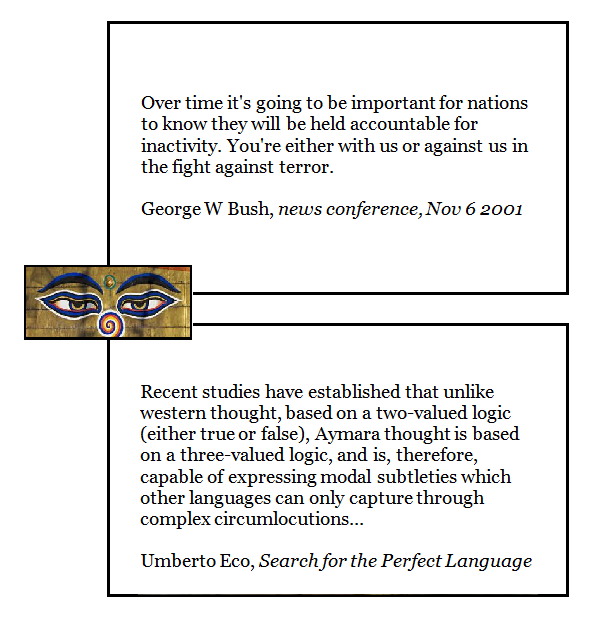
I know, it sounds inherently ridiculous, but what would happen if we thought in threes instead of twos? I mean, we tend to see things in terms of black and white, good and bad. Let’s set up a binary of our own — US President George W Bush vs the Aymara of the Andes and Altiploano:

Two into three won’t go, as they used to say in math class when I was a kid.

Hegel thought otherwise. Hegel thought two needed to move on into three, or we’d be stuck with binaries in stasis for ever. Hegel’s dialectic is about the possibility called three — which opens the otherwise static two up to various kinds of process…

**

We tend to view conflicts in binary terms: “who goes there, friend or foe?” is the challenge I was supposed to offer Mad Mitch the Axe Man if I ran across him as a CCF trainee in the grounds of my old school, Wellington College.

What is conflict is viewed in trinary?

Here is Chris Crawford, from his justly famous 1982 Art of Computer Game Design:

The advantage of asymmetric games lies in the ability to build nontransitive or triangular relationships into the game. Transitivity is a well-defined mathematical property. In the context of games it is best illustrated with the rock-scissors-paper game. Two players play this game; each secretly selects one of the three pieces; they simultaneously announce and compare their choices. If both made the same choice the result is a draw and the game is repeated. If they make different choices, then rock breaks scissors, scissors cut paper, and paper enfolds rock. This relationship, in which each component can defeat one other and can be defeated by one other, is a nontransitive relationship; the fact that rock beats scissors and scissors beat paper does not mean that rock beats paper.

We’re back in play…

**

Here, too, is a bit from m’friend Wm. Benzon, jazz-player, blogger, polymath:

Three against two is one of the most important rhythm ‘cells’ in all of music. What do I mean, three against two? You play three evenly spaced beats in one ‘stream’ in the same period of time you play two evenly spaced beats in another ‘stream.’ It sounds simple enough but, the problem is that three and two do not have a common divisor, making the ‘evenly spaced’ part of the formula a bit tricky. The two patterns coincide on the first beat, but the second and third beats of the three-beat stream happen at different times from the second beat of the two-beat stream. And if you think that’s a lot of verbiage for something that ought to be simple, when then you’re beginning to get the idea.

Noting that the brain has a hard time moving from two to three this way, Benzon quotes old-time piano virtuoso Joseph Hoffman:

In faster motion it is far better to practise at first each hand alone and with somewhat exaggerated accents of each group until the two relative speeds are well established in the mind. Then try to play the two hands together in a sort of semi-automatic way. Frequent correct repetition of the same figure will soon change your semi-automatic state into a a conscious one, and thus train your ear to listen to and control two different rhythms or groupings at the same time.

Those readers already familiar with my insistence on many-voiced (ie polyphonic) listening will quickly grasp that Hoffman is speaking of just that kind of broadening of our mental horizons — of our thinking capacities.

**

I’d like to close part 1 of this two part post within my “Numbers by the numbers” series, with a quote from LtGen Paul Van Riper (USMC Ret.), The Foundation of Strategic Thinking at Infinity Journal:

The United States and its allies need senior civilian officials and military officers who grasp the fundamental nature of systems, are adept at building shared mental models, comprehend the significance of Clausewitz’s paradoxical trinity, understand operational art and can connect strategic thinking with tactical actions through operational design. These are the true competencies of modern defense professionals.

As in conflict, as in Clausewitz, so in conflict resolution: we need to be able to think in trinary — in trinities — and beyond.

More on that — which interested me enough that I once designed a trinary game of my own, played with great splash and delight by three kids in a swimming pool — in the second part of this post.

Game On, Face Off, Onion

Friday, August 24th, 2012

[ By Charles Cameron — with almost no effort & no comment — games, war, realism, Onion ]
.

Modern Warfare 3:

Modern Warfare 3 — Face Off:

The Onion’s Modern Warfare 3:

Pussy Riot VI: counterpoint and counterfactuals

Wednesday, August 22nd, 2012

[ by Charles Cameron — compare and contrast as a means of contextualizing, suggesting a tool that might be of use to the IC in any number of circumstances ]
.

In this particular case, Pussy Riot is the topic, comparison with is the method, and some form of graphic the appropriate medium around which to build a presentation.


.

Both these statements have been made recently by Catholic priests, and they portray opposite positions on the matter. Again, it is my sense that the graphical representation of these remarks calls forth in the reader both similarities and differences, as Cath Styles nicely put it:

A general principle can be distilled from this. Perhaps: In the very moment we identify a similarity between two objects, we recognise their difference. In other words, the process of drawing two things together creates an equal opposite force that draws attention to their natural distance. So the act of seeking resemblance – consistency, or patterns – simultaneously renders visible the inconsistencies, the structures and textures of our social world. And the greater the conceptual distance between the two likened objects, the more interesting the likening – and the greater the understanding to be found.

From my point of view, the direct juxtaposition in a DoubleQuote or equivalent format does the job nicely when two fairly simple quotes are considered together.

Things can get more complex than that when a variety of discourses come together, but the same general principles can still be applied, and a graphical representation sought.

Bearing Cath’s point in mind, then, I’d like to examine some of the ways in which people have contextualized the Pussy Riot event in the Cathedral with counterfactual instances (ie by contrasting it with instances that in some ways parallel the factual instance, but in “what if” style alternate universes.

**

Here, then, are the documents I’ll be drawing on. First, from Khanya, a blog I’ve praised in an earlier post:

An Amnesty International petition site (Take Action Now – Amnesty International USA) urges people to send an email with the following text to the Russian prosecuting authorities:

I respectfully urge you to drop the charges of hooliganism and immediately and unconditionally release Maria Alekhina, Ekaterina Samutsevich and Nadezhda Tolokonnikova. Furthermore, I call on you to immediately and impartially investigate threats received by the family members and lawyers of the three women and, if necessary, ensure their protection. Whether or not the women were involved in the performance in the cathedral, freedom of expression is a human right under Article 19 of the Universal Declaration of Human Rights, and no one should be jailed for the peaceful exercise of this right. Thank you for your attention to this serious matter.

Now imagine, for a moment, that the boot was on the other foot.

Imagine that it was a Western European country, and that the act of “hooliganism” concerned was daubing swastikas on a synagogue. If that were the case, would Amnesty International be urging its members and the general public to send messages saying:

Whether or not the women were involved in writing the graffiti on the synagogue, freedom of expression is a human right under Article 19 of the Universal Declaration of Human Rights, and no one should be jailed for the peaceful exercise of this right. Thank you for your attention to this serious matter.

I think that in Western Europe such a petition would be widely regarded as “hate speech”, and “anti-Semitic”, as would the graffiti. So why does Amnesty International think that it is OK to encourage people to send such things to Russia?

And then, of course, one can put the boot back on the first foot again. If these same three young women had daubed graffiti on a synagogue in Moscow, would they have been prosecuted for the same offence and in the same way as they have been in this case?

So there are differences between Russian culture and Western culture, and differences within Russian and Western culture.

That’s a pretty impressive example of the counterfactual genre — and doubly so, it seems to me, because of the final reversal, the twist in its tail.

**

Next, here’s another quote from the same Fr. Hogan we quoted above. In this case, the mosque is used as the primary contrast to the cathedral, but the synagogue also makes an appearance — and Fr. Hogan throws at least one other interesting contrast into the mix — comparing Putin and western leaders:

Protest is fine, the day will come, I’m sure, and not too far away either I think, when we Christians may be protesting against our governments and engaging in civil disobedience, but protest must always respect others and the faith of others. As some have asked, would these ladies do the same in a mosque? They would not for two reasons – it would not be politically incorrect and they might end up being stoned to death before they had a chance to get out of the building. Is it legitimate to mock faith and descecrate places held sacred by people in order to protest against a political regime?

Some will say these ladies did so because the Orthodox Church is too close to the Russian government. Okay, well Judaism is considered by many to be too close to Zionism and the State of Israel – well, where are the lewd feminists dancing in the synagogues mocking Abraham and Moses? They are not there because they know it is inappropriate and wrong – just as it is inappropriate and wrong to desecrate a place of Christian worship.

What interests me here is that he uses multiple counterfactual contrasts, which perhaps makes his paragraphs a little less elegant than Khanya’s — but interesting in the complexity it adds to his analysis.

I’ll return to that remark about “we Christians may be protesting against our government” later.

**

My last text — and I’ve quoted it here on ZP before — is Josh Shahryar‘s tweet:

I wonder if #PussyRiot would get so much attention if they were a band of men called #DickMob.

That comes at the Pussy Riot issue from a completely different angle, and is very elegantly done.

**

Our next task is to see what oppositions we can find in these three statements.

  • Kanya uses Amnesty’s concerns regarding freedom of expression vs appropriateness of expression by comparing the cathedral incident with women “in a Western European country” daubing swastikas on a synagogue, thus also proposing a comparison between eastern and western European mores.
  • Then, in a reversal, Kanya uses the same cathedral incident vs daubing graffiti on a synagogue specifically in Moscow this time, to explore the degree to which Moscow might be more tolerant of anti-Semitism than of anti-Orthodoxy, both in terms of public opinion and via political and legal systems.
  • Fr Hogan’s question poses a contrast between the cathedral (and Orthodoxy and Putin) and a hypothetical mosque (and Islam and, say, a militant faction in Pakistan).
  • His second comparison is between two church-and-state collaborations, Orthodoxy with the Russian state and Judaism with the Zionist, and again the question he raises is whether similar behavior in a parallel situation would be tolerable.
  • Then there’s his intriguing third comparison, which I said I’d return to, in which he suggests that the “not too far” future may hold the need for civil disobedience and anti-government protests by Christians – in the west presumably. Fr Hogan hails from Ireland, which has had its own share of Church troubles and no longer wields the power it once did over Irish people and politics. Present day Russia, then, contrasted with a hypothetical future Ireland.
  • But the malaise is more widespread, and to add a comparison of my own into the pot, Fr Hogan’s remark reminds me of something Cardinal George of Chicago said not so long ago, looking at the looming battle between an increasingly secular state and his own moral stances on such issues as abortion and same sex marriage:

    I expect to die in bed, my successor will die in prison and his successor will die a martyr in the public square.

  • But that’s oblique to our narrative here…

  • Finally, there’s Josh Shahryar’s contrast between a factual girl band named Pussy Riot and a counterfactual boy band called DickMob.

**

What sort of a graphic would allow us to rotate all these polarities in our minds?

One answer is a Sembl-type game board — see design below — but with concepts rather thyan objects in the “positions” on the board:

But I’m also after other possibilities here. What would our fine artists, engineers, architects, dancers, cartographers, logicians, musicians, data visualizers and computer scientists suggest?

**

It would of course be nice if we could wrap this whole business of counterfactuals with a nice British cuppa tea, eh? Perhaps we can…

From a comment in the Guardian:

With the best will in the world I can’t see that if a bunch of noisy youngsters stood up in Westminster Abbey and screamed obscenities about the Queen to the accompaniment of electric guitars turned up to eleven, that the rest of the world would throw up its hands in horror if they were first stopped and then charged with an offence.

What’s that? We endured the Blitz, for goodness sake!

Pussy Riot V: Kasparov

Tuesday, August 21st, 2012

[ by Charles Cameron — the Garry Kasparov arrest ]
.

It isn’t chess. It isn’t, as we’d say in England, cricket. It besmirches the good name athletes like Arsen Galstyan brought Russia in the London Olympics.

It is Garry Kasparov, arrested for protesting the trial of Pussy Riot.

photo credit: Reuters

.

In yestrdays Wall Street Journal, under the title When Putin’s Thugs Came for Me, Kasparov — Russia’s one-time youngest ever undisputed World Chess Champion — wrote:

The men refused to tell me why I was being arrested and shoved me into a police van. When I got up to again ask why I had been detained, things turned violent. I was restrained, choked and struck several times by a group of officers before being driven to the police station with dozens of other protesters. After several hours I was released, but not before they told me I was being criminally investigated for assaulting a police officer who claimed I had bitten him.

It would be easy to laugh at such a bizarre charge when there are already so many videos and photos of the police assaulting me. But in a country where you can be imprisoned for two years for singing a song, laughter does not come easily. My bruises will heal long before the members of Pussy Riot are free to see their young children again. In the past, Mr. Putin’s critics and enemies have been jailed on a wide variety of spurious criminal charges, from fraud to terrorism.

But now the masks are off. Unlikely as it may be, the three members of a punk band have become our first true political prisoners.

**

If it was chess, here’s what we’d have to call it: a knight hustled into a van by pawns.

Pew II: Prevalence of belief in the Jinn

Monday, August 13th, 2012

[ by Charles Cameron — Corbin on Queen Bilqis, Qur’an and hadith regarding jinn, Pew statistics on belief in jinn — with some earlier Natsec implications & a non-serious suggestion from contemporary physics ]
.

La Jinn the Mystical Genie of the Lamp
from the Yu-Gi-Oh card game

.

I’ve been “fond” of the jinn (djenoun) since first encountering them in the brilliant short stories of Paul Bowles, and notably his A Hundred Camels in the Courtyard.

But that’s a literary fondness, neither science nor belief-based on my part. In my view, that’s only right and proper, since djenoun belong in the realm of imagination — or better said, the Imaginal, as Henry Corbin terms it — see note 16, p, 326. of his Creative Imagination in the Sufism of Ibn ‘Arabi, where he speaks of the Sheikh’s Bilqis Queen of Saba in his poetry as a being “born from a jinn and a woman” — it’s a fascinating passage, connecting Bilqis with Jesus in terms of the (unorthodox) angelology that Corbin envisioned uniting the Abrahamic faiths at a visionary level.

**

Here are two of the mentions of jinn in the Qur’an:

And the Jinn race We had created before from the fire of a scorching wind. [Sura 15, 27]

Say: It has been revealed to me that a company of Jinns listened (to the Qur’an). They say ‘We have really heard a wonderful Recital! It gives guidance to the Right and we have believed therein: We shall not join (in worship) any (gods) with our Lord. And exalted is the Majesty of our Lord: He has taken neither a wife nor a son.’ [Sura 72, 1-3]

And here is a tale of the Prophet and a jinn, as narrated by the Companion Malik ibn Anas:

The Prophet said to the jinni: “This is the stride of a jinni, as well as the tone of his voice!” The jinni replied: “My name is Hamah ibn Laqqis ibn Iblis.” The Prophet said: “Only two generations seperate you from him [Iblis].” He replied: “True.” The Prophet asked: “How long have you lived?” The jinni replied: “Almost all of time. I was a small boy when Abel was killed. I believed in Noah and repented at his hands after I stubbornly refused to submit to his call, until he wept and wept. I am indeed a repentant — God keep me from being among the ignorant! I met the prophet Hud and believed in his call. I met Abraham, and I was with him when he was thrown in the fire. I was with Joseph, too, when his brothers hurled him into the well—I preceded him to its bottom. I met the prophet Shu’ayb, and Moses and Jesus the son of Mary, who told me: ‘If you meet Muhammad, tell him Jesus salutes thee!’ Now I’ve delivered his message to you, and I believe in you.” The Prophet said: “What is your desire, 0 Hamah?” He said: “Moses taught me the Torah, Jesus the Gospels, can you teach me the Qur’an?” So the Prophet taught him the Qur’an.

The Tasneem Project

**

Literal vs metaphorical, let alone imaginal belief is not something the interviewers who conducted the Pew poll had the leisure to distinguish — but for the record, here are their findings as to the Muslim belief in jinns:
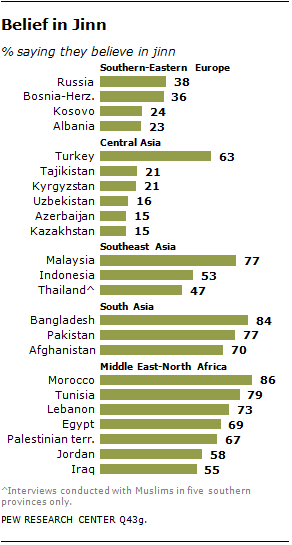
According to the Quran, God created jinn as well as angels and humans. Belief in jinn is relatively widespread – in 13 of 23 countries where the question was asked, more than half of Muslims believe in these supernatural beings.

In the South Asian countries surveyed, at least seven-in-ten Muslims affirm that jinn exist, including 84% in Bangladesh. In Southeast Asia, a similar proportion of Malaysian Muslims (77%) believe in jinn, while fewer in Indonesia (53%) and Thailand (47%) share this belief.

Across the Middle Eastern and North African nations surveyed, belief in jinn ranges from 86% in Morocco to 55% in Iraq.

Overall, Muslims in Central Asia and across Southern and Eastern Europe (Russia and the Balkans) are least likely to say that jinn are real. In Central Asia, Turkey is the only country where a majority (63%) of Muslims believe in jinn. Elsewhere in Central Asia, about a fifth or fewer Muslims accept the existence of jinn. In Southern and Eastern Europe, fewer than four-in-ten in any country surveyed believe in these supernatural beings.

In general, Muslims who pray several times a day are more likely to believe in jinn. For example, in Russia, 62% of those who pray more than once a day say that jinn exist, compared with 24% of those who pray less often. A similar gap also appears in Lebanon (+25 percentage points), Malaysia (+24) and Afghanistan (+21).

The survey also asked if respondents had ever seen jinn. In 21 of the 23 countries where the question was asked, fewer than one-in-ten report having seen jinn, while the proportion is 12% in Bangladesh and 10% in Lebanon.

**

Two markers concerning National Security concerns regarding Pakistan, nuclear weapons and those who believe (literally, energetically) in jinns — from the early 2000s, but dating back by implication to the era of Zia ul-Haq:

Just after the September 2001 terrorist attacks in the U.S., Pakistan’s intelligence service detained two retired nuclear scientists who had met with senior members of al Qaeda, including Mr. bin Laden, during charity work in Afghanistan. One, Sultan Bashiruddin Mahmood, was a former director at the Pakistan Atomic Energy Commission and a controversial Islamic scholar who had postulated that energy could be harnessed from fiery spirits called djinns.

WSJ, Inside Pakistan’s Drive To Guard Its A-Bombs

But as a subscriber to a brand of what is known to practitioners as “Islamic science,” which holds that the Koran is a fount of scientific knowledge, Mr. Bashiruddin Mahmood has published papers concerning djinni, which are described in the Koran as beings made of fire. He has proposed that these entities could be tapped to solve the energy crisis, and he has written on how to understand the mechanics of life after death.

NY Times, Pakistani Atomic Expert, Arrested Last Week, Had Strong Pro-Taliban Views

— together with a Pakistani critique:

If a scientist is European or Hindu he will be restricted in his vision by reason. A Muslim scientist has unlimited scope; he will relate his science to miracles, mostly performed by himself. Sultan Bashiruddin, our top enrichment expert, believed he could draw electricity from a captured jinn. (For Pakistan’s needs just one jinn would suffice.)

Khaled Ahmed, Scientists, our kind

There are times when beliefs have, or might just have, consequences.

**

Jinn are significant not only for their own sakes, so to speak, but also for their etymological implications. To quote again from the Tasneem Project:

One saying of the Prophet (aws) mentions that, “God divided the jinn and the humans into ten parts. One part makes up the human race, and the other nine parts is made up of the jinn.” The invisible is everywhere. The Arabic language itself bears witness to how the invisible realm insinuates itself on everyday life. In Arabic, each time the two letters jeem and nun occur together, as in jinn, they convey the meaning of invisible or hidden. Thus, paradise is jannah because paradise is hidden from the human sight; janin is the foetus in the womb; the expression ajannahu al-layl means the night covered him.

The jinn, like paradise itself, are among the hidden secrets…

**

And how large is the universe, that it might encompass the angels and jinn? Hugh Everett III quite brilliantly argued for what has come to be known as the “many worlds” hypothesis in quantum measurement while still a grad student:

Hugh Everett III was a student in his mid-twenties in 1957 when he presented his revolutionary formulation of quantum mechanics in his PhD thesis. Everett himself called his theory variously; pure wave mechanics, the relative-state formulation of quantum mechanics, and the theory of the universal wave function. His theory, however, came to be popularly known as the many-worlds interpretation, because it predicts that everything that might happen, does in fact happen. As the physicist Bryce DeWitt later described it, Everett’s theory predicts that our universe is composed of countless parallel universes that are each constantly splitting into yet further copies, and in the process, creating copies of each observer, each of which subsequently observes a different quantum universe and splits into further copies.

While a science fiction fan might embrace such a theory simply by dint of how cool it would be if something like that were true, one might naturally wonder what good scientific reason one might have for believing that our universe is in fact composed of countless parallel splitting universes.

**

The whole article from which that quote was taken, The Quantum Measurement Problem and the Everett Interpretation, is indeed worth reading. But whereas physicists and (most) science fiction writers might confine their “many worlds” to physical, “materialist” universes, students of the imaginal are under no such restriction, as the same Tasneem Project article suggests:

The Muslim universe has always been made up of multiple worlds – the Qur’an itself refers to “universes” in the plural, in its open chapter al-fatihah. According to prophetic tradition, the cosmos consists of 18000 universes. …

So the jinn when summoned might come — somewhat unexpectedly — from one of Everett’s more hidden “many worlds”, perhaps?

Switch to our mobile site