zenpundit.com » games

Archive for the ‘games’ Category

Landmines in Paradise Garden

Wednesday, August 8th, 2012

[ by Charles Cameron — pros and cons of an important piece by Scott Atran — who among us can comprehend religion? ]
.

At play (Minesweeper) in the Fields of the Lord (Bosch, Garden of Eden)

.
Scott Atran, the anthropologist who gave us the book Talking to the Enemy, has got it right (as to importance) but wrong (as to procedure) in his latest, significant piece on Foreign Policy, God and the Ivory Tower: What we don’t understand about religion just might kill us.

First, the importance of the issue he’s discussing – understanding religions (emphatically plural, IMO):

Religion molds a nation in which it thrives, sometimes producing solidarity and sacred causes so powerful that citizens are willing to kill or die for a common good (as when Judea’s Jews around the time of Christ persisted in rebellion unto political annihilation in the face of the Roman Empire’s overwhelmingly military might). But religion can also hinder a society’s ability to work out differences with others, especially if those others don’t understand what religion is all about. That’s the mess we find ourselves in today, not only among different groups of Americans in the so-called culture wars, but between secular and Judeo-Christian America and many Muslim countries.

Time and again, countries go to war without understanding the transcendent drives and dreams of adversaries who see a very different world. Yet we needn’t fly blindly into the storm.

Atran is exactly right: we needn’t fly blindly into the storm — but to avoid flying blindly we need to understand those “drives and dreams of adversaries who see a very different world” — and to avoid flying into the storm at all we may (all of us, friends and foes alike) need to understand our own “transcendent drives and dreams” better than we do at present.

The question is, who can help us do that?

That’s what I mean by the procedure — the path that should be taken to achieve that kind of understanding. And note: there are different kinds of understanding — theoretical, imaginative, visceral… dispassionate, empathetic, impassioned…

**

Atran’s answer is science:

Science can help us understand religion and the sacred just as it can help us understand the genome or the structure of the universe. This, in turn, can make policy better informed.

There’s only one problem there. I can believe that scientists of extraordinary breadth and insight – Einstein, Bohr, Oppenheimer, Gell-Mann, Feynman probably – and social scientists — Bateson certainly, Victor Turner, Atran perhaps – my lists are not exhaustive – could make useful suggestions for scientific approaches to the field of religion.

But scientists in general? As Atran notes:

If you look at the prestigious U.S. National Academy of Sciences or Britain’s Royal Society, well over 90 percent of members are non-religious. That may help explain why some of the bestselling books by scientists about religion aren’t about the science of religion as much as the reasons that it’s no longer necessary to believe.

Non-believers may “get” what’s dangerous about religions, but they almost certainly won’t “get” what’s marvelous and inspiring about them.

And believers are no better – they may get what’s great about their own tradition, but still see nothing but perdition in the traditions of others…

So to get a decent set of insights worth experimenting with — or modeling, for that matter — requires a blend of subtle thinkers to include some social anthropologists, some scholars of comparative religion, some sociologists with fine-tuned statistical skills, some depth psychologists… believers, skeptics, atheists and agnostics… with a whole wild variety of plumages, specialties and interests.

Yes, and some poets, historians, some hard scientists. Yes.

**

How easy is it to get things wrong?

In his paper Reframing Sacred Values [link is to .pdf] written with Robert Axelrod — the political scientist whose contest for winning strategies for the iterated Prisoner’s Dilemma game put “tit for tat” and agent based modeling on the map in his books The Evolution of Cooperation and The Complexity of Cooperation — Atran speaks of “Rational versus Devoted Actors“.

The distinction is a significant one. And the paper itself is important because, as Atran and Axelrod suggest:

Counterintuitively, understanding an opponent’s sacred values, we believe, offers surprising opportunities for breakthroughs to peace. Because of the emotional unwillingness of those in conflict situations to negotiate sacred values, conventional wisdom suggests that negotiators should either leave sacred values for last in political negotiations or should try to bypass them with sufficient material incentives. Our empirical findings and historical analysis suggest that conventional wisdom is wrong. In fact, offering to provide material benefits in exchange for giving up a sacred value actually makes settlement more difficult because people see the offering as an insult rather than a compromise. But we also found that making symbolic concessions of no apparent material benefit might open the way to resolving seemingly irresolvable conflicts.

But who is to say which actors are “devoted”?

The most devoted may be the one who stands in most need of redemption, the one who has sinned the most, not the one who has been the most pious. Let me put that another way: the most devoted may be the drunken reveler rather than the regular church- or mosque-goer.

**

Consider:

Inigo was a courtier, a conquistador, a musketeer. The commandments were of course unquestionable in theory, but practice was entirely another matter. Church was for times of danger or for celebration of victory, and he never prayed so hard to our Lady as before a duel. In his last years when he had no need to be boastful, he was quoted by his secretary- biographer: “Though he was attached to the faith, he lived no way in conformity with it and did not avoid sin. Rather, he was much addicted to gambling and dissolute in his dealings with women, contentious and keen about using his sword.”

Inigo found plenty of trouble…

A scientist might not think such a person a reliable example of religious fervor. An antagonist of religion might think it illustrates the flaws of religion perfectly.

The passage in question comes from a life of St. Ignatius of Loyola, founder of the Jesuits.

Religion is a subtle matter. We may think it a matter of belief, but it may be a matter of behavior – orthopraxy vs orthodoxy is the distinction the folks in religious studies make — or of visionary experience.

It may “take one to know one” – as Thomas Merton, the Catholic contemplative understood the Buddhist contemplatives he met. But then he was open to the possibility that others might have intuitions not dissimilar to those he himself had had. “I’m deeply impregnated with Sufism,” he once wrote — Sufism being the mystical strand in Islam. Indeed, I received a letter from him myself while still a student at Oxford, in which he wrote of his life in the Abbey of Gethsemani, “here you get beaten for being a dervish. I am bruised for this all day long.”

**

But again, one can be blinded by one’s own faith to the merits of the faiths of others. And this is also a subtle business.

Retired US Gen. Jerry Boykin, for instance, said in April last year (link is to YouTube video):

Sharia law is a very serious threat in America. We are being invaded by a group of people who see it as their absolute imperative to establish a legal system in America which will in fact destroy our Constitution to be replaced by this thing called Sharia law.

One wonders what Boykin might make of the late California Presbyterian teacher, RJ Rushdoony — a figure, I’m guessing, far to the General’s right?

As is widely known, the New Testament contains a “Great Commission” which Christ gave to his apostles after his Resurrection:

Then Jesus came to them and said, “All authority in heaven and on earth has been given to me. Therefore go and make disciples of all nations, baptizing them in the name of the Father and of the Son and of the Holy Spirit, and teaching them to obey everything I have commanded you. And surely I am with you always, to the very end of the age.” — Matthew 28:18-20.

Rushdoony, in his master work The Institutes of Biblical Law, makes it clear that in his views, this constitutes a divine mandate to bring Biblical law into effect in all nations: “The fulfillment of that covenant is their great commission: to subdue all things and all nations to Christ and His law-word” (Institutes, p. 14) and this is to be achieved in terms of a single world order, “The goal is the developed Kingdom of God, the New Jerusalem, a world order under God’s law” (Institutes, p. 357).

Sadly, the church no longer recognizes the full implications of the Great Commission, and has fallen into a heresy that is political in nature: “The church today has fallen prey to the heresy of democracy” (Institutes, p. 747). In truth, the laws of a democratic society will need to be replaced by the laws of God as set forth in the Old Testament: “While all Scripture is God’s law word, the heart of that law is the law of Moses” (Institutes, p. 675).

Here’s where it gets trickier, though:

Slavery, too, will need to be reinstituted: “The (Biblical) Law here is humane and also unsentimental. It recognizes that some people are by nature slaves and will always be so. It both requires that they be dealt with in a godly manner and also that the slave recognizes his position and accepts it with grace” (Institutes, p. 251).

**

This thing called “religion” is difficult to pin down. It has extremes that appear unconscionable even to many who claim devotion to the same scriptures as do the extremists. It features violence, peace, apocalypse as destruction and apocalypse as fresh creation.

Atran is an anthropologist – he surely knows this.

The study of religion involves walking through a minefield — in the gardens of Paradise…

The Olympic Truce

Sunday, July 29th, 2012

[ by Charles Cameron — the Truce, great gospel music, and athletes in ads in slomo — a personal view ]
.


.

If there are two things about the Olympics I like, they would be the Olympic Truce, and athletes in slow motion.

Here’s what the IOC’s site has to say about the Truce:

The tradition of the “Truce” or “Ekecheiria” was established in ancient Greece in the 9th century BC by the signature of a treaty between three kings. During the Truce period, the athletes, artists and their families, as well as ordinary pilgrims, could travel in total safety to participate in or attend the Olympic Games and return afterwards to their respective countries

and it’s relevance today:

Taking into account the global context in which sport and the Olympic Games exist, the International Olympic Committee (IOC) decided to revive the ancient concept of the Olympic Truce with the view to protecting, as far as possible, the interests of the athletes and sport in general, and to encourage searching for peaceful and diplomatic solutions to the conflicts around the world.

Through this global and symbolic concept, the IOC aims to :

  • mobilise youth for the promotion of the Olympic ideals;
  • use sport to establish contacts between communities in conflict; and
  • offer humanitarian support in countries at war ; and more generally :
  • to create a window of opportunities for dialogue and reconciliation.

**

To be honest, I don’t care in the least what human runs fastest or jumps highest, and if I did I wouldn’t have a huge investment in what territory he or she comes from or lives in.

The Games are the Games though, they affect people’s lives, and are affected by them. I have, here in my room, a copy of the official book of the 1936 Games which I picked up in a swap meet for a dollar or two:

American Olympic Committee Report, 1936, Games of the XIth Olympiad, Berlin

Somewhere, also, I have the official English playbook for the 1934 Oberammergau Passion Play — two stark reminders of how we are sometimes suborned from the better angels of our nature by the worse…

If I have a minute of silence, then, it is for the Israeli athletes killed at the 1972 Munich Games.

**

breath,
breath

**

Again, corporate sponsorships, banking industries and advertising are not generally among my favored interests, but slow motion is — and while I care little for the athletic record-setting and patriotic rivalrous sides of the Olympics, great athletes are often beautiful, something the Greek sculptors understood, and slomo can capture that beauty for us.

Besides, I have always been a fan of Morgan Freeman, ever since I heard him play the role of the Preacher opposite Clarence Fountain in Gospel at Colonus — undoubtedly the most joyous theatrical experience of my life…

Here to give you a taste is Freeman’s opening sermon:

and perhaps the most audacious musical moment of all, the great battle of the bands as Oedipus attempts to enter Colonus:

**

breath,
breath

**

Here, then, are three VISA ads for the Games this year, accompanied by that unmistakable Freeman voice, and offered here for the beauty, sheer joy and creative excellence they present.

First, the audience speaking to the heart of the athlete — itself a remarkable insight:

Second, the way running itself runs like a thread through the life of Lopez Lomong:

And third, the difference a hundredth of a second makes — and again, the roar of the crowd:

That last clip has Morgan Freeman saying:

A hundredth of a second – it’s faster than the blink of an eye, faster than a flash of lightning – and it was the difference between Michael Phelps winning eight gold medals instead of seven – a hundredth of a second – just think of the cheers if lightning strikes twice!

I know — that’s the speed thing, not the beauty thing. And I’m an ideas man — an aesthetic man, not an athletic man.

So I take my long jumps sideways, in the mind…

**

Wikipedia tells us:

US National Park Ranger Roy Sullivan has the record for being struck by lightning the most times. Sullivan was struck seven times during his 35-year career. He lost the nail on one of his big toes, and suffered multiple injuries to the rest of his body

Again I think of the poet Randall Jarrell, whom I quoted here not so long ago as saying:

A good poet is someone who manages, in a lifetime of standing out in thunderstorms, to be struck by lightning five or six times; a dozen or two dozen times and he is great.

Only the Muse knows what damage that does to the poet’s mind.

**

breath,
breath

**

To sum up:

If I were God — and friends, that’s not in nay way a risk we need to concern ourselves about, flat out impossible — I would be watching the Olympics in slomo from a dozen angles simultaneously, without commentators.

And I’d be praying everyone world-wide would take the Truce as seriously as the Games.

When they say it’s a game-changer…

Thursday, July 26th, 2012

[ by Charles Cameron — are they talking about shooting for a goal, hitting your target, making a move — or lofting one up the fairway? ]
.

As you may have gathered, I really love that quote from the philosopher MacIntyre. Here we go again:

Image courtesy of my friend Oink, aka Peter Feltham. It seems like gameplay gets more risky by the hour…

Look, I’m sorry to be so blunt — I: modeling ideas

Thursday, July 19th, 2012

[ by Charles Cameron — a stray thought, endlessly ricocheting — with a friendly wink to @khanserai ]
.

chessboard by Ji Lee

.
Back in 2006 the US National Strategy for Combating Terrorism suggested:

In the long run, winning the War on Terror means winning the battle of ideas. Ideas can transform the embittered and disillusioned either into murderers willing to kill innocents, or into free peoples living harmoniously in a diverse society.

So. More than five years have passed.

Look, I’m sorry to be so blunt… but how good are we now at modeling, simulating and / or gaming ideas?

Numbers by the numbers: four

Wednesday, July 18th, 2012

[ by Charles Cameron — importance of the ratio form (“this is to that as thus is to so”) as a bridge between domains and silos, creative leaps, the glass bead game, and finally, Chittick’s joke about camels, sex and translations from the Arabic ]
.

.

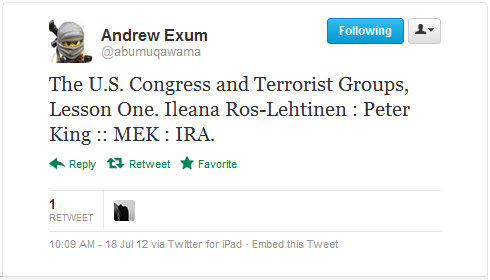
I retweeted this tweet of Andrew Exum‘s to my friend Paul Pilkington because I know he’s working on a project to find out what “this is to that” is to some other “this is to that” — across a wide swathe of human culture.

Note particularly that Exum is using this formal device to illuminate, to give insight, in an area of importance to analysts, strategic thinkers and decision makers.

I’m also retweeting Exum to Paul because I believe Paul’s simple experiment, based as it is on his reading of Hermann Hesse‘s Glass Bead Game, has the capacity to build an architecture of thought (a) crossing all disciplines and (b) spanning the trivial with the profound.

I’m doing something similar with Cath Styles in our Sembl games project — but this time I want to concentrate on Paul’s approach, and since there are four moving parts in an a is to be as c is to d configuration, I’m calling this post Numbers by the numbers: four — number three will just have to wait a while.

**

To get a sense of what Paul is up to, we can go to his Twitter Project page, which describes the fourth in a series of books he’s writing — and also follow him on Twitter, where he posts as Just Knecht.

Two of Paul’s recent tweets express his sense of the task pretty incisively:

The whole of language is the holding up of one unlike thing to compare, contrast and connect with another

Curating is a matter juxtaposition of work against work, artist against artist, place against place – A.Searle on Documenta 13, The Guardian

On his Twitter Project Page, he tells us:

Each tweet is an individual Glass Bead Game move, which is a comparison (metaphor, simile or analogy) across different areas, and may be either a statement or a question.

In question form, these are not unlike analogy questions from SAT tests with an additional dimension of general knowledge, cultural invention and intellectual playfulness. The basic challenge is to work out the relationship between two terms in one context, and apply it in another. Sometimes a tweet will extend an analogy further, which would be the beginning of forming a larger game from an individual move.

Some of the most interesting moves do not have right or wrong answers. Some have canonical or original answers, but they’re not necessarily right. In fact, very often I will post something I’ve picked up from elsewhere which I would love to see improved on, challenged, or at least better explained by others.

He then poses some of the sorts of questions that intrigue him:

Who is the J.H.Prynne of contemporary dance? Like Prynne in contemporary poetry they need to have been ‘out there’ right at the edge of theory and practice for some time, and also deeply steeped in tradition at the same time. Merce Cunningham? Suggestions welcome … And Heston Blumethal or Ferran Adrià might be the Prynne of cookery. But what about the Prynne of contemporary warfare?

What is the equivalent of sonata form in architecture? Goethe and Hegel both said ‘architecture is frozen music’ but neither really explained what they meant. If it is, then is there an architectural equivalent in Western architecture of the key structural form in Western art music? Suggestions welcome …

So, Zenpundit readers — who is the JH Prynne of contemporary warfare?

**

Not so long ago, in Numbers by the numbers: one, I posted a series of self-referential tweets that I’d collected over the last month or two — here I’d like to present some of Paul’s recent tweets:

Let’s start with one that’s a foreign policy insight, arguably as significant to day as it was when Vance first said it:

16 Jul @justknecht
“The Strait of Hormuz is the jugular vein of the West” (Cyrus Vance)

If these tweets can be timeless, they can also be timely:

4 Jul @justknecht
The Higgs boson is the quantum of the Higgs field, just as the photon is the quantum of the electromagnetic field

As they accumulate over time, they can build a conceptual “mesh” that engages an entire field — in this case, recent classical music — while linking it to a variety of other areas:

16 Jul @justknecht
“Boulez’ Derive 2 sounds like birthday cakes ought to” – Philip Clark, Gramophone

22 Jun @justknecht
Wagner was a beautiful sunset that was mistaken for a dawn – Claude Debussy, quoted by Geoffrey Norris in Gramophone

30 May @justknecht
Fauré’s Theme and Variations (no. 9) is like an evening star falling slowly from the sky – Bryce Morrison cites Alfred Cortot in Gramophone

11 May @justknecht
Kraftwerk is the Warhol of pop music – The New Yorker

There’s profundity here:

9 Jun @justknecht
“Space is to place as eternity is to time.” – Joseph Joubert

This could be, as Paul says, “the beginning of forming a larger game from an individual move” — that quote in itself could plausibly be the keystone of an architecture bridging science with religion…

There are historical parallels to consider:

31 May @justknecht
Robert Burton : Oxford :: Jeremy Prynne :: Cambridge

Catty remarks by Nobel laureates:

21 May @justknecht
“Thinking is to humans as swimming is to cats” (Nobel laureate Daniel Kahneman)

Near-tautologies:

21 May @justknecht
Macon Telegraph: Recipes are to food as blueprints are to buildings.

And, ooh, exotic forms of slander!

18 May @justknecht
“[Your daughter] has lovers as numerous as the striking of tablas on Palm Sunday” – Arabic satire by Abu Nawas, 756 – 813 AD

Once again, it’s form that generates insight, not content. Get used to form, play around with it, and content will leap out at you from the page, from the screen.

**

I’m no Arabist myself, but ah! that last quote reminds me irresistibly of the difficulties faced by translators from the Arabic, as recounted by William Chittick in The Self-disclosure of God: Principles of Ibn Al-‘Arabi’s Cosmology (SUNY Press, 1998, pp. xxxv-xxvi.)

An old joke among orientalists tells us that every Arabic word has four meanings: It means what it means, then it means the opposite of what it means, then it has something to do with sex, and finally it designates something to do with a camel …. The rational mind tends to push the meaning of a word away from experience to ‘what it means’ but the imaginal mind finds the self-disclosure of the Real in the sex and the camel … it is in the world’s concrete realities that God is found, not in its abstractions.

I’d been looking for an excuse to post that quote on Zenpundit — now I’ve found it!


Switch to our mobile site