zenpundit.com » Religion

Archive for the ‘Religion’ Category

The Said Symphony: move 19

Sunday, March 18th, 2012

[ by Charles Cameron – extended analytic game on Israeli-Palestinian conflict — for those who wish to catch up, our game thus far consists of an intro to the game and game board, followed by moves 1-5, 6-9, then moves 10-11 which together constitute a meditation, moves 12, 13-15, 16-17, and most recently before this, move 18 with cadenza ]

Move 19: The view from above

Move content:

Discussing strategy, the very canny LTG (USMC, Ret’d.) Paul Van Riper had this to say:

What we tend to do is look toward the enemy. We’re only looking one way: from us to them. But the good commanders take two other views. They mentally move forward and look back to themselves. They look from the enemy back to the friendly, and they try to imagine how the enemy might attack them. The third is to get a bird’s-eye view, a top-down view, where you take the whole scene in. The amateur looks one way; the professional looks at least three different ways.

A bird’s-eye view, a hawk’s eye view, a top-down view, an overview, a view from 30,000 feet, a God’s eye view, a view from above, a zoom…

If move 18 and its cadenza gave us a view of the depth of vision or insight that is necessary for a full and rich understanding of the world we live in — its qualitative or spiritual scope, if you like — this next move, with its picnic and drone-sight, addresses its breadth in space and time — materially and quantitatively speaking.

The classic expression of the sheer material scope of the universe was put together by Charles and Ray Eames in their justly celebrated film, Powers of Ten, from which the lower of these two images is drawn:

Here are some other relevant scans of the scope of things, in terms of time and space:

The Scale of the Universe 2
A Brief History of The Universe
The Known Universe
A Time-Lapse Map of Every Nuclear Explosion Since 1945

These are impressive videos to be sure, but as an aside I’ll invite you to ask yourselves how well they compare with this zoom in words, a poem by the zennist, ecologist, essayist and poet Gary Snyder, from his book, Axe Handles: Poems:
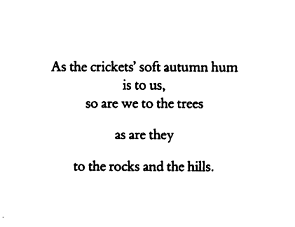
Such breadth of vision, such craft.

*

If this “material scope of things” too has a cadenza, it would be that all of this is shot through with some primary oppositions, dappled as the poet Gerard Manley Hopkins would have it, with swift, slow; sweet, sour; adazzle, dim — as indicated in the drone-sight and picnic double image at the head of this move.

This dappling, this constant flux of opposites, takes many forms — day and night lead to the more abstract light and dark, which can then be interpreted morally as good and evil, to which we respond with repulsion and attraction as the case may be, building our worldviews from love or fear…

At different scales the opposites that matter most to us may have different names and shadings, but here I’d just like to draw attention to the dappling of our world with:

competition and cooperation
Darwin‘s natural selection and Kropotkin‘s mutual aid
duel and duet (ah! — a favorite phrasing of mine)
war and peace

Provocatively, we find this dappling in scriptures, too, wherein the ripples of such verses as “The LORD is a man of war: the LORD is his name” (Exodus 15.3) dropped like a stone into the pond of the human mind, meet with the ripples of other verses such as “God is love; and he that dwelleth in love dwelleth in God, and God in him” (I John 4.16).

There are times when we take such oppositions literally, perhaps too literally, and times when we begin to see oppositions as abstract and theoretical end-points to what is in fact a yin-yang process continually unfolding…

Which brings me by a commodius vicus of recirculation to this image of the great opposition between war and peace, its dappling, its unfolding:

Links claimed:

To the Lamb, move 18: this move presents the material scope of the universe in counterpoint to its visionary scope as laid out in move 18 with its cadenza.

To Revelation, move 17 — the word revelation means unveiling, as we have seen, and our sciences and technologies, with their spectra of telescopes, microscopes, cameras and zooms, are unveiling and revealing to us much about the physicality of the world we live in — much that was accounted for in other times and places through intuition, vision and poetry.

This scientific and technical revelation of material existence, for many of us moderns, has largely eclipsed the mode of visionary revelation of move 17 — yet it cannot eradicate it. Implicit in this move, then, is the sense that we carry with us both subjective and objective, inner and outer, qualitative and quantitative understandings — though the data that “sight” and “insight” provide us with may be different in kind, and resolving them may be something of a koan to us, the deep problem in consciousness as philosophers of science have named it — and that we can discount neither one if we are to have and maintain a rich sense of our situation.

Comment:

If the two previous moves have shown us the scope of the universe we co-inhabit, perhaps we should now make our own zoom in, much as James Joyce did when he had the schoolboy Stephen inscribe his name and address in his geography book as Stephen Dedalus, Class of Elements, Clongowes Wood College, Sallins, County Kildare, Ireland, Europe, The World, Universe – an address that Stephen then read both forwards and backwards, finding himself in one direction, and finding in the other that he had no means of knowing what might lie beyond the universe…

Imagine then, skipping rapidly from (unimaginable) cosmos via such things as the intriguingly named End of Greatness to galaxy or nebula…

…solar system and planet — whence we can slow down and zero gently in on the Middle (or as my friend Ralph Birnbaum would call it, the Muddle) East, Israel / Palestine, Jerusalem / Al Quds / the Temple Mount / Noble Sanctuary – and to such matters of contemplative vision and tribal passion as the first, second and projected third Temples, the al-Aqsa mosque.

Our increasing focus will bring us, then, to that the rock which Jews believe marks the place where Abraham bound his son Isaac (the Akedah), and which Muslims believe to be the place of ascent of the Prophet to the celestial realms (the Mi’raj) on his Night Journey (Qur’an, Al-Isra).

Here again myth and history collide, and both visionary and material considerations merge in the heart of the what my friend the Israeli journalist Gershom Gorenberg has justly called “the most contested piece of real estate on earth”.
Quite the contrast

Tuesday, March 13th, 2012

[ by Charles Cameron — the Joseph Kony rumpus, and Robert Fowler on the religious zealotry of AQIM ]
.

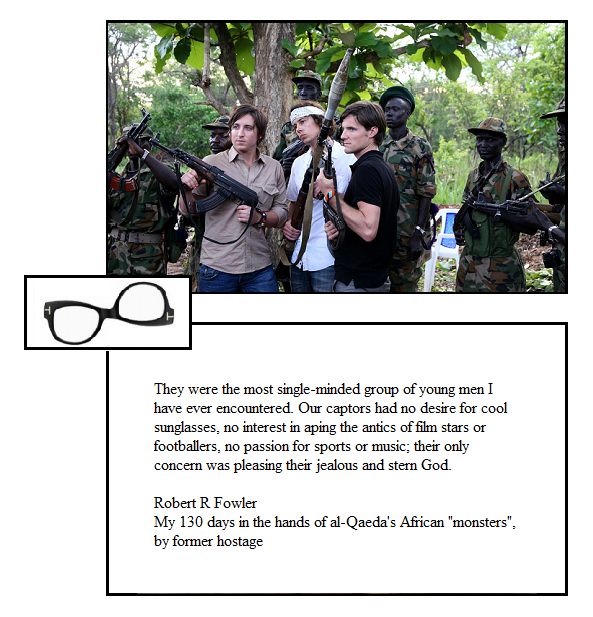
Above:

In the Glenna Gordon photo above the text is Jason Russell, the film-maker who put together the Joseph Kony 2012 campaign, who says of himself:

I am a rebel soul: dream evangelist. I am obsessed with people. I tell stories by making inspiring movies that move people’s emotions, and then I take those emotions and transform them into action. My middle name is Radical. I married my best friend.

— radical, yeah, and looking “tough” — or as one commentator on the Visible Children tumblr said, “posing”:

Here’s a photo of the founders of Invisible Children posing with weapons and personnel of the Sudan People’s Liberation Army. Both the Ugandan army and Sudan People’s Liberation Army are riddled with accusations of rape and looting, but Invisible Children defends them, arguing that the Ugandan army is “better equipped than that of any of the other affected countries”, although Kony is no longer active in Uganda and hasn’t been since 2006 by their own admission. These books each refer to the rape and sexual assault that are perennial issues with the UPDF, the military group Invisible Children is defending.

Below:

By way of contrast: the text below the photo is culled from Robert R Fowler‘s searing account of his al-Qaeda in the Islamic Maghreb (AQIM, but please don’t call it AA-kem) captors. As he also said:

Kidnappings of Westerners have fueled debate among securocrats as to whether our AQIM captors might simply bandits flying an Islamic flag of convenience. I know that to be the wrong answer. Our kidnappers were utterly focused religious zealots who believed absolutely in their cause. They sought to expel Western infidels from Muslim lands and to destroy what they saw as apostate Western-stooge governments who were usurping God’s purposes across the Muslim world. The concepts and ideals we hold most dear were anathema to them: liberty, freedom, justice, democracy, human rights, equality between the sexes — all matters which they considered to be the exclusive province of Allah.

Yes, that contains the popular idea that “they hate us for our freedoms” — but in the context of what I can only call ruthless religious idealism.

Fowler is very clear on that. And no posing.

Sounds like Fowler’s book, A Season in Hell, goes right onto the anti-library lists.

Relics, sports memorabilia and other collectibles

Tuesday, March 13th, 2012

[ by Charles Cameron — addendum to an earlier post ]
.

Blog-friend Michael Robinson pointed me towards some interesting materials today that are relevant to my earlier post Of dust and breath, and I’m drawing here on his various emails to present them to you.

Each of these stories has more details than can be mentioned here: in each case, the link will take you to further riches.

1.

As Michael points out, “The ‘celebrity memorabilia,’ ‘sports memorabilia’ market — and also the ‘film memorabilia’ stuff is completely analogous to relics” featuring “individual players ‘worn’ unwashed game shirts or ‘Gone With The Wind Dresses’ and the like”.

His reference here for further reading is to Tim Munby‘s Cult of the Autograph Letter in England (1962), which “traces the rise of these sentimental phenomena in what after all was a Protestant Culture”. Michael notes, “if memory serves I think it simultaneous to the beginnings of Methodism, though from memory Munby draws no parallels”.

2.

Moving on to religious collectibles (assuming for a moment that sports memorabilia don’t qualify, not a necessary assumption), he points us to an article in the Toledo Blade today titled Ex-Toledoan sleuths out biblical relics for collectors, which discusses Scott Carroll‘s work in putting together the Green Collection, selections from which are currently on display at the Vatican:

Former Toledoan Scott Carroll doesn’t break into dusty tombs or dodge poisoned arrows, but the charismatic professor’s globe-trotting adventures in amassing the world’s largest private collection of rare biblical texts and artifacts have earned him the reputation of “the Indiana Jones of biblical archaeology.”

Mr. Carroll … has purchased nearly 50,000 ancient biblical papyri, texts, and artifacts since November, 2009, for the Green Collection, funded by Steve Green and the Green family. The Oklahoma City-based owners of 499 Hobby Lobby retail stores in 41 states, the Greens have been bankrolling Mr. Carroll’s collecting with the ultimate goal of having the items displayed in a nonsectarian Bible museum.

“I tell the Greens that I trust them to know where to put a store, and they need to trust me to stock the shelves,” Mr. Carroll said in a telephone interview he gave The Blade from Rome, where the Green Collection this month opened an exhibit at the Vatican called Verbum Domini, or Word of the Lord. The exhibit, which is free and open to the public, features 152 artifacts displayed contextually in settings ranging from re-creations of the Qumran caves where the Dead Sea Scrolls were discovered to a monastic scriptorium and an excavation of a Roman garbage city in Egypt.

I liked this passage, too…

Mr. Carroll said he has to laugh at opening an exhibit in Vatican City, seat of the global Roman Catholic Church, when he thinks of his childhood run-ins with the church.

“It’s kind of ironic because I was suspended and expelled from several Toledo Catholic schools in my upbringing,” he said. One of the expulsions, he added, was for setting fire to a church when he was in grade school.

“I chuckled at length talking to cardinals about my expulsions,” he said. “I was an athlete and rather rambunctious as a child — and that is putting it mildly. I was too active, not very self-disciplined, and ran into trouble.”

Reminiscing about one’s setting a church on fire as a youth sounds like an intriguing was of breaking the ice with their Eminences.

3.

Michael also drew my attention to this account of Rabbi Menachem Youlus [depicted above], “a self-described ‘Jewish Indiana Jones'” according to the New York Times – Indiana lookalikes seem to be cropping up all over! – who for years “told stories of traveling to Eastern Europe and beyond to search for historic Torahs that were lost or hidden during the Holocaust” but recently admitted he had lied (NYT, Rabbi Admits Torah Tales Were a Fraud, February 2):

“Between 2004 and 2010, I falsely represented that I had personally obtained vintage Torah scrolls — in particular ways, in particular locations — in Europe and Israel,” he told Judge Colleen McMahon of Federal District Court. “I know what I did was wrong, and I deeply regret my conduct.”

4.

Finally, from the world of Islamic art, Michael brings us another tale of collectors and their sometimes disreputable practices — this time from The Economist and having to do with the 16th-century illuminated version of Ferdowsi‘s epic Shahnameh, with its “lyrical calligraphy on gold-spattered pages” and “258 painted miniatures”, purchased at auction and “broken up” [as also depicted] – to the horror of collectors and bibliophiles – by Arthur Houghton :

In 1976 Houghton auctioned seven of its paintings at Christie’s for £863,500 ($1.6m): nearly four times more than the $450,000 he had paid for the whole book. He gave 78 pages to the Metropolitan where he was chairman of the trustees. When he died in 1990, 120 pages remained in the manuscript. These went back to Iran in 1994 in a swap for “Woman III” by Willem de Kooning, an abstract expressionist painter. Each side of the swap was valued at $20m.

5.

Hypothesis: all collectibles are talismans, all talismans are sacred.

****

Further addendum:

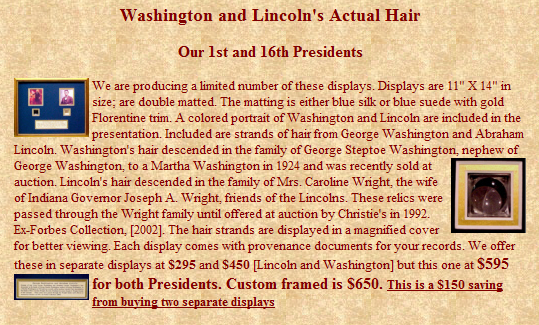
I’d intended to post this as a comment, but the comment function seems to be off — will try to fix that — but Michael’s most recent post to me included a pointer to a still current offer of a highly-collectible Americana twosome:

Available for order today from The Historical Shop, Metairie, LA

ADDENDUM:

Zen here – dealing with an internal server error as it relates to comments and pings on Charles’ post. Unable to turn comments back on at the present time – only this post seems to be encountering problems. Trying to fix.

ADDENDUM to the ADDENDUM:

Comments are now open.


A fatwa on the disposal of the Qur’an by fire

Saturday, March 10th, 2012

[ by Charles Cameron — fire, respect, or local fury? a meld of motives ]
.

Yesterday my friend and colleague Dr Tim Furnish posted a piece on the permissibility of Qur’an burning on PJ Media under the title Burning Defaced Korans: Islam-Approved. My own experience of Islam is colored by almost fifty years of exposure to the Sufi poets (I corresponded with Thomas Merton about “dervish” spirituality in 1964, see Merton’s Road to Joy: The Letters Of Thomas Merton To New And Old Friends, p. 333), so my emphasis in these matters differs somewhat from that of Dr Furnish, but I wanted in particular to thank him for pointing us all to the fatwa issued by the Permanent Committee of Research & Islaamic Rulings Of the Kingdom of Saudi Arabia, which informs us, among other things, that:

It has been confirmed in Saheeh al Bukhaaree in the chapter entitled, “The Collection of The Qur’an”, that ‘Uthmaan Bin ‘Afaan (radi Allahu ‘anhu) ordered four of the good and righteous reciters from the Sahaabah to transcribe copies of the Qur’an from the Mushaf which was gathered by the command of Abu Bakr (radi Allahu ‘anhu). When they completed this task, ‘Uthmaan sent out copies of these Qur’ans to every region. Then he ordered that all other pages and copies of the Qur’an be burnt.

The Director of Religious Affairs of the Islamic Center of Southern California, Imam Jihad Turk, similarly remarked in an NPR interview last September (again, h/t to Dr Furnish for the pointer):

The Qur’an as an idea is something that is in the hearts and the minds of the believers and followers of Islam. It’s not the actual text. It’s not the piece of paper. Muslims don’t worship the text of the Qur’an or destroy the Qur’an.

Although it’s not sacred or something that’s worshiped, it is considered the representation of the sacred word of God, and given that it’s a representation of it, a Muslim would want to make sure that it’s treated respectfully.

When Muslims want to respectfully dispose of a text of the Qur’an that is no longer usable, we will burn it. So if someone, for example, in their own private collection or library had a text of the Qur’an that was damaged or that was in disrepair, so the binding was ruined, etc., or it got torn, they might bring it by to the Islamic Center and ask that someone here dispose of it properly if they were unsure how to do that. And what I’ll do is I’ll take it to my fireplace at home and burn it there in the fireplace. So I sort of take the pages out and then burn it to make sure that it gets thoroughly charred and is no longer recognizable as script.

In the Islamic tradition, it’s the Arabic that is really considered the authentic, original scripture. The very early scripture of the Qur’an—when it was first collated and put into a binding there were a lot of loose papers around, and this was about 1,400 years ago. The first companions of Muhammad, led under the leadership of the third caliph, Uthman, actually instructed the followers to take all of those pages and burn them, and so that kind of set the precedent as to what should be done. If you burn it, it destroys the word, the ink on the paper. It’s no longer perceptible, and so therefore it is no longer scripture. It’s just ashes at that point.

Taking those two comments together, it would appear that it’s not fire so much as respect that’s at issue, theologically speaking. Not that the folks rioting in Afghanistan were necessarily rioting theologically.

And in today’s Afghanistan, it also stands to reason that there are other factors in play…

*

In my own response to Dr Furnish, I quoted Dr. Abdalqadir as-Sufi, who wrote:

We have news for the poor creature. He cannot burn the Qur’an. It is impossible. The Qur’an is the uncreated word of Allah. When a Muslim asks another Muslim to hand it to him he does not say, “give me the Qur’an” but rather “give me the Mus-haf.” That is to say , “give me the copy.”

[ … ] The Qur’an is the uncreated word of Allah. That is why it is unassailable. Of course, we treat the Copy with respect. However this unbalanced peasant preacher, in copying Mao and The Red Guards simply displays his ignorance. “Allah uses the enemies of the Deen to advance the Deen.”

When word came to a remote Muslim village in China that Mao’s Revolutionary Guards were coming to burn their Mus-hafs, the Imam assembled all the children and began to teach them to recite the Qur’an. When the Guards finally arrived they were met by smiling villagers in front of a pile of Copies. As the Guards set fire to the books the sounds of a hundred children came from the Mosque reciting the blessed words of the Qur’an.

The subtleties are always more interesting than the barbarities — which is why a scholarly approach to such enthusiastically contested issues is so important.

*

FWIW, I’ve come at this topic before, and found myself in some neat conversations — see Burning scriptures and human lives, also Of Quantity and Quality I: weighing man against book, and more recently On fire: issues in theology and politics – ii.

In the shadow of the sacred

Saturday, March 10th, 2012

[ by Charles Cameron — international theft and collection of sacred objects, icons, relics ]


image credit: © Chriusha / CC-BY-SA-3.0

The other day I posted an image of the stolen heart of St Laurence O’Toole – and today’s Irish Independent [h/t Michael Robinson] carried a story headlined ‘Relic hunter’ may be behind theft of heart:

Church officials now fear a “relic hunter” may be behind the theft of the heart of St Laurence O’Toole from Christ Church Cathedral last weekend.

And there are suggestions the same person may be responsible for last year’s theft of the True Cross from the Holy Cross Abbey in Co Tipperary as well as the attempted theft of a relic of St Brigid from a church in Dublin.

A relic hunter!

*

I thought I ought to look into this a bit deeper, and what I found probably shouldn’t have surprised me, but did. A 2006 report from the Los Angeles Times headed Stolen icon travels a well-worn trail contained some interesting perspective — and striking statistics:

The collapse of the Soviet Union and the Yugoslav wars brought a flood of looted Christian works — including icons, chalices, crosses and gilded iconostases, or altar walls — into a black market already heavy with objects from places such as Eastern Europe and Turkish-occupied northern Cyprus. The wars in Iraq and Afghanistan drew an unprecedented wave of Muslim and pre-Islamic artifacts and cultural patrimony. Recently, investigators have noticed a surge in stolen works from Latin America and Southeast Asia, such as Buddhist ceremonial figures and pre-Columbian sacramental pieces.

“It’s a phenomenon that is now so widespread,” said Jennifer Thevenot, a spokeswoman for the Paris-based International Council of Museums, which works with Interpol and other agencies on art theft issues. “It affects all regions and all religions.”

Interpol and the U.N. cultural heritage agency UNESCO call stolen art the No. 3 illegal market behind drugs and arms trading.

Interpol statistics offer some guidance. For 2004 — the most recent data available — nearly 1,800 thefts were reported from places of worship, led by Italy and Russia. For the same period, there were 334 museum thefts and 291 from dealers or galleries.

Sacred beats secular in art theft, by almost 3 to 1!

*

I think it’s pretty clear that you don’t collect a stolen icon or relic because you want to ingratiate yourself to the divine by making it a private object of your devotion when the religion in question considers theft a sin… and the iconoclasts of old would have been perfectly content to smash or burn examples of imagery that they deemed offensive to the divine command.

No — the collectors for whom relic hunters hunt relics (which is quite a tongue-twister, if you like such things) collect them because of the aura of the sacred which they exude – likely with a dash of sin for the thrill of it, much like a twist of angostura bitters in gin…

The shadow of the sacred…


Switch to our mobile site