zenpundit.com » Apocalyptic

Archive for the ‘Apocalyptic’ Category

Carlos Fuentes (1928 – 2012)

Wednesday, May 16th, 2012

[ by Charles Cameron — in memory of Carlos Fuentes, requiescat in pace ]
.


.

Carlos Fuentes‘ great novel, Terra Nostra, opens with these words:

Incredible the first animal that dreamed of another animal.

It’s a sentence to stop you in your tracks, a sentence to give pause to time itself, circling back on itself like the serpent that eats its own tail, a dream of a sentence, a dream sentence.

Fuentes continues:

Monstrous the first vertebrate that succeeded in standing on two feet and thus spread terror among the beasts still normally and happily crawling close to the ground through the slime of creation. Astounding the first telephone call, the first boiling water, the first song, the first loincloth.

How does a mind move so agilely among these many and diverse firsts — the sleeping, the archeo-anthropological, the technical, the musical, the shameful or sinful or perhaps decorative, even erotic? In a single paragraph — the first in a book that will run 890 pages and not tire?

And Fuentes continues:

About four o’clock in the morning one fourteenth of July, Pollo Phoibee, asleep in his high garret room, door and windows flung wide, dreamed these things, and prepared to answer them himself.

Pollo Phoibee dreamed these things, Carlos Fuentes dreamed Pollo Phoibee…

And we are in Paris, Paris of the artists, of the garret, and yet a Paris where the Seine is boiling, where the Louvre has become crystalline, the black eyes of the gargoyles of Notre Dame see “a much vaster panorama”…

*

Carlos Fuentes died today, and I am saddened — remembering him signing my short, fat British Penguin paperback of Terra Nostra (its fondly remembered cover image above) and commenting that it was his preferred English edition, since one could slip it into one’s pocket…

And Terra Nostra was special to me, both as a great and tumultuous fiction, and as a fiction that quoted Norman Cohn‘s In Pursuit of the Millenniun, the book that back in my Oxford days introduced me to the history of apocalyptic thought… a fiction also familiar with Frances Yates, another scholar I greatly admire, and her writings on the Memory Theater

Carlos Fuentes, the imagination that conceived Terra Nostra, is no longer with us.

*

He had been a diplomat, this great imagination. Born into a diplo family, he had served as Mexican ambassador to Paris — Paris of the diplomatic banquets, but also of the artist’s garret, of this New World imagination spanning continents and centuries as though they were a playground, the playground of a single, multiple, cosmopolitan and erudite mind.

The poet Paul Claudel, French ambassador to Japan, was reproved by the Surrealists in 1925 with the words:

One cannot be both ambassador for France and poet!

The poet Saint-John Perse was secretary to the French Embassy in Peking, and later General Secretary of the French Foreign Office. The poet Giorgos Seferis was Royal Greek Ambassador to the United Kingdom. The poet Pablo Neruda was Chilean ambassador to France… The poet Octavio Paz, Mexico’s ambassador to India.

Among novelists, it was Lawrence Durrell — an Englishman born in India with what he described as “a Tibetan mentality” — one who found life in England itself “like an autopsy … so, so dreary” — who was British press attaché in Alexandria, Egypt, during World War II, where as they say:

Ostensibly working, Durrell was in reality closely observing the assortment of sights, sensations, and people that wartime Alexandria, a crossroads of the East and West, had to offer.

The result was his masterpiece, The Alexandria Quartet.

*

Fuentes is heir to many lineages: of Mexico, of the world, of literature, of diplomacy, of the imagination.

In honoring him today, my researches turned up this apposite quote from Aldo Matteucci at the Reflections on Diplomacy blog:

To survive, a diplomat needs poetry. Filed amidst the many layers of the brief, the short poem will refresh the bleary mind. Poetry brings distance – hence perspective and insight. Poetry reminds the diplomat that the best professional is the amateur.

Most deeply – poetry is truth.

Carlos Fuentes survives us all.

Updating the Apocalypse

Tuesday, May 15th, 2012

[ by Charles Cameron — four shifts in apocalyptic thinking, us & them, sacred and secular ]
.


.

Every time something significant happens in Europe or the Middle East, those who have worked out their apocalyptic timelines ahead of time have to make appropriate adjustments.

1.

Today, the Christian apocalyptic writer Joel Richardson took note of recent events in Europe in a piece entitled The Collapse of the Euro = The Collapse of the Euro-Centered End-Time Perspective? and asked:

as the collapse of the Euro monetary unity appears to loom over all of us, how will such an global earthquake affect the popular, but equally collapsing Euro-centered perspective on the end times?

Joel may be onto something, we may be on the verge of a major shift in Christian end times emphasis — away from Europe and towards Joel’s Islamic Antichrist theory, as explored in his book The Islamic Antichrist: The Shocking Truth about the Real Nature of the Beast and his forthcoming Mideast Beast: The Scriptural Case For an Islamic Antichrist.

2.

I’ve put a screen shot at the top of this post from an end times video featuring Europe as the evil empire and the Pope as Antichrist – it’s a brilliant graphic pairing that illustrates the older theory visually and viscerally, and should you so wish, you can watch the whole thing here. Note also the comment from SyriacBoy10 below the video:

In the Bible and the Quran, it is said that the Antichrist will come from Europe which is expected to be in this generation due to the signs and global disasters.

Just what place names in scriptures might refer to just what places or entities in modern or far future times is always a matter of interpretation — as Joel himself neatly demonstrated with a variety of “biblical” maps in his Prophezine post Where is Magog, Meshech and Tubal?

And for that matter, is our Coptic friend speaking of the Antichrist in the Qur’an, or the Dajjal? The two are commonly inflated, which gets a bit confusing after a while…

3.

And here’s Joel on failed predictions of the EU as the pivotal demonic empire of the last days in prophecy:

Nearly 20 years ago, I intently watched as a very popular Christian television prophecy teacher declared, “The present formation of the European Union is literally the fulfillment of Bible prophecy right before our eyes!”

According to this teacher, the creation of the European Union represented a biblically prophesied revived Roman Empire. Because the last-days empire of the Antichrist, as described in the books of Daniel and Revelation, is portrayed as a 10-nation alliance, this teacher confidently declared that when the number of EU member states reached 10, this would signal the imminent return of Jesus Christ.

Soon, the number of EU member states reached the magic number 10, just as this teacher had predicted. Then the number reached 11, and then 12. Soon there were 20. Today there are 27 member states. The teacher’s very confident predictions failed.

4.

As it happens, I correspond with Joel on occasion and like the man, despite our holding very different theological opinions. In particular, I like to quote this passage from his description of an interview he gave on NPR:

I explained to my host that unless a supernatural man bursts forth from the sky in glory, there is absolutely nothing that the world needs to worry about with regard to Christian end-time beliefs. Christians are called to passively await their defender. They are not attempting to usher in His return. Muslims, on the other hand, are actively pursuing the day when their militaristic leader comes to lead them on into victory. Many believe that they can usher in his coming.

I’d be interested to know what GEN Boykin would make of that…

5.

All in all, I see four trends in apocalyptic thinking at the present time.

First, there’s a trend, suggested by Joel Richardson in his articles linked above, away from an earlier Eurocentric focus of end times interpretation, and towards his own view of Islam – and of the Mahdi (awaited by many Muslims) as Antichrist.

Second, there’s a trend noted by another occasional correspondent of mine, Julie Ingersoll, in one of her two recent articles on Kirk Cameron in Religion Dispatches – more precisely, a theological shift:

from the larger premillennialist evangelical world that he depicted in Left Behind to the postmillennialist dominion theology of the Reconstructionists.

Third, It seems to me that there’s a trend away from the “soon expectation” of the Mahdi of President Ahmadinejad in Iran, as the Supreme Jurisprudent, Khamenei, withdraws his support from his President and Ahmadinejad enters his lame duck phase…

And finally, there are mild signs that apocalyptic itself and religious motives more generally are slowly entering the discourse of the strategically minded, including those whose secular worldviews have hitherto all too often led them to dismiss both religious and apocalyptic drivers as irrational and unserious.

Columbia’s upcoming Hertog Global Strategy Initiative with its focus this year on Religious Violence and Apocalyptic Movements, which I mentioned recently, is one such sign – another is the attention paid to Khorasan — a name with strong Mahdist associations — in a post at the Long Wars Journal today.

6.

Luckily, we have Richard Landes‘ massive, brilliant Heaven on Earth: The Varieties of the Millennial Experience to educate us in the bewildering profusion of forms, both secular and sacred, that millennial hopes and fears can take.

And with Israel’s departing Shin Beth chief calling PM Netanyahu “messianic” – using the same term Netanyahu used for Ahmedinajad – it’s about time, too.

Messianic symmetries

Sunday, April 29th, 2012

[ by Charles Cameron — Shin Bet’s Yuval Diskin calles Netanyahu messianic, Netanyahu called Ahmadinejad messianic, and other millenarian parallels and face-offs ]
.

One man’s Christ is another man’s Antichrist:

We’ll get to Diskin and Netanyahu, but first some background.

It is not uncommon to see the face-off between the West and Global Jihad — however you might prefer to name the opposing sides — as both asymmetrical (our kevlar vs their shalwar kameez, so to speak) and symmetrical (our crusaders vs their mujahideen, so to speak).

There are several aspects of these symmetries and asymmetries that interest me:

1.

The first is that the asymmetries are typically quantitative: one side has more firepower than the other, more troops and more sophisticated weaponry, and indeed, the conflict or flurry of conflicts in question does seem to fall under the rubric of asymmetric warfare, and those who write about asymmetries with the deepest understanding are typically those whose “loop” is to observe, orient, decide and act… while by way of contrast, the symmetries are most frequently observed by those whose “loop” is to observe, comprehend, describe and influence, and the symmetries they observe are typically qualitative, operating at the level of ideas.

I’ll get to a couple of examples shortly.

2.

The second is that within the asymmetries, it is not uncommon to find a reversal of polarities by which the lesser outsmarts and defeats the greater force. I’m thinking here of David and Goliath as the archetypal version, and of Nigel Howard, in Confrontation Analysis: how to win operations other than war, writing:

the problem of defense in the modern world is the paradoxical one of finding ways for the strong to defeat the weak.

A different aspect of asymmetry emerges when one can think of Israel as both the powerful high-tech occupier of a poorly-equipped and stateless mass of Palestinians, and a tiny emergent Jewish democracy surrounded on all sides (except the sea) by Arab and or Muslim once and future foes… a Goliath seen one way, a David the other…

What’s intriguing here is that in some ways everybody wants to be David, right?

3.

The third point of interest is the frequency with which the symmetries appear to contain explicit millenarian, messianic or apocalyptic elements.

Here are two examples. The first is from Gilles Kepel, who has been studying Muslim political movements for decades – he wrote The Prophet and the Pharaoh: Islamist movements in Sadat’s Egypt in 1984. In his 2010 Beyond Terror and Martyrdom: The Future of the Middle East, p. 10, he writes:B

ush, Cheney, and the neoconservatives on one hand, Bin Laden, Zawahiri, and Al Qaeda on the other — both sides staked their claim to power on a vision of global rectification through violent means. But the utopian ends that supposedly justified those means — universal democracy or a universal Islamist state — proved impossible to achieve, and in a few short years the opposing dreams of Bush and Bin Laden had devolved into an endless shared nightmare.

And then there’s Arundhati Roy, whose Guardian piece, The algebra of infinite justice, written less than a month after 9/11, asked:

What is Osama bin Laden? He’s America’s family secret. He is the American president’s dark doppelganger. The savage twin of all that purports to be beautiful and civilised. He has been sculpted from the spare rib of a world laid to waste by America’s foreign policy: its gunboat diplomacy, its nuclear arsenal, its vulgarly stated policy of “full-spectrum dominance”, its chilling disregard for non-American lives… Now that the family secret has been spilled, the twins are blurring into one another and gradually becoming interchangeable. … Now Bush and Bin Laden have even begun to borrow each other’s rhetoric. Each refers to the other as “the head of the snake”. Both invoke God and use the loose millenarian currency of good and evil as their terms of reference.

Note here that Kepel’s “vision of global rectification through violent means” and Roy’s “loose millenarian currency of good and evil” both have resonance that falls clearly within Richard Landes’ corpus of “varieties of millennial experience“.

4.

Even more explicitly messianic is the parallelism / opposition observed by Jean-Pierre Filiu, Kepel’s Sciences Po colleague, in his Apocalypse in Islam, where he notes that:

the emergence of al-Qaida has been accompanied by a millenarian rereading of jihadist terrorism that considers the Taliban sanctuary in Afghanistan to be only a first step toward the establishment of a universal caliphate… the Hour is near. The signs are there for all to see.

and writes with reference to Ahmadinejad and his Mahdist cohorts in the next paragraph:

These tragic visionaries share with the most farsighted of American neoconservatives the conviction that an implacable conflict is foretold in prophecy.

concluding (with regard to both, I would imagine):

It is therefor less a clash of civilizations that is now beginning to take shape than a confrontation of millenarianisms.

5.

Tim Furnish has a milder variant on the classic “One man’s Christ is another man’s Antichrist” theme as the opening sentence of his study of Mahdisms, Holiest Wars — he writes:

One man’s messiah is another man’s heretic…

which in turn reminds me of Jorge Luis Borges and his short classic, The Theologians, in which he describes the vicissitudes of two men deeply concerned with the nature of God — the heretic John of Panonia and the heresy-hunter Aurelian, his nemesis: Borges concludes his tale of these two intertwined lives with an extraordinary symmetry:

The end of this story can only be related in metaphors since it takes place in the kingdom of heaven, where there is no time. Perhaps it would be correct to say that Aurelian spoke with God and that He was so little interested in religious differences that He took him for John of Pannonia. This, however, would imply a confusion in the divine mind. It is more correct to say that in Paradise, Aurelian learned that, for the unfathomable divinity, he and John of Pannonia (the orthodox believer and the heretic, the abhorrer and the abhorred, the accuser and the accused) formed one single person.

But let there be no mistake about it, theologies differ. Safar Al-Hawali may use some of Hal Lindsey‘s exegetical devices to elucidate the end times from an Islamic perspective and proclaim “the Messiah = Christ Jesus Son of Mary, Allah’s servant and messenger” — but Islam’s Mahdi is pretty clearly Joel Richardson‘s Antichrist.

6.

What I hope to have accomplished thus far is to show two things: that keeping an eye out for symmetries and antitheses is a powerful tool for exploring conflict, especially at the qualitative and ideological level, and that messianic juxtapositions in particular have great force, and crop up with significant frequency in the literature of the “sacred vs secular war” also known to some as “jihad vs crusade”.

7.

But hey, we came here to talk about Netanyahu and his spy, right? I find the juxtaposition of these two quotes — one from the current Israeli Prime Minister shortly before he was elected, the other just a few days ago by the man who was recently his spy-chief — striking, particularly in the contex provided above:
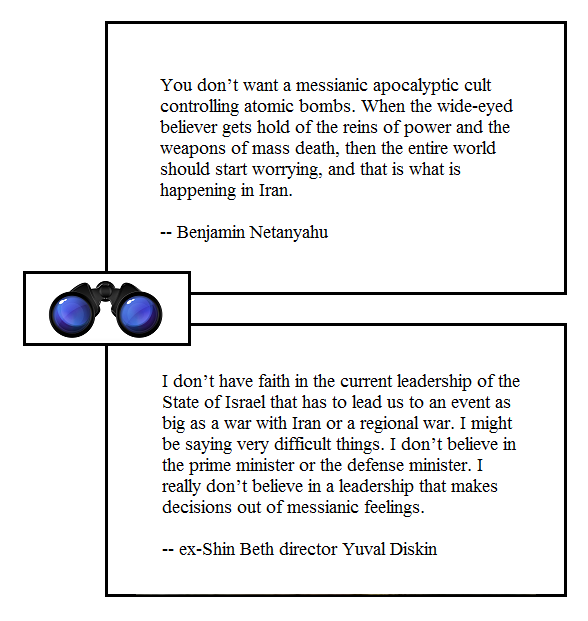
I try to read carefully. When I first saw the Yuval Diskin quote it was contextualized as suggesting that Benjamin Netanyahu and Ehud Barak were the leaders making “decisions out of messianic feelings” – but then for a moment it occurred to me that Diskin might have been saying “I don’t believe the prime minister’s accusation that the leadership of Iran makes decisions based on messianic feelings is correct – I see them as rational, persuadable actors.”

But no: Yuval Diskin is quite clear that it is Netanyahu and Barak he is talking about in this extended quote from Ha’Aretz:

My major problem is that I have no faith in the current leadership, which must lead us in an event on the scale of war with Iran or a regional war. I don’t believe in either the prime minister or the defense minister. I don’t believe in a leadership that makes decisions based on messianic feelings. They are two messianics – the one from Akirov or the Assuta project and the other from Gaza Street or Caesarea. Believe me, I have observed them from up close… They are not people who I, on a personal level, trust to lead Israel to an event on that scale and carry it off. These are not people who I would want to have holding the wheel in such an event.

Perhaps because I am more than usually sensitive to apocalyptic and messianic fervor, I find the implications of both Netanyahu’s and Diskin’s observations – if accurate as to the respective temperaments of the leaders concerned — quite chilling.

8.

As so often, I’m hoping to raise questions here — to prompt deliberative thinking, not to argue or persuade.

Games and doctrines, scriptures and interpretations

Tuesday, April 10th, 2012

[ by Charles Cameron — exploring a possible parallel between the interpretation of prophecies and the simulation of irregular operations ]
.

Well, not exactly, but you get the drift…

We seem to have been in the business of prophesying or predicting the future, especially with regard to warfare, for millennia. Wargaming and scenario planning are at least arguably just the latest souped-up, hi-tech versions of an age-old trade…

1.

The other day on Zenpundit, I quoted Bernard McGinn, the dean of apocalyptic studies, contrasting Martin Luther‘s approach to interpreting Revelation with that of such earlier eschatologists as Joachim of Fiore:

Earlier interpreters, such as Joachim (but not Augustine), had also claimed to find a consonance between Revelation’s prophecies and the events of Church history, but they had begun with Scripture and used it as a key to unlock history. Paradoxically, Luther, the great champion of the biblical word, claimed that history enabled him to make sense of Revelation…

Translating that into contemporary terms – does the believer scour the news media in search of evidence of “where we are” in an already defined end times scenario based on Revelation, or search Revelation to find a way to make sense of current events and breaking news?

That may seem a tricky question, and the empirical answer may be that believers shift back and forth between scripture and news, constantly adjusting their interpretation of each to fit the other.

2.

And yet there are some issues where the question comes more sharply into focus. If the 1948 creation of the State of Israel is a significant marker in the prophetic timeline –- as it is both for many Christian readers of apocalyptic literature and for many Muslims too -– then certain other things must happen.

Thus J. Daniel Hays and colleagues write in the Dictionary of Biblical Prophecy and End Times (Zondervan, 2009):

One of the more popular views among Christians in the United States and Canada is that the creation of the modern state of Israel is a literal fulfillment of Old Testament prophecy. In this view, a literal understanding of the Old Testament prophecies of the end times demands a physical state of Israel in Palestine; thus the creation of this state after hundreds of years is seen not only as a fulfillment, but as a sign that the end times are drawing near.

Many writers, primarily classic dispensationalists, state that with the formation of modern Israel, the world political stage is set for the unfolding of end-time events (see DISPENSATIONALISM, CLASSICAL). Some early writers went so far as to argue that when Israel was created in 1948, an end-times “time clock” began that would be fulfilled within one generation. They derived this understanding primarily from Mark 13:30, where after speaking of the end times, Jesus stated that “this generation will not pass away until all these things have happened.” Some writers believed that the end would come before 1988, or forty years (ie, one generation) after 1948.

3.

In line with this, Hal Lindsey discusses the fig tree parable of Matthew 24.32-34 in his best-selling Late Great Planet Earth, published in 1970:

Now learn the parable from the fig tree: when its branch has already become tender and puts forth its leaves, you know that summer is near; so, you too, when you see all these things, recognize that He is near, right at the door. Truly I say to you, this generation will not pass away until all these things take place.

Lindsey then writes:

But the most important sign in Matthew has to be the restoration of the Jews to the land in the rebirth of Israel… When the Jewish people, after nearly 2,000 years of exile, under relentless persecutiomn, became a nation again on 14 May 1948 the “fig tree” put forth its first leaves.

Jesus said that this would indicate that He was “at the door,” ready to return. Then He said, “Truly I say to you, this generation will not pass away until all these things take place” (Matthew 24:34 NASB).

What generation? Obviously, in context, the generation that would see the signs – chief among them the rebirth of Israel. A generation in the Bible is something like forty years. If this is a correct deduction, then within forty years or so of 1948, all these things could take place…

Within forty years or so of 1948 — and now it’s 2012.

4.

Indeed, one of Lindsey’s readers quoted Lindsey’s Late Great Plan Earth in his own book, The Day of Wrath, published at the tun of the millennium in 2000:

The large Jewish presence in Palestine which has not been seen in two thousand years. Hal Lindsey says in The Late Great Planet Earth that before the establishment of the State of Israel none of the future events were clearly understood, but now that that has occurred, the countdown has begun for the occurrence of the indicator events connected to all of the types of prophecy, and on the basis of the prophecies, the entire world will focus on the middle-east, and especially Israel in the last days.

That reader was Sheikh Safar al-Hawali — a writer known to bin Laden, who had read at least one of his earlier books — and in The Day of Wrath al-Hawali, using techniques of scriptural interpretation he borrowed from Hal Lindsey, calculated that the victorious armies of the jihad would re-take Jerusalem in 2012.

Which would fit nicely with a certain hadith — al-Hawali does not mention it — which describes a victorious army sweeping from Khorasan to Jerusalem under black banners …

Happily, both authors are wise enough to note that their own scriptures declare that “But of that day and hour no one knows, not even the angels of heaven, nor the Son, but the Father alone” (Matthew 24.36) and “Verily the knowledge of the Hour is with Allah alone” (Qur’an 31.34).

5.

And all this is what sprang to mind, when I read NDU CASL roundtable and talk in Rex Bynum Rex Brynen‘s fine PAXsims blog today.

Perhaps that’s not so surprising: the human mind is still the human mind, still driven by what al-Hawali calls the “innate yearning of mankind to unveil the future”.

6.

Bynum Brynen’s post describes Mike Markowitz of the Center for Naval Analyses talking about some research CNA had been doing into wargaming “irregular operations” and notes:

In his presentation, Mike drew a distinction at one point between simulation “modeling” and “representation,” the former more appropriate for the physics of kinetic operations, while the latter highlights the importance of narrative (as well as the inherent “fuzziness” of diplomatic, social, and economic factors — especially in irregular warfare). A large part of Joe’s presentation also touched upon the challenge of validating simulations of insurgency with their substantial DIME (Diplomatic/ Information/Military/Economic) or PMESII (Political/Military/Economic/Social/Infrastructure/ Information) elements.

We’re getting pretty close to the qualitative modeling or mapping of thoughts here, which interests me a great deal as the designer of “thinking games” — so Bynum Brynen definitely had my attention here.

But it was his next point that seemed to me to offer a close parallel to Bernard McGinn’s contrast between Joachim’s and Luther’s methods of interpreting Revelation:

With regard to gaming COIN, then, one is faced with a challenge. Does one build dynamics into the game that reflect doctrinal assumptions about the way the world works? Or does one build a model of the world and then see how doctrine (or alternative doctrinal approaches) work, thereby encouraging original, critical thinking? In the former case, how does one avoid building a simulation that confirms existing approaches because it is, in essence, biased from the outset to do so? In the latter case, where does one derive that alternative model from?

7.

Obviously, in both cases it’s best to find a shoe that fits the foot, rather than to shoe-horn a foot into a shoe that really doesn’t fit it.

But the same question needs to be answered in each case: which is to be the shoe, and which the foot?

Al-Awlaki and the former and latter rains

Saturday, March 31st, 2012

[ by Charles Cameron — former and latter rain in OT, NT and hadith, also YouTube eulogy for Anwar al-Awlaki ]
.

I’ve posted more than once about Sheikh Imran Nazar Hosein [eg: The United States of Islam and Iran or Afghanistan? The Black Flags of Khorasan]: today I saw a clip (screen-cap above) in which he eulogizes Anwar al-Awlaki.

What interests me in Sheikh Imran Hosein’s eulogy is that he references a hadith of the Prophet about the first and last showers of rain

*

So first, some background.

The imagery of “the first rain and the latter rain” dates back at least to the Torah.

In Deuteronomy 11.13-14, we read:

And it shall come to pass, if ye shall hearken diligently unto my commandments which I command you this day, to love the Lord your God, and to serve him with all your heart and with all your soul, that I will give you the rain of your land in his due season, the first rain and the latter rain, that thou mayest gather in thy corn, and thy wine, and thine oil.

That seems to be a fairly straight forward agricultural usage, although as I mentioned recently, scriptural exegesis under the PaRDeS system involves four levels of interpretation.

Joel 2.23 picks up the theme:

Be glad then, ye children of Zion, and rejoice in the LORD your God: for he hath given you the former rain moderately, and he will cause to come down for you the rain, the former rain, and the latter rain in the first month.

But this comes in a celebrated chapter which begins with the sounding of an apocalyptic trumpet and the declaration that “the day of the LORD cometh, for it is nigh at hand” – and which also contains the prophecy (verses 28-30):

I will pour out my spirit upon all flesh; and your sons and your daughters shall prophesy, your old men shall dream dreams, your young men shall see visions: And also upon the servants and upon the handmaids in those days will I pour out my spirit. And I will shew wonders in the heavens and in the earth, blood, and fire, and pillars of smoke…

By the time we reach the New Testament, the theme is clearly used (James 5.7) with a Christian eschatological implication:

Be patient therefore, brethren, unto the coming of the Lord. Behold, the husbandman waiteth for the precious fruit of the earth, and hath long patience for it, until he receive the early and latter rain

And indeed, the imagery of the Latter Rain as an outpouring of the Spirit to occur in the end times has given rise to a movement or series of Pentecostal movements going under the name of the Latter Rain, which have at times drawn the disapproval of apologetics scholars and even fellow Pentecostals.

*

Bearing that in mind, it is interesting to note the following hadith of the Prophet:

The Prophet, sallaallaahu `alaihi wa sallam, further said:

“The example of my Ummah is like that of rain. It is not known whether the initial part (of the rain) is good or the latter part.”

Ibn Taymiyyah, the medieval theologian whose previously somewhat obscure work strongly influenced ‘Abd al-Wahhab, and thus the modern Wahhabi current, commented on this hadith:

..what it means is that among those who come later there will be those who are similar to those who came before, and they will be so close that the one who tries to compare them will not know which is better, even though one of them is in fact better.

This is glad tidings for those who come later, that among them will be those who are close to those who came before them, as it says in another hadeeth: “The best of my ummah are the first and the last, and between them there will be some crookedness. Would that I could see my brethren.” They said, “Are we not your brethren?” He said, “You are my companions.” This shows that precedence was given to the Sahaabah, because they alone are his companions, which is a higher status than merely being brothers.”

*

In his tribute to “our brother Sheikh Anwar al-Awlaki” Sheikh Imran Hosein says “I don’t think there’s need to say more than one statement about Anwar al-Awlaki.” He then quotes the same hadith, repeating the first phrase for emphasis:

My Ummah is like the rain. My Ummah is like the rain: I do not know which shower is better, the first or the last.

And concludes:

Anwar Awlaki belongs to the last shower. That is his status, may Allah grant him Jannah.

— Jannah being the garden of Paradise.

*

But see for yourself — the video clip is only a minute long, and the hadith and commentary are provided below it on the YouTube site:


Switch to our mobile site