zenpundit.com » Apocalyptic

Archive for the ‘Apocalyptic’ Category

3% of human brains pop, fizzle and #FAIL in any kind of heat

Friday, October 14th, 2011

[ by Charles Cameron – Occupy movement, banks and rumors of banks, date setting, apocalyptic, and just a hint of Y2K ]

.
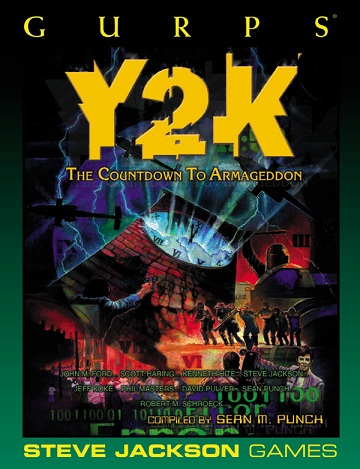
gurps-y2k.jpg

I’ve said it before, I think: we’re witnessing Y2K: the Expectation in slo-mo.

1.

Now it’s time for banks and rumors of banks to run up the flagpole once again.  As I say in the title of this post, there’s a certain percentage of human brains that simply can’t take the heat, and should stay out of the kitchen. Perhaps I’m being generous in my estimate of the percentage…

So here are three dates to mark on your calendar: October 15th, which is tomorrow at the time of writing, October 21st, coming up shortly, and October 31st, if we live to see the day…

Let’s take them in reverse order:


The October 31st option lacks intelligence, in my not always humble opinion, for two reasons: first, because it’s all a bit like yelling fire in a cinema for the deaf when you don’t know sign language — almost no-one will pay enough attention to take the action you’re recommending — and second, because even if you want to see a significant change away from the ways in which money can buy influence at the moment, the idea of crashing the banks as a means to that end will only turn people away from the larger movement into which you’ve somehow inserted yourself.

Informing politicians that the more “bought and paid for” money they get, the fewer voters will vote for them is one thing. Creating a sustainable parallel system that could mitigate crises, ensuring local food distribution in the event of a disruption of the trucking industry for instance, is another, in much the same spirit.  But crashing the world economic system isn’t even a thing — it’s demented.

So October 31st is a non-starter: pop, fizzle and #FAIL.

Which is lucky, because according to Harold Camping, whose one hundred million dollar campaign to alert us all that the world would end earlier this year didn’t manage to buy God’s decision-making process, there won’t be anyone, anywhere, after October 21st — let alone any banks to withdraw funds from.

No doubt, like Camping’s previous predictions, this one too will fizzle and #FAIL

I wouldn’t care to guess what percentage of my 3% of human brains unable to take the heat will be following Camping at this point, or what percentage the bank crasher will claim, but there’s still room on my dance card for 2012, and this won’t be the last we hear of such ideas.

2.

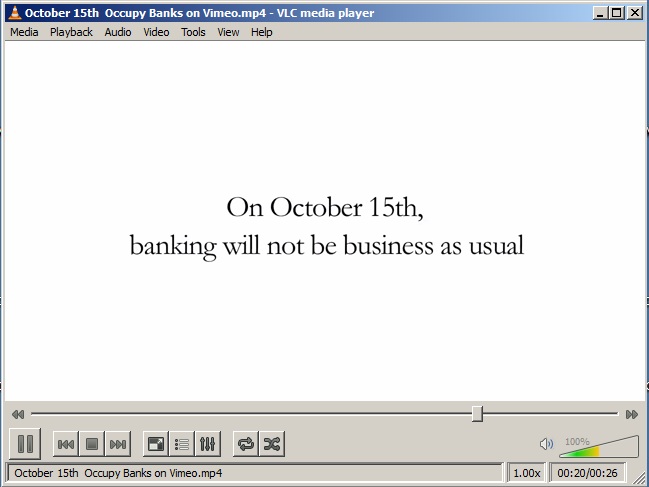
Which leaves us with tomorrow, a day very much like yesterday… which it will soon turn into?
not-as-usual.jpg

This one’s interesting because although it has a date certain — one, mark you, that conflicts with the October 31st idea — the event itself doesn’t appear to be scripted [see video].

So who knows?  The suspense is killing me — but it won’t be for long.

3.

Y2K had its fair share of apocalyptic expectations, threatened SCADA failures, worries about supply chains, bank runs and the like, and I’ve suggested [more than once] that we could really use a decent map of our critical dependencies — one that includes our human capacities for fear, fury, obstructionism, fatalism, indecision, generosity, competition and cooperation…

Time for an eTank — or an  iTank, or a G+Tank — eh?

Come now, let us reason together..

Scenario planning and prophecy

Friday, October 14th, 2011

[ by Charles Cameron — futurism, prediction, Christian and Islamic apocalyptic traditions, fiction ]
.
clancy-rosenberg.jpg

Two new thrillers.  And what caught my eye — fascinated as I am by the whole business of prophecy and prediction, scenario planning and science fiction — was Wolf Blitzer‘s pronouncement about Tom Clancy on his CNN blog today:

Sometimes nonfiction seems to follow fiction, especially, it seems, in the case of Tom Clancy and his spy novels.

Here’s Blitzer’s supporting evidence:

In 1994, he wrote a thriller called “Debt of Honor.” Long before the terrorist attacks of 9/11, Clancy had a character fly a Boeing 747 into the U.S. Capitol. Clancy’s “The Teeth of the Tiger,” published in 2003, features a man named Mohammed who has a network of Colombian drug cartel thugs who plot evil deeds against the U.S. His newest book is entitled “Against All Enemies.” A major plot line has Taliban terrorists joining hands with Mexican drug cartel killers to launch attacks in the United States. A friend who’s read all the Clancy books alerted me to this when he heard of the Obama administration’s accusations that Iran plotted to have members of a Mexican drug cartel kill Saudi Arabia’s ambassador to the United States, Adel al-Jubeir. “Seems like terrorists are big Clancy fans,” my friend suggested…

Not so fast, Wolf and Wolf’s friend. They might equally well have been reading Joel Rosenberg (also, or instead).

Clancy does this sort of stuff because he’s a scenario planner turned novelist — Rosenberg does it because he’s a student of prophecy turned novelist.  Come to that, I rather like the idea that prophecy and scenario planning might be related.

Here’s an excerpt from Wikipedia’s current article about Rosenberg:

Nine months before the September 11th attacks, Rosenberg wrote a novel with a kamikaze plane attack on an American city. Five months before the 2003 invasion of Iraq, he wrote a novel about war with Saddam Hussein, the death of Yasser Arafat eight months before it occurred, a story with Russia, Iran, and Libya forming a military alliance against Israel occurring the date of publishing, the rebuilding of the city of Babylon, Iran vowing to have Israel “wiped off the face of the map forever” five months before Iranian President Ahmadinejad used similar language, and the discovery of huge amounts of oil and natural gas in Israel (a major gas discovery occurred in January 2009).

Neat, hunh?

Or of course, they could just all be playing Steve Jackson‘s 1995 Illuminati card game

illuminaticardgametowers.jpg

I suppose we should add role-playing and card-reading to our list of prognostic activities…

*

In any case…

I enjoy Joel Rosenberg’s books.  His thrillers are full of Christian and Islamic apocalyptic elements, of course, which are of continuing interest to me — especially when they cross over into each others’ territories.  I’ve been meaning to write up my review of the first book in his current series for months now — my copy must have a hundred or so little colored flags in it, marking passage of interest, plot points and so on.

And there are things Rosenberg gets seriously wrong that are important. It’s dangerous when someone who influences thousands through his Epicenter conferences and his appearances with Glenn Beck is unable to distinguish the Hojjatiyeh Society (a small group that may not even exist at this point) from Twelver (ie orthodox Shi’ite) Islam.

But it’s because I think:

  • that Islamic apocalyptic is important and all too often overlooked,
  • that he thinks so, too,
  • that his tying it in with policy proposals carries some weight,
  • that the brisk pace of his novels reaches readers who have not much other access to ideas about the Mullahs, the Twelfth Imam or Mahdi, and the issue of the Iranian nuclear program, and
  • that there are scholars in a position to clarify and correct some of his mistakes and misconceptions,

that I still hope to review the first book in the current series, The Twelfth Imam, and his new book, The Tehran Initiative, right alongside it.

Heck, I’d be more than happy to review the new Clancy, too.

Arab Spring and apocalyptic dawn

Sunday, October 2nd, 2011

[ by Charles Cameron — Mahdism and the Arab Spring, depth of apocalyptic expectation not limited to militant circles ]

.

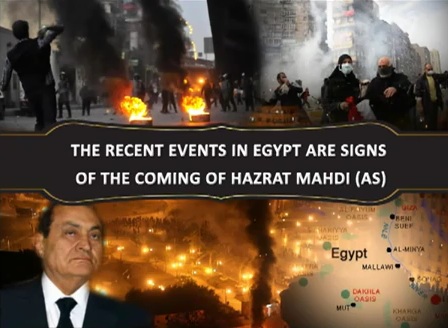
recent-events.jpg

screen-cap from a Feb 2011 video associated with Harun Yahya, see below

I’ve been holding back on posts about Shi’ite apocalypticism, because it seems to me that President Ahmadinejad‘s influence is on the wane for reasons not entirely disconnected from his keen and oft-expressed expectation of the soon coming of the Hidden Imam.

I have posted a couple of times recently on Sunni apocalyptic — but there my focus has been on AQ, Taliban and the black banners of Khorasan, as illuminated recently by the books of Syed Saleem Shahzad and Ali Soufan. My next forays will hopefully concern another strand of militant Sunni apocalyptic– the traditions of jihad against India (Ghazwa-ul-Hind) — and I’d also very much like to turn my attention some more to some of the eschatological issues in current Christian circles in the US.

But first: a quick glimpse of apocalyptic expectation in the Arab Spring.

1.

Under the title Mubarak’s fall spawns End of Times prophecies, Yasmine Fathi recently reported in Egypt’s Al Ahram online:

The idea of Mubarak as Anti-Christ has caught fire on social networking sites, with many users presenting Muslim Hadiths, sayings of the Prophet, in support of the theory. While others dispute the notion, they nevertheless posit Mubarak’s very existence as a sign that the end is indeed nigh.

One website noted that, according to certain Islamic beliefs, doomsday will come after Egypt is ruled by a leader whose first name is “Mohamed” and second name is “Hussein,” of which “Hosni” – Mubarak’s middle name – is a variation. This, say doomsday-watchers, constitutes further proof that his existence – and recent fall – represented a sign that the end of time can be expected any day now.

One theory currently making the rounds on the web suggests that the world will end on 26 September – this Monday – due to massive earthquakes caused by a rare planetary alignment. The quakes, believers say, will make Japan’s recent disaster look like a walk in the park.

Even Egypt’s Coptic Patriarch, Pope Shenouda III, referred to the prediction, joking at the end of his last weekly sermon, “We’ll meet again next Wednesday after the earthquake, God willing.”

After the theory was savaged by local and international scientists, however, the public’s attention has shifted again to the year 2012 – only three months away – which many fatalists fear will be our last year on earth, since the Mayan calendar ends on 21 December of next year.

The first point to note here is that apocalyptic sentiment is alive and thriving in the Arab world — and not just in the militant jihadist circles of AQ and the like — or Hamas — either.

That’s a significant datum — and our cue for another reading of JP Filiu‘s Apocalypse in Islam.

2.

The number and variety of strands converging in these few brief paragraphs is impressive:

social networking
apocalyptic expectation catching fire
Mubarak’s name as a sign
a date certain — a week from now
cross-religious banter from Pope Shenouda

— and there’s even a reference to the “Mayan” chronology with its 2012 end-date — which (though Fathi doesn’t mention it) just happens to coincide with the Saudi dissident Sheikh Safar al-Hawali‘s ETA for the return of Jerusalem to Islam on the final page of his pamphlet, The Day of Wrath.

3.

Let’s go back to Fathi for a more nuanced — and theologically informed — view:

But according to Amena Nosseir, professor of Islamic theology and philosophy at Cairo’s Al-Azhar University, the true date of the “final hour” will never be revealed to mankind.

“God has not bestowed knowledge of the final hour to any of his prophets or worshippers, and there’s a holy wisdom behind his decision to withhold this information,” she said. “God created humans to create life on this planet, so it doesn’t make sense that he would give them the knowledge of when the end of time will be.”

Even al-Hawali qualifies his suggested date thus:

Therefore, the end -or the beginning of the end- will be 1967 + 45 = 2012, or in lunar years 1387 + 45 = 1433.

This is what we hope will happen, but we do not declare it to be absolutely certain, but if the fundamentalists would like to bet with us, as Quraysh did with Abu Bakr concerning the Qur’anic prophecy concerning the Romans, then without doubt they will lose, although we cannot guarantee that it will be that exact year!

Setting a date for time to end may be the most reliable method yet devised for proving oneself unreliable.

4.

There are other stirrings.

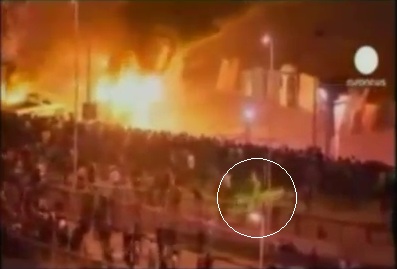
Harun Yahya, an influential Turkish figure, reports that a green horse and rider can be discerned in a recent Cairo video, and proposes that the rider is Khidr — the teacher of Moses in Sura 18 of the Qur’an (which the great scholar Louis Massignon terms “the apocalypse of Islam”) and a mysterious figure of inspiration in Islamic lore…

khidr-in-egyptian-video.jpg

He also “reads” Mubarak as an eschatological figure — the Rook — and indeed, this entire video — only five minutes long and readily available on YouTube — is worth watching, to get a visceral sense of how strong this narrative current is:

BTW: see Halverson, Goodall and Corman‘s Master Narratives of Islamist Extremism for a sense of how significant “narrative” is… and then, yes, reread Filiu!

*

Hat-tip for a hot tip to Bryan Alexander.

Mapping our interdependencies and vulnerabilities [with a glance at Y2K]

Wednesday, September 28th, 2011

[ by Charles Cameron — mapping, silos, Y2K, 9/11, rumors, wars, Boeing 747s, Diebold voting machines, vulnerabilities, dependencies ]


www.fun1001.com | Send this image to your friend

The “bug” of Y2K never quite measured up to the 1919 influenza bug in terms of devastating effect — but as TPM Barnett wrote in The Pentagon’s New Map:

Whether Y2K turned out to be nothing or a complete disaster was less important, research-wise, than the thinking we pursued as we tried to imagine – in advance – what a terrible shock to the system would do to the United States and the world in this day and age.

1.

My own personal preoccupations during the run-up to Y2K had to do with cults, militias and terrorists — any one of which might have tried for a spectacle.

As it turned out, though, Al Qaida’s plan to set off a bomb at Los Angeles International Airport on New Year’s Eve, 1999 was foiled when Albert Ressam was arrested attempting to enter the US from Canada — so that aspect of what might have happened during the roll-over was essentially postponed until September 11, 2001. And the leaders of the Ugandan Movement for the Restoration of the Ten Commandments of God, acting on visionary instructions (allegedly) from the Virgin Mary, announced that the end of the world had been postponed from Dec 31 / Jan 1 till March 17 — at which point they burned 500 of their members to death in their locked church. So that apocalyptic possibility, too, was temporarily averted.

2.

Don Beck of the National Values Center / The Spiral Dynamics Group, commented to me at one point in the run-up:

Y2K is like a lightening bolt: when it strikes and lights up the sky, we will see the contours of our social systems.

— and that quote from Beck, along with Barnett’s observation, pointed strongly to the fact that we don’t have anything remotely resembling a decent global map of interdependencies and vulnerabilities.

What we have instead is a PERT chart for this or that, Markov diagrams, social network maps, railroad maps and timetables… oodles and oodles of smaller pieces of the puzzle of past, present and future… each with its own symbol system and limited scope. Our mapping, in other words, is territorialized, siloed, and disconnected, while the world system which is integral to our being and survival is connected, indeed, seamlessly interwoven.

I’ve suggested before now that our mapping needs to pass across the Cartesian divide from the objective to the subjective, from materiel to morale, from the quantitative to the qualitative, and from rumors to wars. It also needs a uniform language or translation service, so that Jay Forrester system dynamic models can “talk” with PERT and Markov and the rest, Bucky Fuller‘s World Game included.

I suppose some of all this is ongoing, somewhere behind impenetrable curtains, but I wonder how much.

3.

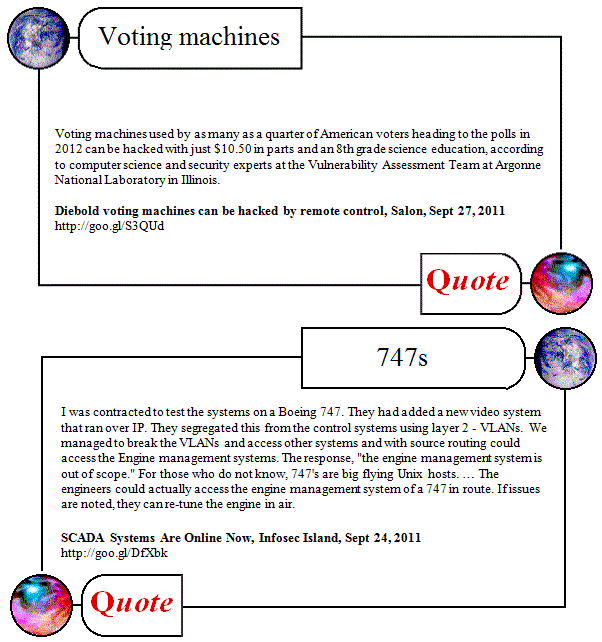
In the meantime, and working from open source materials, the only kind to which I have access – here are two data points we might have noted a litle earlier, if we had decent interdependency and vulnerability mapping:

quo-vulnerabilities.gif

Fear-mongering — or significant alerts?  I’m not tech savvy enough to know.

4.

Tom Barnett’s point about “the thinking we pursued as we tried to imagine – in advance – what a terrible shock to the system would do to the United States and the world in this day and age” still stands.

Y2K was what first alerted me to the significance of SCADAs.

Something very like what Y2K might have been seems to be unfolding — but slowly, slowly.

Are we thinking yet?

Dead Sea Scrolls & Nag Hammadi Codices online

Wednesday, September 28th, 2011

[ by Charles Cameron — archaeology, Biblical scholarship, eschatology, digital literacy ]

.

Both the Dead Sea scrolls from Qumran and the Gnostic and associated codices from Nag Hammadi are now available for study online:

quo-codices.jpg

The Nag Hammadi Archive can be explored via the Claremont Colleges Digital Library, and the Digital Dead Sea Scrolls via the Israel Museum, Jerusalem.

Here’s a description of the War Scroll from Qumran, which “is dated to the late first century BCE or early first century CE”:

Against the backdrop of a long biblical tradition concerning a final war at the End of Days (Ezekiel 38-39; Daniel 7-12), this scroll describes a seven stage, dualistic confrontation between the “Sons of Light” (the term used by Community members to refer to themselves), under the leadership of the “Prince of Light” (also called Michael, the Archangel) – and the “Sons of Darkness” (a nickname for the enemies of the Community, Jews and non-Jews alike), aided by a nation called the Kittim (Romans?), headed by Belial. The confrontation would last 49 years, terminating in the victory of the “Sons of Light” and the restoration of the Temple service and sacrifices. The War Scroll describes battle arrays, weaponry, the ages of the participants, and military maneuvers, recalling Hellenistic and Roman military manuals.

You can see why I’m interested.

The Nag Hammadi texts are a little less well known but include — along with a variety of other texts, some of them self-described as “apocalypses” — the now celebrated Gospel of Thomas, which Bart Erhman reads as continuing a “de-apocalypticizing” of Jesus’ message which he finds beginning in Luke and continuing in John:

In the Gospel of Thomas, for example, written somewhat later than John, there is a clear attack on anyone who believes in a future Kingdom here on earth. In some sayings, for example, Jesus denies that the Kingdom involves an actual place but “is within you and outside you” (saying 3); he castigates the disciples for being concerned about the end (saying 18); and he spurns their question about when the Kingdom will come, since “the Kingdom of the Father is spread out on the earth and people do not see it” (saying 113).

Again, you can see why I am delighted that these texts are becoming available to a wider scholarly audience…

In both the Nag Hammadi codices and Qumran scrolls, we have texts that were lost for almost two thousand years and discovered, somewhat haphazardly, in 1945 and 1947 respectively, providing us with rich insights into the religious ferment around a time and place that have been pivotal for western civilization.

Now, more than half a century later, the web — as it becomes our global museum and our in-house library — brings us closer to both…


Switch to our mobile site