zenpundit.com » Israel

Archive for the ‘Israel’ Category

Ali Soufan: AQ, Khorasan and the Black Banners

Saturday, September 17th, 2011

[ by Charles Cameron — yet more black banners, Khorasan, Jerusalem and Armageddon, with the usual strategic implications ]
.
soufan-book-cover.jpg
.

It’s beginning to be embarrassing how obvious the Khorasan / black banner / Mahdism meme is getting these days.  Earlier this week I pointed it out as the basic through-line of Syed Saleem Shahzad‘s Inside Al-Qaeda and the Taliban: Beyond bin Laden and 9/11. Today it’s Ali Soufan‘s turn.

In his book, The Black Banners: The Inside Story of 9/11 and the War Against Al-Qaeda — which I hope to review here — Soufan too makes the apocalyptic significance of AQ’s jihad painfully apparent. Take his title, for instance

Black banners, eh?

Those would presumably be the ones mentioned to Soufan by Abu Jandal, who began to quote the hadith:

If you see the black banners coming from Khurasan, join that army, even if you have to crawl over ice; no power will be able to stop them —

at which point Soufan broke in and completed the hadith for him:

— and they will finally read Baitul Maqdis [Jerusalem], where they will erect their flags.

And in case you missed it, that’s an explicitly end-times, Mahdist hadith, as you can see from (eg) this Hizb-ut-Tahrir-associated site:

Messenger of Allah said: “If you see the Black Banners coming from Khurasan go to them immediately, even if you must crawl over ice, because indeed amongst them is the Caliph, Al Mahdi.” [Narrated on authority of Ibn Majah, Al-Hakim, Ahmad]

Soufan goes on to say:

I was to hear that reputed hadith from many al-Qaeda members I interrogated. It was one of al-Qaeda’s favorites.

Khurasan is a term for a historical region spanning northeastern and eastern Iran and parts of Turkmenistan, Uzbekistan, Tajikistan, Afghanistan, and northwestern Pakistan. Because of the hadith, jihadists believe that this is the region from which they will inflict a major defeat against their enemies — in the Islamic version of Armageddon. Bin Laden’s 1996 declaration of war against the United States – a main text for al-Qaeda members – ends with the dateline “Friday, August 23, 1996, in the Hindu Kush, Afghanistan.” It’s not a coincidence that bin Laden made al-Qaeda’s flag black; he also regularly cited the hadith and referenced Khurasan when recruiting, motivating, and fundraising. Al-Qaeda operatives I interrogated were often convinced that, by joining al-Qaeda, they were fulfilling the words of the Prophet.

It is an indication of how imperfectly we know our enemy that to most people in the West, and even among supposed al-Qaeda experts, the image of the black banners means little…

I could go on, but that’s surely enough.

*

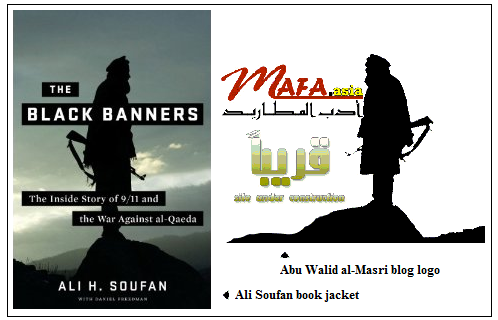
And by the way, who is that man on the cover, anyway?

banners-mafa-juxtaposed.png

UBL and Fisk: a quick note on something that caught me eye

Sunday, August 7th, 2011

[ by Charles Cameron — taqiyya, diplomacy, or theology? ]

.

I understand that Robert Fisk is viewed differently by different segments of the public, and hope we won’t get entangled in that discussion here – because I want to quote a story he tells, with an eye for two or three significant details.

The first detail, which you’ll find right at the end of the story, has to do with a leader’s standing when he must “withdraw” in front of his men – in other words, it’s a matter of honor and shame, and Fisk clearly feels that’s a motif of significance in his tale, though we might miss it if we weren’t specifically looking for it…

Here then is the story as Fisk tells it:

19 March 1997. There was a sudden scratching of voices outside the tent, thin and urgent like the soundtrack of an old movie. Then the flap snapped up and Bin Laden walked in, dressed in a turban and green robes. I stood up, half bent under the canvas, and we shook hands, both of us forced by the tarpaulin that touched our heads to greet each other like Ottoman pashas, bowed and looking up into the other’s face. Again, he looked tired, and I had noticed a slight limp when he walked into the tent. His beard was greyer, his face thinner than I remembered it. Yet he was all smiles, almost jovial, placing the rifle which he had carried into the tent on the mattress to his left, insisting on more tea for his guest. For several seconds he looked at the ground. Then he looked at me with an even bigger smile, beneficent and, I thought at once, very disturbing.

“Mr Robert,” he began, and he looked around at the other men in combat jackets and soft brown hats who had crowded into the tent. “Mr Robert, one of our brothers had a dream. He dreamed that you came to us one day on a horse, that you had a beard and that you were a spiritual person. You wore a robe like us. This means you are a true Muslim.” This was terrifying. It was one of the most fearful moments of my life. I understood Bin Laden’s meaning a split second in front of each of his words. Dream. Horse. Beard. Spiritual. Robe. Muslim. The other men in the tent were all nodding and looking at me, some smiling, others silently at the Englishman who had appeared in the dream of the “brother”. I was appalled. It was both a trap and an invitation, and the most dangerous moment to be among the most dangerous men in the world. I could not reject the “dream” lest I suggest Bin Laden was lying. Yet I could not accept its meaning without myself lying, without suggesting that what was clearly intended of me – that I should accept this “dream” as a prophecy and a divine instruction – might be fulfilled. For this man to trust me, a foreigner, to come to them without prejudice, that was one thing. But to imagine that I would join them in their struggle, that I would become one with them, was beyond any possibility. The coven was waiting for a reply.

Was I imagining this? Could this not be just an elaborate, rhetorical way of expressing traditional respect towards a visitor? Was this not merely the attempt of a Muslim to gain an adherent to the faith? Was Bin Laden really trying – let us be frank – to recruit me? I feared he was. And I immediately understood what this might mean. A Westerner, a white man from England, a journalist on a respectable newspaper – not a British convert to Islam of Arab or Asian origin – would be a catch indeed. He would go unsuspected, he could become a government official, join an army, even – as I would contemplate just over four years later – learn to fly an airliner. I had to get out of this, quickly, and I was trying to find an intellectual escape tunnel, working so hard in digging it that my brain was on fire.

“Sheikh Osama,” I began, even before I had decided on my next words. “Sheikh Osama, I am not a Muslim.” There was silence in the tent. “I am a journalist.” No one could dispute that. “And the job of a journalist is to tell the truth.” No one would want to dispute that. “And that is what I intend to do in my life – to tell the truth.” Bin Laden was watching me like a hawk. And he understood. I was declining the offer. In front of his men, it was now Bin Laden’s turn to withdraw, to cover his retreat gracefully. “If you tell the truth, that means you are a good Muslim,” he said. The men in the tent in their combat jackets and beards all nodded at this sagacity. Bin Laden smiled. I was saved.

I’m interested in the honor / shame angle because I have just been reading my friend Richard Landes‘ paper Edward Said and the Culture of Honour and Shame: Orientalism and Our Misperceptions of the Arab-Israeli Conflict and his blog post Game Theory and Social Emotions… I may not always agree with Richard, but he certainly sets me thinking…

The second point of interest here — which I’ve noted before — is the emphasis in the minds of bin Laden and his followers on the prophetic nature of dreams.

It is the third that is, if Fisk is accurate in his recall here, the most interesting – that bin Laden would utter the words “If you tell the truth, that means you are a good Muslim.” Fisk is not threatening him, so this is not an occasion for taqiyya as I understand it – perhaps it is an occasion, as Fisk himself suggests, for diplomacy.

But how does that remark sound as theology in the mode of Ibn Abd al-Wahhab?

The Said Symphony: move 12

Thursday, July 21st, 2011

[ by Charles Cameron – extended analytic game on Israeli-Palestinian conflict — continuing ]

.

I am titling my next move “Moral Equivalence?” with the question mark as the crux of the title, and I am posting it separately since it (a) raises a central question with regards to the entire project and (b) plunges us directly into the twin narratives of Palestinian and Israeli… in parallel, in counterpoint… perhaps in…

Move 12: Moral Equivalence?
move-12.gif

Move Content:

In President Obama‘s address at Cairo University on June 4, 2009, the President presents the two narratives, Israeli and Palestinian, side by side:

America’s strong bonds with Israel are well known. This bond is unbreakable. It is based upon cultural and historical ties, and the recognition that the aspiration for a Jewish homeland is rooted in a tragic history that cannot be denied.

Around the world, the Jewish people were persecuted for centuries, and anti-Semitism in Europe culminated in an unprecedented Holocaust. Tomorrow, I will visit Buchenwald, which was part of a network of camps where Jews were enslaved, tortured, shot and gassed to death by the Third Reich. Six million Jews were killed — more than the entire Jewish population of Israel today. Denying that fact is baseless, it is ignorant, and it is hateful. Threatening Israel with destruction — or repeating vile stereotypes about Jews — is deeply wrong, and only serves to evoke in the minds of Israelis this most painful of memories while preventing the peace that the people of this region deserve.

On the other hand, it is also undeniable that the Palestinian people — Muslims and Christians — have suffered in pursuit of a homeland. For more than 60 years they’ve endured the pain of dislocation. Many wait in refugee camps in the West Bank, Gaza, and neighboring lands for a life of peace and security that they have never been able to lead. They endure the daily humiliations — large and small — that come with occupation. So let there be no doubt: The situation for the Palestinian people is intolerable. And America will not turn our backs on the legitimate Palestinian aspiration for dignity, opportunity, and a state of their own.

For decades then, there has been a stalemate: two peoples with legitimate aspirations, each with a painful history that makes compromise elusive. It’s easy to point fingers — for Palestinians to point to the displacement brought about by Israel’s founding, and for Israelis to point to the constant hostility and attacks throughout its history from within its borders as well as beyond. But if we see this conflict only from one side or the other, then we will be blind to the truth: The only resolution is for the aspirations of both sides to be met through two states, where Israelis and Palestinians each live in peace and security.

Insult #3 in Nile Gardiner‘s piece, “Barack Obama’s top ten insults against Israel,” from the Telegraph blog of April, 2010, consists of the comment:

In his Cairo speech to the Muslim world, President Obama condemned Holocaust denial in the Middle East, but compared the murder of six million Jews during World War Two to the “occupation” of the Palestinian territories, in a disturbing example of moral equivalence:

followed directly by the third paragraph above from Obama’s speech.

The question raised by this move is that of “moral equivalence”. Specifically, I am raising the question of whether Obama’s four paragraphs do indeed contain “a disturbing example of moral equivalence”. More generally, I am asking whether juxtaposition — which is one of the central features of analogical thought, and thus of this game – implies equivalence.

Link claimed:

To Bob Dylan, “One too many mornings” and the lines “You’re right from your side / I’m right from mine” – juxtaposing them like that, is there a moral equivalence implied?

Dylan’s overview doesn’t sound too optimistic about the possibility of any kind of reconciliation of the opposites: “We’re both just one too many mornings / An’ a thousand miles behind…”

Accordingly, this may be an appropriate point at which to note that Edward Said thought the conflict between Israelis and Palestinians was asymmetrical and irreconcilable.

In the interview from which I borrowed Said’s notion of a “symphonic” reading of the conflict, the question and answer immediately following that paragraph reads thus:

Q: Is this a symmetrical conflict between two peoples who have equal rights over the land they share?

A: There is no symmetry in this conflict. One would have to say that. I deeply believe that. There is a guilty side and there are victims. The Palestinians are the victims. I don’t want to say that everything that happened to the Palestinians is the direct result of Israel. But the original distortion in the lives of the Palestinians was introduced by Zionist intervention, which to us – in our narrative – begins with the Balfour Declaration and events thereafter that led to the replacement of one people by another. And it is continuing to this day. This is why Israel is not a state like any other. It is not like France, because there is continuing injustice. The laws of the State of Israel perpetuate injustice.

This is a dialectical conflict. But there is no possible synthesis. In this case, I don’t think it’s possible to ride out the dialectical contradictions. There is no way I know to reconcile the messianic-driven and Holocaust-driven impulse of the Zionists with the Palestinian impulse to stay on the land. These are fundamentally different impulses. This is why I think the essence of the conflict is its irreconcilability.

Comment:

Are the two narratives symmetrical? Is there a moral equivalence between them?

The great early Russian film director Sergei Eisenstein wrote that “the juxtaposition of two shots by splicing them together resembles not so much the simple sum of one shot plus another — as it does a creation.”
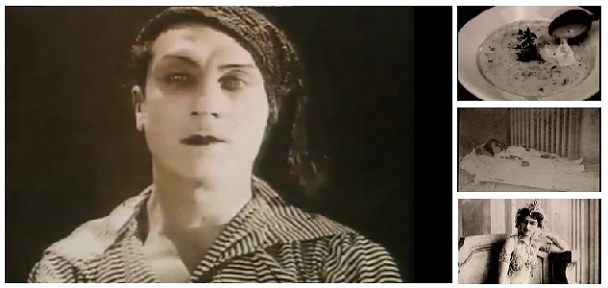
mosjukhin.jpg

His colleague Vsevolod Pudovkin goes further:

Kuleshov and I made an interesting experiment. We took from some film or other several close-ups of the well-known Russian actor Mosjukhin. We chose closeups which were static, and which did not express any feeling at all-quiet close-ups. We joined these close-ups, which were all similar, with other bits of film in three different combinations. In the first combination the close-up of Mosjukhin was immediately followed by a shot of a plate of soup standing on a table. It was obvious and certain that Mosjukhin was looking at this soup. In the second combination the face of Mosjukhin was joined to shots showing a coffin in which lay a dead woman. In the third the close-up was followed by a shot of a little girl playing with a funny toy bear. When we showed the three combinations to an audience which had not been let into the secret the result was terrific. The public raved about the acting of the artist. They pointed out the heavy pensiveness of his mood over the forgotten soup, were touched and moved by the deep sorrow with which he looked on the dead woman, and admired the light, happy smile with which he surveyed the girl at play. But we knew that in all three cases the face was exactly the same.

What I am getting at here is, first and foremost, that juxtaposition is a rhetorical and aesthetic device, and that how to “read” a given juxtaposition is not necessarily obvious.

In a subsequent move, I shall discuss the specific philosophical problem involved in weighing one body of suffering against another

Martin van Creveld on The Lebanon War

Monday, June 27th, 2011


Eminent and controversial military historian, Martin van Creveld, analyzes the 2006 Israeli-Hezbollah War in the latest issue of Infinity Journal. Some Excerpts:

The Second Lebanon War: A Re-assessment

….Though the decision to retaliate in force was inevitable, it also meant that the Israel Defense Force (IDF) was taken by surprise and did not have time to prepare properly. Of the entire vast order of battle, only five regular brigades were immediately available. Moreover, these brigades had spent years doing little but carrying out counter-insurgency operations in the Occupied Territories. As a result, they had almost forgotten how to fight a real enemy; he who fights the weak will end up by becoming weak. Some of the burden fell on the Israeli Navy which shelled Lebanon’s coast, imposed a blockade, and cut the country off from the world. In doing so, one of its modern ships was hit by an Iranian-built surface to sea missile, suffering damage and taking some casualties. Since this was the first time in thirty-nine years anything of the kind had happened, it was a considerable propaganda victory for Hezbollah. At the same time it proved how much the crew had underestimated the enemy, since they (perhaps acting on their superiors’ orders) had not even switched on the vessel’s electronic defenses.

….”Stark raving mad” (majnun, in Arabic) was, in fact, the way many people in Lebanon and the rest of the Arab world reacted to the Israeli attack. As the statements of several of Hezbollah’s top leaders indicated, they too were surprised by the strength of the Israeli reaction. None of the organization’s original objectives were achieved. Its fighters remain in prison; the Israeli “occupation” of Shaba Farm continues; and Jerusalem, which it set itself as its ultimate objective to liberate, remains as firmly in Israeli hands as it has been during the last forty-four years. What the war did do was to show that, in case of war, neither Syria nor Iran would necessarily come to Lebanon’s rescue. The country’s infrastructure was left in ruins. Thirty thousand dwellings were destroyed or damaged, and dozens of bridges, underpasses, and gas stations demolished. Hundred of thousands of people were forced to flee, and as many as 2,000 killed.

Free registration required to read the article.

This piece is heavily IDF-centric in the analysis, perhaps reflecting van Creveld’s established authority on command and logistics and his recent work on air power, but I was surprised by the lack of space devoted to Hezbollah’s operations, given the author’s deep influence on 4GW theory and the study of postmodern irregular and asymmetric warfare. That may reflect, in part, the thrust of Infinity as a publication or the need for brevity but there’s an almost Clausewitzian subtext in the conclusion.


Switch to our mobile site