zenpundit.com » literature

Archive for the ‘literature’ Category

Bérubé, Plotinus, and William Shakespeare

Sunday, February 17th, 2013

[ by Charles Camerontotus mundus agit histrionem ]
.

Or as Shakespeare‘s Melancholy Jacques famously observed in As You Like It: All the world’s a stage…

**

On the off-chance that you’ll take a few minutes to read it once again, profound beauty being a river into which we cannot dip too often, I’ll give you the whole speech:

All the world’s a stage,
And all the men and women merely players:
They have their exits and their entrances;
And one man in his time plays many parts,
His acts being seven ages. At first, the infant,
Mewling and puking in the nurse’s arms.
And then the whining school-boy, with his satchel
And shining morning face, creeping like snail
Unwillingly to school. And then the lover,
Sighing like furnace, with a woeful ballad
Made to his mistress’ eyebrow. Then a soldier,
Full of strange oaths and bearded like the pard,
Jealous in honour, sudden and quick in quarrel,
Seeking the bubble reputation
Even in the cannon’s mouth. And then the justice,
In fair round belly with good capon lined,
With eyes severe and beard of formal cut,
Full of wise saws and modern instances;
And so he plays his part. The sixth age shifts
Into the lean and slipper’d pantaloon,
With spectacles on nose and pouch on side,
His youthful hose, well saved, a world too wide
For his shrunk shank; and his big manly voice,
Turning again toward childish treble, pipes
And whistles in his sound. Last scene of all,
That ends this strange eventful history,
Is second childishness and mere oblivion,
Sans teeth, sans eyes, sans taste, sans everything.

**

Sources:

Bérubé, A Theory of Theory of Mind
Plotinus, Third Ennead, ii, 15
Shakespeare, As You Like It, Act II Scene vii.

Infinite in faculty, quintessence of dust

Saturday, January 12th, 2013

[ by Charles Cameron — on the cutting off of hands, the eternal life of martyrs, and the vast and petty nature of we poor amazing humans ]
.

As you know, I love apposite juxtapositions between religious texts – if you’re into cognition, it’s called pattern recognition, in Jung or Plato it would be familiarizing oneself with the archetypes, and in terms of creativity it’s “one swell foop” of analysis and synthesis, an oak in an acorn, insight in a nutshell.

At times, as here, the comparison presents a significant similarity that “sees things” from a very different vantage point from our everyday selves – a refreshing and salutary reminder, perhaps, from high altitude, even if it’s not the street-level view we require to navigate life’s many smaller obstacles and minor goals.

**

Here are two such comparisons that have served a somewhat different purpose for me –- showing me that aspects of another religion’s practice that I find shocking have echoes in my own tradition. I do not claim these correspondences to be exact — but if we allow them to be, I believe we may find them illuminating:

and:

My hope is that such examples can help us to approach the “other” with greater respect and understanding — where we agree, and even where we strongly disagree.

In the way of peace. For it is written in the Injil, in the Gospel (Matthew 5:9):

Blessed are the peacemakers: for they shall be called the children of God.

**

But to return us to the high altitude view from which we began, I’ll give Shakespeare the final word:

   HAMLET: I have of late–but
wherefore I know not–lost all my mirth, forgone all
custom of exercises; and indeed it goes so heavily
with my disposition that this goodly frame, the
earth, seems to me a sterile promontory, this most
excellent canopy, the air, look you, this brave
o’erhanging firmament, this majestical roof fretted
with golden fire, why, it appears no other thing to
me than a foul and pestilent congregation of vapours.
What a piece of work is a man! how noble in reason!
how infinite in faculty! in form and moving how
express and admirable! in action how like an angel!
in apprehension how like a god! the beauty of the
world! the paragon of animals! And yet, to me,
what is this quintessence of dust?

The Story of Sembl, I: Herman Hesse’s Glass Bead Game

Wednesday, January 2nd, 2013

[ by Charles Cameron — cross-posted from Sembl — first in a series on the inspirations & developments that led to Sembl, & the aspirations that flow from them ]
.
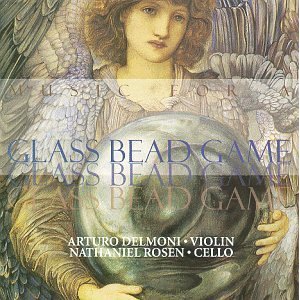
Music for a Glass Bead Game, Arturo Delmoni & Nathaniel Rosen, from  John Marks Records

.

Hermann Hesse is just about due for a revival.

While other novelists on the whole explored the “real world” around them, the outside world, the world of other people and things, Hermann Hesse was concerned with the “inner” world – the world of hopes, dreams, distress, anguish, rage and insight. With his 1927 novel Steppenwolf, he introduced us to the “dark side” of ourselves, our “shadow” to use Jung’s term, long before Star Wars, longer before the Sith Lord Cheney committed the United States to work “sort of the dark side, if you will … to spend time in the shadows in the intelligence world.” And if Steppenwolf showed us our shadow, in his earlier novel Siddhartha (1922) he had already shown us the light – in a deliciously sensual revisioning of the young Buddha‘s ascetic purity.

Siddhartha and Steppenwolf between them provided cover for generations of young idealists coming to terms with their own dreams and nightmares, but it was in his final great novel Das Glasperlenspiel (1943), known in English as The Glass Bead Game or Magister Ludi, which won him the Nobel Prize in Literature while confusing and losing many of his admirers — and inspiring beyond measure those who stayed with him.

Hesse’s grand vision was of a game played by the members of a scholarly caste – monastic Brahmins of a secular, post European world – whose purpose, pleasure and play it was to bring all human culture into one architecture, one music, woven of similarities, parallelisms, patterns, archetypes.

As an architecture of insights, Hesse spoke of this great game of his as “harmoniously building the hundred-gated cathedral of Mind.” In musical terms, he described the game as a virtual music in which “ideas” rather than “melodies” would be harmonized or held in counterpoint:

All the insights, noble thoughts, and works of art that the human race has produced in its creative eras, all that subsequent periods of scholarly study have reduced to concepts and converted into intellectual values the Glass Bead Game player plays like the organist on an organ. And this organ has attained an almost unimaginable perfection; its manuals and pedals range over the entire intellectual cosmos; its stops are almost beyond number.

And the game’s ultimate destination – besides the creation of an overarching synthesis uniting sciences and arts, great leaps of discovery and profound flights of imagination?

Every transition from major to minor in a sonata, every transformation of a myth or a religious cult, every classical or artistic formulation was, I realized in that flashing moment, if seen with a truly meditative mind, nothing but a direct route into the interior of the cosmic mystery, where in the alternation between inhaling and exhaling, between heaven and earth, between Yin and Yang, holiness is forever being created.

The ultimate aim is contemplative simplicity, meditation, a renewed sense of the sacred.

It was not the characters in the novel, nor its plot, that won Hesse the Nobel Prize: there is hardly a female character in the entire book, the males are largely cardboard imitations of people, and the plot such as it is might have made a fine twenty page novella – no need there for a 550-page masterpiece.

No, it is the game itself that holds the imagination, as the Himalayas might hold the attention of one who had lived a lifetime in the lowlands. And catch hold the imaginations of brilliant minds it has.

Hesse’s old friend and rival Thomas Mann inscribed a presentation copy of his novel Doctor Faustus with the words: “To Hermann Hesse, this glass bead game with black beads.”

Christopher Alexander, the progenitor of pattern languages, distilled the essence of his thinking in his “Bead Game Conjecture”:

That it is possible to invent a unifying concept of structure within which all the various concepts of structure now current in different fields of art and science, can be seen from a single point of view. This conjecture is not new. In one form or another people have been wondering about it, as long as they have been wondering about structure itself; but in our world, confused and fragmented by specialisation, the conjecture takes on special significance. If our grasp of the world is to remain coherent, we need a bead game; and it is therefore vital for us to ask ourselves whether or not a bead game can be invented.

Manfred Eigen, Nobel laureate in Chemistry, wrote of his book on molecular biology with Ruth Winkler-Oswatitsch, Laws of the Game:

We hope to translate Hermann Hesse’s symbol of the glass bead game back into reality.

John Holland, father of genetic algorithms, told an interviewer:

I’ve been working toward it all my life, this Das Glasperlenspiel. It was a very scholarly game, starting with an abacus, where people set up musical themes, then do variations on it, like a fugue. Then they’d expand it to where it could include other artistic forms, and eventually cultural symbols. It became a very sophisticated game for setting up themes, almost as a poet would, and building variations as a composer. It was a way of symbolizing music and of building broad insights into the world.

If I could get at all close to producing something like the glass bead game I can’t think of anything that would delight me more.

Mid-way between architecture and music, forming an arch between the arts and sciences, Hesse’s imaginative game has been construed on many levels and in many ways, serving the needs of molecular biology, artificial intelligence, architecture and more. But what of its nature as a game to be played?

From my point of view as a game designer, Hesse’s game is both an artwork – to be played as Bach or the blues are played – and a game – to be played as soccer or chess are played.

And what a game!

When I was a very young poet

Tuesday, January 1st, 2013

[ by Charles Cameron — a suggested solution to what ails the US Congress, Bertold Brecht style — and trace evidence of some early unpublished poems ]
.

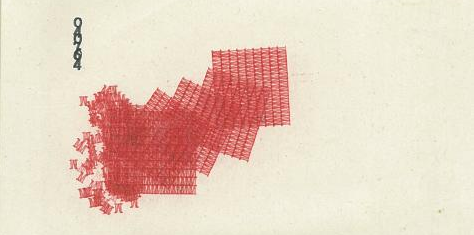
from a private communication, dom sylvester houedard, 1964

**

I was reading Shivam Vij‘s piece, The epiphanic moment of the lathi charge, on Kafila today, and he included a quote from Bertolt Brecht that was intriguing enough — and appropriate enough to the fiscal-cliff-jumping mood in Congress these last few days — that I looked for the source, and found it in this poem:

The Solution
Bertolt Brecht, tr John Willett
.

After the uprising of the 17th June
The Secretary of the Writer’s Union
Had leaflets distributed in the Stalinallee
Stating that the people
Had forfeited the confidence of the government
And could win it back only
By redoubled efforts. Would it not be easier
In that case for the government
To dissolve the people
And elect another?

**

When I was a very young poet, my friend Dom Sylvester Houédard sent some very young poems of mine to John Willett, who was then the Editor of the Times Literary Supplement. They didn’t publish them, but I did get a mention in the TLS a little later, in one of Sylvester’s own writings on the British poetry avant-garde. In any case, here’s the note Sylvester sent me, letting me know he’d been submitting my stuff to Willett:

As you can see, Dom Sylvester could do some pretty nifty graphics with his old Olivetti Lettera 22 typewriter. He’d gotten into the habit while working in British Army Intelligence somewhere in the Far East during World War II as I recall — before he came home and became a monk. Why? Because Army Intelligence demanded he send them 16-page reports, and he could only ever find fifteen pages worth of intel to send them. They disapproved of blank pages, he complied with orders by filling the final pages of his reports with graphical poetry. And thus a tiny whirlpool in the arts was born…

Okay, enough: Sylvester was a phenomenon of mind and heart, and is sorely missed.

As I said, I was very young when he sent those poems of mine to the TLS — it was 1964, and I was a student at Christ Church, Oxford, “chch” in Sylvester’s abbreviation — but the name of John Willett stayed with me, like a runic talisman. So I just can’t help but notice when my daily reading, almost fifty years later, brings up his name again — this time as a noted Brecht translator.

The Hobbit: Narrative Validation or Vandalism?

Sunday, December 30th, 2012

The Hobbit: An Unexpected Journey a film by Peter Jackson

The Hobbit:Or There and Back Again by J.R.R. Tolkien 

Last night, I took the kids and my nephew to see The Hobbit. In essence, it was less the classic tale woven by J.R.R. Tolkien than a sequel to The Avengers with a cast of Dwarves.

Peter Jackson has made, as he did with The Lord of the Rings movie trilogy, a visually stunning film with The Hobbit. Jackson once again excelled at translating many physical settings of Tolkien’s Middle-Earth into screen reality. Erebor looks the way you would expect an age-old Dwarven kingdom should. Dol Guldor (alluded to ever so briefly in the book) appears to be the place of dread that would attract a great malevolent spirit like Sauron, This extends to some of the characters; the Great Goblin’s semi-comic personage manages to capture some of the original charm of The Hobbit as a children’s story before it later became part of the narrative for Tolkien’s larger and darker romantic epic, The Lord of the Rings.

Unfortunately, the tendency that Jackson demonstrated as the films of The Lord of the Rings progressed,to take ever greater artistic liberties with Tolkien’s story, have, with his swollen ego, run riot in The Hobbit. The primary antagonist in the film, Azog the Orc chieftain is lifted from other Tolkien material, given mutant powers, a scary metal hand and an albino warg by Jackson and is brutally imposed on the story. The wizard Radagast the Brown, whose head for some reason is encrusted with bird crap, gets much screen time as he  zips around Middle-Earth like Mario Andretti on a sleigh pulled by magical bunnies when he is not getting high on ‘shrooms.

What began as a necessary fleshing out of narrative allusions and foreshadowing to effectively translate literature into a movie ended up as Jackson’s sheer invention and gratuitous abuse of the characters, all of whom sword fight more often than Conan the Barbarian and more bloodily than Leonidas. If Thorin had shouted in the midst of battle with the Goblins, “Dwarves! Tonight we dine in Mordor!” no one in the audience would have been the least bit surprised.  Zorro and the Three Musketeers had less skill with a blade in hand-to-hand combat than do these Dwarves, Gandalf or at times, Bilbo Baggins.

The only scenes where Jackson manages genuine fidelity to the story are the ones with Gollum, Bilbo and their Riddle-Game – perhaps out of fear of trivializing his previous movies, Tolkien’s actual dialogue and plot  enters the script before vanishing again into a Jacksonian cinematic homage to every American action movie ever made. No wonder Christopher Tolkien looks on with weary despair.

There’s a name for this kind of genre….

Fan fiction.


Switch to our mobile site