[ by Charles Cameron — numbers as analytic categories, introducing a series of posts ]
.
Umpteen Ways of Looking at a Possum
.
This is the first post in a series, suggesting that we think in numbers — among other analytic categories — with a great deal of our thinking revolving specifically around binaries: war and peace, friend and foe, good and (axis of) evil and so forth. At times this serves us well, at times it leads us to overly simplistic, misleading, false, dangerous conclusions.
One is a single data point, perhaps an anomaly.
Two is a duel or a duet, an opposition or a trend, competition or collaboration.
Three is enough to permit shifting alliances.
Four tends to square off into two pair … and so forth.
So let me put it this way: numbers are analytic categories, categories of thought, categories worth thinking about.
In this series, we’ll start with the earliest positive integers, and see where we go from there.
**
Umpteen is a delightful number. The umpteen ways book, should you be interested, is about a New Orleans poet, Everette Maddox. I don’t know his work, perhaps we should get acquainted.
*****
I am eager to know what sorts of insights you can derive from or find echoed in this series of posts.
[ by Charles Cameron — Taliban use of social media with side ramble on the cognition of similars, parallels and opposites ]
.
.
It’s not like it’s a big deal or anything, it’s just a footnote, a detail — but God is in the details, the devil is in the details. And it looks as though a certain Twitter account does belong to the Taliban after all.
Some back-story:
A while back, on my way to make other points, I posted this:
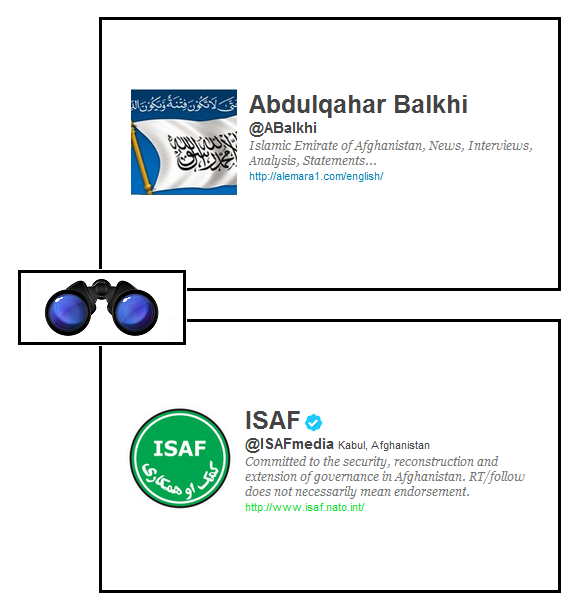
I wasn’t the first or last to make the connection between A Balkhi and the Taliban, nor to note the Twitter-exchanges between Balkhi and the ISAF press office — but I happened to have this habit of juxtaposing similars and opposites, and had developed the “Specs” format used here, with the little binoculars inset, to suggest the idea of seeing parallel or opposite things in parallel or opposition — a sort of mental equivalent of stereoscopic vision or stereophonic sound — in the hope that something about the comparison and contrast would add a depth dimension to understanding.
As a footnote to a footnote to a footnote, I think the Necker Cube can add an interesting aspect to this business of stereoscopic thinking:
When two things are so much the same and so utterly different that, as with a Necker Cube (or the positive and negative of a photo rapidly alternating) the mind flashes rapidly from one view to its exact and opposite other, a metacognitive insight arises about what I can only term the two in one in twoness experienced.
File that under number theory, koans.
But that’s about metacognition, let’s get back to the Taliban on Twitter.
No. Just no. The account @abalkhi appears to have nothing to do with the Taliban (see below). I’d also be interested to see the evidence for the statement that ‘Taliban spokesmen also frequently spar with Nato press officers’. I have not seen a single instance of this. Every other story on these accounts repeats this claim. And it’s presumably quite an important distinction: an official spokesman (we might assume it is a man) engaged in verbal attacks on the official ISAF account is a different thing from some fanboy in his bedroom doing the same thing.
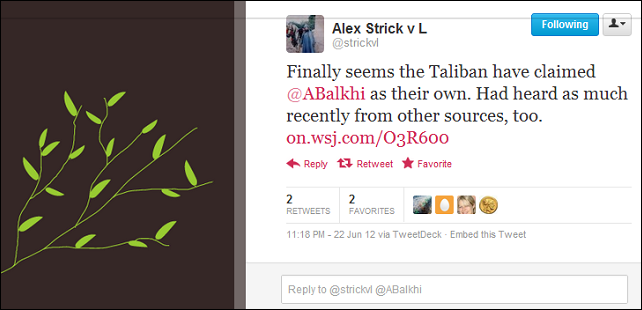
Today, Alex (I hope that’s the appropriate way to name him) reversed himself with the tweet featured at the top of this post.
The pool of people to whom it matters whether A Balkhi is an official Talibvan site or a fan site is probably quite small, and by now they will all surely have either read the Wall Street Journal, seen Alex’s tweet, or arrived at whatever conclusion in the matter their own intelligence sources have suggested to them.
In the enormity of cyberspace, then, this whole post of mine is just a footnote to a footnote.
Alex’s piece from which I quoted above, on the other hand, is a true footnote: it provides us with a decent summary of Twitter-feeds associated with the Taliban, helpfully annotated.
Let’s call it a benchmark — and while this business about A Balkhi may be just a detail, benchmarks are go-tos, and I hope Alex will update his.
[ by Charles Cameron — of [almost] no military or intelligence interest, this is a post for computer scientists, historians, scientists, artists, contemplatives and other creatives ]
.
I’ve been on a bit of a binge about medieval and renaissance diagrams recently, putting together an anthology of early “semantic networks” for the Sembl game site – but also thinking about the alternate track of art history which would focus on diagrams rather than paintings (I’m thinking of two dimensions here, hence no mention of sculpture) – an alternate history which may have something to teach our richly diagrammatic and data-visual times.
My interest in all this tracks back at least to my early encounter with an essay by the computer scientist Margaret Masterman in Theoria to Theory (1967).
*
Yesterday brought me a post from Jason Wells, a scientist and bright all-rounder I follow on Google+, in which he posted an image of the cosmos from the Ptolemaic (pre-Copernical) point of view, which I’ve put at the head of this post.
Jason commented on this diagram:
As pretty as this is, this is not how your universe works.
That is all.
The diagram Jason posted purports to be mathematically and astronomically based: it is, if you like, a quantitative diagram. I don’t happen to think it’s pretty, although the two creatures (angels, goddesses?) up towards the top of the circle may be, and the serpent eating its tail around it is nicely done -– I think it has a rather austere beauty to be honest, but I’m likely to concede to Jason that it isn’t “true” in the sense of being an accurate representation of the (abstract) laws of celestial motion.
But then I also think there’s more to truth than accuracy, useful though that may be – there’s also a qualitative element to truth, and perhaps “beauty” is (among other things) a name for it.
*
Yesterday also brought me a news bulletin that ties into that same interest in medieval and renaissance diagrams. From the Vatican Information Service (via Chant Cafe) , we learn that Hildegarde of Bingen (1098 – 1179) is now a saint of the Catholic Church with universal cultus:
Vatican City, 10 May 2012 (VIS) – The Holy Father today received in audience Cardinal Angelo Amato S.D.B., prefect of the Congregation for the Causes of Saints. During the audience he extended the liturgical cult of St. Hildegard of Bingen (1089-1179) to the universal Church, inscribing her in the catalogue of saints.
Consider, then, in contrast to Jason’s mechanistic Ptolemaic diagram, this diagram which today’s fresh-minted saint produced in the late 1140s or early 1150s to illustrate her visionary intuitions of the universe in the first of three books, Scivias:
and these two, from Liber divinorum operum:
and:
These, I take it, are purely qualitative images in contrast to the Ptolemaic diagram — making no propositional claims as to physical or mathematical accuracy, but portraying Hildegarde’s sense of cosmic order. And just as we would not argue whether it is Van Gogh or El Greco who is “right” about the skies in their respective paintings, so I don’t think Hildegarde is worried about which of her diagrams is “right” in its portrayal of the world she lived and prayed in – each one illustrates some aspect of her vision of the world, and one does not necessarily contradict another.
*
Here are two descriptions of Hildegarde’s world, which may give us some insight into the diagrams above. For the top one:
For Hildegard of Bingen, twelfth century German Benedictine abbess, the universe is like an egg in the womb of God. Her view of the universe, conditioned as it is by her times and her education, represents her visionary understanding of God’s motherhood of this sphere that we call the universe. Hers is a view that is organic and holistic, coloured neither by Greek philosophy nor Enlightenment rationalism, refreshing and strikingly “true” in its perceptions around the source of created life.
God created the world out of the four elements, to glorify His name. He strengthened the world with the wind. He connected the world to the stars. And he filled the world with all kinds of creatures. He then put human beings throughout the world, giving them great power as stewards of all Creation. Human beings cannot live without the rest of nature, they must care for all natural things.
It’s probably worth mentioning that three of the “four elements” of the ancients are still known to us, though we call them “states” rather than “elements” at this point — the solid, liquid and gaseous states correspond with what the ancients called “earth”, “water” and “air”, respectively — and it has even been suggested that their “fire” corresponds to the fourth state we now term “plasmas” — not my line of business, however, so who knows?
*
Hildegarde picked up the word “viriditas” from Gregory the Great and made it peculiarly her own. It means greeness, literally, and freshness by extension — but for Hildegarde’s integral view of all that is, it also carries a theological dimension, Christ being the greening of the world for her:
For Hildegard, viriditas was an attribute of the Divine nature, a reflection of God’s goodness and beauty. It stood for vitality, fertility, fruitfulness and growth; in fact all the things that we now associate with the “greenness” of nature. For us today “greenness” is a sign that the Earth is healthy and flourishing. Similarly, for Hildegard, viriditas was synonymous with physical and spiritual health, with the continuing vivifying force of the Holy Spirit.
.
Dr Carmel Bendon Davis, Hildegard of Bingen: Eco-warrior and Superwoman
This greening or freshening is not, for Hildegarde, just a matter of earth and water, of river and forest, it is also infused with fire and air:
I am likewise the fiery life of the substance of divinity. I flame over the beauty of the fields and sparkle in the waters, and I burn in sun, moon, and stars. And with an airy wind that sustains all things with invisible life, I raise them up vitally. For air lives in greenness and flowers, waters flow as if alive, the sun, too, lives in his light, and when the moon comes to her decline she is kindled by his light, as it were to live again… Thus I, the fiery force, am hidden in [the winds], and they take fire from me, just as breath continually moves a man, and as a windy flame exists in fire. All of these live in their essence and are not found in death, because I am life.
Understanding in the soul is like the Veriditas of the branches and the leaves of the tree
It is, in fact, neither exclusively natural nor supernatural, but non-dual.
*
Dylan Thomas, being a Welshman and a poet, thus has an insight that bears a family resemblance to Hildegarde’s, but phrases it in a way that leaves the “force” neither personified nor otherwise… and thus with no necessary doctrinal implication:
The force that through the green fuse drives the flower
Drives my green age; that blasts the roots of trees
Is my destroyer.
And I am dumb to tell the crooked rose
My youth is bent by the same wintry fever.
For Hildegarde, this “force” is also Christ — for he himself is the “the fiery life of the substance of divinity” — and his coming to earth a greening and freshening of a world until then barren of the love he brought.
*
Hildegarde was the abbess in charge of a small flotilla of nuns — but also a mystic, a visionary, philosopher, poet, painter and songstress…
Her song of creation, O Viriditas, bears comparison in spirit with St Francis‘ Canticle of the Sun. She writes to her “green” Christ and his “green” planet:
O greenness of God’s finger
with which God built a vineyard
that shines in heaven
as an established pillar:
You are glorious in God’s preparation.
And o height of the mountain
that will never be dispersed
in the judgment of God,
you nevertheless stand from afar as an exile,
but it is not in the power
of the armed man
to seize you.
You are glorious in God’s preparation.
Glory be to the Father and to the Son
and to the Holy Spirit.
You are glorious in God’s preparation.
And she sets her words to the music of the times:
Indeed, her music is sung even today…
How’s that for a twelfth century statement of what we’d these days call “ecology”?
*
But all this risks getting far too ethereal, I have wandered far along my own epicycles from Jason Wells’ point, and methinks I should bring us back down to earth.
Dennis The Constitutional Peasant, in Monty Python and the Holy Grail, meets King Arthur and complains, “What I object to is you automatically treatin’ me like an inferior.” It’s understandable — but so, perhaps, is king Arthur’s response: “Well, I am king.”
Two worldviews clash here — and in the ensuing debate, Arthurian myth meets contemporary politics:
Dennis’ Mother: Well how’d you become king, then?
Arthur: The Lady of the Lake,… [Angel chorus begins singing in background] her arm clad in the purest shimmering samite, held aloft Excalibur from the bosom of the water signifying by Divine Providence that I, Arthur, was to carry Excalibur. [Angel chorus ends] That is why I am your king!
Dennis: Listen. Strange women lying in ponds distributing swords is no basis for a system of government. Supreme executive power derives from a mandate from the masses, not from some farcical aquatic ceremony.
Arthur: Be quiet!
Dennis: You can’t expect to wield supreme power just ’cause some watery tart threw a sword at you!
Arthur: Shut up!
Dennis: I mean, if I went ’round saying I was an emperor just because some moistened bint had lobbed a scimitar at me, they’d put me away!
Or if some bint told me the universe was a cosmic egg in the womb of God, for that matter — even if Benedict XVI did just add her to the calendar of saints.
*
Here you go, courtesy of YouTube:
*
Frankly I appreciate both modes of thinking — the mythic and the scientific — and believe we’re in the sort of territory here that Nils Bohr was thinking of when he said:
The opposite of a true statement is a false statement. But the opposite of a profound truth may be another profound truth.
[ by Charles Cameron — when sequence becomes simultaneous, the pictorial eye, rethinking thinking, continuing from Simul I ]
.
What better day to begin writing this second post on simultaneity than the day on which Google celebrated the birthday of Eadweard Muybridge with a Google Doodle — not that I’ll get the post finished within those same 24 hours!
The film — sequence of frames? stills? which would you call it? — that Muybridge took of a horse, used in that Google Doodle [view it in motion, here], is celebrated as showing beyond a doubt that when galloping, all four of a horse’s hooves may be in the air at the same time.
But is it — Muybridge’s work product — sequential, ie a film, or simultaneous, ie the presentation of many moments at one time?
That question gets to the heart of an issue that all narrative faces, as we shall see. First, the pictorial side of things.
*
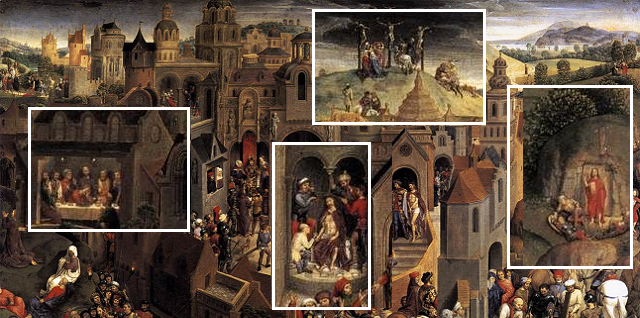
Hans Memling‘s Passion of Christ (above) tells the gospel narrative, from Christ’s entry into Jerusalem and the Last Supper through his crucifixion, entombment and resurrection to his appearances in Emmaus and by the sea of Galilee in one canvas, much as Bach’s Matthew Passion [link is to Harnoncourt video] tells major portions of the same narrative in three hours of unfolding musical drama.
*
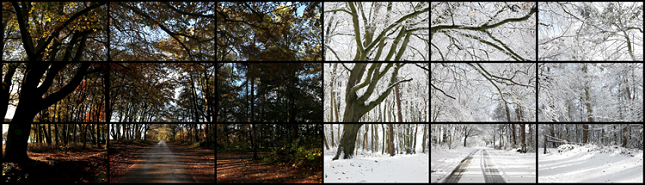
David Hockney has recently been working on forms of what I can only call “asynchronous synchrony” — as exemplified here:
This image comes from a fascinating article describing Hockney’s current work by Martin Gayford, titled The Mind’s Eye, which you can find in MIT’s Technology Review, Sept/Oct 2011:
We are watching 18 screens showing high-definition images captured by nine cameras. Each camera was set at a different angle, and many were set at different exposures. In some cases, the images were filmed a few seconds apart, so the viewer is looking, simultaneously, at two different points in time. The result is a moving collage, a sight that has never quite been seen before. But what the cameras are pointing at is so ordinary that most of us would drive past it with scarcely a glance.
As with the Muybridge video above, “the viewer is looking, simultaneously, at different points in time”. Here Hockney does this with video cameras — but he achieves something of the same effect of time-displacement with still photos, too, as you can see in his brilliant portrait of the sculptor Henry Moore, hosted on the British Council’s Venice Biennale site.
Here is Gayford’s concluding paragraph, tying Hockney’s work into the larger context of our need for multiple frames of reference:
“Don’t we need people who can see things from different points of view?” Hockney asks. “Lots of artists, and all kinds of artists. They look at life from another angle.” Certainly, that is precisely what David Hockney is doing, and has always done. And yes, we do need it.
*
Memling again — and here I have enlarged and “framed” four of the 23 scenes from the passion of Christ which he has incorporated in the one painting: the Last Supper, the Crowning with Thorns, the Crucifixion, the Resurrection — Thursday evening through Sunday, and from life to death and back again.
*
It was Holy Week for Christians just last week, so perhaps you will forgive my having been preoccupied with images of the passion during the season set aside for such meditations — but what I want to point out to you is timeless, and indeed brings the transcendent into the everyday. Let’s take a look at a Hitchcock film next, then, and see how a contemporary videographer Jeff Desom has remixed the already Hockney-like Rear Window [link to IMDb] to create his own time-lapse telling of the tale [link to Vimeo], from which I took this screen-grab:
*
Time-lapse — simultaneity? The philosopher Alfred North Whitehead once wrote:
The communion of saints is a great and inspiring assemblage, but it has only one possible hall of meeting, and that is the present; and the mere lapse of time through which any particular group of saints must travel to reach that meeting-place, makes very little difference.
And so it is with this other Memling painting — and many others like it, by artists old and new:
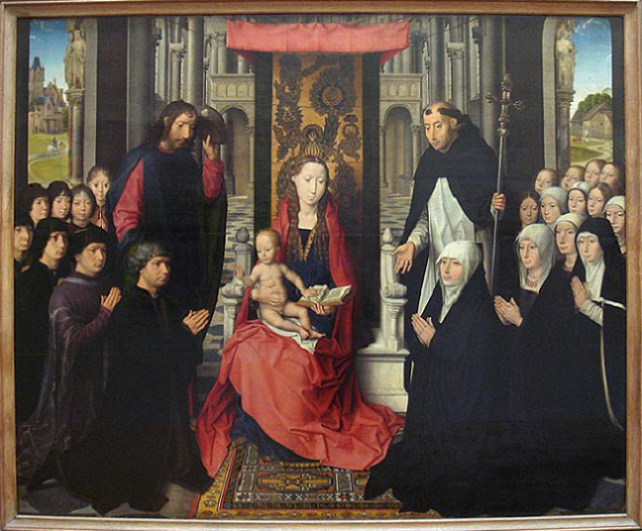
Here we see the Virgin Mary and Christ child with Saints Dominic and James — there’s an eleven centuries gap right there, St Dominic lived from 1170 – 1221, more than a millennium after Christ — and Memling has St Dominic presenting his patron, the spice trader Jacques Floreins with his family to Christ, circa 1490. With everyone dressed in late 15th-century fashions…
Whitehead — co-author with Bertie Russell of Principia Mathematica — see how amazing this is? — could have been thinking of Memling: “the mere lapse of time through which any particular group of saints must travel to reach that meeting-place, makes very little difference”.
*
Coming up next: how this affects our understanding of story.
For an understanding of the setup David Hockney uses for his multiple-video takes, see here and specifically this and this. For the setup used by Jeff Desom in his Rear Window remix, see here and specifically this.
[ by Charles Cameron — simultaneity in art, life, theology, war and thought ]
.
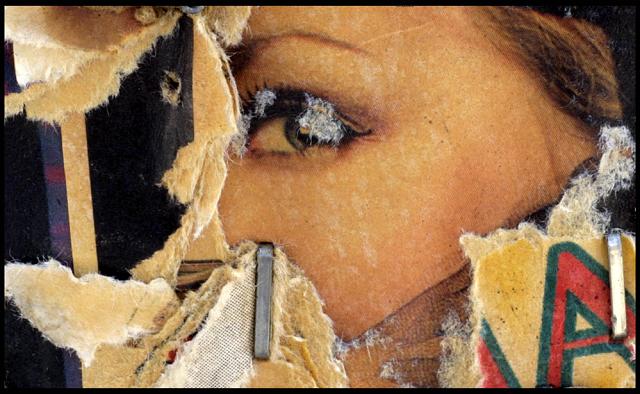
We rip up the past to make room for the present, we staple the present onto the past, we lose much of the meaning our words and images once had in fragments, snatches and colors…
image credit: MR McDonald
Even the staples eventually rust.
*
Still the past can at times be seen in the present, as earlier writing can still be seen in a palimpsest.
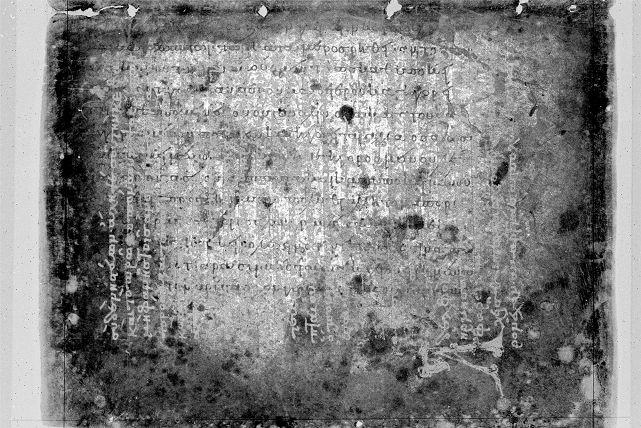
The Archimedes Palimpsest is [and I paraphrase] a Byzantine euchologion or prayer book manuscript, thought to have been completed by April 1229, and probably made in Jerusalem. Much of the parchment the scribes used in making the prayer book came from a earlier book of works by Archimedes, including his “On Floating Bodies” – a treatise of which no other copy survives. It seems the Archimedes manuscript dates back to tenth century Constantinople.
image credit: Archimedes Palimpsest Project
Erase Constantinople from your parchment, cut it and rotate it 90°, and you can build Jerusalem in its place. Peer deeply into prayer using multispectral imaging several hundred years later — and you may find combinatorial mathematics dating back more than two millennia…
What you are seeing in this image above is the workings of a mind two centuries BCE, transcribed in the tenth century CE, and made visible beneath and through other writing from the thirteenth, by twenty-first century tech.
So it is that Archimedes speaks to us today.
*
A palimpsest, then, is a layering of time on time, and the world we walk and talk in is itself a palimpsest.
image credit: MR McDonald
The enduring, you might say, can be seen through the transient — the zebra crossing through the snow.
*
To see two times at once — to see history, accurately or otherwise, as a metaphor for today — is to see simultaneously.
image credit: Larenkov, Wrecked tank “Tiger” in Tiergarten park
[ edited to add: Larenkov takes black and white photos from WW II, shoots the same scene in color from the same position today, and masterfully stitches them together digitally to create an image that allows the ghost of the past to seen in the present — brilliant! ]
There is another world that is more real than a world determined by war: the world that has been redeemed by Christ.
He then clarifies his intent in saying:
The statement that there is a world without war in a war-determined world is an eschatological remark. Christians live in two ages in which, as Oliver O’Donovan puts it, “the passing age of the principalities and powers has overlapped with the coming age of God’s kingdom.” O’Donovan calls this the “doctrine of the Two” because it expresses the Christian conviction that Christ has triumphed over the rulers of this age by making the rule of God triumphantly present in the mission of the church. Accordingly the church is not at liberty to withdraw from the world but must undertake its mission in the confident hope of success.
*
Indeed, both Christianity and Zen would say that the greatest palimpsest is the palimpsest in which the transient circumstances of one’s life can all but obliterate the imperishable truth that underlies them — a palimpsest whose deepest layers may be read not with x-rays but by insight.
Christ lived in two times, or more accurately, time and eternity — to him the palimpsest was transparent, and thus he spoke (in John 8:58) what I suspect are the most profound five words in the Gospels:
Zenpundit is a blog dedicated to exploring the intersections of foreign policy, history, military theory, national security,strategic thinking, futurism, cognition and a number of other esoteric pursuits.